
Brazilian Mushroom (Agaricus blazei): What Studies Say
Agaricus blazei and insulin resistance and liver. We describe studies involving humans, including a report of severe liver damage in cancer patients.
The Brazilian mushroom has entered supplements as a mushroom supporting immunity, and most descriptions end with beta-glucans and a list of presumed benefits. However, studies involving humans are scarce, concern one type of preparation, and lead to conclusions that are much narrower than the label suggests. There is also a clinical report, which Polish descriptions of this mushroom usually remain silent about, concerning severe liver damage. We have gathered here works that studied humans, providing the number of participants, type of preparation, and duration for each. Where data comes solely from animals, it is stated explicitly. We separately distinguish three forms of the raw material, which commercial descriptions treat interchangeably, although only one of them has been studied. Finally, we explain why the beta-glucan content stated on the packaging is a number that cannot be compared to anything without a measurement method.
KEY INFORMATION
• The current species name is Agaricus subrufescens; A. blazei and A. brasiliensis are its synonyms used interchangeably in the literature.
• In a randomized double-blind trial, the extract was administered as an addition to metformin and gliclazide, not as a replacement (Hsu et al., Journal of Alternative and Complementary Medicine, 2007).
• Three cases of severe liver damage have been described in cancer patients taking the extract of this mushroom; two of them died (Mukai et al., Japanese Journal of Clinical Oncology, 2006).
• Anti-cancer and anti-allergic effects have been described in mouse models, not in humans.
• The European Medicines Agency has not included this mushroom in its herbal monograph. Status of the list checked on August 16, 2026.
What is the real name of this mushroom and why are there several names?
In the literature, the same mushroom appears under three Latin names, which complicates the comparison of studies. The current species name is Agaricus subrufescens, while the names Agaricus blazei and Agaricus brasiliensis function as its synonyms. Mycological works state this explicitly, providing a set of synonyms alongside the main name (Ribas et al., Bioresource Technology, 2009).
The practical significance of this confusion is greater than it seems. Those looking for safety data under one name may overlook reports published under another. Additionally, there is a layer of trade names under which the raw material is sold in Japan and Brazil, which say nothing about the species or the form of the preparation.
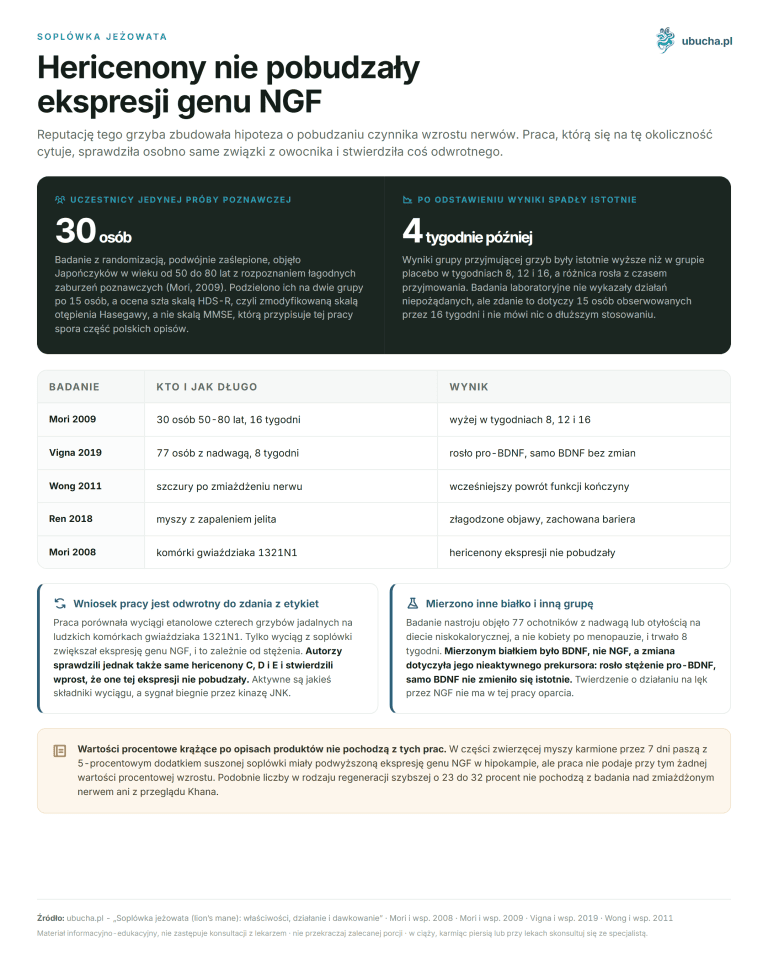
It is also necessary to distinguish three things that supplement descriptions treat interchangeably: the fruiting body, mycelium grown on grain substrate, and extract. These are not variants of the same product. The studies involving humans referred to in this text were conducted on extract, not on dried fruiting bodies or mycelium. Transferring their results to mycelium powder is an assumption that no one has verified. This same distinction determines the value of other mushroom preparations, which we discuss in relation to Lion’s Mane.
Does the Brazilian mushroom improve insulin sensitivity?
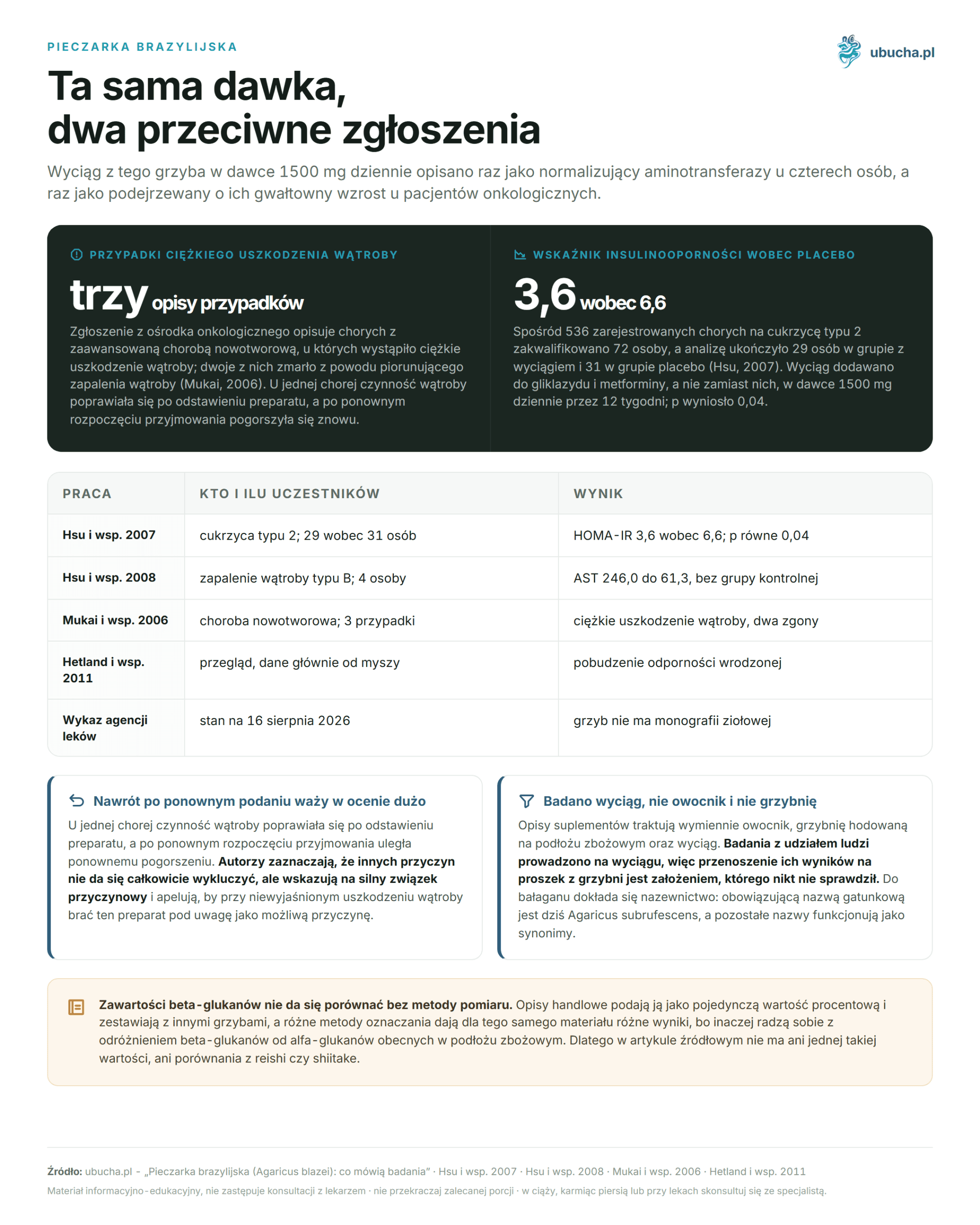
This question has an answer based on one well-designed trial. A randomized double-blind study with a placebo group included patients with type 2 diabetes, of the 536 registered patients, 72 were qualified, and 29 in the extract group and 31 in the placebo group completed the analysis. All participants had been taking gliclazide and metformin for at least six months, and the extract or placebo was added to this treatment at a dose of 1500 mg daily for 12 weeks.
The result was as follows: the HOMA-IR insulin resistance index was 3.6 (standard deviation 2.5) in the extract group compared to 6.6 (standard deviation 7.4) in the placebo group, with a significance level of p equal to 0.04. The adiponectin concentration in plasma increased by 20.0 percent in the extract group, while it decreased by 12.0 percent in the placebo group. The authors indicate the increase in adiponectin as a possible mechanism for the observed improvement and note that further studies with longer follow-up are needed.
Two things must be stated explicitly here, as supplement descriptions often omit them. First, this was a supplement to pharmacological treatment, not a replacement: both groups were taking two antidiabetic medications. Second, the endpoint was an index calculated from fasting glucose and insulin, not a hard clinical endpoint. The decision to combine such a preparation with glucose-lowering medications is up to the attending physician, who knows the doses and results of the specific patient.
What is known about the effect of this mushroom on the liver?
The answer is uncomfortable because the data points in both directions. On the beneficial side, there is an open pilot observation in patients with chronic viral hepatitis B: it involved four people, who took the extract at a dose of 1500 mg daily for twelve months, and the average AST activity decreased from 246.0 to 61.3, while ALT decreased from 151.0 to 46.1 units per liter. The authors call this a preliminary observation. Four people without a comparison group is too narrow a basis to speak of efficacy.
On the risk side, there is a report from an oncology center describing three patients with advanced cancer who experienced severe liver damage. Two of them died from fulminant hepatitis. All were taking the extract of the Brazilian mushroom, one of the most popular preparations used by Japanese cancer patients. In one patient, liver function improved after discontinuing the preparation, and after resuming it, it worsened again. The authors note that other causes cannot be completely ruled out, but they indicate a strong causal link and urge that in cases of unexplained liver damage, this preparation should be considered as a possible cause.
The recurrence of damage after resuming intake weighs particularly heavily in the assessment of drug-induced liver injuries. Both works do not summarize the safety note: the same preparation at the same daily dose was described once as normalizing aminotransferases in four people and once as suspected of causing their sharp increase in cancer patients.
| Study | Who and how many participants | Preparation and duration | Result |
|---|---|---|---|
| Hsu et al., 2007 | type 2 diabetes; 29 vs 31 people, randomization, double-blind | extract 1500 mg/day for 12 weeks, added to gliclazide and metformin | HOMA-IR 3.6 vs 6.6 (p = 0.04); adiponectin +20 percent vs -12 percent |
| Hsu et al., 2008 | viral hepatitis B; 4 people, open study, no control | extract 1500 mg/day for 12 months | AST 246.0 to 61.3; ALT 151.0 to 46.1 units per liter |
| Mukai et al., 2006 | advanced cancer; 3 case reports | extract, self-administration by patients | severe liver damage, two deaths; recurrence after resuming in one person |
| Hetland et al., 2011 | review; data mainly from mouse models | extracts, various protocols | stimulation of innate immune cells; in humans, anti-inflammatory effects described in inflammatory bowel diseases |
Which actions have been studied exclusively in animals?
Most of what is read about the Brazilian mushroom comes from mouse models. A review dedicated to this mushroom states that it is rich in immunomodulating polysaccharides called beta-glucans, and anti-cancer, anti-infective, as well as anti-allergic and anti-asthmatic effects have been demonstrated in mouse models (Hetland et al., Advances in Pharmacological Sciences, 2011). The mechanism is described as stimulation of innate immune cells, including monocytes, NK cells, and dendritic cells.
The only effect described in this review in humans is the anti-inflammatory effect in patients with inflammatory bowel disease. This is the entire human layer of this study. Statements like “supports immunity” are therefore based on mechanistic assumptions and data from mice, not on clinical trials with endpoints in the form of illnesses or duration of infections.
This same caution applies to oncological applications. We did not find a study involving humans that would allow describing this mushroom as an adjunct to cancer treatment. The juxtaposition of this lack with the report of liver damage in cancer patients above forms a warning rather than an encouragement. A similar distinction between mechanism and outcome is discussed in relation to beta-glucans and immunity.
Why should numbers about beta-glucans and agaritine be read with a method?
Commercial descriptions provide the content of beta-glucans as a single percentage value and compare it with other mushrooms. Such a number means little without two pieces of information: whether it comes from the manufacturer’s declaration or from measurement, and what method was used to obtain it. Different methods yield different results for the same material because they handle the distinction between beta-glucans and alpha-glucans present in the grain substrate differently. For this reason, we do not provide any percentage value or comparison with reishi or shiitake here: we did not find a source that provided a measurement method for them.
Similarly, caution should be exercised when reading the agaritine thread. This is a compound naturally present in the genus Agaricus, and thus also in the commonly eaten button mushroom. Claims circulating online that its amount in the supplement is several times lower than the thresholds studied toxicologically would require a comparison of a specific product with a specific dose from a study, and we did not find such a comparison in available sources. An honest summary therefore sounds like this: the question of agaritine remains open, and its presence is neither a cause for panic nor something that can be dismissed with a single sentence about sub-threshold amounts.
Frequently Asked Questions
What is the current Latin name for the Brazilian mushroom?
The current species name is Agaricus subrufescens, while the names Agaricus blazei and Agaricus brasiliensis are its synonyms. All three appear in the literature, so when looking for safety data, it is worth checking each one separately.
Does the Brazilian mushroom lower blood sugar?
In a randomized double-blind trial, the extract improved the HOMA-IR insulin resistance index in people with type 2 diabetes. However, the preparation was administered as an addition to metformin and gliclazide, not as a replacement, and sixty people completed the analysis.
Can the Brazilian mushroom damage the liver?
Three cases of severe liver damage have been described in patients with advanced cancer taking the extract of this mushroom; two of them died. In one person, symptoms recurred after resuming the preparation. In cases of unexplained liver damage, it is important to inform the doctor about it.
Does this mushroom have anti-cancer effects?
Anti-cancer effects have been described in mouse models. We did not find a study involving humans that would allow describing the Brazilian mushroom as an adjunct to cancer treatment. The report of liver damage concerned cancer patients.
What is the difference between the fruiting body, mycelium, and extract?
These are three different raw materials. Many mushroom supplements contain mycelium grown on grain substrate, while the studies involving humans described in this article were conducted on the extract. Transferring their results to mycelium powder is not supported by data.
Does the Brazilian mushroom have a monograph from the European Medicines Agency?
No. The list of raw materials subject to evaluation by the committee for herbal medicinal products checked on August 16, 2026, does not include this mushroom. Therefore, there is no agreed European usage time, age restriction, or note regarding pregnancy and breastfeeding.
At the Bucha store, there is no Brazilian mushroom in any form. Other mushroom and plant raw materials can be found in the categories adaptogens and herbs. Stock status as of August 16, 2026.
This article is for informational and educational purposes and does not constitute medical advice. Before starting supplementation, consult your doctor, especially if you are taking medications regularly, are pregnant or breastfeeding, or have a chronic illness.
Author: Michał Waluk · Published: 2026-08-09 · Updated: 2026-08-16