
Flavonoids in Cannabis: Sources, Role and Action (Guide)
Flavonoids in cannabis: how many there are, where they sit in the plant, and what has really been measured about cannflavins. Numbers from measurements, not from product descriptions.
When discussing cannabis, the focus is almost exclusively on cannabinoids, while flavonoids appear in product descriptions as a footnote: that they exist, that there are over twenty of them, and that two of them do not occur anywhere else in nature. The first two statements are supported by measurements. The third is also, but it has become embellished with numbers and names that do not resolve to any work. This article collects what is truly marked in the plant: how many flavonoids are present, in which part of the plant they reside, what has been measured about cannflavins, and how this differs from the statements that appear on labels. Several popular claims along the way fall, and one of them turns exactly one hundred and eighty degrees from what descriptions of the dried flower repeat.
KEY INFORMATION
• Approximately twenty flavonoids have been identified in cannabis, mainly flavones and flavonols (Andre et al., Frontiers in Plant Science 2016).
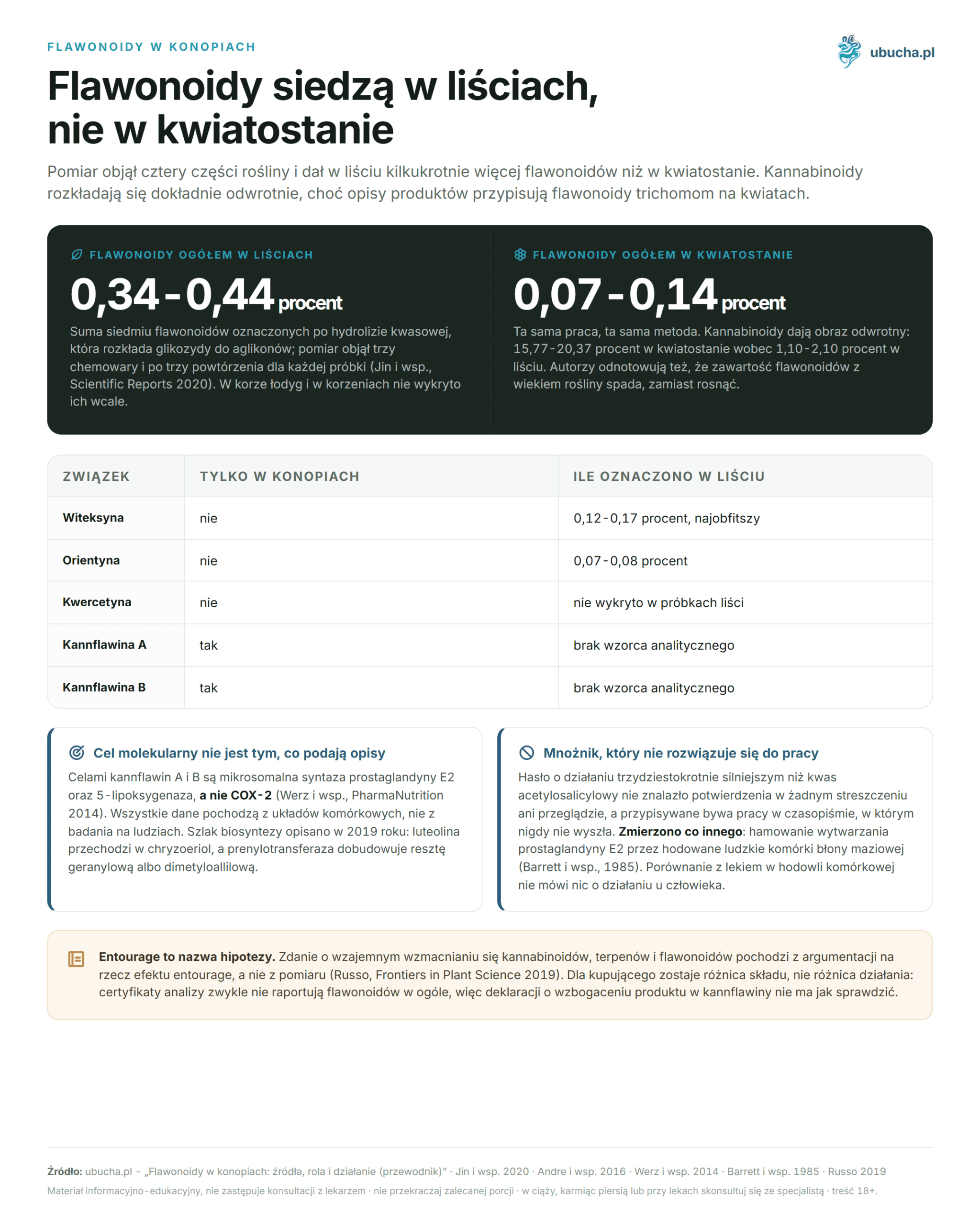
• They are most abundant in leaves: 0.34-0.44% compared to 0.07-0.14% in the inflorescence; none were detected in the roots and stem bark (Jin et al., Scientific Reports 2020).
• The molecular targets of cannflavins A and B are mPGES-1 and 5-lipoxygenase, not COX-2 (Werz et al., PharmaNutrition 2014).
• The entourage effect remains a hypothesis, not a measured quantity.
What are flavonoids and where do they come from in cannabis?
They are a group of phenolic compounds produced by plants via the phenylpropanoid pathway, from phenylalanine. The entire family of plant phenols includes over ten thousand described structures, and approximately twenty flavonoids have been identified in cannabis, mainly belonging to flavones and flavonols (Andre et al., Frontiers in Plant Science 2016). A later review raises this number to twenty-six (Jin et al., Scientific Reports 2020).
They occur as free aglycones or bound to sugars. The core list consists of derivatives of apigenin, luteolin, kaempferol, and quercetin, while cannflavins stand apart, being methylated isoprenoid flavones that have not been found in any other species (Andre et al., 2016).
In the plant, flavonoids serve protective and signaling functions: they absorb ultraviolet radiation, participate in defense against pathogens, and create patterns visible to pollinators. It is worth noting that in 2016, the Andre review directly stated the lack of data on the biosynthesis of flavonoids in cannabis, indicating luteolin only as a probable precursor of cannflavins. This gap was closed three years later.
What are cannflavins and what has really been measured about them?
These are prenylated flavones that accumulate exclusively in cannabis. Cannflavin A and cannflavin B were isolated from a cannabinoid-free ethanol extract and described as a pair of new compounds (Barrett et al., Experientia 1986). A year earlier, the same team described the mechanism: an inhibitor of prostaglandin E2 production isolated from cannabis in cultured human synovial cells in rheumatoid arthritis (Barrett et al., Biochemical Pharmacology 1985).
This is cell culture, not human testing, and this boundary is most often crossed in product descriptions. The circulating claim of an effect thirty times greater than acetylsalicylic acid has not been confirmed in any summary or review that could be opened here, and it is often attributed to a paper in a journal where it never appeared.
The molecular targets were established only in 2014, and COX-2 is not one of them. Cannflavins from cannabis sprouts act on microsomal prostaglandin E2 synthase and 5-lipoxygenase (Werz et al., PharmaNutrition 2014). This is confirmed by an independent review of cannabis phytochemistry, adding that the anti-inflammatory action of cannflavins is poorly studied (Pellati et al., BioMed Research International 2018).
The biosynthetic pathway was described in 2019: luteolin is converted to chrysoeriol by the action of the methyltransferase CsOMT21, and the prenyltransferase CsPT3 adds the geranyl or dimethylallyl residue, yielding cannflavin A and B, respectively. The authors cautiously summarize the existing data, writing about anti-inflammatory action in animal cell models (Rea et al., Phytochemistry 2019). The third compound in this family, cannflavin C, is repeated in descriptions with a specific name and year of discovery, but such attribution does not resolve to any work in either Europe PMC or Crossref.
Where in the plant are flavonoids most abundant?
In the leaves, not in the inflorescence. The measurement included inflorescences, leaves, stem bark, and roots of three chemovars. The total flavonoid content was 0.34-0.44% in leaves and only 0.07-0.14% in the inflorescence, and none were detected in the stem bark and roots at all (Jin et al., 2020). The difference thus reaches several times, and to the detriment of the part of the plant that is sold as the most valuable.
This reverses the statement repeated in product descriptions, according to which flavonoids accumulate most densely in the trichomes on the inflorescences. Trichomes are the site of cannabinoid and terpene production; in the same measurement, the inflorescence had 15.77-20.37% cannabinoids compared to 1.10-2.10% in the leaf, which is exactly the opposite distribution from flavonoids.
The authors note, citing earlier work, another difference from cannabinoids: the flavonoid content in the plant decreases with age, rather than increasing. The practical consequence for extracts is simple. Raw material from the flower tops will be rich in cannabinoids and poor in flavonoids, while material from leaves will be the opposite. Oil pressed from seeds contains practically neither, as seeds are not the site of their production; traces of cannabinoids come from contamination with resin during harvesting.
It is also important to know how this measurement was performed, as the method determines what could even appear in it. The content was counted as the sum of seven flavonoids identified after acid hydrolysis, which breaks down glycosides into aglycones. The numbers thus describe the pool of these seven compounds, not all flavonoids present in the tissue. The measurement itself included three chemovars and four parts of the plant, with three repetitions for each sample.
Which cannabis flavonoids have measurements, and which only mentions?
The distinction is important because product descriptions mix quantitatively measured compounds with those that did not appear in the measurement. In the profiling study, seven flavonoids were identified after acid hydrolysis, and cannflavins were not included at all because analytical standards were not available at the time of the study (Jin et al., 2020).
| Compound | Only in cannabis | What was measured in the plant (Jin et al., 2020) |
|---|---|---|
| Vitexin | no | most abundant flavonoid: 0.12-0.17% in leaves, 0.02-0.06% in inflorescence |
| Orientin | no | 0.07-0.08% in leaves, 0.01-0.03% in inflorescence |
| Apigenin | no | 0.03-0.07% in leaves, 0.004-0.01% in inflorescence |
| Iso-vitexin | no | measured, values lower than in earlier works |
| Luteolin | no | measured, values lower than in earlier works |
| Quercetin | no | not detected in leaf samples; earlier work reported 0.2% |
| Kaempferol | no | not detected in leaf samples |
| Cannflavin A | yes | not quantitatively measured, no analytical standard available |
| Cannflavin B | yes | not quantitatively measured, no analytical standard available |
The row for quercetin deserves attention because it is often mentioned first in cannabis product descriptions. The authors explain the discrepancy by the age of the plants and differences between varieties, and they themselves note that in their leaf samples they found neither quercetin nor kaempferol. This does not mean that they are not present in cannabis, as older works describe them; it means that they are not compounds on which one can base a statement about content in a specific raw material without testing that raw material.
In contrast, vitexin and orientin have been consistently measured and are used along with glycosides to distinguish cannabis subspecies. We have gathered a broader background on plant flavonoids, beyond cannabis, in the text about rutin and hesperidin.
Do flavonoids enhance the effect of CBD?
No one has measured this. The statement about the mutual enhancement of cannabinoids, terpenes, and flavonoids comes from arguments in favor of the entourage effect, not from measurement. The author of this argument formulates it as a thesis: the case for synergy is, in his opinion, strong enough to suggest that a single molecule cannot match the potential of the whole plant (Russo, Frontiers in Plant Science 2019). This is a hypothesis requiring verification, not a result.
The development of the concept itself and its history has been described separately in the cannabis connoisseur’s dictionary. The conclusion there is the same: entourage is the name of a hypothesis, not a measured quantity.
For the buyer, there remains a difference in composition, not a difference in action. Full-spectrum extract retains the plant profile along with terpenes and flavonoids, broad-spectrum extract removes THC, and isolate contains only cannabidiol and has neither terpenes nor flavonoids. We have outlined the differences between these three forms in the comparison full spectrum and broad spectrum. Analysis certificates usually do not report flavonoids at all, so a declaration of enriching a product with cannflavins cannot be verified by the buyer.
The absence of such an item in the certificate is not solely a neglect of producers. The profiling work on the plant’s composition omitted cannflavins precisely because there were no analytical standards available to measure them (Jin et al., 2020). Since the research laboratory had no means to identify these compounds in the raw material, a quantitative declaration on the packaging requires indicating the method and laboratory, not just the label’s slogan.
Frequently Asked Questions
What are flavonoids in cannabis?
These are phenolic compounds produced by the plant via the phenylpropanoid pathway, serving protective and signaling functions. Approximately twenty have been identified in cannabis, and according to a later review, twenty-six, mainly flavones and flavonols (Andre et al., 2016; Jin et al., 2020).
What are cannflavins and why are they unique?
These are prenylated flavones that accumulate exclusively in cannabis, described in 1986. Their molecular targets are microsomal prostaglandin E2 synthase and 5-lipoxygenase, not COX-2, as product descriptions state (Werz et al., PharmaNutrition 2014). All data comes from cell systems.
Is cannflavin A stronger than aspirin?
This multiplier has not been confirmed in any available summary or review. However, inhibition of prostaglandin E2 production by cultured human synovial cells was measured (Barrett et al., 1985). Comparison with a drug in cell culture says nothing about action in humans.
Where in the cannabis plant are flavonoids concentrated?
In the leaves. The total content was 0.34-0.44%, compared to 0.07-0.14% in the inflorescence, and no flavonoids were detected in the roots and stem bark (Jin et al., 2020). Cannabinoids are distributed inversely: 15.77-20.37% in the inflorescence compared to 1.10-2.10% in the leaf.
Do flavonoids enhance the effect of CBD?
This has not been measured. The entourage effect is a hypothesis presented as an argument for the superiority of the whole plant over a single molecule (Russo, Frontiers in Plant Science 2019). Full-spectrum extract differs from isolate in composition, not in proven enhancement of effect.
Are there flavonoids in hemp seed oil?
No. Flavonoids are produced in leaves and inflorescences, while oil is pressed from seeds, which are not the site of their production. For the same reason, seed oil does not contain cannabinoids except for traces from contamination with resin during harvesting.
Whether a given product retains a full plant profile is determined by its composition declared by the producer, not just the name on the label. The oils available in the store ubucha.pl are collected in the oils category.
This article is for informational and educational purposes and does not replace consultation with a doctor. If you are pregnant, breastfeeding, taking medications, or have chronic conditions, consult the use of supplements or herbs with a specialist.
Author: Michał Waluk · Published: 2026-08-09 · Updated: 2026-08-16