
Neurobiology of Addiction: How CBD Suppresses the Reward Pathway and Cue-Induced Craving
Cannabidiol reduced craving triggered by cues in individuals with heroin addiction. We examine what the studies have shown and where the evidence ends.
Addiction is not a matter of willpower. It is a learned change in the brain circuits responsible for motivation and reward prediction. One of the best-described mechanisms of relapse is cue-induced craving: seeing a place or object associated with the substance triggers a desire stronger than the memory of the intoxication itself. In 2019, Yasmin Hurd’s team tested in a randomized, placebo-controlled study whether cannabidiol can suppress this mechanism in individuals with heroin addiction. The result was positive and surprisingly durable. This article explains what exactly was demonstrated, what mechanism was proposed, and where the line is drawn between research findings and what can be said about commercially available products.
KEY INFORMATION
• In the 2019 study by Hurd and colleagues, cannabidiol was administered at doses of 400 mg or 800 mg once daily for three consecutive days, not as a single dose.
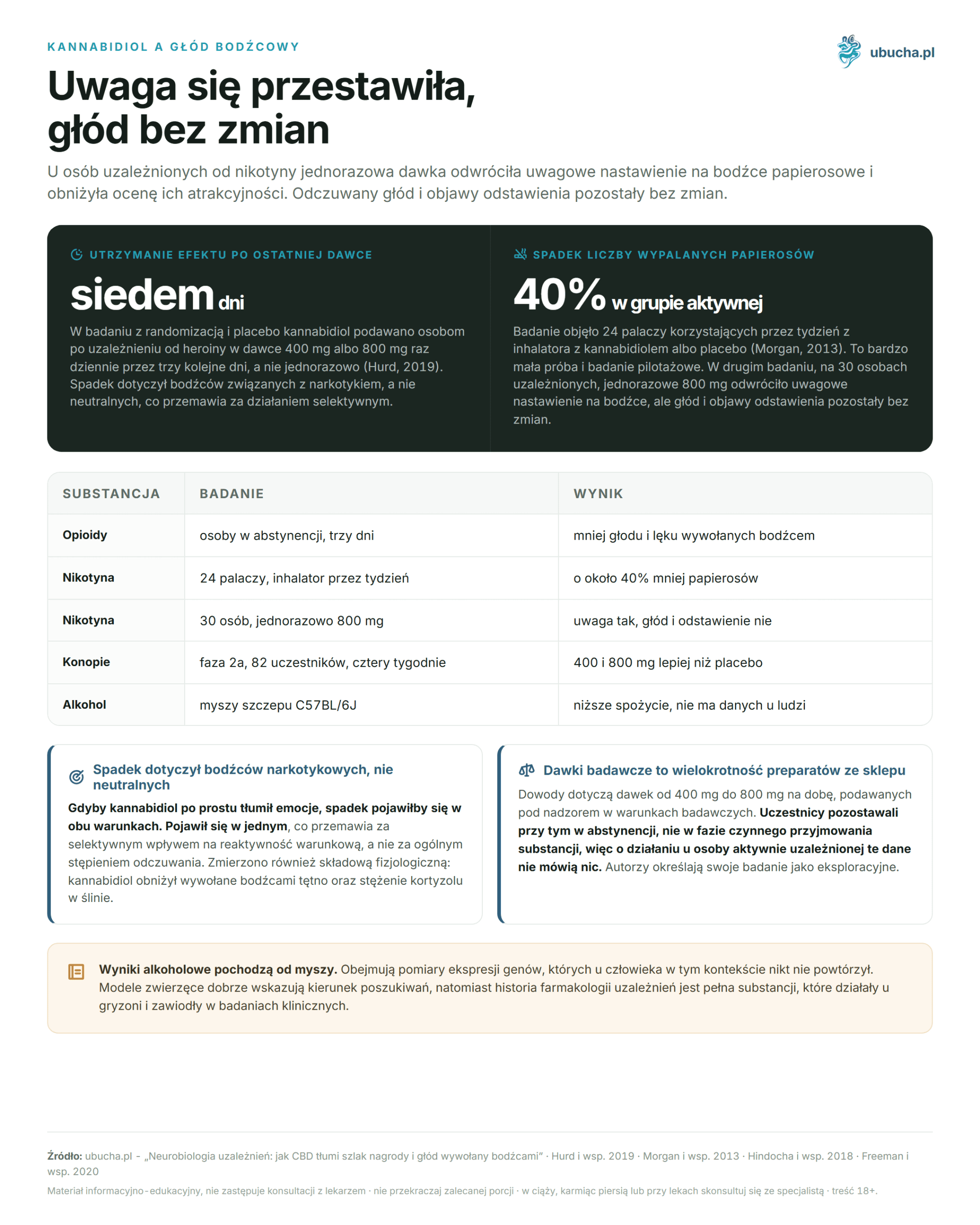
• Cannabidiol reduced craving and anxiety triggered by drug-related cues, and the effect lasted seven days after the last administration.
• The decrease pertained to drug-related cues, not neutral ones, which supports selective action.
• The authors describe their study as exploratory and conclude that further research is needed, not a ready therapy.
• The research doses far exceed the amounts found in consumer products.
• The World Health Organization stated in 2018 that pure cannabidiol does not exhibit abuse potential or dependence in humans.
What is the reward pathway and why is addiction so hard to break?
The reward pathway connects the ventral tegmental area with the nucleus accumbens and the prefrontal cortex. The dopamine signal encodes not so much pleasure itself but the value of the expected reward. Psychoactive substances shift this system so that anticipation increases while the actual experience weakens.
Chronic substance use triggers glutamatergic remodeling in the striatal-thalamic-cortical pathways, involving the orbitofrontal cortex and cingulate gyrus, as well as in limbic structures. Changes in the enlarged amygdala create a sustained state of negative emotional tension, which in itself perpetuates substance seeking (Volkow et al., Physiological Reviews, 2019).
Most counterintuitive is the observation that in an addicted person, the mere intake of the substance is associated with a weakened, not heightened, dopamine release in reward areas. The discrepancy between the size of the reward anticipated by cues and the actual experience may be what drives further use. The popular notion that a drug simply provides a stronger dopamine spike than food or social contact describes at best the first exposures, not established addiction.
The motivation to seek substances is instead driven by dopamine release triggered by the cues themselves, with weakened inhibitory control from the prefrontal cortex. Therefore, a person in long-term abstinence can react to a smell or place more strongly than to the memory of intoxication. We discussed how the same circuit responds to food cues in the text about the neurobiology of increased appetite after cannabis.
How does cannabidiol act on this pathway at the molecular level?
cannabidiol does not block D1 or D2 dopamine receptors, as antipsychotic drugs do. Its influence is indirect and spread across several systems. Three main points of action are most often mentioned, with varying strength of evidence for each, and it is worth separating them.
| Point of Action | What has been demonstrated | Research Model | What does not follow from this |
|---|---|---|---|
| 5-HT1A Receptor | Cannabidiol acts as an agonist with moderate affinity for the human 5-HT1A receptor | Cell culture, cloned receptor (Russo et al., Neurochemical Research, 2005) | The study did not measure dopamine or reward pathway activity |
| Anandamide Signaling | Cannabidiol moderately inhibits the breakdown of anandamide, and in a clinical study, it increased its serum levels | Randomized study in individuals with acute schizophrenia (Leweke et al., Translational Psychiatry, 2012) | The result pertains to psychosis, not substance use disorders |
| Stress Reactivity | Cannabidiol reduced cue-induced heart rate and cortisol levels in saliva | Randomized, placebo-controlled study in individuals with opioid addiction (Hurd et al., American Journal of Psychiatry, 2019) | Physiological measurement, not brain activity imaging |
This comparison explains why popular descriptions of the mechanism can easily diverge. The statement that activation of 5-HT1A inhibits excessive dopamine in the nucleus accumbens sounds coherent, yet the study most often cited in this context examined receptor binding in cell culture and says nothing about dopamine. A reliable description ends with the statement that cannabidiol has documented affinity for 5-HT1A and increases anandamide levels in humans. The translation of these facts to the reward circuit remains a hypothesis supported by clinical results, not a measured causal chain.
What did the study by Hurd and colleagues really demonstrate?
Individuals diagnosed with heroin addiction, remaining in abstinence, received cannabidiol at doses of 400 mg or 800 mg once daily for three consecutive days, or placebo. The study measured craving and anxiety triggered by the presentation of drug-related cues, compared to neutral cues.
Administration of cannabidiol significantly reduced both craving and anxiety triggered by drug cues. The effect lasted for another seven days after the last of the three administrations, long after the substance had left the bloodstream. This chronic component makes the result interesting, as it suggests a change in circuit reactivity rather than a temporary pharmacological effect (Hurd et al., American Journal of Psychiatry, 2019).
The distinction between drug-related and neutral cues is crucial here. If cannabidiol simply suppressed emotions, the decrease would have appeared in both conditions. It appeared in one, which supports a selective influence on conditioned reactivity, rather than a general dulling of perception.
A physiological component was also measured. Cannabidiol reduced cue-induced heart rate and cortisol levels in saliva. No impact on cognitive functions or serious adverse events was recorded.
It is worth keeping proportions in mind. The authors describe their study as exploratory and formulate their conclusion cautiously: the result justifies further investigation of cannabidiol as a possible option in the treatment of opioid addiction. This is not a registration or clinical recommendation. We discuss the relationship between cannabis and opioid medications in more detail in the comparison of the effectiveness and safety of both groups.
Does cannabidiol work for other addictions besides opioids?
Data exists for nicotine, cannabis, and alcohol, but they differ in quality by an order of magnitude. The strongest material pertains to cannabis use disorder, where a phase 2 study has been completed. For alcohol, we currently only have animal models.
| Substance | Study | Result | What is missing |
|---|---|---|---|
| Nicotine | 24 smokers, cannabidiol inhaler or placebo for a week (Morgan et al., Addictive Behaviors, 2013) | Reduction in the number of cigarettes smoked by about 40% in the active group | Very small sample, pilot study |
| Nicotine | 30 dependent individuals, single 800 mg orally (Hindocha et al., Addiction, 2018) | Reversal of attentional bias towards cigarette cues and reduction in their attractiveness rating | Craving and withdrawal symptoms remained unchanged |
| Cannabis | Phase 2a, 82 participants, four weeks of treatment (Freeman et al., Lancet Psychiatry, 2020) | Doses of 400 mg and 800 mg more effective than placebo, 200 mg dose rejected as ineffective | No phase 3 study |
| Alcohol | C57BL/6J mice (Viudez-Martínez et al., Addiction Biology, 2018) | Lower alcohol consumption and weaker motivation to obtain it. Milder relapse after withdrawal and changes in tyrosine hydroxylase expression in the ventral tegmental area | Animal model, no confirmation in humans |
This comparison includes one result that popular discussions usually overlook. In smokers, cannabidiol changed the way the brain processes cigarette cues, yet it did not reduce either craving or withdrawal symptom severity. The discrepancy between attentional and subjective measures is informative in itself, as it shows that an impact on cue reactivity does not automatically translate to what a person feels. We discuss research on other substances considered in addiction therapy, including ibogaine, separately.
It is important to separate two issues that are often confused in this topic. The above pertains to whether cannabidiol can help in overcoming addiction to other substances. A separate question is whether cannabidiol itself is addictive, and we address this in the text about CBD, addiction, and intoxication.
What do these results not yet prove?
The evidence pertains to doses from 400 mg to 800 mg per day, administered under supervision in research conditions. This is multiple times the amounts found in consumer products. Translating the conclusion from such a study to a store-bought product currently has no basis.
The second boundary concerns the studied group. Participants in the Hurd study remained in abstinence, not in the phase of active substance use. These data say nothing about the action of cannabidiol in an actively addicted person.
The third concerns the species. The alcohol results come from mice, not rats or humans, and involve measurements of gene expression that have not been replicated in humans in this context. Animal models indicate directions for research well, but the history of addiction pharmacology is full of substances that worked in rodents and failed in clinical trials.
A separate issue is the safety of cannabidiol itself. The World Health Organization expert committee stated in a 2018 review that cannabidiol does not exhibit effects indicating abuse potential or dependence in humans and that no public health problems related to its pure form have been reported (WHO, Cannabidiol Critical Review Report, 2018). We expand on this topic in the text about whether CBD is addictive.
Finally, cannabidiol does not replace treatment. The standard of care in opioid addiction includes agonist pharmacotherapy and psychotherapeutic interventions, and the studied action of cannabidiol pertains to one component of the problem, namely reactivity to conditioned cues.
Frequently Asked Questions
Does cannabidiol reduce drug craving?
In a randomized, placebo-controlled study of individuals with heroin addiction, cannabidiol administered at doses of 400 mg or 800 mg once daily for three days significantly reduced craving and anxiety triggered by drug-related cues. The effect lasted seven days after the last administration.
How does cannabidiol affect the dopamine reward pathway?
It does not block D1 or D2 dopamine receptors. Its agonistic affinity for the 5-HT1A receptor has been documented in cell culture, as well as an increase in anandamide levels in humans. The translation of these mechanisms to human reward circuit activity remains a hypothesis, not a measured causal chain.
Does cannabidiol help quit smoking?
Two small studies provide an incomplete picture. In the first, smokers using a cannabidiol inhaler smoked about 40% fewer cigarettes over a week. In the second, a single dose of 800 mg reversed attentional bias towards cigarette cues but did not change craving or withdrawal symptoms.
Does cannabidiol work for alcohol addiction?
This has not been conclusively studied in humans. Available data comes from mice, where cannabidiol reduced alcohol consumption, motivation to obtain it, and relapse severity after withdrawal. Animal results indicate direction but do not provide a basis for human application.
Can cannabidiol replace addiction treatment?
No. Studies evaluate it as a potential supplement, not a substitute for therapy. Standard treatment includes psychotherapy and, in opioid addiction, agonist pharmacotherapy. The described action of cannabidiol pertains only to reactivity to conditioned cues, which is one component of the disorder.
Retail products, including cannabis oils, provide doses incomparably lower than those used in the described studies and are not intended for addiction treatment.
This article is for informational and educational purposes only and does not constitute medical advice. Before starting to use cannabis or CBD for therapeutic purposes, consult with a doctor, especially if you are taking other medications, are pregnant, or breastfeeding.
Author: Michał Waluk · Published: 2026-08-09 · Updated: 2026-08-24