
Does CBD cause addiction? What science says and why myths circulate on the internet
Does CBD cause addiction? We check what the WHO wrote in 2018, what studies have shown about the abuse potential in humans, and what has not yet been studied.
The question of addiction arises with CBD more often than any other, and the answers circulate online along with numbers that no one verifies. A reasonable starting point is different: what exactly was measured, in whom, and by what method. The World Health Organization wrote in a review from 2018 that cannabidiol does not exhibit effects indicating potential for abuse or addiction in humans. The same document contains a sentence quoted much less frequently: controlled studies in humans on physical dependence, that is, on tolerance and withdrawal symptoms, have not been conducted. These two sentences are not contradictory, but mean different things. This text separates four concepts that blend together in casual conversation, shows research results in humans along with the number of participants and dosage, and also states what cannot be inferred from these studies.
KEY INFORMATION
• WHO in the 2018 review: in humans, cannabidiol does not exhibit effects indicating potential for abuse or addiction.
• The same document states that controlled studies in humans on tolerance and withdrawal symptoms after CBD have not been conducted.
• In the Babalonis study, 31 individuals regularly smoking cannabis received 200, 400, or 800 mg of CBD orally. The result was indistinguishable from placebo.
• Cannabis withdrawal syndrome is a separate entity in the DSM-5 classification. In a meta-analysis of 47 studies involving 23,518 participants, symptoms occurred in 47% of regular users.
• EFSA provides a provisional safe dose of CBD at 0.0275 mg per kilogram of body weight per day, which is about 2 mg for a person weighing 70 kg.
What exactly did the WHO state about CBD addiction?
The WHO Expert Committee on Drug Dependence wrote in a critical review in June 2018 that in humans, cannabidiol does not exhibit effects indicating any potential for abuse or addiction and that no public health problems related to its pure form have been reported to date (WHO, Cannabidiol Critical Review Report, 2018). This sentence is the most frequently repeated in Polish texts about cannabis and is true.
Two other excerpts from the same document are cited less frequently. The first concerns physical dependence: controlled studies in humans on tolerance and withdrawal symptoms after cannabidiol have not been conducted. The second states that no studies on animals regarding the potential for physical dependence have been found. The absence of reports on symptoms is not the same as a studied absence of symptoms.
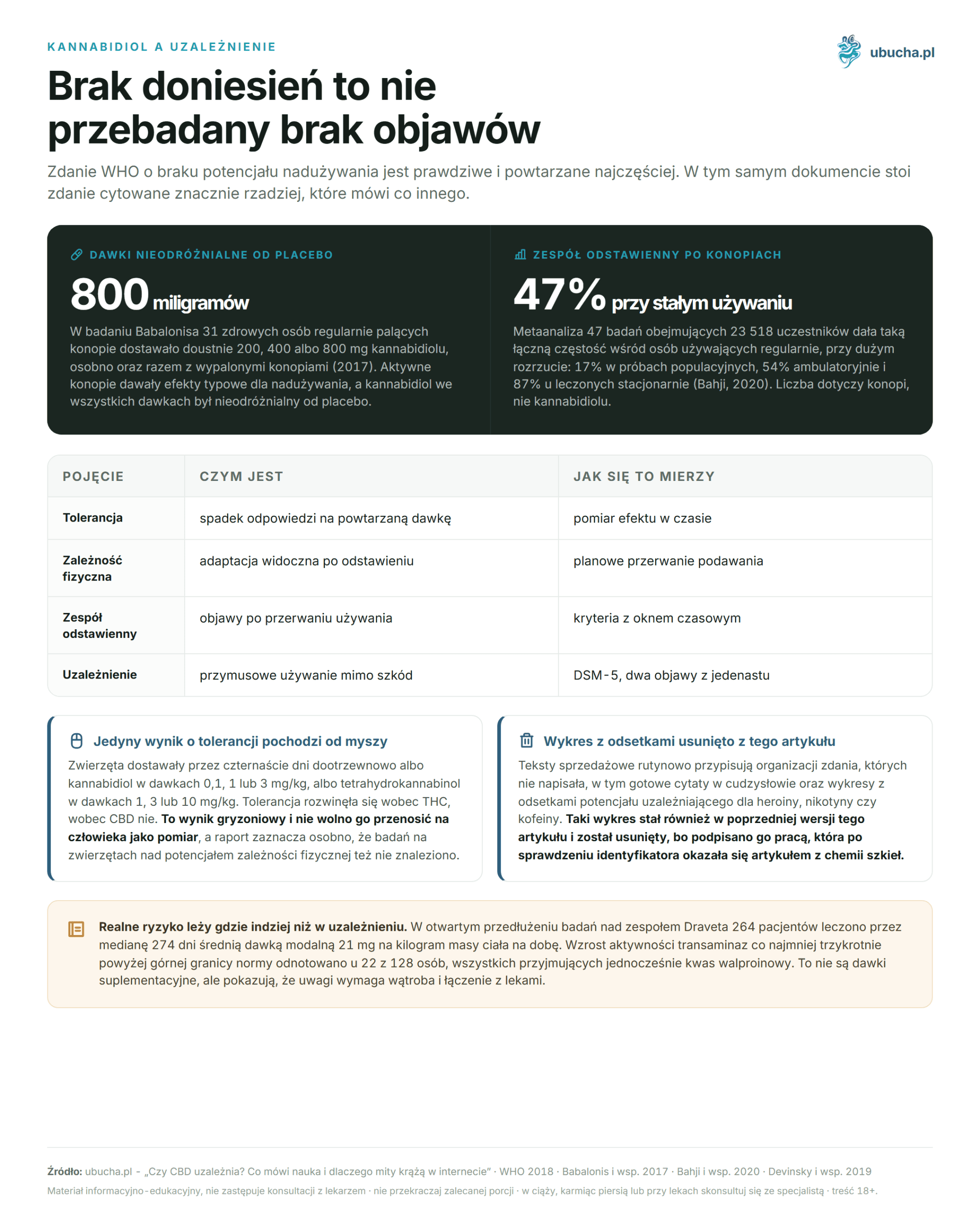
The only result regarding the absence of tolerance cited in the report comes from an experiment on mice. The animals received either CBD at doses of 0.1, 1, or 3 mg/kg, or THC at doses of 1, 3, or 10 mg/kg, either intraperitoneally or subcutaneously for fourteen days. Tolerance developed to THC, but not to CBD. This is a rodent result and cannot be transferred to humans as a measurement. In consumer texts, it is often transferred nonetheless, along with the name of the organization that never described it that way.
What is the difference between tolerance, dependence, and addiction?
These are four distinct phenomena that can coexist but are not identical, and in casual conversation, they blend into one word. The distinction determines what a given study actually measured, so without it, no result can be read fairly.
| Concept | What it is | How it is measured |
|---|---|---|
| Tolerance | Decrease in the body’s response to a repeated dose, necessitating an increase | Repeated administration of the same dose and measurement of effect over time |
| Physical dependence | Adaptation of the body that only reveals itself after cessation | Planned cessation of administration and observation of symptoms |
| Withdrawal syndrome | A set of symptoms after stopping intensive use | Diagnostic criteria with a specified time window |
| Addiction | A pattern of compulsive use despite harm | DSM-5 criteria, at least two of eleven within a year |
Studies on abuse potential, on which the WHO assessment is based, measure only one fragment of this picture: subjective liking of the substance after a single dose and the desire to take it again. They do not answer the question of what happens after a year of daily use in the general population. We expand on these concepts in the post about why the topic of addiction and intoxication raises controversy.
What have studies shown about the abuse potential of CBD in humans?
There are two, and both have clear methodology. In the Babalonis study, 31 healthy individuals who regularly smoked cannabis received cannabidiol orally at doses of 0, 200, 400, or 800 mg, separately and together with smoked cannabis. The design was within-subject, randomized, double-blind, and placebo-controlled, with sessions occurring once a week for eight weeks. Active cannabis produced predictable effects typical of abuse, while cannabidiol at all doses was indistinguishable from placebo (Babalonis et al., Drug and Alcohol Dependence, 2017).
The second study involved 43 individuals recreationally using multiple substances, of which 35 entered the pharmacodynamic analysis. Single doses of cannabidiol at 750, 1500, and 4500 mg were compared with alprazolam at 2 mg, dronabinol at 10 and 30 mg, and placebo. The 750 mg dose did not differ from placebo in terms of drug liking, while the 1500 and 4500 mg doses did differ, although the average difference was less than 10 points compared to over 18 points for positive controls. Unlike alprazolam, cannabidiol did not affect cognitive or psychomotor tests (Schoedel et al., Epilepsy & Behavior, 2018).
The limitation of both studies is the same. They measure a single dose in a population selected to be sensitive to psychoactive substances. They answer the question of whether the substance produces an effect that someone would want to experience again. They do not answer the question of what happens after a year of daily use.
Where does the myth of CBD addiction come from?
The strongest source is a mental shortcut linking the plant with one of its components. Cannabidiol comes from Cannabis sativa, just like tetrahydrocannabinol, but these are two distinct pharmacological substances. THC stimulates CB1 receptors in the reward system, while cannabidiol does not bind to them in this way and does not induce euphoria. In press headlines, this distinction usually disappears, as the term “compound from marijuana” does not require explanation.
The second layer is institutional. Decades of drug messaging have built an association that a single article does not break, and some doctors in Poland do not have up-to-date information about cannabidiol or avoid the topic. A patient who does not receive a reliable answer in the office seeks it online, where facts are mixed with advertising.
The third layer is on our side of the table. Sales texts routinely attribute to the WHO sentences that the organization did not write, including ready-made quotes in quotation marks and graphs with percentages of addictive potential for heroin, nicotine, or caffeine. Such a graph was also in the previous version of this article and was removed because it was attributed to a work that, upon checking the identifier, turned out to be an article from glass chemistry. A numerical claim without backing is a fabrication regardless of how credible it looks.
Is CBD being studied as an aid in overcoming addictions?
Yes, and this is the most interesting direction in this matter. A review by Navarrete and colleagues gathered preclinical and clinical data on how cannabidiol alters the reinforcing, motivational, and withdrawal effects of addictive substances. It included alcohol and opioids, nicotine, cannabinoids, as well as psychostimulants. The authors emphasize the lack of reinforcing properties of cannabidiol itself (Navarrete et al., Frontiers in Pharmacology, 2021).
The strongest single result comes from a study by Hurd and colleagues. It was an exploratory, randomized, double-blind placebo-controlled design involving individuals with heroin addiction who remained abstinent. Participants received 400 or 800 mg of cannabidiol once daily for three consecutive days. Cravings and anxiety triggered by exposure to drug-related cues decreased both immediately after administration and seven days after the last dose, along with a decrease in heart rate and cortisol levels in saliva. No serious adverse effects were reported (Hurd et al., American Journal of Psychiatry, 2019).
These are studies, not therapy. The standard of care for opioid addiction is based on agonist pharmacotherapy and psychotherapeutic interventions, and cannabidiol does not have registration for this indication. We break down the mechanisms separately in the post about the neurobiology of addiction and the reward pathway.
How to recognize withdrawal syndrome from THC and when to seek help?
This part is often omitted in texts about cannabidiol and concerns substances from the same plant. The DSM-5 classification recognized cannabis withdrawal syndrome as a separate diagnostic entity in 2013. Diagnosis requires at least three of seven symptoms within about a week of cessation, which must cause clinically significant distress or impairment in functioning. Among the seven items on this list are irritability, sleep disturbances with restless dreams, decreased appetite, and depressive mood.
The scale is measured. A meta-analysis of 47 studies involving 23,518 participants yielded a total withdrawal syndrome frequency of 47% among regular users, with a large range: 17% in population trials, 54% in outpatient settings, and 87% among inpatients (Bahji et al., JAMA Network Open, 2020). A separate review of 21 epidemiological studies states that cannabis use disorder affects 22% of those who have used it, and among young people using weekly or daily, the risk of developing dependence rises to 33% (Leung et al., Addictive Behaviors, 2020).
The practical conclusion is simple. If symptoms after stopping cannabis interfere with work, sleep, or relationships for more than a few days, or if returning to use serves only to alleviate them, it is time to contact a doctor or addiction treatment center, not to take another supplement. We described the withdrawal process in detail in the post about how long the effects of cannabis withdrawal last.
What is known about the safety of CBD with long-term use?
The longest data comes from an open extension of studies on Dravet syndrome. It involved 264 patients, with a median treatment time of 274 days ranging from 1 to 512 days, and a modal average dose of 21 mg per kilogram of body weight per day. Adverse effects occurred in 93.2% of participants and were mostly mild or moderate in severity; the most common were diarrhea in 34.5%, fever in 27.3%, decreased appetite in 25.4%, and drowsiness in 24.6%. Due to adverse effects, treatment was discontinued in 6.4% of patients, and an increase in transaminase activity at least three times above the upper limit of normal was noted in 22 out of 128 individuals, all of whom were taking valproic acid simultaneously (Devinsky et al., Epilepsia, 2019).
These are not supplemental doses and this is not the population of the reader of this text, but it shows where the real risk lies: in the liver and in combination with medications, not in addiction. This is supported by the European assessment. EFSA provides a provisional safe dose of 0.0275 mg per kilogram of body weight per day, which is about 2 mg for a person weighing 70 kg, derived using the benchmark dose method with an uncertainty factor of 400. The safety of cannabidiol cannot be established today in individuals under 25 years of age, in pregnant and breastfeeding women, and in individuals taking medications simultaneously (EFSA, EFSA Journal, 2026).
Frequently Asked Questions
Does CBD cause addiction?
The WHO stated in 2018 that cannabidiol does not exhibit effects indicating potential for abuse or addiction in humans. However, the same document notes that controlled studies in humans on tolerance and withdrawal symptoms after CBD have not been conducted. Therefore, the evidence pertains to the potential for abuse, not long-term use.
Will withdrawal symptoms occur after stopping CBD?
There is no study that has verified this. The WHO explicitly states that there are no controlled studies in humans on physical dependence after cannabidiol, and no studies in animals have been found in this regard. The absence of reports on symptoms is not the same as a studied absence of symptoms, so the honest answer is: it is unknown.
Can one become accustomed to CBD and increase the dose?
This has not been measured in humans. The only result regarding the absence of tolerance cited by the WHO report comes from a fourteen-day experiment on mice, where tolerance developed to THC, but not to CBD. The popular phenomenon of reverse tolerance found online has no confirmation in the peer-reviewed literature.
What is the difference between CBD and THC in terms of addiction?
THC stimulates CB1 receptors in the reward system and has documented addictive potential: cannabis use disorder affects 22% of those who have used it. Cannabidiol does not bind to CB1 in this way, does not induce euphoria, and in studies of abuse potential, it performed like a placebo.
Can CBD help in treating addictions?
It is being studied for this role. In a randomized placebo-controlled study of individuals with heroin addiction, doses of 400 and 800 mg over three days reduced cravings and anxiety triggered by drug-related cues. This is an exploratory result, not a registered indication, and does not replace standard treatment.
You can find cannabidiol in oil form in the category of hemp oils.
This article is for informational and educational purposes and does not constitute medical advice. Before starting to use cannabis or CBD for therapeutic purposes, consult a doctor, especially if you are taking other medications, are pregnant, or breastfeeding.
Author: Michał Waluk · Published: 2026-05-29 · Updated: 2026-08-16