
WHO Report from 2018 on CBD: What the World Health Organization Really Stated
The WHO ECDD report from 2018 on CBD: what the committee really stated about dependence, safety, and drug interactions, and how the UN voted.
In June 2018, the WHO Expert Committee on Drug Dependence (ECDD) met in Geneva and adopted a Critical Review of cannabidiol (WHO ECDD, 2018). The document is often cited as evidence that WHO recognized CBD as safe and effective. This is not the case. The report answers one question: should pure cannabidiol be subject to international drug control? The distinction matters because a version circulating in the public domain attributes statements to this document that it does not contain, regarding the absence of withdrawal symptoms, the inhibition of specific liver enzymes, and Alzheimer’s disease. Below, we reproduce what is written in the report, what is not included, and what survived the UN vote from later recommendations.
KEY INFORMATION
• The ECDD report is a Critical Review from the 40th session of the committee, Geneva, June 4-7, 2018. It expands on an earlier preliminary review from November 2017.
• The committee wrote that in humans, CBD does not exhibit effects indicating potential for abuse or dependence and that it is generally well tolerated.
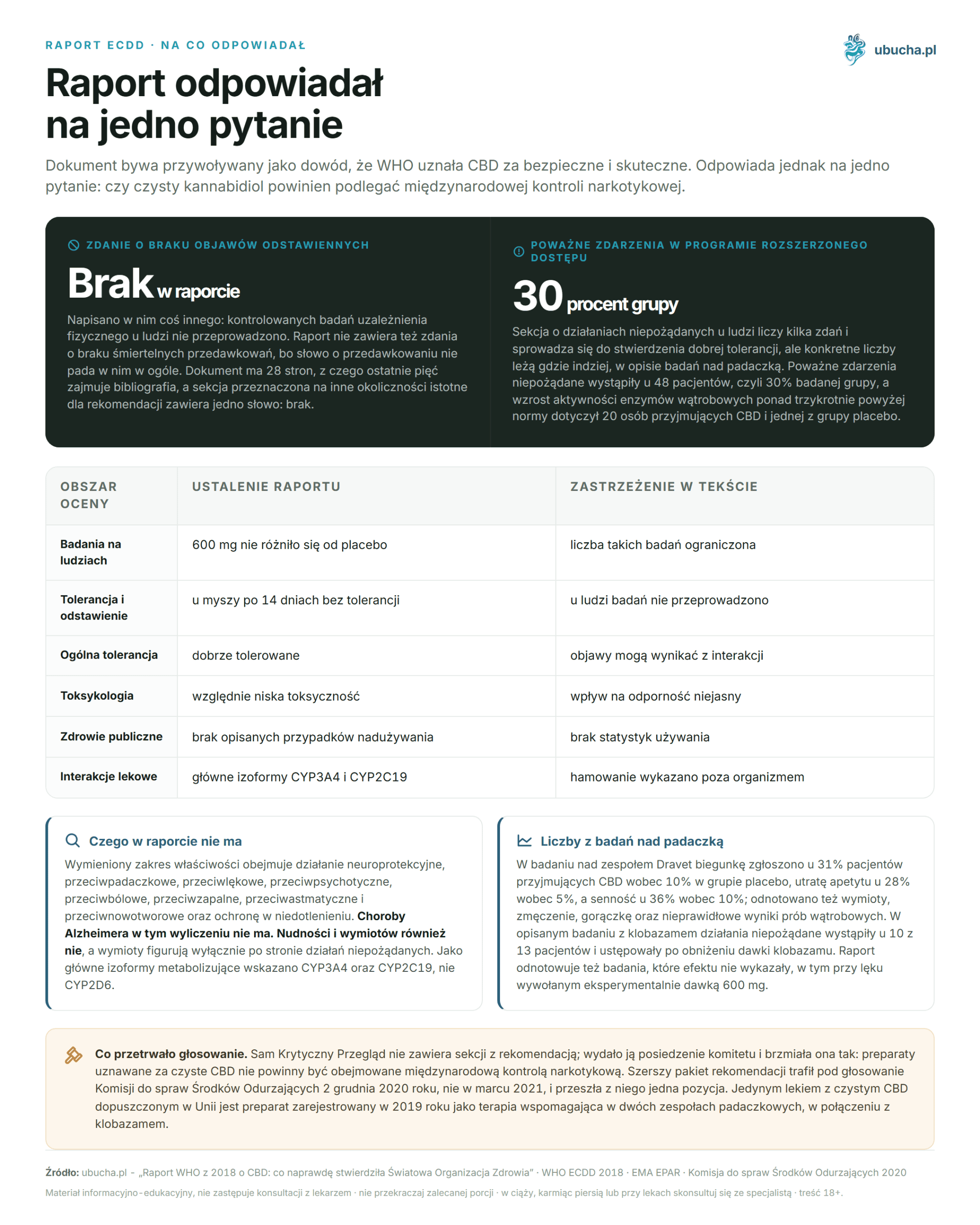
• The report does not contain a statement about the absence of withdrawal symptoms. It states something different: controlled studies on physical dependence in humans have not been conducted.
• Alzheimer’s disease, nausea, and vomiting do not appear in the report as areas of therapeutic activity. Vomiting is mentioned only as an adverse effect.
• The recommendation regarding products containing up to 0.2% THC comes from a later committee meeting and was rejected by the UN on December 2, 2020.
Why did WHO evaluate CBD only in 2018?
Because there was no formal reason before. The ECDD assesses substances for their potential for dependence and the need for international control, and cannabidiol itself is not listed in the schedules of the 1961, 1971, or 1988 conventions. The problem arose from another side: CBD produced as an extract from cannabis fell under Schedule I of the 1961 convention.
The order of the committee’s work is described in the report itself. The thirty-eighth session recommended preparing preliminary documentation for cannabis substances. The thirty-ninth session conducted a preliminary review of cannabidiol in November 2017. The 2018 document is, in its own words, an extension and update of that review. It has 28 pages, of which the last five are bibliography, and section 19, designated for other circumstances relevant to the recommendations, contains one word: none. If you are looking for pharmacological bases, we have described them separately in the entry about the properties of CBD.
Pressure also came from the practical side. The section on national controls shows that countries were already going in four different directions. The British agency MHRA recognized CBD products used for medical purposes as medicinal products in 2016. Switzerland excluded cannabidiol from drug law because it does not produce a psychoactive effect. Australia moved therapeutic CBD products to the prescription category in 2015. In the United States, cannabidiol remained in Schedule I of the federal Controlled Substances Act at that time.
What did the report state about dependence and safety?
The summary of the report states that in human studies, CBD does not exhibit effects indicating any potential for abuse or dependence and that the substance is generally well tolerated and has a good safety profile. Each of these statements has a caveat in the text of the report that popular summaries usually do not convey.
| Area of Assessment | ECDD 2018 Report Finding | Caveat in the Report Text |
|---|---|---|
| Human Studies | 600 mg orally did not differ from placebo on ARCI scales, in intoxication assessment and psychotic symptoms | The number of such studies is limited |
| Animal Studies | CBD did not substitute for THC in the drug discrimination test | Doses of 10 and 20 mg/kg raised the threshold for intracranial self-stimulation, unlike cocaine or opioids |
| Tolerance and Withdrawal | In mice, after 14 days of administration, no tolerance was observed | Controlled studies on physical dependence in humans have not been conducted |
| Overall Tolerance | Well tolerated, good safety profile | Reported adverse effects may result from interactions with patients’ medications |
| Toxicology | Relatively low toxicity in in vitro and animal studies | Not all possible effects have been studied, the impact on the immune system remains unclear |
| Public Health | No described cases of abuse or dependence on pure CBD | No published statistics on non-medical use |
The report does not contain a statement about the absence of fatal overdoses. The word overdose does not appear in it at all.
What adverse effects and drug interactions were noted?
The section on adverse effects in humans consists of a few sentences and boils down to stating good tolerance. Specific numbers lie elsewhere, in the description of studies on epilepsy, and are much less benign than the summaries of this report suggest.
In the Dravet syndrome study, diarrhea was reported in 31% of patients taking CBD compared to 10% in the placebo group, loss of appetite in 28% compared to 5%, and drowsiness in 36% compared to 10%. Vomiting, fatigue, fever, and abnormal liver function test results were also noted. In the expanded access program, serious adverse events occurred in 48 patients, or 30% of the study group. In the Lennox-Gastaut syndrome study, an increase in liver enzyme activity more than three times above the upper limit of normal affected 20 individuals taking CBD and one individual from the placebo group.
The report treats interactions more cautiously than the circulating version does. Seven enzymes capable of metabolizing CBD are listed, with CYP3A4 and CYP2C19 identified as the two main isoforms, not CYP2D6. Inhibition of isoenzymes has been demonstrated in vitro, and the report explicitly cautions that it is unknown whether it occurs at concentrations achieved in clinically used doses. In the described study with clobazam, adverse effects occurred in 10 out of 13 patients and resolved after reducing the dose of clobazam.
For which conditions did WHO note therapeutic activity?
Most notably for epilepsy. The report states that the clinical application of CBD is most advanced in the treatment of epilepsy and that clinical studies have demonstrated efficacy against at least some of its forms. For other indications, the formula is more cautious: for most, there are only preclinical data, and for some, preclinical data along with limited clinical data.
The range of properties mentioned in the report includes neuroprotective, anticonvulsant, anxiolytic, antipsychotic, analgesic, anti-inflammatory, anti-asthmatic, and anti-cancer effects, as well as protection in hypoxia and ischemia. Alzheimer’s disease is not included in this enumeration. Nausea and vomiting are also not mentioned; vomiting appears solely on the side of adverse effects. The report also notes studies that did not demonstrate an effect: in ulcerative colitis, in chronic pain in kidney transplant patients, and in anxiety induced by an experimental dose of 600 mg. The only drug with pure CBD authorized for market release in the EU is Epidyolex, registered on September 19, 2019, as an adjunctive therapy for Lennox-Gastaut syndrome and Dravet syndrome in combination with clobazam, as well as for tuberous sclerosis (EMA, EPAR Epidyolex).
How did the WHO recommendation change international law?
Less than is commonly believed. The Critical Review itself does not contain a section with a recommendation. It was issued by the 40th session of the committee and stated that products considered pure CBD should not be subject to international drug control because the substance has not been found to have psychoactive properties or potential for abuse (WHO, 2018).
A broader package of recommendations regarding cannabis was created at the next committee meeting and was put to a vote by the Commission on Narcotic Drugs on December 2, 2020, not in March 2021. One item passed: cannabis and cannabis resin were removed from Schedule IV of the 1961 Convention by a vote of 27 to 25 with one abstention, after 59 years of the strictest regime. The substances remained in Schedule I. The proposal regarding products with a predominance of cannabidiol and containing no more than 0.2% delta-9-THC was rejected (UN News, 2020). The argument against the proposal was simple: since cannabidiol is not listed in the schedules of any of the three conventions, a separate designation does not organize anything. The effect is that the position of pure CBD in international law today is based not on a regulation but on its absence. The 2020 vote did not legalize anything in national orders because the conventions set minimum control for states, not maximum. How these decisions translated into individual orders is shown in the comparison of legal systems regulating CBD.
What does the WHO report mean for consumers in Poland?
Directly nothing, because Polish regulations do not refer to ECDD documents. Cannabidiol is not listed in any controlled substance lists, and the boundary between industrial hemp and cannabis other than industrial is 0.3%. It is calculated as the sum of delta-9-THC and tetrahydrocannabinolic acid (THCA), rounded to one decimal place, in accordance with Article 4 point 5 of the Act of July 29, 2005 on Counteracting Drug Addiction (Journal of Laws 2023, item 1939) as amended by the Act of March 24, 2022 (Journal of Laws 2022, item 763), effective from May 7, 2022. The national threshold corresponds to the EU threshold, but it does not result from it. These are two separate regulations of the same value.
The food pathway remains open. Cannabidiol has not been entered on the EU list of novel foods, and the European Food Safety Authority in its opinion of February 9, 2026, derived a temporary safe level of consumption of 0.0275 mg per kilogram of body weight per day, about 2 mg for a person weighing 70 kg, and only for raw material with a purity of at least 98%. The Authority also stated that the safety of CBD cannot be established for individuals under 25 years of age, pregnant and breastfeeding women, and individuals taking medications, and maintained reservations regarding the liver, hormonal, nervous, and reproductive systems (EFSA, 2026). The market context of this dispute is described in the entry about regulation of CBD products in Poland.
Frequently Asked Questions
What did the WHO report from 2018 state about CBD?
That in humans, CBD does not exhibit effects indicating potential for abuse or dependence and is generally well tolerated, with a good safety profile. The report also cautions that reported adverse effects may result from interactions with medications taken concurrently by patients.
Did WHO recognize CBD as a drug?
No. The committee assessed only the justification for subjecting pure cannabidiol to international drug control, not its clinical efficacy. At the time the report was created, no product containing pure CBD had yet been authorized for market release, and Epidiolex was still in the registration process.
Does the WHO report state that CBD does not cause withdrawal symptoms?
No, and this is one of the most frequently repeated misinterpretations. The report states that controlled studies on the potential for physical dependence in humans, including withdrawal and tolerance, have not been conducted. The lack of studies is not the same as evidence of the absence of the phenomenon.
Did the UN adopt WHO’s recommendations regarding CBD?
Only partially. The Commission on Narcotic Drugs removed cannabis and cannabis resin from Schedule IV of the 1961 Convention on December 2, 2020, by a vote of 27 to 25. The proposal to exempt products with a predominance of CBD and containing up to 0.2% THC was rejected.
Does the WHO report change anything in Polish law?
No, it does not change anything. CBD is not listed in Polish controlled substance lists regardless of WHO’s position, and the threshold of 0.3% calculated as the sum of delta-9-THC and THCA results from the Act on Counteracting Drug Addiction. The food status of cannabidiol in the EU remains unresolved.
Oils with hemp extract in the store at Bucha can be found in the oils category.
This article is for informational and educational purposes only and does not constitute medical advice. Before starting to use cannabis or CBD for therapeutic purposes, consult a doctor, especially if you are taking other medications, are pregnant, or breastfeeding.
Author: Michał Waluk · Published: 2026-08-09 · Updated: 2026-08-10