
Ginkgo for Tinnitus: Does It Help
Does ginkgo biloba help with tinnitus? A Cochrane review from 2022 included 12 studies and 1915 participants. Check what the clinical studies really show.
Tinnitus is one of the more common reasons for visiting a family doctor: in England alone, it is estimated that there are about three-quarters of a million such consultations annually (Cochrane, 2022). There is practically no effective pharmacological treatment for tinnitus, so patients turn to what is available over the counter. Ginkgo biloba, or Japanese ginkgo, has been the most commonly recommended herb for tinnitus for decades and is still advertised as such. Meanwhile, clinical studies conducted over the past twenty years paint a rather clear picture, only inconsistent with this reputation. Below, we gather what exactly has been checked, on how many people, and with what results, as well as what has stronger foundations in this indication.
KEY INFORMATION
• The Cochrane review from 2022 included 12 studies and 1915 participants, and the certainty of evidence was rated as low to very low (Sereda et al., Cochrane Database of Systematic Reviews, 2022).
• The largest randomized study included 1121 people and showed no advantage over placebo.
• The European Medicines Agency does not list tinnitus among the indications for ginkgo leaf.
• Ginkgo may increase the risk of bleeding in people taking blood-thinning medications.
Does ginkgo biloba help with tinnitus?
According to the current state of research, there is no evidence that it helps. The Cochrane review from 2022, which included 12 randomized studies and 1915 participants, states uncertainty regarding the benefits and harms of using ginkgo for tinnitus, with evidence certainty for all reported endpoints rated as low to very low.
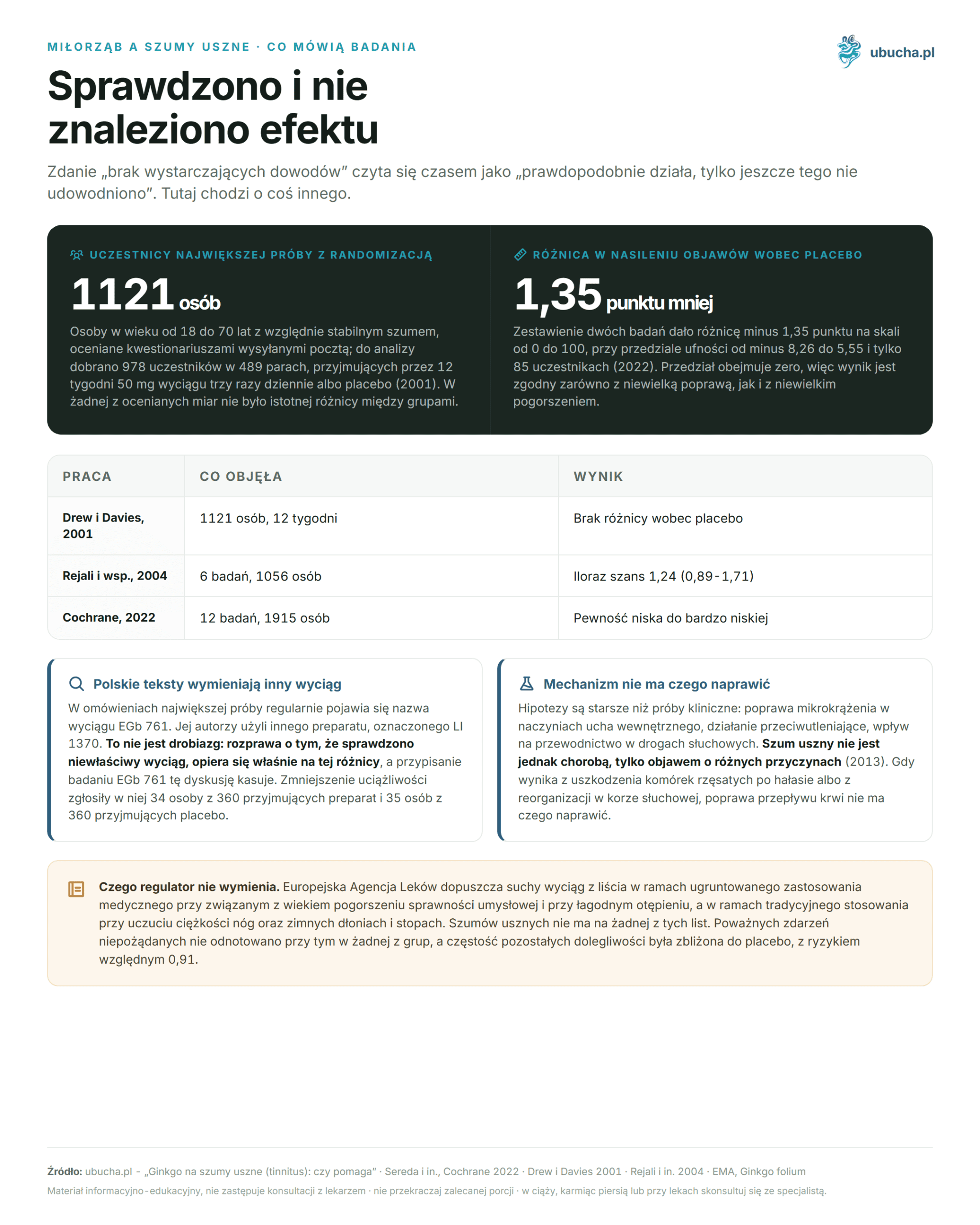
The numbers behind this conclusion are worth seeing directly. When comparing two studies, the difference in symptom severity measured by the Tinnitus Handicap Inventory questionnaire was minus 1.35 points on a scale from 0 to 100, with a confidence interval from minus 8.26 to 5.55 and only 85 participants (Sereda et al., Cochrane Database of Systematic Reviews, 2022). The interval includes zero, so the result is consistent with both a slight improvement and a slight worsening.
This distinction is often blurred. The phrase “there is insufficient evidence” is sometimes read as “it probably works, it just hasn’t been proven yet.” Here, it is about something else: studies have been conducted, some of them were large, and no effect was found.
What did the largest randomized study show?
The largest study remains the trial by Drew and Davies published in the BMJ in 2001. It involved 1121 people aged 18 to 70, with relatively stable tinnitus, assessed by questionnaires sent by mail; 978 participants in 489 pairs were selected for analysis. The loudness of the noise was assessed on a six-point scale and its annoyance on a five-point scale, before treatment, during treatment, and after it.
Participants took LI 1370 extract at a dose of 50 mg three times a day or a placebo for 12 weeks. There was no significant difference between groups in any of the assessed measures. A reduction in the annoyance of the noise after 12 weeks was reported by 34 out of 360 taking the preparation and 35 out of 360 taking the placebo (Drew and Davies, BMJ, 2001).
We noticed that the name of the extract EGb 761 regularly appears in Polish texts about this study. Drew and Davies used a different preparation, marked LI 1370. This is not a trivial detail: the argument that “the wrong extract was tested” is based precisely on this difference, and attributing the study to EGb 761 nullifies this discussion.
What did later reviews add?
They confirmed the direction of the result. Rejali and colleagues combined their own randomized trial, involving 66 patients, with a meta-analysis of six placebo-controlled studies. Improvement was noted in 21.6 percent of those treated with ginkgo, or 107 out of 552, compared to 18.4 percent in the placebo group, or 87 out of 504. The odds ratio was 1.24 with a confidence interval from 0.89 to 1.71, thus indistinguishable from no effect (Rejali et al., Clinical Otolaryngology, 2004).
The Cochrane review from 2022 added safety data to this picture. In four studies involving 1154 people, no serious adverse events were reported in any group, and the frequency of other ailments, such as gastrointestinal problems, headaches, and allergic reactions, was similar to placebo, with a relative risk of 0.91.
| Study | Participants | Result |
|---|---|---|
| Drew and Davies, 2001 | 1121 people, 12 weeks | No difference compared to placebo |
| Rejali et al., 2004 | 6 studies, 1056 people | Odds ratio 1.24 (0.89-1.71) |
| Cochrane, 2022 | 12 studies, 1915 people | Evidence certainty low to very low |
How would ginkgo work on the inner ear?
Mechanistic hypotheses are older than clinical trials, and they fueled the popularity of ginkgo in this indication. It was assumed that it would improve microcirculation in the vessels of the inner ear, provide antioxidant action to protect hair cells, and influence conduction in the auditory pathways.
The problem is that tinnitus is not a disease but a symptom with various causes. Risk factors include hearing loss, ototoxic medications, head trauma, and depression (Baguley et al., The Lancet, 2013). When the noise results from damage to hair cells due to noise or from reorganization in the auditory cortex, improving blood flow has nothing to repair.
This is also evident in objective measurements. When the loudness of the noise was measured using audiometric matching after 12 weeks, the difference compared to placebo was minus 4 decibels with a confidence interval from minus 13.33 to 5.33, based on one study with 73 participants. Quality of life assessed by the Glasgow Health Status Inventory questionnaire after three months differed by minus 0.58 points with a range from minus 4.67 to 3.51.
This explains why a mechanism that looks sensible on paper does not translate into study results. What is measurable is the change felt by the patient, not the probability of action derived from pharmacology. The profile of ingredients and broader applications of ginkgo are described in our entry about ginkgo biloba and its properties.
What does ginkgo have stronger evidence for than tinnitus?
The European Medicines Agency allows the dry extract from ginkgo leaves for established medical use to improve age-related cognitive decline and quality of life in adults with mild dementia. Under traditional use, it lists powdered leaves for the feeling of heaviness in the legs and cold hands and feet. Tinnitus is not mentioned on either list (EMA, monograph Ginkgo folium).
Also, in the cognitive area, the evidence is not uniform. The GuidAge study included 2854 people over 70 reporting memory problems, who took 120 mg of EGb 761 extract twice a day or a placebo for 5 years. A probable diagnosis of Alzheimer’s disease was made in 61 people in the ginkgo group and 73 in the placebo group, with a risk ratio of 0.84 and a range from 0.60 to 1.18 (Vellas et al., The Lancet Neurology, 2012). Prevention was not demonstrated. A Cochrane review covering 36 studies on dementia and cognitive disorders defined the evidence of benefits as inconsistent and uncertain (Birks and Grimley Evans, Cochrane, 2009).
What really helps with tinnitus and when to be cautious?
The strongest basis is the combination of sound therapy with counseling conducted in the spirit of cognitive-behavioral therapy. Hearing aids for confirmed hearing loss, broadband sound therapy, and counseling are methods mentioned as available, and cognitive-behavioral therapy is indicated for some patients (Baguley et al., The Lancet, 2013).
None of these methods remove the sound. They change the annoyance of the noise and daily functioning, which, given the symptom’s many causes, is a realistic treatment goal. The starting point remains ENT diagnostics, as some causes of tinnitus require causal treatment.
Is it worth adding ginkgo to a hearing aid? The Cochrane review found one study on this, involving 22 people, and rated the certainty of evidence for all its endpoints as very low, not formulating any numerical conclusion from it. With such a small sample, it is impossible to distinguish the effect of the preparation from chance.
With ginkgo itself, caution concerns bleeding. The agency reports cases of bleeding from the eye, nose, brain, and gastrointestinal tract and recommends that people prone to bleeding or taking blood-thinning medications use the dry extract only after consulting a doctor. This includes warfarin, acetylsalicylic acid, and clopidogrel. We have gathered a comparison of herbs used for cognitive function in our entry about herbs for concentration, and a similar discrepancy between reputation and evidence is described in relation to black cohosh.
Frequently Asked Questions
Does ginkgo biloba help with tinnitus?
There is no evidence that it helps. A Cochrane review from 2022 included 12 studies and 1915 participants and found uncertainty regarding the benefits and harms, with evidence certainty rated from low to very low (Sereda et al., Cochrane, 2022). Diagnosis starts with an ENT specialist.
What exactly was checked in the largest study?
Drew and Davies included 1121 people aged 18-70 with relatively stable tinnitus. For 12 weeks, they took LI 1370 extract at a dose of 50 mg three times a day or a placebo. None of the assessed measures differed between groups (BMJ, 2001).
Is ginkgo registered for the treatment of tinnitus?
No. The European Medicines Agency’s monograph lists improvement related to age-related cognitive decline in adults with mild dementia for the dry extract, and for the powdered leaf, it mentions minor circulatory disorders (EMA, Ginkgo folium). Tinnitus is not included.
Does ginkgo prevent Alzheimer’s disease?
This has not been demonstrated. In the GuidAge study, 2854 people over 70 took the extract or placebo for 5 years, and the risk ratio for diagnosis was 0.84 with a range of 0.60 to 1.18 (Vellas et al., The Lancet Neurology, 2012). The difference was not significant.
Can ginkgo increase the risk of bleeding?
The agency reports cases of bleeding from the eye, nose, brain, and gastrointestinal tract. People prone to bleeding or taking blood-thinning medications, including warfarin, acetylsalicylic acid, and clopidogrel, should use the dry extract only after consulting a doctor (EMA, Ginkgo folium).
What really helps with tinnitus?
The strongest basis is the combination of sound therapy with counseling conducted in the spirit of cognitive-behavioral therapy, and for those with confirmed hearing loss, hearing aids (Baguley et al., The Lancet, 2013). These methods reduce the annoyance of the noise but do not remove the sound itself.
This article is for informational and educational purposes only and does not constitute medical advice. Before starting supplementation, consult your doctor, especially if you are taking medications regularly, are pregnant or breastfeeding, or have a chronic illness.
Author: Michał Waluk · Published: 2026-08-09 · Updated: 2026-08-11