
Hemp Flour in Baking: Ratios, Substitutes, and Common Mistakes
How much hemp flour to add to dough, what to replace it with, and what mistakes are most commonly repeated. Ratios based on a study from 2024, not on intuition.
Hemp flour looks like cocoa, absorbs water like a sponge, and colors baked goods a dark green-brown. These are not flaws, but properties you need to know before adding it to a wheat-based recipe. Do it without preparation, and you will take something dense and dry out of the oven. Do it with a plan, and you will bake bread with a distinctly higher protein and fiber content than wheat, with a nutty background in flavor. Below you will find ratios based on a study published in 2024, a list of the most common mistakes, substitutes with numbers from the USDA database, and an honest account of what is not known about this flour. The last point is more important than it seems: some of the repeated numbers about hemp flour have no measurement behind them.
KEY INFORMATION
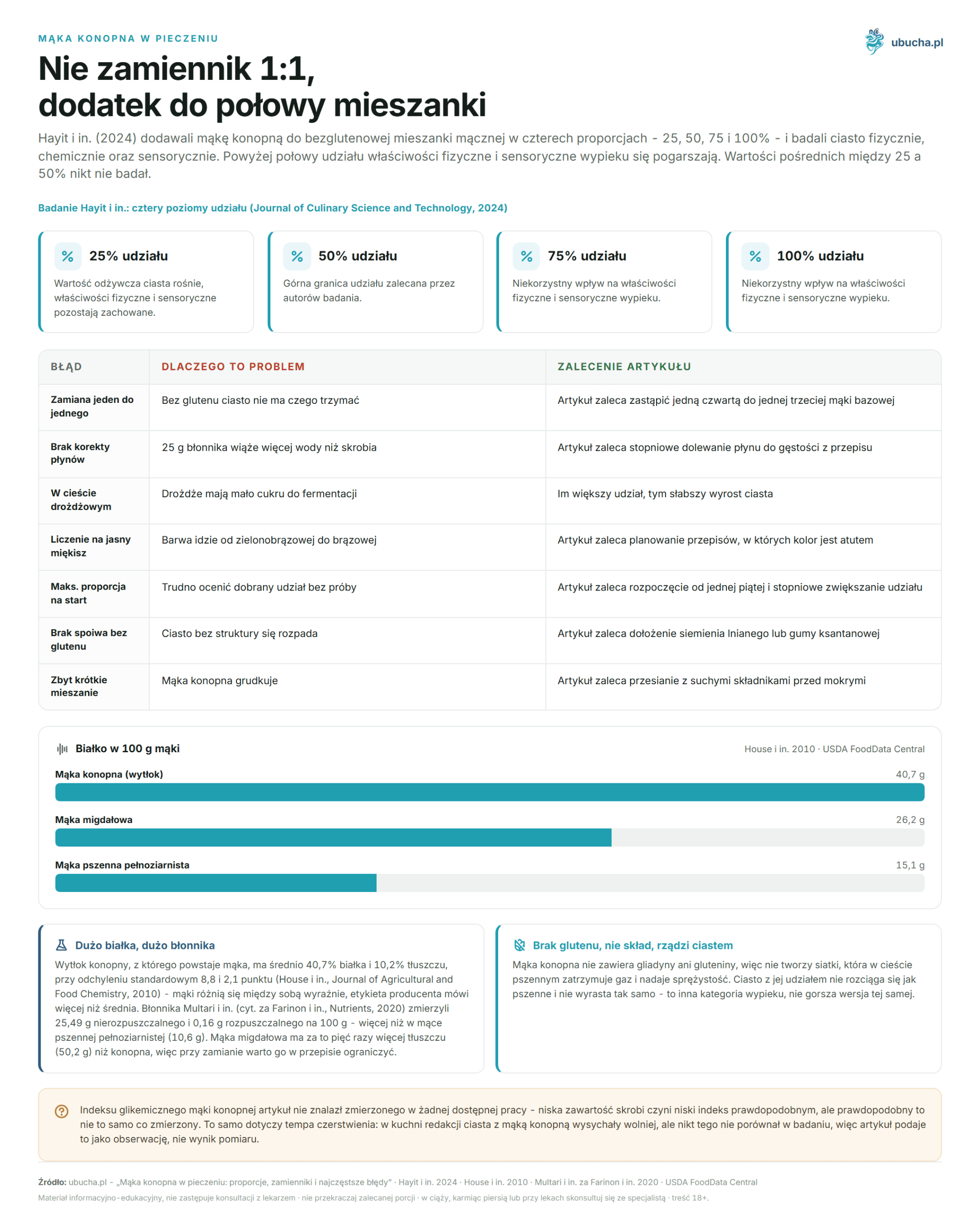
• Above 50% inclusion of hemp flour worsens the physical and sensory properties of the baked product (Hayit et al., Journal of Culinary Science and Technology, 2024).
• Hemp cake, from which flour is made, has an average of 40.7% protein and 10.2% fat (House et al., 2010).
• Fiber in hemp flour was measured at 25.49 g of insoluble and 0.16 g of soluble per 100 g.
• The glycemic index of hemp flour was not found measured in any of the available studies.
What is hemp flour and how does it differ from wheat flour?
It is ground cake left after oil extraction. After pressing oil from hemp seeds (Cannabis sativa L.), a dry mass rich in protein and fiber remains, which is ground into powder. The review by Farinon et al. (Nutrients, 2020) uses the terms hemp cake and hemp flour interchangeably, as they refer to the same product.
The scale of difference compared to wheat is large. House et al. (Journal of Agricultural and Food Chemistry, 2010) measured an average of 40.7% protein and 10.2% fat in hemp cake, with standard deviations of 8.8 and 2.1 points, respectively. This variability is important: flours differ in their degree of defatting, so the label of a specific manufacturer will tell you more than any averaged value. Fiber was measured by Multari’s team, whose results are cited in Farinon’s review: 25.49 g of insoluble and 0.16 g of soluble per 100 g of flour. Whole grain wheat flour, for comparison, has 15.1 g of protein and 10.6 g of fiber per 100 g (USDA FoodData Central).
However, the behavior of the dough is determined not by the composition but by the lack of gluten. Hemp flour does not contain gliadin or glutenin, so it does not form a network that retains gas in wheat dough and gives elasticity. Dough with its inclusion will not stretch like wheat dough and will not rise the same way. It is a different category of baked goods, not a worse version of the same.
How much hemp flour can be added to a baked good?
Up to half of the total flour weight, no more. This conclusion was drawn by Hayit et al. (Journal of Culinary Science and Technology, 2024), who added hemp flour to a gluten-free flour blend in four ratios and studied the finished cakes physically, chemically, and sensorially.
| Hemp flour inclusion | What was measured |
|---|---|
| 25% | nutritional value of the dough increases, physical and sensory properties preserved |
| 50% | upper limit recommended by the authors |
| 75% | negative impact on physical and sensory properties |
| 100% | negative impact on physical and sensory properties |
It is worth seeing what this addition really changes in the finished dough. In Hayit’s study, the protein content in the dough ranged from 9.96% to 17.89%, fiber from 5.00% to 9.55%, fat from 22.64% to 37.04%, and ash from 3.50% to 7.08%. The content of phenolic compounds reached 188.30 mg GAE per gram, and the antioxidant content increased from 49.92% to 82.16%. The authors summarize this in one sentence: hemp flour is suitable for gluten-free cakes because it increases their nutritional value, but it should not exceed half of the blend.
Two caveats to this number. First, the study concerned gluten-free dough, so it does not directly state how much hemp flour a yeast-leavened wheat bread can tolerate. Second, only four levels were tested: 25, 50, 75, and 100 percent, so no intermediate value can be read from this work. In our kitchen, we start with 20-25% and increase the proportion after assessing the effect, but this is practice, not a measurement result.
What mistakes do bakers commonly make with hemp flour?
The most common is a one-to-one substitution. Hemp flour is not a substitute for wheat flour, but an addition to the mix. Below are seven mistakes that recur in initial attempts, and a solution for each.
- One-to-one substitution of wheat flour. Without a gluten network, the dough has nothing to hold onto. Replace at most one quarter to one third of the base flour.
- Lack of liquid adjustment. Over 25 g of insoluble fiber per 100 g binds water more strongly than starch from wheat flour. Add liquid gradually until the dough looks like in the original recipe.
- Hemp flour in yeast dough. Yeast ferments sugars from starch, and hemp flour has almost none. The higher its proportion, the weaker the rise.
- Counting on a light crumb. The color goes from greenish-brown to brown regardless of the proportions. Plan recipes where the dark color is an asset.
- Maximum proportion on the first attempt. Start with one fifth, assess the result, and only then increase the proportion.
- Lack of binder in the gluten-free version. When there is no gluten in the mix at all, add ground flaxseed or xanthan gum to prevent the dough from falling apart.
- Too short mixing of dry ingredients. Hemp flour clumps. Sift it together with the other dry ingredients before adding wet ones.
We have noticed in our baking that cakes with a high proportion of hemp flour dry out more slowly than purely wheat ones. The explanation is self-evident, as fiber binds water, but we have not found a study comparing the staling rate of hemp and wheat baked goods, so we present this as an observation from the kitchen, not a measurement result. If you bake in advance, check this on your own portion before planning it on the menu.
What can replace hemp flour if you don’t have it?
There is no perfect substitute, as no popular flour combines such high protein with such high fiber in the absence of gluten. However, you can choose a substitute for a specific role in the recipe, and the numbers from the USDA database show what you pay for it.
For bread and muffins, almond flour is the closest, which has 26.2 g of protein per 100 g, but also 50.2 g of fat, which is five times more than hemp. When substituting, reduce the fat in the recipe, otherwise the dough will be heavy. Quinoa flour has 11.9 g of protein and 6.3 g of fiber per 100 g, so nutritionally it does not come close to hemp, but it is gluten-free and has a neutral taste.
For pancakes and fritters, buckwheat flour works well: 8.88 g of protein and 10.4 g of fiber per 100 g, with a distinct flavor and dark color that masks the lack of hemp. None of these substitutes, however, will replicate the amino acid profile of hemp flour, which we discuss further in the context of hemp protein in the kitchen.
Which recipes work well with hemp flour?
Those where the dark color and nutty flavor work to the advantage of the baked good, and the structure does not depend solely on gluten. Below are five frameworks from which we start. The proportion of hemp flour is given as a percentage of the total flour in the recipe, so it can be compared with the limit from Hayit’s study.
| Baked good | Flours | Hemp proportion | Baking |
|---|---|---|---|
| Whole grain bread | 300 g whole grain wheat + 100 g hemp | 25% | 200 degrees, 35 minutes |
| Cocoa muffins | 150 g wheat + 100 g hemp | 40% | 180 degrees, 22 minutes |
| Pancakes | 100 g hemp + 100 g buckwheat | 50% | pan, no oven |
| Brownies | 40 g hemp + 40 g wheat + 30 g cocoa | 50% | 175 degrees, 20-22 minutes |
| Banana fritters | 60 g hemp, bananas and eggs as binder | 100% flour, but little flour | pan, low heat |
The whole grain bread from this table gives a measurable effect. Four hundred grams of whole grain wheat flour alone is about 60 g of protein; replacing one quarter with hemp raises this value to about 86 g, or by approximately 40%. This is a number derived from the protein content in both flours, not from a measurement of the finished loaf. A ready recipe for the pan version can be found in the post about hemp flour pancakes, and a broader context in the guide to hemp in the kitchen.
Does hemp flour fit into a gluten-free and keto diet?
Yes for gluten-free, with reservations for keto. Hemp flour is made from hemp seeds, so it does not contain gliadin or glutenin. However, with celiac disease, it is not the raw material that decides, but the facility: if the same line processes wheat, rye, or barley, cross-contamination is possible. Look for the manufacturer’s declaration and a gluten-free certificate.
The situation with carbohydrates is more interesting than is usually written. Callaway measured 27.6 g of fiber per 100 g in whole hemp seeds and found that practically the entire carbohydrate fraction is indeed fiber. In the flour itself, Multari et al. found 25.49 g of insoluble and 0.16 g of soluble fiber per 100 g. Everything indicates a very low content of digestible carbohydrates, but we have not found a specific measurement for hemp flour and will not provide a number that no one has measured.
The same applies to the glycemic index. The statement that hemp flour has the lowest glycemic index among flours circulates in recipes, but in none of the studies we accessed was the glycemic index of hemp flour measured. The low starch content makes this conclusion likely, but likely is not the same as measured, so on a diet controlling glycemia, treat hemp flour like any new ingredient and check its impact on yourself.
Frequently Asked Questions
In what ratio should hemp flour be used instead of wheat flour?
At most up to half of the total flour weight, and for the first attempt, up to one quarter. Hayit et al. added hemp flour to a gluten-free blend in four ratios and found a negative impact on the physical and sensory properties above 50% inclusion. Intermediate values between 25 and 50 percent were not studied.
Is hemp flour gluten-free?
Yes, because hemp seeds do not contain gliadin or glutenin. However, with celiac disease, check the manufacturer’s declaration about the place of production: flour milled on a line that also processes wheat may carry trace amounts of gluten from cross-contamination. A gluten-free certificate is decisive, not the raw material itself.
Why does hemp flour darken baked goods?
The cake retains pigments from the seeds, primarily chlorophyll, which gives it a greenish-brown color. The higher the proportion of hemp flour, the darker the crumb, and no baking technique changes this. Therefore, plan for baked goods where the dark color is suitable: cocoa, whole grain, spiced.
How much protein and fiber does hemp flour have?
House et al. measured an average of 40.7% protein in hemp cake with a standard deviation of 8.8 points, so specific flours differ significantly. Multari et al. found 25.49 g of insoluble and 0.16 g of soluble fiber per 100 g of flour. The manufacturer’s label will tell you more than the averaged value.
Why does dough with hemp flour come out drier?
Because over 25 g of insoluble fiber per 100 g binds water, which the starch from wheat flour would not bind at all. Add liquid gradually and assess the consistency visually, instead of sticking to the recipe’s conversion. Ground flaxseed additionally retains moisture and binds the dough.
What baked goods are best suited for hemp flour?
For those with a dark color and distinct flavor: whole grain breads, cocoa muffins, brownies, whole grain pancakes, and oatmeal cookies. It performs poorly where a light crumb and elasticity from gluten are important, such as in sponge cakes, rolls, and yeast dough.
The hemp flour shop at Bucha does not carry it. The hemp food section today is hemp teas and herbal blends, as of August 16, 2026.
This article is for informational and educational purposes and does not replace consultation with a doctor. If you are pregnant, breastfeeding, taking medications, or have chronic conditions, consult the use of supplements or herbs with a specialist.
Author: Michał Waluk · Published: 2026-06-22 · Updated: 2026-08-16