
Ibogain: the most risky psychedelic and research on addiction
Ibogaine prolongs the QTc interval, and Tabernanthe iboga is a narcotic substance of group I-N in Poland. What measurements, the registry, and the Stanford study showed.
Ibogain has a reputation as a substance that interrupts opioid addiction in one session, and at the same time, it is considered the most dangerous of the studied psychedelic substances. The second part of this opinion is better documented than the first. In Polish-language studies, there is a repeated claim that is simply untrue: that ibogaine is not listed in Polish controlled substance lists. It is listed, and in the most strictly regulated group. Below we show four things that are usually missing in popular discussions: what exactly we read in the text of the regulation, what QTc interval values were measured in patients in hospital conditions, what the Stanford team really studied, whose results circulate on the internet in a distorted version, and what the clinical trial registry contains. The text is for informational purposes only and does not describe how to conduct any session.
KEY INFORMATION
• Tabernanthe iboga, including live plants, dried material, seeds, extracts, and concentrates, is listed under item 178 of the list of narcotic substances of group I-N (Journal of Laws 2024 item 1139).
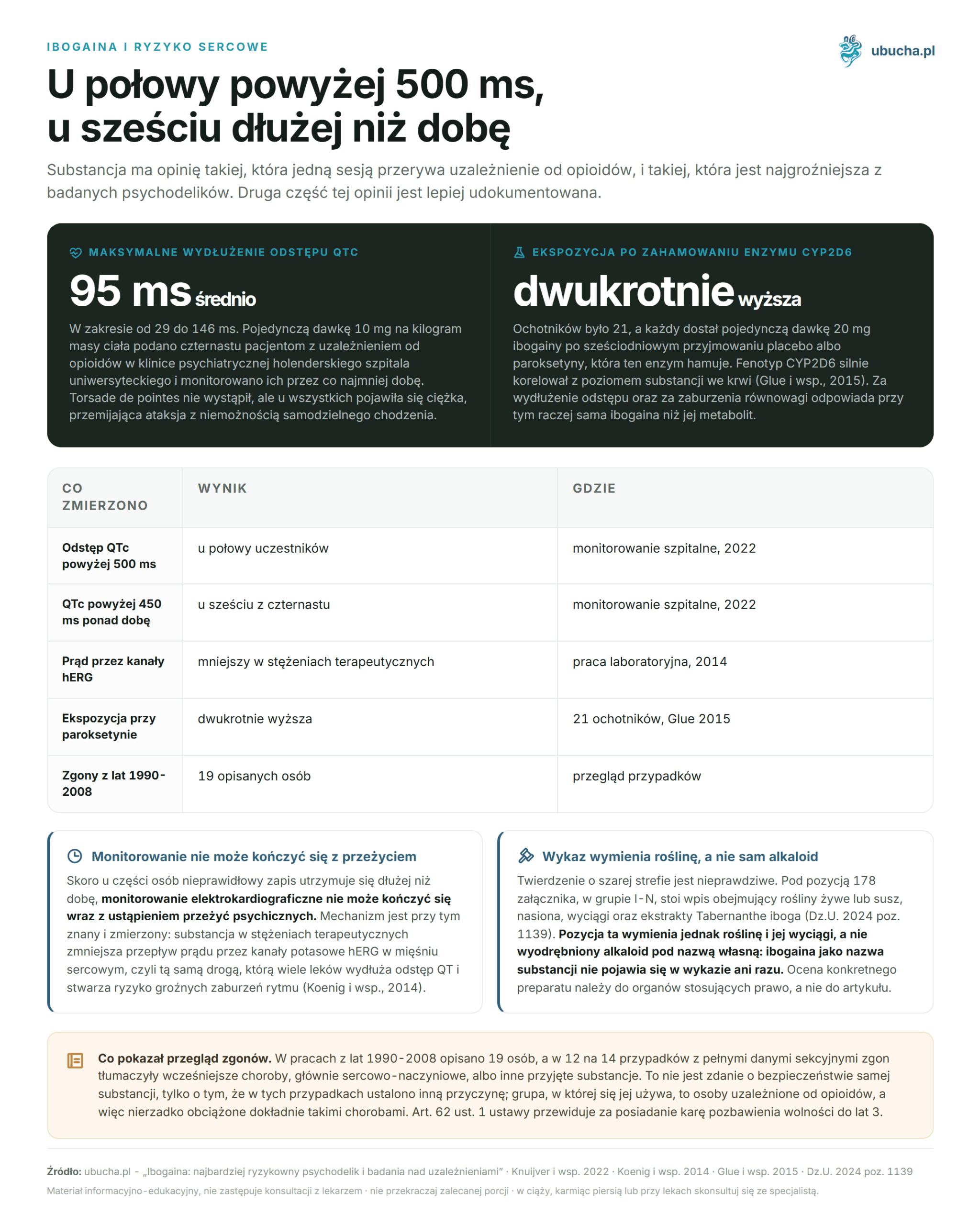
• In a hospital study of 14 people, half of the participants exceeded a QTc interval of 500 ms, and in six, the value above 450 ms persisted for more than a day (Knuijver et al., Addiction, 2022).
• The metabolism of ibogaine depends on the CYP2D6 enzyme, and its inhibition by paroxetine doubled the exposure to the active substance.
• A review of deaths from 1990-2008 described 19 people; in 12 of 14 cases with complete autopsy data, the deaths were explained by pre-existing diseases, mainly cardiovascular, or other substances taken.
What is ibogaine and how does it work?
Ibogaine is an indole alkaloid from the root of Tabernanthe iboga, a shrub growing in Central Africa, where it has been used for generations in initiation rituals of the Bwiti tradition. Pharmacologically, it is atypical because it acts simultaneously on several systems: it is an NMDA receptor antagonist and opioid receptors, as well as a serotonin and dopamine reuptake inhibitor. This multi-directionality explains both the interest of researchers and the complex profile of side effects.
In the liver, ibogaine is converted into noribogaine, a metabolite with its own biological activity. This transformation is mainly carried out by the CYP2D6 enzyme, which has direct practical significance (Glue et al., Journal of Clinical Pharmacology, 2015). In this study, 21 healthy volunteers received a single dose of 20 mg of ibogaine after six days of taking either placebo or paroxetine, which inhibits this enzyme. The exposure to the active substance was about twice as high in the group with paroxetine, and the CYP2D6 phenotype strongly correlated with the level of ibogaine in the blood.
A later study in patients confirmed this relationship and added an important finding for risk assessment: the prolongation of the QTc interval and balance disturbances are more likely due to ibogaine itself than noribogaine (Knuijver et al., Journal of Psychopharmacology, 2024).
What is the legal status of ibogaine in Poland?
The claim of a gray area is untrue. In the consolidated text of the regulation of the Minister of Health regarding the list of psychotropic substances, narcotic drugs, and new psychoactive substances, under item 178 of Annex 2, in group I-N, there is an entry “TABERNANTHE IBOGA - live plants or dried material, seeds, extracts, and concentrates” (Journal of Laws 2024 item 1139). The scope is therefore broad and includes plant material along with preparations obtained from it.
The consequences arise from the Act on Counteracting Drug Addiction (Journal of Laws 2023 item 1939). Art. 33 sec. 1 allows the use of narcotic substances of groups I-N and II-N only for medical, industrial purposes, or conducting research. Art. 62 sec. 1 provides for a penalty of up to 3 years of imprisonment for possession contrary to the provisions of the Act, while in the case of lesser importance, it is a fine, restriction of freedom, or imprisonment for up to one year. The question of importing a preparation purchased abroad is therefore not an open question: the item is subject to the same regulations, regardless of the place of purchase.
It is worth noting one thing that the list does not resolve. Item 178 mentions the plant and its extracts, not the isolated alkaloid by its own name; ibogaine as a substance name does not appear in the list even once. The assessment of a specific preparation belongs to the law enforcement authorities, not to the article. Ibogaine is also not a medicinal product authorized for marketing either in Poland or in the European Union. The contrast with ketamine is instructive: that substance is also listed, but in the group authorized for medical use, which we discuss in the text about ketamine therapy in Poland.
What is the cardiac risk of ibogaine?
The mechanism is known and measured. Ibogaine at therapeutic concentrations reduces the flow of current through hERG potassium channels in the heart muscle, and this is the pathway that many drugs use to prolong the QT interval and create the risk of dangerous arrhythmias (Koenig et al., Addiction Biology, 2014). This is laboratory work, so it describes the mechanism, not the frequency of events in humans.
However, measurements in humans are available and say more than any estimates. In a psychiatric clinic of a Dutch university hospital, 14 patients with opioid addiction were given a single dose of 10 mg per kilogram of body weight and monitored for at least a day. The maximum QTc prolongation averaged 95 ms, ranging from 29 to 146 ms. Half of the participants at some point during the observation exceeded 500 ms, and in six out of fourteen, the value above 450 ms persisted for more than a day after taking the substance. Torsades de pointes did not occur, but all experienced severe, transient ataxia with an inability to walk independently, and the authors also mention bradycardia (Knuijver et al., Addiction, 2022).
These numbers directly imply an organizational requirement. Since in some individuals the abnormal recording persists for more than a day, electrocardiographic monitoring cannot end with the cessation of psychological experiences. A center without continuous recording and without the ability to defibrillate has no means to respond to an event that this measurement describes as real.
Which medications and conditions increase this risk?
The table below summarizes risk factors resulting from the studies described above and from the review of deaths. The latter included all known cases outside Central-West Africa from 1990-2008: 19 people who died within one and a half to 76 hours after taking ibogaine (Alper et al., Journal of Forensic Sciences, 2012). A separate class, common to the entire family of these substances, are serotonergic interactions, which we describe in the text about contraindications and serotonin syndrome.
| Factor | What it involves | How we know |
|---|---|---|
| Cardiovascular diseases in history | In 12 of 14 deaths with complete autopsy data, death was explained by pre-existing diseases, mainly cardiovascular, or other substances taken | Review of 19 deaths, 1990-2008 |
| CYP2D6 inhibitors | Paroxetine doubled exposure to ibogaine and noribogaine in healthy volunteers | Placebo study, 21 people |
| Slow CYP2D6 metabolism | Enzyme phenotype strongly correlates with ibogaine concentration in the blood | The same work and patient study |
| Other QT prolonging drugs | Add to the prolongation that ibogaine itself gives on average by 95 ms | hERG mechanism plus measurement in 14 patients |
| Opioids | In the hospital study, patients were switched from substitution treatment to morphine sulfate before administration | Dutch study protocol |
| Withdrawal from alcohol and benzodiazepines | Seizures related to withdrawal were mentioned as a separate risk factor for death | Review of deaths |
| Plant preparations of unknown composition | Unconscious use of ethnopharmacological forms indicated as a risk factor | Review of deaths |
| Lack of continuous ECG recording | In six out of fourteen patients, QTc above 450 ms persisted for more than a day | Hospital study, 14 patients |
What does the Stanford study from 2024 really show?
The work published in Nature Medicine circulates on the internet as evidence of the effectiveness of ibogaine in addictions. It is not about that. The study involved 30 men, veterans of the United States Army Special Forces, mostly with mild traumatic brain injury, and the endpoint was a change in the World Health Organization disability scale (Cherian et al., Nature Medicine, 2024).
The circulating percentages also diverge from the work. After a month, the reduction in depression symptoms measured by the MADRS scale was 87 percent, and anxiety on the HAM-A scale was 81 percent. The effect sizes were large, but the study was a prospective observation without randomization and without a control group, which the authors themselves emphasize, stating that controlled studies are needed. A separate element often overlooked is the component from the very name of the protocol: participants received ibogaine together with magnesium precisely to limit the prolongation of the QT interval. With an average dose of 12.1 mg per kilogram, continuous five-lead ECG recording for 12 to 16 hours, and blood pressure measurements three times a day, no bradycardia, tachycardia, or significant QT prolongation were observed.
The reader has the right to know one more thing that is not visible in the summaries. The study was conducted at a facility of Ambio Life Sciences near Tijuana, Mexico, and three authors of the work are shareholders of this company; others are listed as creators of patent applications regarding the safety and applications of this protocol. This does not invalidate the result, but it belongs to its description.
What does the clinical trial registry contain?
An inquiry about ibogaine as a studied substance returns nine records (as of August 16, 2026). None of them have published results in the registry, none are phase 3 studies, and two were withdrawn before starting, including one planned as phase 2.
The widespread opinion that there are no randomized studies with a placebo group is inaccurate. Such a study has been conducted: a phase 1 and 2 trial with randomization, double-blinding, and a placebo arm, sponsored by a biotechnology company, involved 116 participants in the UK and ended in January 2024. A second randomized study with quadruple blinding, concerning methadone detoxification, ended in April 2024 and did not have a placebo arm, only a comparison of two dosing regimens. The problem is therefore not the lack of such trials, but the lack of announced results.
A twelve-month observation from New Zealand, described as evidence of the durability of the effect, involved 14 people, of whom a full set of interviews was completed by eight. Significant reductions in the severity of addiction and depression symptoms were noted, as well as withdrawal symptoms immediately after administration. In the same work, the authors noted that one patient included in the study died during treatment (Noller et al., American Journal of Drug and Alcohol Abuse, 2018). For comparison, the scale of studies on other substances from this family: the registry knows 298 studies on psilocybin and 125 on MDMA, which we discuss in the text about therapies using psychedelics.
Frequently Asked Questions
Is ibogaine legal in Poland?
It is not a freely available substance. Tabernanthe iboga, including live plants, dried material, seeds, extracts, and concentrates, is listed under item 178 of the list of narcotic substances of group I-N. Art. 33 sec. 1 of the Act on Counteracting Drug Addiction allows use only for medical, industrial purposes, or conducting research, and art. 62 sec. 1 provides for a penalty of up to 3 years of imprisonment for possession contrary to the provisions of the Act.
Why is ibogaine considered the most dangerous of the studied psychedelic substances?
Because it blocks hERG potassium channels in the heart and prolongs the QTc interval. In a study of 14 patients, the prolongation averaged 95 ms, half of the participants exceeded 500 ms, and in six, the value above 450 ms persisted for more than a day. A review of deaths from 1990-2008 describes 19 people who died within one and a half to 76 hours after ingestion.
How many people have died after ibogaine?
A systematic review of autopsy and toxicological records included 19 deaths outside Central-West Africa from 1990-2008. In 12 of the 14 cases with complete data, the deaths were explained by advanced comorbidities, mainly cardiovascular diseases, or other substances taken. There is no reliable denominator, so the death rates cannot be provided as a coefficient today.
Does ibogaine treat opioid addiction?
Data comes mainly from observations without a control group. A study from New Zealand involving 14 people showed a reduction in withdrawal symptoms and severity of addiction in a one-year observation, but one participant died during treatment. Completed randomized studies have not published results in the registry, so there is still no resolution.
Which medications are particularly dangerous with ibogaine?
Primarily medications that prolong the QT interval, as they add to the prolongation caused by ibogaine itself. A separate group includes drugs that inhibit the CYP2D6 enzyme: in a placebo study, paroxetine doubled the exposure to the active substance. The slow metabolism of this enzyme, genetically conditioned, also increases the concentration of ibogaine in the blood.
Is there a safer version of ibogaine?
Work on analogs with reduced risk of arrhythmia is ongoing, but this is a preclinical stage. The best-described compound from this group reduced the motivation to take heroin and alcohol in rats, and earlier work by this team involved mice (Heinsbroek et al., Psychedelic Medicine, 2023). There are no results in humans, and the registry does not contain a phase 3 study on ibogaine itself.
This article is for informational and educational purposes. It describes clinical studies in which the substance is administered under medical supervision after participant qualification; self-use of these conditions does not replicate. These substances are controlled in Poland under the Act on Counteracting Drug Addiction. If you have suicidal thoughts, call the free, 24-hour numbers 116 123 or 800 70 2222. In case of life-threatening situations: 112.
Author: Michał Waluk · Published: 2026-08-09 · Updated: 2026-08-16