
CBD and Adenosine: Why Inhibition of Reuptake Provides a Calming Effect
CBD inhibits the ENT1 adenosine transporter and enhances adenosine signaling. What exactly was measured, on which animals, and what is still unknown.
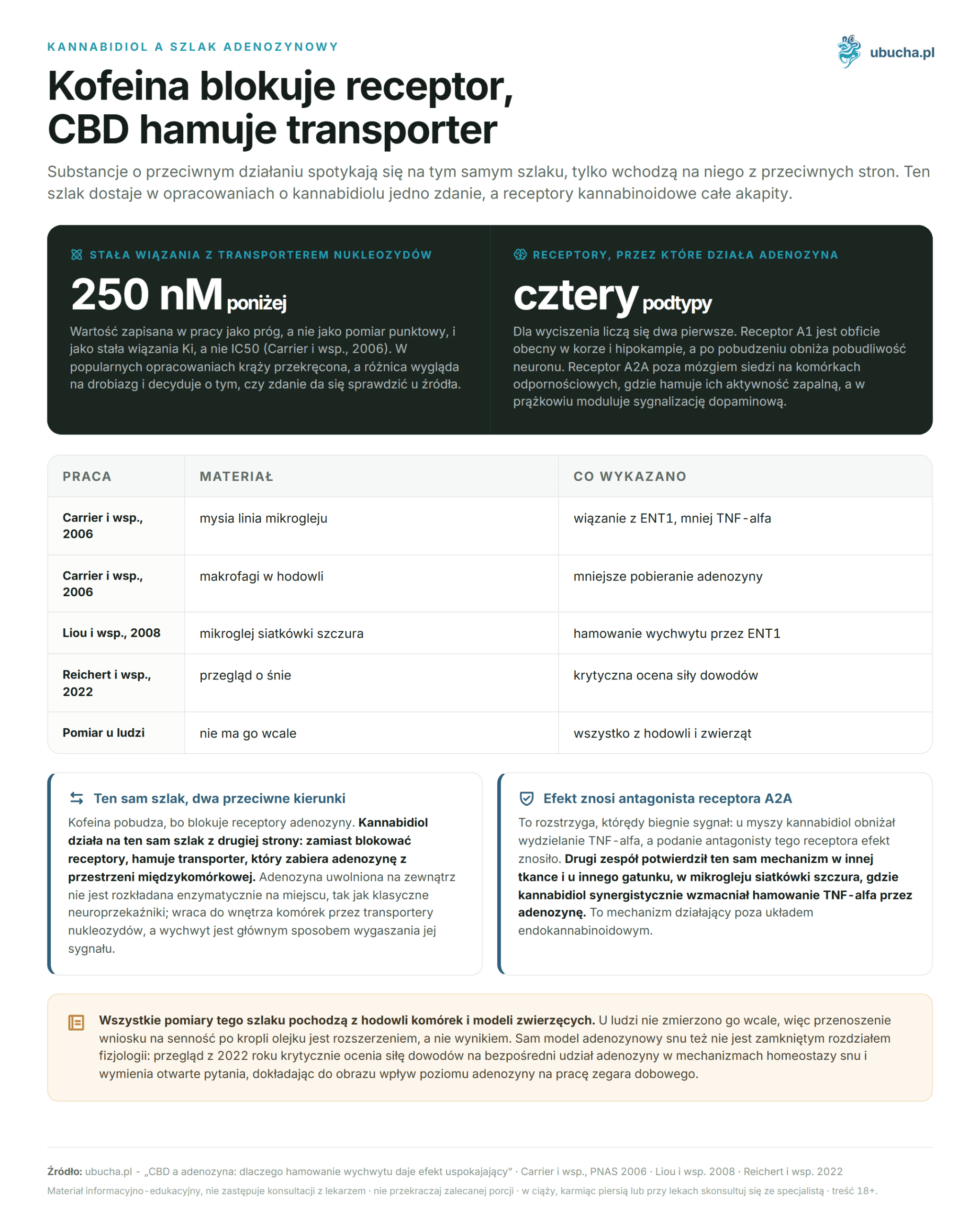
Caffeine stimulates by blocking adenosine receptors. CBD acts on the same pathway from the other side: instead of blocking receptors, it inhibits the transporter that takes adenosine from the intercellular space. Carrier’s team showed in 2006 that cannabidiol binds to the nucleoside transporter ENT1 and thereby enhances the body’s own adenosine signal. This mechanism operates outside the endocannabinoid system, explaining some of the effects of CBD that cannot be attributed to CB1 and CB2 receptors. Since that work, two independent teams have replicated this result in other tissues and species, yet the adenosine pathway still receives only one sentence in studies on cannabidiol, while cannabinoid receptors get entire paragraphs. Below, we break it down: what exactly was measured, on what material, and which popular conclusions go beyond what the studies have shown.
KEY INFORMATION
• CBD binds to the ENT1 transporter with a Ki value below 250 nM, and in mice reduces TNF-alpha secretion; the effect is abolished by the A2A receptor antagonist (Carrier et al., PNAS, 2006).
• Adenosine is a recognized endogenous sleep regulator, and caffeine acts as an antagonist of its receptors.
• The mechanism of CBD and caffeine goes in opposite directions on the same pathway.
• All measurements of this pathway for CBD come from cell cultures and animal models, not from humans.
What is adenosine and why does it cause drowsiness?
Adenosine is a nucleoside formed during the breakdown of ATP, the energy currency of the cell. The more intensely the tissue works, the more adenosine it releases. In the nervous system, this provides a simple fatigue counter: concentration increases throughout the day and pushes the brain towards sleep.
Adenosine acts through four receptors: A1, A2A, A2B, and A3. For calming, the first two are important. The A1 receptor is abundantly present in the cortex and hippocampus, and when activated, it reduces neuronal excitability. The A2A receptor, outside the brain, is found on immune cells, where it inhibits their inflammatory activity, and in the striatum, it modulates dopamine signaling.
Adenosine is now widely recognized as an endogenous substance regulating sleep, while caffeine is seen as an antagonist of the receptors on which adenosine acts. Newer studies add to this picture the influence of adenosine levels on the circadian clock, so alongside increasing fatigue, the time of day also plays a role (Reichert et al., Journal of Sleep Research, 2022).
It should be noted that Reichert’s review critically assesses the strength of evidence for the direct involvement of adenosine in sleep homeostasis mechanisms and lists open questions. This is not a closed chapter in physiology, but a well-documented yet still debated model.
How does CBD inhibit the ENT1 transporter?
Adenosine released into the extracellular space is not enzymatically broken down on site, as classical neurotransmitters are. It returns to the interior of cells through nucleoside transporters, and reuptake is the main way to extinguish its signal. The most important of these transporters is ENT1.
Carrier’s team studied the effect of THC and CBD on microglial proliferation. Both compounds reduced the uptake of labeled adenosine by a mouse microglial cell line and by RAW264.7 macrophages, with CBD being stronger in this regard than THC. Binding studies confirmed that cannabidiol binds to the ENT1 transporter with a Ki value below 250 nanomoles per liter (Carrier et al., PNAS, 2006).
It is worth noting this number exactly as it stands in the paper, as it has been misrepresented in popular summaries. This is a binding constant Ki, not IC50, and is given as a value below the threshold, not as a point measurement. The difference may seem trivial, but it determines whether the statement can be verified at the source.
A second team confirmed the same mechanism in another tissue and species. In the retinal microglia of rats, cannabidiol inhibited adenosine uptake via ENT1 and synergistically enhanced TNF-alpha inhibition by adenosine after lipopolysaccharide administration (Liou et al., Investigative Ophthalmology and Visual Science, 2008). Two independent models yield the same result, which is a stronger indication than a single study.
How does the action of CBD differ from caffeine?
Caffeine and CBD modulate the same signaling system in opposite directions. Caffeine blocks A1 and A2A receptors, so adenosine, although present, cannot act. CBD does not affect the receptors; it only hinders the removal of adenosine from the intercellular space, making its signal stronger.
This distinction has practical consequences. Receptor blockade operates independently of how much adenosine is present, as it closes the gate at the end of the pathway. Inhibition of reuptake, on the other hand, requires adenosine that can be retained: when its concentration is low, there is nothing to enhance. This leads to the assumption that the effect of CBD on this pathway depends on the time of day, although no one has measured this in humans.
A separate issue is tolerance. Reichert’s review directly questions whether the effect of caffeine on sleep is the same with a one-time drink and with daily consumption over years, treating it as an open question. The implications for daily coffee consumption are discussed in our text on caffeine tolerance.
| Feature | CBD | Caffeine |
|---|---|---|
| Point of action | ENT1 transporter | A1 and A2A receptors |
| What it does to adenosine | Hinders its uptake into cells | Prevents it from reaching receptors |
| Direction of effect | Enhances adenosine signaling | Extinguishes adenosine signaling |
| Dependence on baseline state | Needs present adenosine | Works independently of its concentration |
| Evidence material for this pathway | Cell cultures and animal models | Human studies, including on sleep |
Does adenosine explain the anti-inflammatory action of CBD?
Yes, and this is the best-documented part of this mechanism. Carrier’s work did not stop at cell culture: in mice with inflammation induced by lipopolysaccharide, a low dose of CBD reduced TNF-alpha production. The effect disappeared after administering the A2A receptor antagonist and did not occur at all in mice lacking this receptor.
This second result is stronger than the measurement of concentrations alone. If the removal of one receptor completely abolishes the anti-inflammatory effect of CBD in this model, it means that the signal goes precisely this way, not alongside it. The authors summarize that cannabidiol enhances adenosine signaling by inhibiting reuptake and that this is a mechanism independent of cannabinoid receptors.
A third team replicated this scheme in yet another model. In a mouse model of acute lung injury, a single dose of CBD reduced neutrophil influx and the production of TNF and IL-6, and a selective A2A receptor antagonist abolished all described anti-inflammatory effects (Ribeiro et al., European Journal of Pharmacology, 2012). Three teams, three tissues, the same point of attachment.
However, the boundary of this knowledge is clear. All three studies are animal models and cell cultures. None measure adenosine concentration in the human brain after CBD intake, so extrapolating the conclusion to humans remains speculative. More about the inflammatory pathway itself can be found in our text on the mechanism of CBD action in inflammatory states.
What does this mechanism mean for sleep?
For now, it means that there is a coherent hypothesis, not proof. Adenosine regulates sleep, CBD inhibits its reuptake in animal models, so enhancing the sleep signal seems logical. However, no one has verified this in humans with a measurement linking CBD intake to changes in adenosine tension and sleep parameters.
In popular discussions, there is a statement that rodents lacking the ENT1 transporter fall asleep faster and have longer slow-wave sleep phases. While preparing this text, we could not find a measurement that would show this; Carrier’s work, usually cited as a source, does not address sleep at all. Until such a study is indicated, we treat this statement as unverified.
However, a more cautious conclusion remains, which does not need to be stretched. Since reuptake inhibition requires adenosine present in the intercellular space, the effect of the same amount of CBD should depend on how much of it is there at the moment. In the morning, after a night, adenosine tension is low; in the evening, it is high. This explains why reports of CBD’s effect on drowsiness can be so divergent and suggests that the time of intake is a variable that is usually not controlled in these reports.
How important is the adenosine pathway compared to other CBD mechanisms?
It is not possible to rank CBD mechanisms once and for all, as their contribution depends on concentration and tissue. However, one can compare orders of magnitude. The binding constant of CBD with ENT1 below 250 nanomoles per liter places this target among the most sensitive described for cannabidiol, meaning it responds first at low concentrations.
Cannabidiol is a polypharmacological substance: it interacts with serotonin receptors, TRPV1 channels, endocannabinoid metabolism, and many other targets. None of these mechanisms alone explains the entire picture of action, and arranging them in a hierarchy without specifying concentration and tissue is usually an overinterpretation. We have separately reviewed the entire map in our text on how CBD works.
The value of the adenosine pathway lies in something other than priority. It is a well-documented route that does not pass through CB1 or CB2 receptors, thus explaining the effects of CBD that persist after their blockade. For researchers, this is an argument that cannabidiol does not act solely on the endocannabinoid system, and that is why Carrier’s work has been cited for twenty years.
Frequently Asked Questions
What is adenosine and how does it work in the nervous system?
Adenosine is a nucleoside formed during the breakdown of ATP. It accumulates in tissue during metabolic activity and stimulates A1 and A2A receptors, which reduce neuronal excitability. It is now widely recognized as an endogenous substance regulating sleep (Reichert et al., Journal of Sleep Research, 2022).
How does CBD inhibit adenosine reuptake?
Cannabidiol binds to the nucleoside transporter ENT1, which under normal conditions takes adenosine from the extracellular space into the cells. The binding constant is below 250 nanomoles per liter, and the measurement was made on a mouse microglial cell line and on macrophages (Carrier et al., PNAS, 2006).
Is this the same mechanism as with caffeine?
No, it is the opposite mechanism. Caffeine blocks A1 and A2A receptors, so adenosine cannot exert a calming effect. CBD does not affect the receptors, it only hinders the removal of adenosine from the intercellular space. Both substances act on the same pathway, but push it in opposite directions.
Is the anti-inflammatory effect of CBD really mediated by adenosine?
In animal models, yes. In mice with inflammation induced by lipopolysaccharide, a low dose of CBD reduced TNF-alpha, and the effect disappeared after blocking the A2A receptor and did not occur in mice lacking this receptor. This was repeated in a mouse lung injury model, where the A2A antagonist abolished all anti-inflammatory effects (Ribeiro et al., European Journal of Pharmacology, 2012).
Has it been proven that CBD improves sleep through adenosine?
No. Adenosine regulates sleep, and CBD inhibits its reuptake in animal models, so the connection seems coherent, but there is a lack of human measurements linking cannabidiol intake with changes in adenosine tension and sleep parameters. This is a mechanistic hypothesis, not a proven clinical effect.
Oils with cannabidiol mentioned in this text can be found in the oils category.
This article is for informational and educational purposes only and does not constitute medical advice. Before starting to use cannabis or CBD for therapeutic purposes, consult a doctor, especially if you are taking other medications, are pregnant, or breastfeeding.
Author: Michał Waluk · Published: 2026-08-09 · Updated: 2026-08-16