
Anandamide at Night, 2-AG During the Day: How ECS Regulates the Sleep-Wake Rhythm
Anandamide and 2-AG change concentration in a circadian rhythm. What measurements in humans have shown, how they differ from rodent data, and how sleep deprivation affects this.
The endocannabinoid system does not operate uniformly throughout the day. Its two main transmitters, anandamide and 2-arachidonoylglycerol, change concentration rhythmically and in opposite directions. The first measurements were taken in the brains of rats in 2004, but only studies on humans from the last decade have shown what this rhythm really looks like in humans: 2-AG has one clear peak in the afternoon, while anandamide has two, including one in the early phase of sleep (Hanlon, Psychoneuroendocrinology, 2020). Along the way to popular summaries, several claims have emerged that measurements do not support. This article shows what is known about the daily rhythm of ECS from studies on humans, where data from rodents end, and what is still unknown about the effects of CBD.
KEY INFORMATION
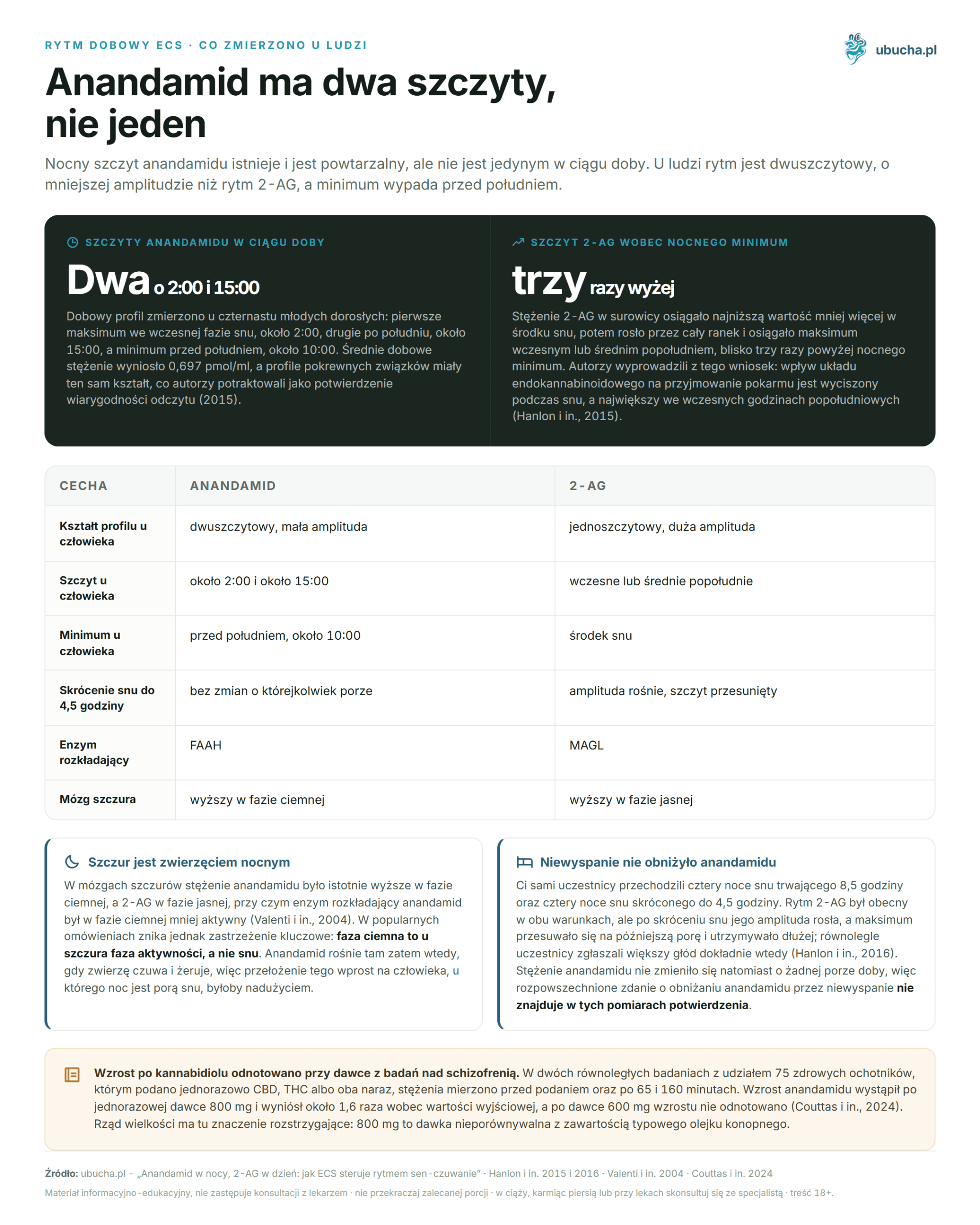
• In humans, 2-AG has a minimum in the middle of sleep and a peak in the early afternoon, nearly three times higher than the nighttime minimum (Hanlon et al., 2015).
• Anandamide in humans has a bimodal rhythm: around two at night and around three in the afternoon, with a minimum before noon.
• Reducing sleep to 4.5 hours strengthens the rhythm of 2-AG and increases appetite, but does not change anandamide levels.
• Data from rat brains come from a nocturnal animal, so its dark phase is an active phase, not sleep.
• An increase in anandamide after CBD was noted after a single dose of 800 mg, not after 600 mg.
How do we know that endocannabinoids have a circadian rhythm?
From measurements in rat brains. Valenti and colleagues measured the concentrations of anandamide (AEA) and 2-arachidonoylglycerol (2-AG) in four brain areas, comparing the light and dark phases of the day. Both compounds changed significantly, but in opposite directions.
In the nucleus accumbens, prefrontal cortex, striatum, and hippocampus, the concentration of anandamide was significantly higher in the dark phase, while the concentration of 2-AG was higher in the light phase. The authors also measured enzyme activity. Fatty acid amide hydrolase (FAAH), which breaks down anandamide, was significantly less active in the dark phase, explaining the increase in AEA there. The activity of the enzymes handling 2-AG changed significantly only in the striatum (Valenti et al., Cellular and Molecular Life Sciences, 2004).
A caveat is needed here, which usually disappears in popular discussions of this study. The rat is a nocturnal animal, so its dark phase is an active phase, not sleep. In rats, anandamide increases when the animal is awake and foraging. Directly translating this to humans, for whom night is a time for sleep, would be an abuse. The rhythm is real and well-measured, but its relationship to behavior needs to be verified separately in humans.
What does the rhythm of 2-AG look like in humans?
2-AG has a clear circadian rhythm in humans with a peak in the afternoon. Fourteen healthy, young participants spent four days under controlled conditions: a set light cycle, standardized meals, and a fixed sleep time. On the third day, blood was drawn for a full 24 hours.
The concentration of 2-AG in serum reached its lowest value roughly in the middle of sleep, that is, in the middle of the nighttime fast. It then rose throughout the morning and peaked in the early or mid-afternoon. The peak value was on average nearly three times higher than the nighttime minimum. A similar shape, though with a smaller amplitude, was observed for the related 2-oleoylglycerol (Hanlon et al., The Journal of Clinical Endocrinology and Metabolism, 2015).
The authors derived a conclusion regarding appetite: the influence of the endocannabinoid system on food intake is muted during sleep and greatest in the early afternoon hours. This finding pertains to humans, not rodents, and is based on measurements taken hourly over a full day, under conditions where light, meals, and sleep were controlled. Of all the material on the ECS rhythm, this is the best-supported fragment.
Does anandamide really only increase at night?
No. In humans, anandamide has a bimodal rhythm, not a unimodal one. The same research group measured the daily profile of AEA in fourteen young adults and found two maxima: the first in the early phase of sleep, around two at night, and the second in the afternoon, around three. The minimum occurred before noon.
The average daily concentration of anandamide was 0.697 pmol/ml. The profiles of related compounds, oleoylethanolamide and palmitoylethanolamide, had the same shape, which the authors treated as confirmation of the reliability of the reading. The conclusion of the study is clear: the rhythm of anandamide differs from the rhythm of 2-AG, has a smaller amplitude, and two peaks instead of one. Both transmitters are therefore subject to separate regulatory pathways, even though they act on the same receptors.
For the titular shorthand, this means that the nighttime peak of anandamide exists and is repeatable, but it is not the only one during the day. The phrase “anandamide at night” thus describes a real phenomenon, only it describes it partially. The authors add a practical note for researchers: when measuring endocannabinoids, the time of day must be controlled, otherwise the result depends on the time of blood collection more than on the variable being studied.
How do the rhythms of both endocannabinoids differ?
The following table organizes what has been measured separately in rodents and separately in humans. The rows intentionally separate both species, as in popular discussions this data is often merged into one picture, and they differ in both shape and interpretation. The most important discrepancy concerns the response to sleep deprivation: the two endocannabinoids behave differently then, even though they act on the same receptors. This difference is also the reason why measuring only one of them gives an incomplete picture.
| Feature | Anandamide (AEA) | 2-AG |
|---|---|---|
| Rat brain (Valenti 2004) | Higher in the dark phase, that is, in the active phase of the animal | Higher in the light phase, that is, in the resting phase of the animal |
| Profile shape in humans | Bimodal, small amplitude | Unimodal, large amplitude |
| Peak in humans | Around 2:00 and around 15:00 | Early or mid-afternoon |
| Minimum in humans | Before noon, around 10:00 | Middle of sleep |
| Amplitude in humans | Small | Peak nearly three times above minimum |
| Reducing sleep to 4.5 hours | No changes at any time of day | Amplitude increases, peak shifted and prolonged |
| Degrading enzyme | FAAH | MAGL |
| Change after a single CBD dose | Increase about 1.6 times after 800 mg, none after 600 mg | No increase reported |
What does sleep deprivation do to this rhythm?
Reducing sleep strengthens the rhythm of 2-AG instead of disrupting it. In a randomized crossover study, the same participants underwent four nights of normal sleep lasting 8.5 hours and four nights of sleep reduced to 4.5 hours. After each series, their daily profile of 2-AG was measured.
The rhythm was present in both conditions, but after sleep deprivation, its amplitude increased, and the maximum shifted to a later time and lasted longer. Concurrently, participants reported greater hunger and appetite exactly when the afternoon concentration of 2-AG was elevated, and they had more difficulty resisting tasty snacks (Hanlon et al., Sleep, 2016).
Anandamide behaved differently. Its concentration did not change after sleep deprivation at any time of day, nor did the concentrations of both related compounds. The authors conclude that both endocannabinoids are subject to separate regulatory mechanisms and that a physiological disturbance may affect one without impacting the other. The widespread belief that sleep deprivation lowers anandamide is not supported by these measurements.
Outside the brain, the picture is even more divided. Daily profiling in rats showed that endocannabinoids oscillate with a tissue-dependent phase in plasma and liver, while in the adrenal glands, their concentrations did not oscillate at all. However, the expression of receptor genes rhythmically changed, and shifting the feeding time to daytime altered some of them (Sládek et al., Biochimica et Biophysica Acta, 2019). The ECS rhythm is therefore not a single clock, but a set of local clocks.
Does CBD raise anandamide in the evening?
So far, there is no evidence for this at doses found in consumer products. This was directly tested in two parallel clinical studies involving 75 healthy volunteers who were given a single dose of CBD, THC, or both at once, and the concentrations of endocannabinoids in serum were measured before administration and after 65 and 160 minutes.
An increase in anandamide occurred after a single dose of 800 mg of CBD and was about 1.6 times the baseline value. No increase was noted after a dose of 600 mg. THC administered alone lowered anandamide levels, and the value returned to baseline after 160 minutes. The strongest increase was provided by the combination of both substances (Couttas et al., BMJ Mental Health, 2024). The order of magnitude is decisive here: 800 mg is a dose from schizophrenia studies, not comparable to the content of a typical hemp oil.
The clinical picture of cannabinoids’ effects on sleep remains ambiguous. A literature review summarized that CBD has potential for insomnia that is only preliminarily outlined, while THC shortens the time to fall asleep but may worsen sleep quality with prolonged use (Babson et al., Current Psychiatry Reports, 2017). We write more about this in the text about hemp and sleep.
Separately, there is the issue of safety. EFSA in its opinion from 2026 derived a provisional safe dose of 0.0275 mg per kilogram of body weight per day, or about 2 mg for a person weighing 70 kg, using an uncertainty factor of 400. This applies only to supplements with at least 98% purity CBD and without nanoparticles. The panel also stated that the safety of CBD cannot be established in individuals under 25 years of age, in pregnant and breastfeeding women, and in individuals taking medications (EFSA, EFSA Journal, 2026).
Frequently Asked Questions
Does anandamide increase at night?
Partially. In humans, anandamide has two daily peaks: one in the early phase of sleep, around two at night, and another in the afternoon, around three, with a minimum before noon. The nighttime increase is therefore real and repeatable, but it is not the only one during the day, and the amplitude of the entire rhythm is small.
When does 2-AG peak in humans?
In the early or mid-afternoon. The minimum occurs roughly in the middle of sleep, after which the concentration rises throughout the morning. The peak value is on average nearly three times higher than the nighttime minimum. Measurements were taken from fourteen healthy individuals under controlled light, meal, and sleep conditions.
Does sleep deprivation lower anandamide?
No. In a crossover study, reducing sleep to 4.5 hours did not change anandamide levels at any time of day. However, the rhythm of 2-AG changed: its amplitude increased, and the peak shifted to a later time and lasted longer, accompanied by increased hunger and difficulty resisting snacking.
Does CBD raise anandamide levels?
In a study of 75 healthy volunteers, an increase in anandamide, about 1.6 times, occurred after a single dose of 800 mg of CBD. No increase was noted after 600 mg. These are doses used in psychiatric studies, not comparable to the content of consumer products, so transferring this result to oil is not justified.
Why can’t results from rat studies be directly transferred?
Because the rat is a nocturnal animal, and its dark phase is an active phase, not sleep. Anandamide increased in rats when the animals were awake and foraging. Comparing this to the human night, which is a time for sleep, reverses the meaning of the observations. Therefore, interspecies data require separate confirmation in humans.
Can the timing of CBD intake be adjusted to the ECS rhythm?
There are no studies that have tested this. The circadian rhythm of endocannabinoids is documented, but no trial has compared different times of CBD administration in relation to sleep. However, the authors of the measurements recommend controlling the time of day in the studies themselves, as concentrations depend on the time of blood collection.
If you are looking for products in this category, you will find hemp oils in the u Bucha store.
This article is for informational and educational purposes only and does not constitute medical advice. Before starting to use cannabis or CBD for therapeutic purposes, consult a doctor, especially if you are taking other medications, are pregnant, or breastfeeding.
Author: Michał Waluk · Published: 2026-08-09 · Updated: 2026-08-16