
Cranberry for urinary tract: dosage and does it work (table)
What cranberry does to the risk of recurrent urinary tract infections. A meta-analysis from Archives of Internal Medicine, a year-long study by Stothers, and the truth about warfarin.
Cranberry is one of the few plant materials for which there are randomized studies on preventing urinary tract infections. However, there are many misunderstandings surrounding it: regarding the mechanism, how much one needs to drink, and the alleged interaction with anticoagulant medications. In this article, we summarize what individual studies actually measured and in which groups, where the scope of their conclusions ends, and in which situations cranberry will not help. We start with the mechanism, as it determines the answer to the question of when cranberry will help and when it is unlikely to work. The table below describes the studies, not the doses to be measured: the decision about supplementation in recurrent infections is made by the attending physician, who knows the history of recurrences and urine culture results.
KEY INFORMATION
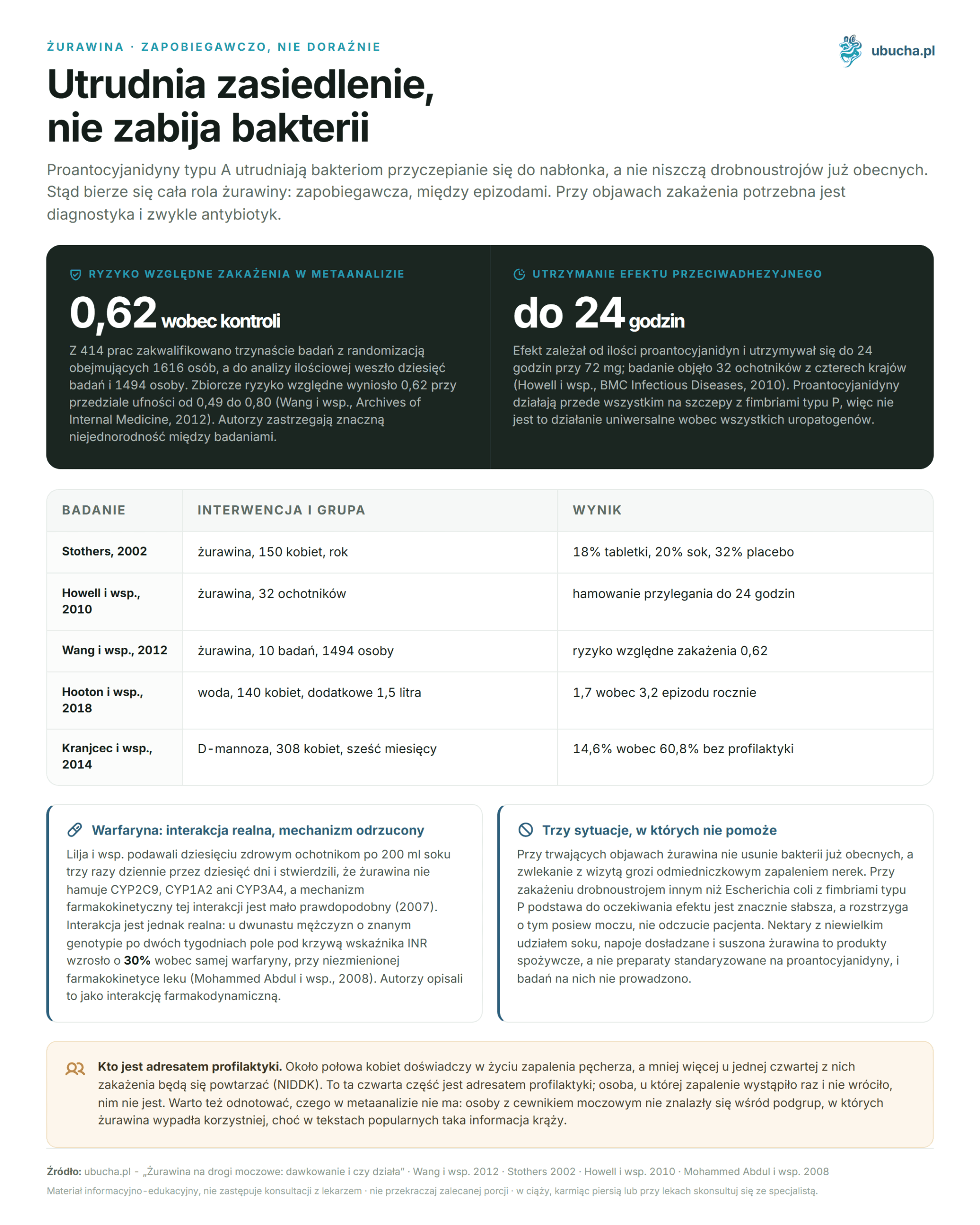
• A meta-analysis of ten randomized studies with 1494 participants showed a relative risk of infection of 0.62 for those using cranberry products compared to those not using them (Wang et al., Archives of Internal Medicine, 2012).
• In a year-long study of 150 women, symptomatic infection occurred in 20% of those drinking juice and 18% of those taking tablets compared to 32% in the placebo group (Stothers, The Canadian Journal of Urology, 2002).
• The active ingredients are type A proanthocyanidins, which hinder Escherichia coli bacteria from adhering to the epithelium; the effect lasted up to 24 hours with 72 mg of proanthocyanidins (Howell et al., BMC Infectious Diseases, 2010).
• Cranberry enhances the effect of warfarin, but not through liver enzymes: a study in healthy volunteers did not show inhibition of CYP2C9, CYP1A2, or CYP3A4.
• Cranberry acts preventively, not therapeutically. In case of infection symptoms, diagnostics and usually an antibiotic are needed.
How does cranberry affect the urinary tract?
For years, it was repeated that cranberry acidifies urine and thus discourages bacteria. Today, a different mechanism is accepted: type A proanthocyanidins make it difficult for bacteria to adhere to the urinary tract epithelium. A bacterium that cannot attach is washed out with urine before it can multiply.
This was measured by Howell et al. (BMC Infectious Diseases, 2010) in a randomized, double-blind, placebo-controlled study on 32 volunteers from Japan, Hungary, Spain, and France. The anti-adhesion activity of urine was assessed by two methods: the mannose-resistant hemagglutination test and the test on human T24 epithelial cell line. The urine of individuals taking cranberry powder significantly inhibited bacterial adhesion compared to urine after placebo. The effect depended on the amount of proanthocyanidins and lasted up to 24 hours with 72 mg. In a model on the nematode Caenorhabditis elegans, the strain of Escherichia coli grown in the urine of such individuals killed fewer worms, which the authors interpreted as a weakening of bacterial virulence.
Two clarifications are important here. Proanthocyanidins primarily act on strains with P-type fimbriae, so this is not a universal action against all uropathogens. And it is not a bactericidal action: cranberry hinders colonization, but does not kill bacteria already present. Hence its preventive role, which we will return to in further sections.
Does cranberry really reduce the risk of infections?
Yes, although the strength of the effect is moderate, and the quality of evidence is heterogeneous. The broadest review comes from Archives of Internal Medicine. Wang et al. (2012) searched three databases without language restrictions and from 414 works qualified thirteen randomized studies involving 1616 people; ten studies and 1494 people were included in the quantitative analysis.
The pooled relative risk of infection for those using cranberry products compared to those not using them was 0.62 with a confidence interval from 0.49 to 0.80. The subgroup analysis indicated where the effect was more pronounced: in women with recurrent infections, the relative risk was 0.53, in female populations 0.49, in children 0.33, in those drinking cranberry juice 0.47, and in those taking the product more than twice a day 0.58.
The authors accompanied these numbers with a clear caveat: there was significant heterogeneity between studies, so the result should be read with caution. It is also worth noting what is not included in this review. Individuals with urinary catheters were not among the subgroups where cranberry performed better, although such information circulates in popular texts. We noted that this is one of the more frequently repeated reinforcements of this result and has no backing in the source.
What did the year-long study with juice and tablets show?
The most practical data comes from a study that followed 150 women for a year and compared two forms of cranberry at once. The table below summarizes three works that form the core evidence described in this article.
| Study | Who and how many | What was given | Result |
|---|---|---|---|
| Stothers, 2002 | 150 sexually active women aged 21-72, observation for one year | Tablets twice a day or juice at 250 ml three times a day, compared to placebo | Symptomatic infection in 18% on tablets and 20% on juice compared to 32% on placebo |
| Howell et al., 2010 | 32 volunteers from four countries | Cranberry powder standardized for proanthocyanidins, compared to placebo | Inhibition of bacterial adhesion maintained for up to 24 hours with 72 mg of proanthocyanidins |
| Wang et al., 2012 | Review of 13 studies, 10 in meta-analysis, 1494 people | Various cranberry products compared to placebo and control | Relative risk of infection 0.62 |
The study Stothers (The Canadian Journal of Urology, 2002) deserves a separate mention, as it is sometimes cited with numbers that are not in it. Participants were randomly assigned for a year to three arms: placebo, cranberry tablets taken twice a day, and cranberry juice at 250 ml three times a day. Antibiotic use over the year was lower in both arms with cranberry than in the placebo group. The author also calculated costs and found that tablets were twice as cost-effective as juice, with an average annual cost of prevention of 624 dollars for tablets and 1400 dollars for juice, at prices from the time of the study.
Who is affected by recurrent urinary tract infections?
The scale of the problem explains why preventive methods other than antibiotics are being sought. Urinary tract infections are among the most common bacterial infections and predominantly affect women, due to the anatomy of the urethra.
The American NIDDK institute states that about half of women will experience bladder inflammation in their lifetime, and about one-fourth of them will have recurrent infections (NIDDK, National Institutes of Health). It is this one-fourth that is the target of prevention, as repeated courses of antibiotics carry their own costs: side effects and increasing bacterial resistance.
The meta-analysis described above aligns well with this. The most apparent benefit was noted precisely in the subgroup of women with recurrent infections and in female populations in general. An individual who has had a bladder infection once and it has not returned is not a candidate for continuous supplementation, and chronic use of anything without indication is not justified. We write more broadly about plant methods of supporting the urinary system in our post about natural support for kidneys and urinary tract.
When does cranberry not help?
The most important limitation arises directly from the mechanism. Cranberry makes it difficult for bacteria to adhere to the epithelium, so it works before an infection develops. When symptoms are ongoing, such as burning, frequent urges, and pain above the pubic symphysis, it will not remove bacteria already present. Delaying a doctor’s visit risks pyelonephritis, and in case of fever, the matter is urgent.
The second limitation concerns the type of bacteria. Proanthocyanidins have been described as a factor primarily inhibiting the adhesion of Escherichia coli strains with P fimbriae. In case of infection with another microorganism, the basis for expecting an effect is significantly weaker, and this is determined by urine culture, not the patient’s feeling.
The third limitation is practical and concerns the form of the preparation. Nectars with a small amount of juice, sweetened drinks, and dried cranberry are food products, not standardized preparations for proanthocyanidins, and studies have not been conducted on them. We noted that some disappointments with cranberry stem from this and from reaching for it only during an infection, which is when it cannot be expected to work.
What else reduces recurrences besides cranberry?
Cranberry is one element of prevention, not the entire strategy. Two other interventions have randomized studies behind them and are worth knowing, as both clearly reduced the number of recurrences compared to the control group.
Hydration was tested in a year-long study by Hooton et al. (JAMA Internal Medicine, 2018). It involved 140 premenopausal women with at least three episodes of bladder inflammation in the past year, who drank less than 1.5 liters of fluids daily. Half were instructed to drink an additional 1.5 liters of water daily for twelve months. The average number of episodes was 1.7 in the water group compared to 3.2 in the control group, and the average number of antibiotic courses was 1.9 and 3.6, respectively. The interval between episodes extended from an average of 84 to 143 days.
The second intervention is D-mannose. In a study by Kranjcec et al. (World Journal of Urology, 2014), 308 women after treatment for acute bladder inflammation were assigned for six months to three groups: D-mannose at 2 g daily, nitrofurantoin at 50 mg daily, or no prophylaxis. Recurrence occurred in 14.6% in the D-mannose group, 20.4% in the nitrofurantoin group, and 60.8% without prophylaxis. The difference between D-mannose and the antibiotic was not significant, and adverse effects in both active arms were mild. We dedicated a separate post to D-mannose for recurrent bladder inflammation.
Is cranberry safe and what can it interact with?
Cranberry is well tolerated, and the only well-documented interaction concerns warfarin. However, it requires clarification, as the commonly cited mechanism has been studied and rejected.
Lilja et al. (Clinical Pharmacology and Therapeutics, 2007) administered 200 ml of cranberry juice three times a day for ten days to ten healthy volunteers and then measured the fates of marker drugs for three liver enzymes. The juice did not increase the concentration or area under the curve of warfarin, tizanidine, and midazolam, and the authors stated that cranberry does not inhibit the activity of CYP2C9, CYP1A2, or CYP3A4 and that the pharmacokinetic mechanism of this interaction is unlikely.
However, the interaction is real, just of a different kind. Mohammed Abdul et al. (British Journal of Pharmacology, 2008) studied twelve healthy men with known CYP2C9 and VKORC1 genotypes in a crossover design. After two weeks of taking cranberry, the area under the curve of the INR index increased by 30% compared to warfarin alone, even though the pharmacokinetics of warfarin did not change. The authors described this as a pharmacodynamic interaction and recommended careful monitoring when using both preparations simultaneously. Therefore, a person taking warfarin should discuss cranberry with their attending physician, rather than rely on explanations through liver enzymes, which studies have not confirmed.
Frequently asked questions
Does cranberry cure bladder inflammation?
No. The proanthocyanidins in cranberry make it difficult for bacteria to adhere to the epithelium, but they do not kill microorganisms that are already present. In case of infection symptoms, a medical consultation is needed, and usually an antibiotic. The role of cranberry is preventive, between episodes, not immediate.
By how much does cranberry reduce the risk of infection?
In a meta-analysis of ten studies involving 1494 people, the relative risk was 0.62 for those using cranberry products (Wang et al., Archives of Internal Medicine, 2012). In the subgroup of women with recurrent infections, it was 0.53. The authors note significant heterogeneity among the included studies.
Does cranberry juice work the same as capsules?
In a year-long study by Stothers, symptomatic infection occurred in 20% of women drinking juice and 18% taking tablets, compared to 32% on placebo. Juice was given at 250 ml three times a day. The author calculated that tablets were twice as cost-effective as juice.
How long did the prevention last in the studies?
The Stothers study lasted twelve months, and the D-mannose study lasted six. The meta-analysis included studies of varying durations. The length of use for a specific person is determined by the doctor, who knows the history of recurrences and urine culture results.
Can cranberry be combined with warfarin?
This requires medical supervision. After two weeks of taking cranberry, the area under the curve of the INR index increased by 30% in healthy volunteers, with unchanged pharmacokinetics of warfarin (Mohammed Abdul et al., 2008). A separate study excluded a mechanism based on inhibiting liver enzymes.
You can find such products in the supplements category in our store.
This article is for informational and educational purposes and does not constitute medical advice. Before starting supplementation, consult your doctor, especially if you are taking medications regularly, are pregnant or breastfeeding, or have a chronic illness.
Author: Michał Waluk · Published: 2026-08-09 · Updated: 2026-08-11