
Increased Appetite After Marijuana - Where Does Gastrophagia Come From? Neurobiology, Therapy, Obesity Paradox
Neurobiology of gastrophagia: POMC neurons, smell, ghrelin, and insulin. What studies really say about appetite after THC and lower BMI in regular users.
Increased appetite after marijuana, known in Polish slang as gastrophagia, was for decades an anecdote every clinician knew but no one could explain. This changed in 2015 when a Yale team showed in Nature that THC does not turn off the satiety center in the hypothalamus but shifts it: the same neurons that normally inhibit eating start secreting a peptide that enhances it. Below we break down this mechanism, check what studies on ghrelin and leptin really measure, and show why regular cannabis users statistically have a lower obesity rate despite eating more in the short term. Along the way, we also point out numbers commonly repeated in popular descriptions of this phenomenon that have no basis in any study.
KEY INFORMATION
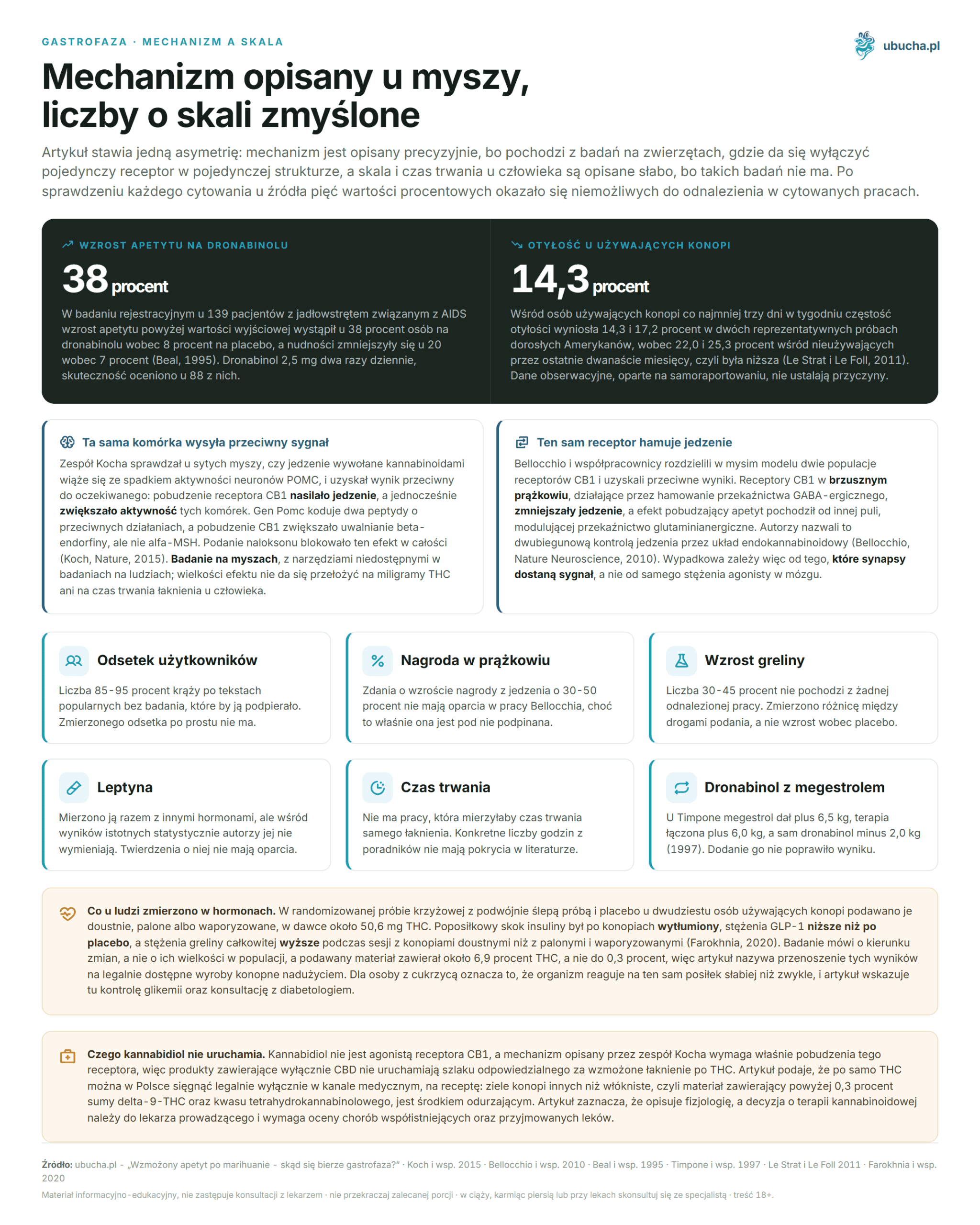
• THC activates hypothalamic POMC neurons and switches their secretion from alpha-MSH to beta-endorphin, and naloxone administration abolishes this effect (Koch et al., Nature, 2015).
• CB1 receptors also enhance eating through smell by weakening inhibition in the olfactory bulb (Soria-Gómez et al., 2014).
• Obesity affects 14.3 and 17.2 percent of people using cannabis at least three days a week versus 22.0 and 25.3 percent of non-users (Le Strat and Le Foll, 2011).
• The same CB1 receptor in the ventral striatum acts oppositely, inhibiting eating.
What is gastrophagia and how does it differ from ordinary hunger?
It is pharmacologically induced appetite appearing after THC consumption regardless of the body’s nutritional state. In the literature, it is described as cannabinoid-induced hyperphagia. It differs from physiological hunger in one thing: it does not signal an energy deficit. One can be full and still feel a strong need to eat.
Kirkham in a 2009 review describes this state by two phenomena at once. The first is a strong desire for specific food, the second is an intensification of its sensory and hedonic properties. In other words, not only do you want food more, but it also subjectively tastes better. The author links both to the physiological role of endocannabinoids in controlling food motivation.
The mechanism is not limited to one system, which is why the effect can be so hard to endure. THC acts simultaneously on the hypothalamus, the reward system in the striatum, the olfactory pathway, and peripherally on gastrointestinal hormones. Each of these pathways has been described by separate studies and each drives behavior in the same direction.
It is worth noting immediately what is not in this description. There is no measured percentage of people who experience gastrophagia. The figure “85-95 percent of users” circulates in popular texts without supporting studies, and we removed it from this article along with the unsupported footnote.
Source: Kirkham, International Review of Psychiatry 2009.
How does THC shift satiety neurons in the hypothalamus?
POMC neurons in the arcuate nucleus of the hypothalamus are the primary satiety center in mammals. Koch’s team tested whether cannabinoid-induced eating in satiated mice was associated with decreased activity of these neurons and found the opposite. CB1 receptor stimulation increased eating and simultaneously increased POMC cell activity.
The explanation lies in the fact that the Pomc gene encodes two peptides with opposite effects: alpha-MSH, which inhibits eating, and beta-endorphin, an opioid peptide that enhances it. CB1 stimulation increased beta-endorphin release in the hypothalamus but not alpha-MSH. The same cell thus sends the opposite signal instead of simply shutting down.
The authors built causal evidence from two sides. Silencing POMC neurons by DREADD reduced CB1-driven eating, and their activation enhanced it. Naloxone administration, an opioid receptor antagonist, systemically or directly into the hypothalamus, completely blocked the acute CB1 feeding effect.
The same study includes an energy-related aspect. The effect required mitochondrial adaptations and disappeared when they were blocked. A separate study by Bénard et al. showed why: CB1 receptors are also located in neuronal mitochondrial membranes, where they reduce cyclic AMP levels, protein kinase A activity, and cellular respiration.
It is worth noting what this study does not resolve. It was performed on mice using genetic and pharmacological tools unavailable in human studies, and the effect size cannot be translated into milligrams of THC or duration of appetite in humans. The mechanism is well described, but the scale in humans is much weaker.
Sources: Koch et al., Nature 2015 and Bénard et al., Nature Neuroscience 2012.
What does smell have to do with appetite after cannabis?
More than the common “everything smells better” suggests. Soria-Gómez and colleagues showed that CB1 receptors enhance eating in hungry mice precisely by improving odor detection, not only through feeding centers. Smell is the causal link in this mechanism, not a side effect.
The anatomy of this pathway is unusual. CB1 receptors are abundant on axon terminals of cortical glutamatergic neurons projecting back to the olfactory bulb, where they stimulate inhibitory granule cells. Cannabinoids weaken this descending excitation, so inhibition in the bulb decreases, and the odor signal passes stronger.
The authors confirmed this three ways simultaneously: pharmacological manipulation, genetic manipulation, and optogenetic stimulation of the same connection in a living animal. In each system, increased odor detection correlated with increased food intake. This is a rare example of closing the chain from receptor to behavior.
The broader conclusion the authors make goes beyond cannabis. Cortical feedback projections to the olfactory bulb link the body’s internal state with perception, meaning hunger literally sharpens the sense. THC taps into the existing hunger mechanism rather than creating a new one.
This leads to the simplest practical advice in the entire article, and one no one applies. Since the odor signal is the causal link, removing food smells from the environment weakens the stimulus at its source. A closed kitchen, hidden packaging, and ventilated room do more than a resolution not to reach for chips. The opposite applies to patients whose appetite is a therapeutic goal: there, the smell of a warm meal is part of the intervention.
Source: Soria-Gómez et al., Nature Neuroscience 2014.
Do CB1 receptors in the striatum definitely enhance eating?
Not always, and this is a finding popular gastrophagia descriptions reverse. Bellocchio and colleagues separated two CB1 receptor populations in a mouse model and obtained opposite results. CB1 receptors in the ventral striatum acting via inhibition of GABAergic transmission caused a hypophagic effect, reducing eating.
The appetite-stimulating effect came from another pool: CB1 receptors modulating excitatory glutamatergic transmission. The authors called this bipolar control of eating by the endocannabinoid system. The net effect thus depends on which synapses receive the signal, not on the agonist concentration in the brain.
This has a consequence worth remembering when reading guides. Statements like “THC increases food reward in the striatum by several tens of percent” have no basis in this study, which is most often cited for them. We removed the figure “30-50 percent” from this article because it does not appear in any cited source.
What remains is less flashy and more useful. The same receptor in two brain locations does two opposite things, and observed gastrophagia is the sum of these forces, not a simple stimulation of the pleasure center. That is why reactions vary so much between individuals and sessions.
Separately, we described how cannabidiol acts on the reward pathway and stimulus-induced hunger. Source: Bellocchio et al., Nature Neuroscience 2010.
What does THC do to ghrelin, insulin, and satiety hormones?
The best answer comes from a study where the same people received cannabis by three routes. Farokhnia and colleagues conducted a randomized, double-blind, placebo-controlled crossover trial with twenty cannabis users. In four sessions, cannabis was administered orally, smoked, vaporized, or placebo, at about 50.6 mg THC dose.
The clearest result concerned insulin. The insulin spike observed after placebo, triggered by eating a cookie during the session, was suppressed after cannabis administration. GLP-1 levels, a satiety hormone from the gut, were lower under cannabis than placebo. Both effects weaken the “enough” signal.
Ghrelin behaved differently than usually reported. It was not a simple increase versus placebo but a difference between administration routes: total ghrelin levels during oral cannabis sessions were higher than during smoked and vaporized sessions. The popular figure “ghrelin increase of 30-45 percent” does not come from any found study and was removed from this text.
Leptin deserves a separate mention because popular descriptions attribute much to it. It was measured alongside other hormones in this study, but the authors do not list it among statistically significant results. The claim that THC reduces hypothalamic leptin sensitivity in humans thus has no support in this study and is not present in this article version.
For a person with diabetes, this section has direct implications. Sudden consumption of large amounts of simple carbohydrates during hyperphagia phase combined with suppressed insulin response is a system requiring meal planning and glycemic control, not improvisation.
Two things about this study’s scope. It included twenty people, so it speaks to direction of changes, not their magnitude in the population. Cannabis contained about 6.9 percent THC, i.e., material from medical or research channels, not products with up to 0.3 percent content. Applying these results to legally available hemp products would be an abuse.
Source: Farokhnia et al., Translational Psychiatry 2020.
What role does the endocannabinoid system play in the gut?
The gut is the second place where this system controls eating, independently of the brain. Izzo and Sharkey in a 2010 review describe the endocannabinoid system as distributed throughout the gastrointestinal tract, with regional differentiation and organ-specific actions.
The list of functions it modulates is long: food intake, nausea and vomiting, gastric secretion, gastroprotection, motility, ion transport, visceral sensation, intestinal inflammation, and cell proliferation. Cellular targets include enteric nervous system neurons, epithelial cells, and immune cells.
It is worth noting that the list of molecular targets goes beyond cannabinoid receptors themselves. The authors list alongside them TRPV1 receptors, peroxisome proliferator-activated receptor alpha, and orphan receptors GPR55 and GPR119. This is why cannabis gut effects are hard to reduce to one receptor and one direction.
The practical consequence is that in some people with chronic gastrointestinal complaints, appetite improvement after cannabis may result not so much from hunger center stimulation but from reduced discomfort that previously hindered eating. These are two different mechanisms with a similar outward effect.
A newer review by DiPatrizio adds one thread linking gut and brain directly. The endocannabinoid system participates in fat intake controlled by the gut-brain axis, hunger signaling, maintaining intestinal barrier integrity, and dynamic interactions with microbiota. The author notes that precise neural and molecular mechanisms in individual tissues remain largely undescribed.
Sources: Izzo and Sharkey, Pharmacology and Therapeutics 2010 and DiPatrizio, Cannabis and Cannabinoid Research 2016.
What do doctors use appetite stimulation for?
For treating anorexia in wasting diseases, for over thirty years. Beal et al.’s registration study included 139 patients with AIDS-related anorexia and weight loss of at least 2.3 kg. Participants received dronabinol 2.5 mg twice daily or placebo, with efficacy assessed in 88 of them.
The results are concrete and worth reading carefully. Appetite increase above baseline occurred in 38 percent on dronabinol versus 8 percent on placebo. Nausea decreased in 20 versus 7 percent. Body weight in the active group remained stable, while in placebo it dropped by 0.4 kg on average, but this difference was not statistically significant.
The second area is psychological anorexia, where evidence is weaker and more cautious. Andries et al. conducted a crossover placebo-controlled study in 25 women with severe, long-term anorexia, administering dronabinol 2.5 mg twice daily for four weeks. Weight gain over placebo was 0.73 kg and significant, but eating disorder scale scores did not change.
The third area is cancer cachexia, where caution is needed with shortcuts. The 2011 international consensus defines it as a multifactorial syndrome involving progressive skeletal muscle loss not fully reversible by conventional nutritional support. Appetite stimulation is thus a supportive care element, not syndrome treatment, as abnormal metabolism also plays a role.
Sources: Beal et al., Journal of Pain and Symptom Management 1995, Andries et al., International Journal of Eating Disorders 2014, and Fearon et al., The Lancet Oncology 2011.
What exactly did dronabinol studies show?
Less than internet summaries suggest, and in one point the opposite. The table below compares three studies most often cited in gastrophagia texts with what was actually measured.
| Study | Regimen | Result |
|---|---|---|
| Beal 1995, n=139 | dronabinol 2.5 mg twice daily vs placebo | appetite increase in 38 vs 8 percent, stable body weight |
| Haney 2007, n=10 | dronabinol 5 and 10 mg vs marijuana 2.0 and 3.9 percent THC | both forms increased calorie intake and body weight dose-dependently |
| Timpone 1997, n=52 | dronabinol, megestrol, and both combined | megestrol plus 6.5 kg, combined therapy plus 6.0 kg, dronabinol alone minus 2.0 kg |
The third row requires comment, as the previous article version described it oppositely. Adding dronabinol to megestrol did not improve results: the megestrol-only group gained slightly more than the combined group, and the dronabinol-only group lost weight. For megestrol, but not dronabinol, pharmacokinetic parameters correlated with weight change and hunger ratings.
Haney’s study should be read carefully regarding size. It included ten HIV-positive marijuana-smoking individuals in two sixteen-day hospital stays. All cannabinoid conditions except the lowest dronabinol dose caused clear intoxication, rated as pleasant and without cognitive impairment. Sleep improved only with higher THC marijuana.
Sources: Haney et al., JAIDS 2007 and Timpone et al., AIDS Research and Human Retroviruses 1997.
Why do regular users have lower obesity rates?
Because short-term increased eating does not straightforwardly translate to body weight over years. Le Strat and Le Foll analyzed two representative population studies of adult Americans: NESARC 2001-2002 and NCS-R 2001-2003. Adjusted obesity prevalence was 22.0 and 25.3 percent among those not reporting cannabis use in the past twelve months.
Among those using cannabis at least three days a week, the same rates were 14.3 and 17.2 percent. The difference was not explained by tobacco smoking, and after adjusting for sex and age, cannabis use was associated with BMI differences in both samples. The authors cautiously conclude obesity prevalence is lower in cannabis users than non-users.
A second study adds a metabolic picture. Penner et al. analyzed data from 4657 adults in NHANES 2005-2010, including 579 current cannabis users. Current use was associated with 16 percent lower fasting insulin and 17 percent lower HOMA-IR insulin resistance index, as well as smaller waist circumference.
What these data do not say is equally important. These are observational self-report studies, so they do not establish causality. Penner et al. found no dose-dependence among current users, which would be expected if causal. Marijuana is thus not a weight control method but a variable co-occurring with it.
We develop the weight loss thread separately in the text about what studies say about cannabidiol and body weight. Sources: Le Strat and Le Foll, American Journal of Epidemiology 2011 and Penner et al., The American Journal of Medicine 2013.
Which beliefs about gastrophagia are false?
Four recur most often and each can be resolved by a study or lack thereof. The table below compares them with what is really known, without breaking each into a separate section.
| Belief | State of knowledge |
|---|---|
| Gastrophagia affects almost everyone | no study reports percentage; descriptions mention large variability between individuals |
| Cannabidiol also causes it | CBD is not a CB1 receptor agonist, so Koch’s mechanism does not apply |
| Gastrophagia leads to weight gain | in two large population samples, obesity was less common in cannabis users |
| Dronabinol does not produce full effect | it does: Haney showed it increased calorie intake and body weight comparably to smoked marijuana |
Separately, it is worth addressing duration. No study measures appetite duration itself, but data exist on administration route differences. In a controlled comparison by Newmeyer et al., significant heart rate increase occurred half an hour after smoking and vaporizing, and only after 1.5 and 3 hours after oral dose.
Hence a reasonable practical rule: inhalation acts faster and wears off faster, oral acts slower and longer. Specific hour numbers often cited in guides have no literature basis and are better not repeated.
The same pattern applies to a fifth, less often stated belief: that since the mechanism is described, the effect is predictable. It is not. Bellocchio’s work shows the net effect depends on which synapses receive the signal, and clinical dronabinol studies yield divergent results at similar doses. Individual variability is the rule, not the exception.
Source: Newmeyer et al., Drug and Alcohol Dependence 2017.
How to manage gastrophagia in practice?
Depending on whether you want to use or limit it. For a patient with cachexia, it is a desired effect and it is worth providing a meal under it. For someone avoiding caloric surplus, it is a side effect requiring environmental preparation, as decisions during the phase are made faster than reflection.
| Situation | What to do |
|---|---|
| Patient with anorexia or cachexia | meal prepared in advance, high-calorie and easy to eat, given during peak appetite window |
| Person monitoring calorie balance | meal before session, hydration, processed foods out of reach |
| Patient with diabetes | glycemic control, quick glucose source at hand, low glycemic index meals |
| Person with eating disorder | decision only with treating physician, as effect can be bidirectional |
One note on the diabetes row. Farokhnia’s study showed suppression of insulin response to meals under cannabis, so the problem is not just eating a larger portion but that the body reacts less than usual. This argues for measurement, not estimation by feel.
It is also worth planning the eating itself, not just limiting it. Decisions during increased appetite phase are quick and fall on what is closest, so a prepared meal wins over a resolution made during. For a patient, this means ready portions in the fridge; for someone monitoring calories, the opposite: an empty counter and foods requiring effort to get.
For those wanting cannabis effects without appetite stimulation, the decisive factor is cannabinoid choice, not dose. Differences between cannabinoids are described in the comparison THC and THCV.
When can you legally access THC in Poland?
Only in the medical channel, by prescription. Cannabis other than fiber hemp, i.e., material containing above 0.3 percent total delta-9-THC and tetrahydrocannabinolic acid, is a psychoactive substance. Outside the provisions of the Act on Counteracting Drug Addiction, its possession and trade remain prohibited.
The 0.3 percent threshold is calculated as the sum of delta-9-THC and THCA, rounded to one decimal place, and refers to dry mass of flower or fruiting tops from which resin has not been removed. Material below this value is fiber hemp, traded outside the psychoactive substance regime.
Cannabidiol is not listed in any controlled substance schedules, so CBD products are not subject to this regime. However, this does not mean they cause gastrophagia: they are not CB1 receptor agonists, and Koch’s mechanism requires such stimulation. This distinction is practically important for anyone seeking relaxation without ravenous appetite.
It is also worth noting that this article describes physiology and does not encourage use of psychoactive substances outside medical indications. The decision on cannabinoid therapy belongs to the treating physician and requires assessment of comorbidities and medications.
Legal basis: Act of July 29, 2005 on Counteracting Drug Addiction, consolidated text Dz.U. 2023 item 1939, art. 4 points 5 and 37 as amended by the Act of March 24, 2022 (Dz.U. 2022 item 763).
Summary: what this means for the reader
Gastrophagia has a well-documented neurobiological basis and is not folklore. CB1 receptor stimulation shifts POMC neurons from satiety to hunger signaling, sharpens smell via the olfactory bulb, and changes hormonal response to meals. Three independent pathways, three independent studies, consistent direction.
At the same time, the same receptor in the ventral striatum inhibits eating, and regular cannabis users have lower obesity prevalence in large population samples than non-users. The picture is thus not simple, and any text reducing it to one mechanism omits something.
The biggest change in this article version is in numbers. This text had no study identifiers, and links led to journal homepages, not studies. After checking each citation at the source, five percentage values proved impossible to find in cited works, one study did not exist in Europe PMC, epidemiological data were misattributed, and one result was described opposite to the original.
Practically, two things remain. First, if you use THC for medical reasons, appetite stimulation is an intended therapy element and it is worth providing a prepared meal. Second, if you want cannabis effects without this, cannabinoid choice matters, as cannabidiol does not activate the mechanism responsible for gastrophagia.
Regarding the phenomenon itself, remember one asymmetry. The mechanism is precisely described because it comes from animal studies where a single receptor in a single structure can be disabled. The scale and duration in humans are poorly described because such studies simply do not exist. That is why gastrophagia texts sound definitive about mechanisms but numbers are often fabricated.
Frequently Asked Questions
What exactly is gastrophagia?
It is the appetite caused by THC appearing regardless of nutritional status, described in the literature as cannabinoid-induced hyperphagia. Kirkham characterizes it by two phenomena at once: a strong desire to eat and an intensification of its sensory and hedonic properties. It is not metabolic hunger, as it does not signal an energy deficit.
How does THC cause increased appetite?
Through CB1 receptors in several places at once. In the hypothalamus, CB1 stimulation increases the activity of POMC neurons and switches their secretion from alpha-MSH to beta-endorphin, and naloxone administration abolishes this effect. Simultaneously, CB1 receptors weaken inhibition in the olfactory bulb, making food odors detected more efficiently.
Does cannabidiol cause gastrophagia?
No. Cannabidiol is not a CB1 receptor agonist, and the mechanism described by Koch’s team requires stimulation of this receptor. Products containing only CBD therefore do not activate the pathway responsible for increased appetite after THC. Cannabidiol is also not listed in controlled substance schedules.
Does gastrophagia lead to weight gain?
Population data say otherwise. Le Strat and Le Foll showed in two representative samples of adult Americans that obesity affected 14.3 and 17.2 percent of people using cannabis at least three days a week versus 22.0 and 25.3 percent of non-users. These are observational data and do not determine causality.
How long does gastrophagia last?
There is no study measuring the duration of appetite itself. However, the difference between administration routes is known: in a controlled comparison by Newmeyer, heart rate increase occurred half an hour after smoking and vaporizing, and only after 1.5 and 3 hours after oral dose. The inhalation route acts faster and shorter.
Does THC raise ghrelin levels?
A 2020 study by Farokhnia’s team showed that total ghrelin concentrations were higher during oral cannabis sessions than during smoked and vaporized cannabis sessions. In the same study, cannabis suppressed postprandial insulin spikes and lowered GLP-1 levels. The popular figure of a 30-45 percent increase does not come from any found study.
When is appetite stimulation therapeutically beneficial?
In wasting diseases. In Beal’s study of 139 patients with AIDS-related anorexia, dronabinol at 2.5 mg twice daily increased appetite in 38 percent of subjects versus 8 percent on placebo. In severe, long-term anorexia, Andries observed a weight gain of 0.73 kg over placebo within four weeks.
Should diabetics be cautious about gastrophagia?
Yes, for two reasons at once. The first is sudden consumption of a large amount of carbohydrates during increased appetite phase. The second comes from Farokhnia’s study: cannabis suppressed postprandial insulin spikes, so the body responds to the same meal less than usual. Glycemic control and consultation with a diabetologist are necessary.
Products that act on the endocannabinoid system without stimulating appetite are collected in the hemp oils category.
This article is informational and educational and does not constitute medical advice. Before starting cannabis or CBD for therapeutic purposes, consult a doctor, especially if you take other medications, are pregnant, or breastfeeding.
Author: Michał Waluk · Published: 2026-05-06 · Updated: 2026-08-10