
How to Properly Store Marijuana and CBD Flower? A Practical Product Guide
Oils, flower, gummies, creams, and tinctures with CBD require different conditions. Temperature, humidity, packaging, and real expiration dates after opening.
Your CBD oil smells different three months after opening than on the day of purchase. The flower in a plastic bag crumbles in your fingers, and the gummies have stuck together into a lump after a week on the windowsill. This is not bad luck; it’s chemistry. Fairbairn et al. stored solutions of pure cannabinoids and eleven samples of cannabis and resin for two years under various conditions and found that the single factor responsible for the greatest losses was light, not heat (Fairbairn et al., 1976). Each form of cannabis product has its own set of requirements: different packaging, different humidity, different expiration dates after opening. This guide collects them in one place and shows how to recognize when a product is only fit for disposal.
KEY INFORMATION
• Light is more harmful than heat: in a two-year storage study, exposure to light caused the greatest cannabinoid losses, while temperatures up to 20°C proved insignificant (Fairbairn et al., 1976).
• Oils: dark glass bottle, upright position, 15-21°C, use within 6-12 months of opening.
• Flower: glass jar with a packet maintaining 58-62% relative humidity, dark cupboard.
• Food products after opening go into the fridge, cosmetics never into the bathroom.
• Everything out of reach of children and pets, in clearly labeled packaging.
How to store each type of CBD product in short?
Keep oils in a dark glass bottle standing upright, at 15-21°C, and use within 6-12 months of opening. Store flower in a glass jar with a packet maintaining 58-62% relative humidity. Food products after opening go into the fridge, cosmetics outside the bathroom, and alcohol tinctures last the longest.
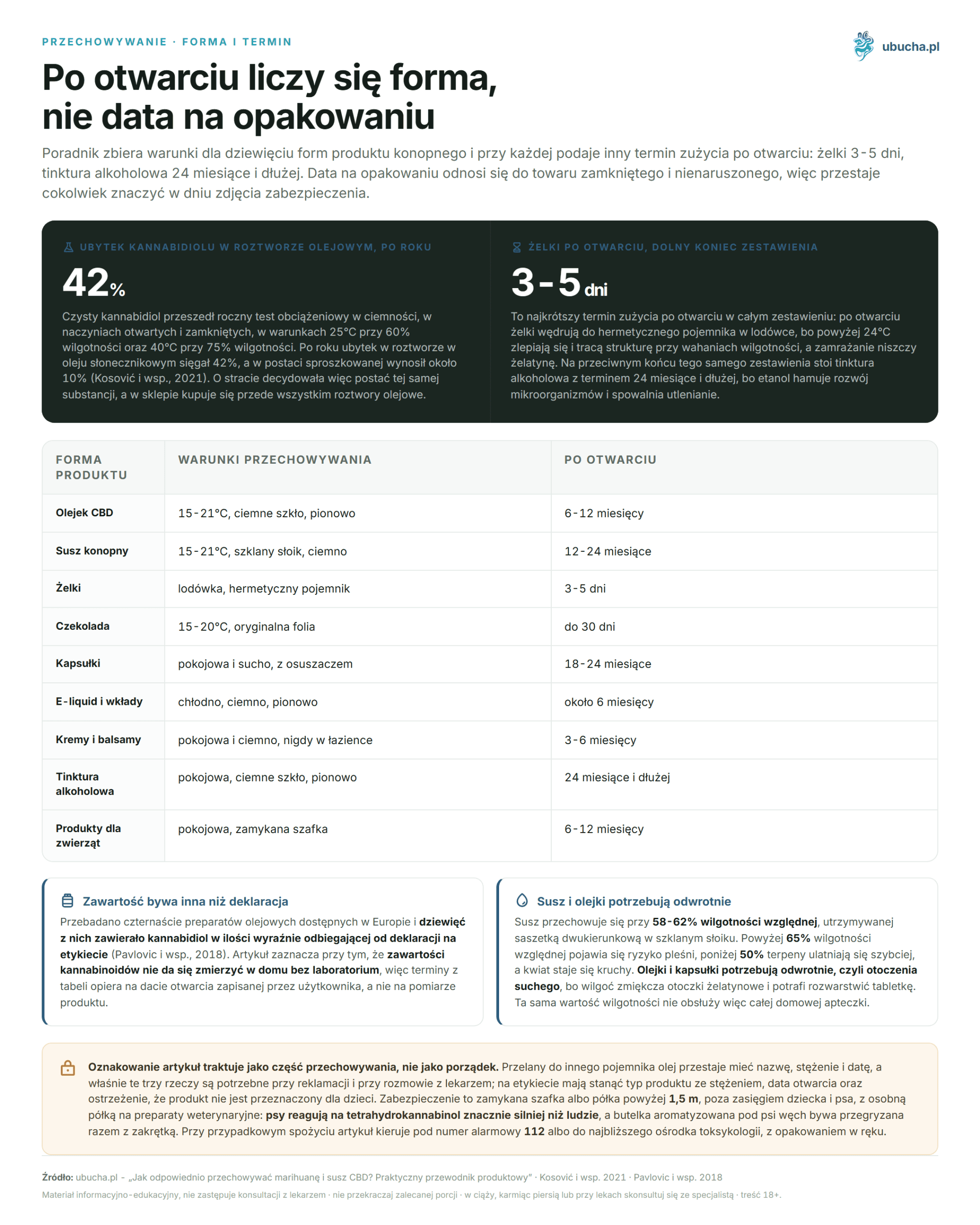
The table below summarizes the conditions for nine forms that most often end up in the home medicine cabinet. The given dates refer to products that have already been opened. The date on the packaging refers to the sealed and intact goods, so it ceases to mean anything on the day you remove the seal.
| Product Type | Temperature | Packaging | After Opening | Note |
|---|---|---|---|---|
| CBD Oil | 15-21°C | dark glass, upright | 6-12 months | fridge optional |
| Hemp Flower | 15-21°C | glass jar, dark | 12-24 months | packet 58-62% RH |
| Gummies | fridge after opening | airtight container | 3-5 days | warning label |
| Chocolate | 15-20°C | original foil | up to 30 days | stable temperature |
| Capsules | room temperature, dry | original with desiccant | 18-24 months | away from steam |
| E-liquid and Cartridges | cool, dark | upright, original | about 6 months | mouthpiece up |
| Creams and Balms | room temperature, dark | original jar | 3-6 months | never in the bathroom |
| Alcohol Tincture | room temperature | dark glass, upright | 24 months or longer | most durable form |
| Pet Products | room temperature | locked cupboard | 6-12 months | separate shelf |
Each of these forms enters the body differently and is dosed differently. If you are just choosing what to reach for, we have gathered the differences between methods in a separate guide on methods of consuming cannabis and CBD.
Why do storage conditions change the potency of the product?
Because cannabinoids degrade under the influence of light, oxygen, and heat, and the product then loses the content declared on the label. Fairbairn et al. stored samples for up to two years and found that exposure to diffuse light, not direct sunlight, caused the greatest single losses, most strongly in solutions.
This same work brings two conclusions that change home practice. First, the impact of temperatures up to 20°C was insignificant, so cooling cannot replace darkness. Second, oxidation in contact with air already caused noticeable losses, and the loss of THC after exposure to light did not translate into an increase in cannabinol content; this increase only appeared with oxidation in the dark. The authors summarized that carefully prepared flower, resin, or extract remains in reasonable condition for one to two years if kept in darkness at room temperature.
The carrier also matters. Kosović et al. subjected pure cannabidiol to a year-long stress test at 25°C with 60% humidity and 40°C with 75% humidity, in open and closed vessels, in darkness. The powdered form proved significantly more durable than the same compound dissolved in sunflower oil: after a year, the loss in the oil solution reached 42%, while in powder it was about 10% (Kosović et al., 2021). Since you primarily buy oil solutions in the store, they require the most attention from you.
Which four factors destroy cannabis products?
Light, oxygen, temperature, humidity. In that order, because light is the most damaging. Citti et al., studying hemp seed oil, described the degradation of acidic forms of cannabinoids as a process occurring under the influence of light, air, and heat, and based on this assessed the durability of oil under various storage conditions (Citti et al., 2018). Each of the four factors acts differently on different forms of the product.
- Light breaks chemical bonds of cannabinoids. Solutions in clear bottles and flower sitting on an open shelf suffer the most. Manufacturers package oil in amber or cobalt glass because such glass blocks a significant portion of ultraviolet radiation. The home version of this protection is simple: a closed cupboard instead of a countertop.
- Oxygen oxidizes both cannabinoids and the carrier oil. Each opening of the bottle adds a fresh dose of air, which is why an open product ages faster than a sealed one with the same production date. For the same reason, it pays to buy smaller packages if you use the product infrequently.
- Temperature accelerates all these reactions. Above 25°C, the rate of degradation noticeably increases, and daily fluctuations additionally work on the exchange of air and moisture in the container. A windowsill, shelf above the stove, and bathroom cupboard usually combine two problems at once: heat and humidity fluctuations.
- Humidity determines the fate of the flower. Above 65% relative humidity, there is a risk of mold, below 50% terpenes evaporate faster, and the flower becomes brittle. Oils and capsules need the opposite, i.e., a dry environment. The same applies to baked goods, where moisture triggers mold faster than oxidation.
How to store CBD oils so they do not lose potency?
In the original dark bottle, standing upright, at 15-21°C, away from windows and heaters. After opening, plan to use it within 6-12 months. A bottle lying on its side constantly touches the rubber bulb of the dropper, which accelerates its consumption and risks leakage, while also increasing the surface area of the oil in contact with air.
Do not pour the oil into plastic or clear glass. Plastic allows light to pass through, and when heated, it can release its own technological additives into the contents. If you must change the packaging, choose a dark glass bottle with an airtight dropper and label it with the date of opening.
The fridge is not a necessity, just a way to extend shelf life in an apartment that exceeds 25°C in summer. The downside is the thickening of the oil and condensation of vapor with each opening of a cold bottle in a warm room. A reasonable compromise looks like this: a supply in the fridge, a bottle used daily in the bedroom drawer. MCT oil-based oils tolerate this better than oils based on hemp seed oil, which is rich in polyunsaturated fatty acids that go rancid faster.
Another reason not to keep oil for years: its content can be different from what is declared. Pavlovic et al. tested fourteen oil products available in Europe and found that nine of them contained cannabidiol in amounts significantly different from what was declared on the label (Pavlovic et al., 2018). A detailed guide on oils can be found in the post about where to best store CBD oil.
How to store hemp flower and CBD buds?
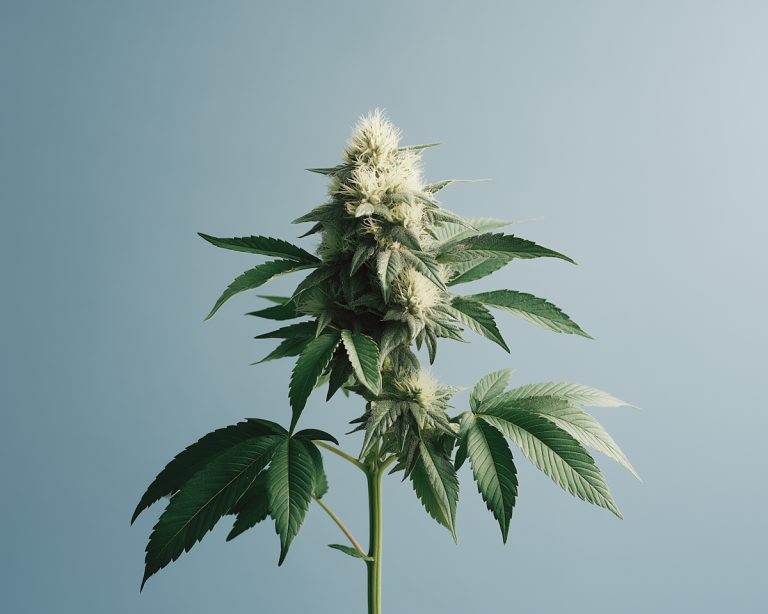
In an airtight glass jar with a two-way packet maintaining 58-62% relative humidity, in a dark cupboard with a stable temperature of 15-21°C. In such conditions, the flower retains its aroma and structure for many months. Darkness does more here than cooling, which confirms Fairbairn’s conclusion about the one or two-year stability of material kept in darkness at room temperature.
A ziplock bag is convenient but bad. Plastic electrifies and attracts glandular hairs, which is the part of the flower where most resin sits; they settle on the walls instead of remaining on the plant. Plastic also exchanges gases with the environment, so its tightness is mechanical, not chemical. Glass is inert, does not absorb terpenes, and does not react with resin.
The packet is chosen according to the target humidity. The 62% variant is default for flower with typical humidity, while the 58% variant works for more resinous material. One packet serves a jar up to 28 g; a larger container needs them proportionally more. Replace the packet when it hardens, usually after 2-4 months. Open the jar only when you really reach for the contents, as each opening releases volatile aromatic compounds and lets fresh oxygen in.
How to store gummies, chocolates, and baked goods with CBD?
In an airtight package, at room temperature until opened, and after opening usually in the fridge. Food products with cannabis spoil just like their non-cannabis counterparts, so they are subject to the same hygiene rules, plus one additional: they must be distinguishable from regular sweets.
- Gummies stick together above 24°C and lose structure with humidity fluctuations. After opening, transfer them to an airtight container in the fridge and use within 3-5 days. Freezing destroys the gelatin.
- Chocolate at 15-20°C lasts for months in its original foil. In the fridge, keep it in a closed container to avoid absorbing odors. A white coating is usually a fat or sugar bloom from temperature fluctuations, not mold.
- Baked goods quickly lose moisture. An airtight container in the fridge, use within 5-7 days. Freezing is possible, but thawed dough has a different texture.
A home rule that solves the most problems at once: every food product with cannabis transferred from its original packaging gets a label with the name, content, and a warning that it is not intended for children. Gummies look like candy, and a cookie looks like a cookie.
How to store capsules, e-liquids, and vaporizer cartridges?
Keep capsules and tablets in the original container with a desiccant packet, in a dry place, at room temperature. Moisture softens gelatin capsules and can cause the tablet to separate, so open the container briefly and close it immediately, and do not throw away the packets until the end of the treatment.
A weekly pill organizer is convenient but not suitable for long-term storage: it allows light in and does not control humidity. Transfer a portion for seven days into it, leaving the rest in the factory packaging.
Store e-liquids cool, dark, and upright. The upright position is not aesthetics but a safeguard against leakage: the dropper thread is rarely fully sealed when laid on its side. After opening, expect about six months of usability, after which the color changes and the aroma fades. Set disposable cartridges and pods with the mouthpiece up, as lying down causes the oil to flow into the nozzle and clog the cartridge. More about the liquids themselves and their safety can be found in the post about how to choose CBD liquid for e-cigarettes.
Two additional rules apply during transport. Place the liquid bottle in a ziplock bag, as one drop of leakage can ruin the contents of a bag with electronics. Do not leave the cartridge or vaporizer in the car during summer: plastic heats up within minutes to a temperature at which the oil thins and begins to leak through seals. In winter, the reverse mechanism works, though less dangerously: cooled liquid thickens and the heater draws it poorly, so the first puff after coming out of the cold can be empty.
How to store creams, balms, and alcohol tinctures?
Keep cannabis cosmetics at room temperature, in a dark and dry place, outside the bathroom. Typical shelf life after opening is 3-6 months for formulations containing water and up to 12-18 months for anhydrous products, i.e., butters and balms based on wax and oils.
The bathroom is the worst possible place for cannabis cosmetics. Steam from the shower condenses in the jar with every bath, and moisture in the emulsion creates an environment for bacteria and fungi. Keep the jar in the bedroom, taking a portion to the bathroom as needed. Signs that the formulation has broken down: separation of oil and water phases, darkening, sour or rancid smell, clumps, or sudden wateriness. Each of these indicates the end of the product’s life, even before the date on the packaging.
Alcohol tinctures are the easiest in this regard. Ethanol inhibits the growth of microorganisms and slows oxidation, so a product in a dark bottle with a dropper, standing upright at room temperature, lasts two years or longer without refrigeration. After a year, the alcoholic sharpness slightly decreases, but this is a change in taste, not potency. If you smell vinegar or rancid fat, you probably have an oil product mistakenly labeled as a tincture.
How to store CBD products for animals?
In the original packaging with a clear label, in a locked cupboard, out of reach of the animal itself. Veterinary oils may be flavored for a dog’s or cat’s sense of smell, so the bottle smells like food to the dog and may be chewed along with the cap.
A dog that swallows the contents of an entire bottle takes a dose many times higher than the daily dose, and dogs react to tetrahydrocannabinol much more strongly than humans. This is a sufficient reason for veterinary products to have their own shelf, preferably with a latch, and a label distinguishing them from human products. Treats retain freshness for about four to six weeks in an airtight container after opening; keep them high, as the dog will smell the packaging faster than you can hide it.
The physical conditions are the same as for human products: dark, dry, stable room temperature, bottle upright. The difference is only in security and description. The label should clearly state for which species and for what body weight the product was purchased, as the dose for a cat and for a shepherd dog are two different sizes, and the bottles look identical.
If you give veterinary oil daily, write the date of opening on the bottle, just like with your own product. The animal will not tell you that the taste has changed, and refusal to take the oil can be the first signal that the carrier oil has gone rancid. Rancid oil is not toxic, but it discourages the animal so effectively that further supplementation becomes pointless.
How to tell if a CBD product has spoiled?
By color, smell, taste, and consistency, with each form giving a different set of symptoms. The common rule is simple: if the product looks, smells, or tastes different than on the day of purchase, stop using it, regardless of the date on the packaging. The table below summarizes symptoms that are visible without any equipment.
| Form | Visual Symptom | Smell Symptom | What to Do |
|---|---|---|---|
| Oil | dark brown color, sediment that does not disappear after shaking | smell of old cooking oil | discard |
| Flower | brown color, crumbling in fingers or stickiness | lack of varietal aroma, mustiness | discard |
| Moldy Flower | white, gray, or blue-green coating, fibrous structures | smell of a damp basement | discard, do not vaporize |
| Gummies | hardening, sugar crystallization, color change | sour smell | assess, discard if moldy |
| Chocolate | white fat or sugar bloom | no changes | usually edible |
| Cream | phase separation, darkening, clumps | sour or rancid smell | discard |
One distinction is worth remembering, as it frequently appears in questions. A white coating on chocolate is usually a fat or sugar bloom from temperature fluctuations, and the product remains edible. A white coating on flower is almost always mold, and no processing can save it, including vaporization.
How to label CBD products and secure them from children?
With a label containing three pieces of information and a locked cupboard. Labeling is a matter of safety, not order: oil poured into another container loses its name, concentration, and date, and these three things are needed for complaints and discussions with a doctor. The simplest solution is a white self-adhesive label and a waterproof marker.
On the label, write the type of product along with the concentration, the date of opening, and a warning that the product is not intended for children. Taking a photo of the original label on your phone takes a second and replaces the batch number when the packaging gets damaged.
- Locked cupboard or shelf above 1.5 m, out of reach of children and dogs.
- Latch securing the doors, especially where food products are stored.
- Caps requiring simultaneous pressure and rotation, if the manufacturer uses them.
- Separate shelf for veterinary products to avoid confusing them with human ones.
- Conversation with household members, including teenagers: these are not vitamins or candies.
In case of accidental ingestion, call emergency number 112 or the nearest toxicology center and take the packaging with you. The staff needs to know exactly what was eaten and in what quantity.
How does storage affect aroma and terpenes?
Terpenes are the most volatile part of the cannabis profile, so they are the first to leave before the cannabinoid content drops. They are responsible for why one strain smells citrusy and another spicy. When they disappear, the flower still burns and vaporizes, but it loses its character.
The loss of terpenes is driven by the same three conditions that spoil cannabinoids: heat, contact with air, and frequent opening of the container. Hence, the practical conclusion is the opposite of intuition. It is not about cooling the product, but about limiting air exchange and keeping it in darkness. A two-way packet helps doubly, as it stabilizes humidity and maintains a local concentration of volatile compounds around the material.
The loss of aroma is also the earliest warning signal you get for free. You cannot measure cannabinoid content at home without a lab, but your nose detects the flattening of the scent profile long before the color or structure of the flower changes. Flower that smells like hay instead of a strain after opening the jar has already gone through a significant part of the process that Fairbairn described as oxidation.
In oils and cosmetics, the same mechanism manifests differently. There, the first to go is the smell of the carrier, not the plant: fresh hemp seed oil smells nutty and grassy, while rancid oil resembles old cooking oil. This change precedes the bitter aftertaste, so it pays to smell the bottle before measuring out a dose.
If you are interested in what happens to the acidic forms of cannabinoids under the influence of temperature, we described it separately in the post about decarboxylation of marijuana.
What does Polish law say about storing cannabis and CBD?
It does not regulate it at all. The regulations specify what can be sold and grown, while home storage conditions are left to the user. However, it matters whether the product falls within the definition of industrial hemp, as this determines its status.
Industrial hemp refers to plants in which the sum of delta-9-THC and tetrahydrocannabinolic acid (THCA) in flowering or fruiting tops does not exceed 0.3% when calculated on a dry weight basis, and the result is rounded to one decimal place. The basis is Article 4 point 5 of the Act of July 29, 2005 on Counteracting Drug Addiction (consolidated text Journal of Laws 2023, item 1939) as amended by the Act of March 24, 2022 (Journal of Laws 2022, item 763), effective from May 7, 2022. The threshold is calculated as the sum of the two compounds, not just delta-9-THC, which changes the result of laboratory testing.
The national threshold corresponds to the EU threshold introduced by Regulation (EU) 2021/2115, applicable from January 1, 2023, but it does not derive from it. These are two separate regulations with the same numerical value. Cannabidiol itself does not appear in the lists of controlled substances. Hexahydrocannabinol (HHC) is listed and remains a controlled substance. Food products with cannabis are additionally subject to food law, including regulations on novel foods.
Frequently Asked Questions
Should CBD oil be kept in the fridge?
No, it doesn’t have to. The fridge extends shelf life, especially in summer in an apartment without air conditioning, but a dark cupboard with a stable temperature of 15-21°C is sufficient.
How long can CBD oil be used after opening?
Typically from 6 to 12 months. MCT oil-based products are more durable than those made with hemp seed oil, which is rich in polyunsaturated fatty acids.
Can hemp flower be frozen?
It’s not a good idea. At negative temperatures, glandular hairs become brittle and fall off the flower with the slightest touch, and upon thawing, moisture condenses, promoting mold.
What to do if CBD gummies have stuck together into one lump?
If there is no visible mold and the expiration date has not passed, they are still safe, although harder to dose.
Is it allowed to pour CBD oil into another bottle?
Yes, provided it is dark glass with an airtight dropper. Do not use plastic, clear glass, or a bottle from another product, as residues of fat accelerate rancidity.
Is the white coating on CBD chocolate mold?
Usually not. It is a fat or sugar bloom, which is a result of temperature fluctuations, and the bar remains edible, although it loses appearance and some aroma.
How to recognize mold on hemp flower?
By a white, gray, or blue-green coating and fibrous structures between the flowers, accompanied by the smell of a damp basement.
Can CBD products for animals be given to humans?
Better not. Veterinary products may be flavored for a dog’s or cat’s sense of smell and have carriers suited to the animal’s metabolism.
Containers, jars, and humidity-regulating packets can be found in the storage accessories category.
This article is for informational and educational purposes only and does not constitute medical advice. Before starting to use cannabis or CBD for therapeutic purposes, consult a doctor, especially if you are taking other medications, are pregnant, or breastfeeding.
Author: Michał Waluk · Published: 2026-05-11 · Updated: 2026-08-10