
Effects of Smoking Marijuana Daily: What Research Says
Daily means 20 days per month for a year. Which effects have strong evidence, which are myths, what is known about women, and where to find help.
Daily means in studies at least 20 days per month for over a year, and with this pattern three effects have the strongest evidence: chronic bronchitis, psychosis in genetically susceptible individuals, and low birth weight in newborns. Marijuana smoked daily for years leaves a mark on several organ systems, but the scale depends on four factors: age of initiation, frequency, THC content, and method of administration. The 2017 report by the National Academies of Sciences, Engineering, and Medicine, the broadest contemporary review, assigns decisive or significant evidence status only to some effects. Chronic bronchitis yes. Psychosis in genetically susceptible individuals yes. Low birth weight in newborns of users yes. The rest fall into moderate or limited evidence categories. This article organizes what is known today about neurological, psychiatric, cardiovascular, respiratory, and hormonal consequences of chronic use, where science ends and journalism begins, and where to find help for addiction in Poland.
KEY INFORMATION
- Among adults who used marijuana in the past year, nearly 3 in 10 met criteria for cannabis use disorder (Hasin et al., JAMA Psychiatry, 2015).
- In the US adult population, prevalence of cannabis use disorder per DSM-5 is 2.5% annually and 6.3% lifetime (Hasin et al., Am J Psychiatry, 2016).
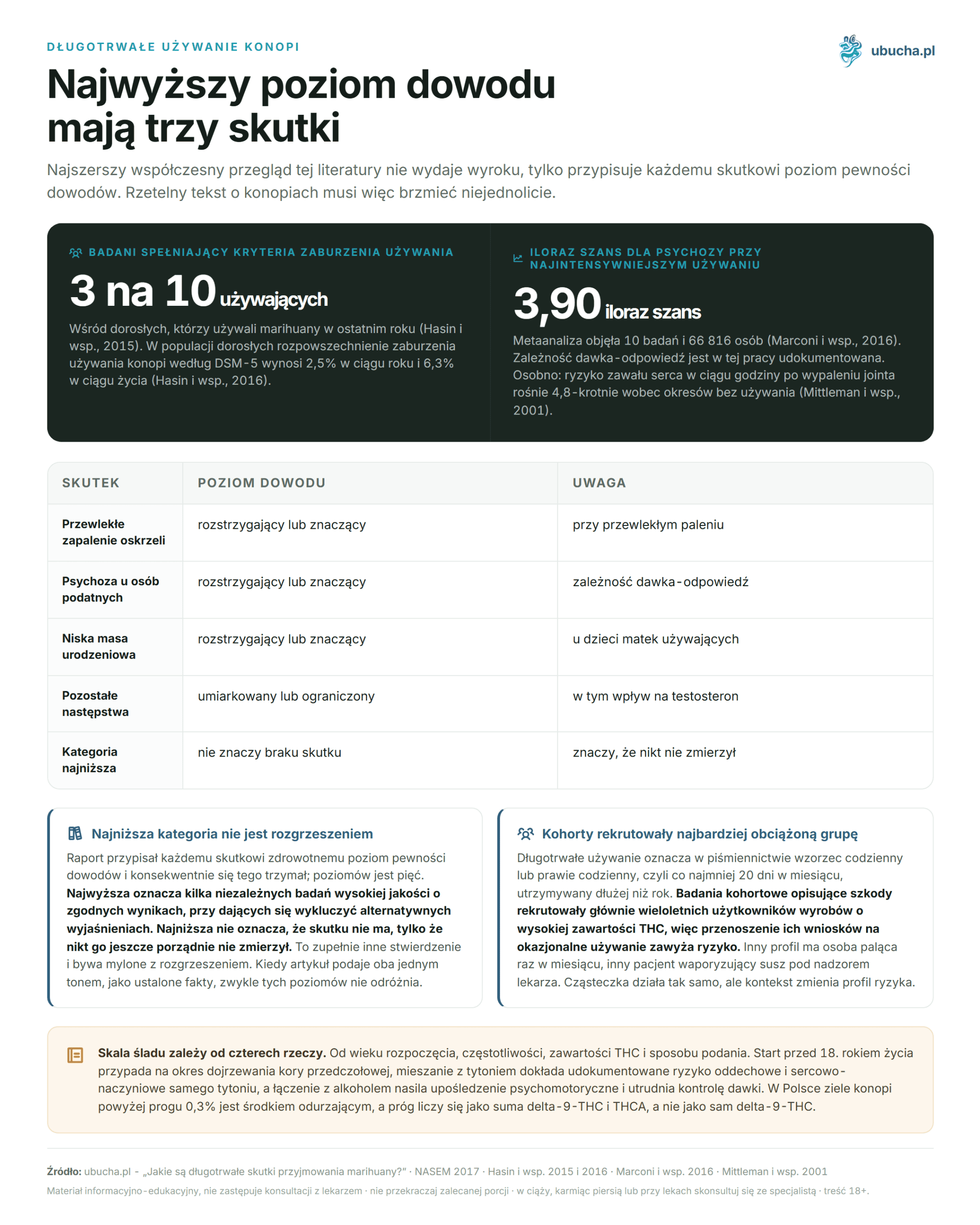
- Among the heaviest users, odds ratio for psychosis is 3.90 compared to non-users; meta-analysis included 10 studies and 66,816 people (Marconi et al., 2016).
- Within an hour after smoking a joint, heart attack risk increases 4.8-fold compared to non-use periods (Mittleman et al., Circulation, 2001).
- In Poland, cannabis herb above 0.3% threshold is a narcotic, and the threshold counts as the sum of delta-9-THC and THCA, not delta-9-THC alone (Dz.U. 2023 poz. 1939).
What does “long-term” marijuana use mean scientifically?
In epidemiological literature, long-term use means a daily or almost daily pattern, i.e., at least 20 days per month, maintained for more than a year. This operational threshold separates occasional recreational use from a pattern for which measurable health harms have been described. Almost everything you read below refers to this latter group.
The distinction is not trivial. The risk profile differs for someone smoking a joint once a month, a patient vaporizing medical herb under doctor supervision, and a long-term user of high-potency concentrates. Cohort studies describing harms mainly recruited the third group, so applying their conclusions to occasional use overestimates risk.
The patterns most burdensome in literature can be summarized in one list.
| Pattern | Why it increases risk |
|---|---|
| Daily smoking for over a year | Cumulative exposure on which all cohorts describing harms are based |
| High-THC strains and concentrates | Dose-response relationship for psychosis documented in Marconi 2016 meta-analysis |
| Start before age 18 | Exposure during adolescent prefrontal cortex maturation, effect fixed in Dunedin cohort |
| Mixing with tobacco | Adds documented respiratory and cardiovascular risks of tobacco itself |
| Combining with alcohol | Enhances psychomotor impairment and complicates dose control |
The medical pattern assumes known dose, defined indication, medical monitoring, and usually shorter time horizon. The recreational pattern in chronic users is lack of titration, self-selection of strains, and years of unsupervised exposure. The molecule acts the same, but context changes risk profile.
How to read scientific evidence on marijuana effects?
Statements like “studies prove” or “science does not confirm” are useless here because they blur the difference between strong evidence and suggestion. The 2017 National Academies of Sciences, Engineering, and Medicine report solved this differently than a typical review: instead of issuing verdicts, it assigned each health effect a level of evidence certainty and consistently adhered to it.
There are five levels, from decisive and significant, through moderate and limited, to no or insufficient evidence. The highest category means several independent high-quality studies with consistent results and reasonable exclusion of alternative explanations. The lowest does not mean no effect; it means no one has properly measured it yet, which is a very different statement and often confused with exoneration.
This gradation explains why a reliable text on marijuana must sound uneven. The link between chronic smoking and bronchitis symptoms stands at a different evidence level than effects on testosterone. When an article presents both in the same tone as established facts, it usually fails to distinguish these levels or deliberately blurs them. In the following sections, each effect includes indication of its evidence base and where the strength ends.
How does long-term marijuana use affect memory and cognitive functions?
Chronic marijuana use is associated with poorer performance in working memory, attention, and executive function tests. The review by Crean et al. (2011) describes deficits in planning, organization, problem-solving, and decision-making, with severity depending on amount, recency, age of initiation, and duration. The same review notes a practical consequence: people with executive dysfunction learn skills needed to quit less well, increasing relapse risk.
The brain matures until about age 25, with the prefrontal cortex, responsible for impulse control and planning, finishing last. THC exposure during intense neuroplasticity acts on a different substrate than in adults. Thus, cognitive effects in adolescents differ from those starting after their twenties.
The most cited evidence for persistence is the Dunedin study, published by Meier et al. in PNAS 2012. A cohort of 1,037 New Zealanders was followed from birth to age 38, with neuropsychological tests at 13 (pre-initiation) and repeated two decades later. Chronic use was linked to declines in multiple domains, even after adjusting for years of education, concentrated in those who started as teens. In this group, cessation did not fully restore baseline levels.
The result sparked methodological debate. Reanalysis by Rogeberg (PNAS, 2013) suggested part of the effect might be socioeconomic status, and later twin cohorts did not fully replicate it. The practical takeaway remains: starting before 18 is inadvisable. For what translates into permanent neuron damage and what does not, see a separate text on whether marijuana kills brain cells.
Does long-term marijuana smoking increase heart attack risk?
Yes, at least in the short window after inhalation and mainly in people with coronary disease. The study by Mittleman et al. (Circulation, 2001) included 3,882 post-myocardial infarction patients and compared reported marijuana use in the hour before symptoms with expected frequency. Heart attack risk was elevated 4.8-fold in this window, with confidence interval 2.4 to 9.5, and quickly returned to baseline. Authors call marijuana smoking a rare but real trigger.
The mechanism is well described. THC stimulates CB1 receptors in the peripheral nervous system, increasing sympathetic tone, heart rate, and altering blood pressure. The vascular-cardiac response is biphasic: tachycardia and hypertension in the first minutes post-inhalation, orthostatic hypotension after half an hour. In young healthy people, this usually has no clinical significance; in heart failure patients or those on antihypertensives, it can be dangerous.
Stroke is a separate issue. The prospective study by Wolff et al. (2011) described multifocal intracranial artery vasospasm linked to cannabis use in young adults after ischemic stroke. This is not a meta-analysis and cannot quantify population risk but indicates a vascular mechanism distinct from that causing heart attacks.
A 2023 American Heart Association conference report, based on data from 157,000 participants in the All of Us program, linked daily marijuana use to higher heart failure risk. This is conference material, not peer-reviewed publication, so treat it as a signal, not a conclusion. Groups for whom this signal matters most are described in the text on side effects of cannabis overuse.
How does chronic marijuana use affect mental health?
Daily use of high-THC strains increases psychosis risk, with a dose-dependent effect. The meta-analysis by Marconi et al. (Schizophrenia Bulletin, 2016) included 10 studies and 66,816 people. Logistic regression gave an odds ratio of 3.90 (CI 2.84-5.34) for schizophrenia and other psychotic disorders in the heaviest users versus non-users. Authors emphasize dose-response was present in all included studies but caution it does not prove causality.
Sensitivity is unevenly distributed. The study by Caspi et al. (Biological Psychiatry, 2005) showed a functional COMT gene polymorphism modifies adolescent cannabis use impact on adult psychosis. Valine allele carriers were most vulnerable to psychotic symptoms and schizophrenia-like disorder, while those with two methionine alleles showed no such effect. This is gene-environment interaction, not determinism.
Mood disorders look different. The meta-analysis by Gobbi et al. (JAMA Psychiatry, 2019) included 11 studies and 23,317 people who used cannabis before age 18. Odds ratios were 1.37 for depression in young adulthood, 1.50 for suicidal ideation, and 3.46 for suicide attempts. The anxiety result, 1.18, was not statistically significant, so repeated claims of “increased anxiety risk” lack support here. Authors note individual risk remains moderate to low but translates to many people due to widespread use. A broader review is in the text on marijuana’s impact on mental health.
How does long-term marijuana smoking affect women outside pregnancy?
Outside pregnancy and fertility, evidence is weaker than for men because women were a minority in studies and results rarely separated by sex. What can be said concerns three areas: menstrual cycle, addiction risk, and heart disease.
Ovulation disturbances were described with heavy use but without established dose threshold or confirmation in controlled studies. Addiction shows a phenomenon called telescoping: women enter treatment after shorter use periods than men despite smaller amounts. Heart risk was described for the whole population with no basis to consider women less vulnerable.
The honest conclusion is: no evidence that long-term smoking is safer for women, and for some effects simply unknown because no separate measurement was done.
What is cannabis use disorder and how to recognize addiction?
Cannabis use disorder is a DSM-5 diagnosis. Its scale in the population is measured. The study by Hasin et al. (Am J Psychiatry, 2016), based on interviews with 36,309 US adults in NESARC-III, found prevalence of 2.5% in the past 12 months and 6.3% lifetime. Those diagnosed used marijuana on average 225 days per year.
A different picture emerges when calculated among users only. Analysis by Hasin et al. (JAMA Psychiatry, 2015) showed that in 2012-2013, 30.6% of past-year users met use disorder criteria, down from 35.6% a decade earlier. The percentage among users fell, but the number diagnosed rose because users increased. Important distinction: risk per user did not rise, user numbers did.
Diagnosis requires meeting 2 of 11 criteria in the past 12 months; number met indicates severity.
| Severity | Number of criteria met | Typical examples of criteria |
|---|---|---|
| Mild | 2-3 | Using larger amounts than intended, unsuccessful attempts to cut down |
| Moderate | 4-5 | Craving, neglecting roles, giving up important activities |
| Severe | 6 or more | Tolerance, withdrawal symptoms, use despite harm and in dangerous situations |
Cannabis withdrawal syndrome entered DSM-5 as a separate entity. Symptoms include irritability, anxiety, sleep disturbances, decreased appetite, and abdominal complaints. They are milder than opioids but can impair functioning enough to cause relapse. It is important to separate two things often conflated: the time THC metabolites remain detectable in the body and the duration of withdrawal symptoms. These are two different clocks; only the latter relates to patient well-being.
What happens after cessation and how long symptoms last is detailed in the text on marijuana withdrawal duration. Legal hemp herb, which these effects do not concern, is collected in the herb category.
What is cannabinoid hyperemesis syndrome?
It is a syndrome of cyclic vomiting, nausea, and abdominal pain in chronic cannabis users, resolving after cessation. The first case series was described by Allen et al. (Gut, 2004) from South Australia. They identified 19 patients with chronic cannabis use and cyclic vomiting, and after exclusions described nine cases plus one previously published.
The strength of this description lies in the dependency pattern. In all patients, chronic cannabis use preceded vomiting onset. Cessation stopped the illness in seven cases. Three did not maintain abstinence and continued to relapse. Three who resumed use after abstinence relapsed again; two of them ceased again and remained healthy. This stop-start-stop pattern is the strongest argument for causality from a case series.
A novel observation was bathing behavior. Nine out of ten patients exhibited prolonged hot water bathing during exacerbations, which brought relief. The symptom is so characteristic it guides diagnosis, though remember this is a small sample of ten, not a large cohort.
In practice, the syndrome is often confused with cyclic vomiting of other causes, acute gastroenteritis, or obstruction. Diagnosis is based on excluding other causes and response to cannabis cessation. Treatment of exacerbation includes hydration and antiemetics, but lasting solution is abstinence.
Does long-term marijuana smoking cause lung cancer and bronchitis?
Bronchitis yes, lung cancer not proven. The review by Tashkin (Annals of the American Thoracic Society, 2013) summarizes three decades of research cautiously. Regular marijuana smoking causes visible and microscopic damage to large airways, consistently linked to chronic bronchitis symptoms that resolve after cessation.
Lung function is different. Smoking cannabis alone does not lead, per this review, to significant abnormalities in function tests, except possible increased lung volume and slight airway resistance increase of unclear clinical meaning. No link to chronic obstructive pulmonary disease was found. This is confirmed by a long 20-year observation by Pletcher et al. (JAMA, 2012) measuring spirometry in 5,115 people in CARDIA study. Occasional and low cumulative exposure was not associated with lung function decline; at highest exposures the relationship flattened or reversed.
Lung cancer is a separate matter. Cannabis smoke contains carcinogens and cocarcinogens, but well-designed epidemiological studies do not indicate increased lung or upper airway cancer risk with light to moderate use. For heavy, long-term use, evidence is mixed. Tashkin concludes overall evidence points to much lower pulmonary complication risk than tobacco, which is not the same as no risk.
Administration form changes exposure. Vaporization limits inhalation of pyrolysis products, and oral forms bypass airways entirely, introducing other issues: delayed onset and harder dose titration.
How does marijuana affect sex hormones and fertility?
Best described data concern sperm. The study by Gundersen et al. (American Journal of Epidemiology, 2015) included 1,215 young Danish men aged 18-28 presenting for mandatory military exam. Participants provided semen and blood samples and answered about marijuana use in the past three months. 45% reported use in that period.
Results depended on frequency. Smoking more than once a week was linked to 28% lower sperm concentration and 29% lower total sperm count after adjusting for confounders. Combined use with other recreational substances lowered concentration by 52% and total count by 55%. Confidence intervals approached zero, so precision is moderate.
Testosterone deserves attention because common belief is opposite. Marijuana smokers had higher testosterone levels, similar to cigarette smokers. The claim that chronic cannabis use lowers testosterone by about 15% is unsupported by this study and should not be repeated as fact.
Data on women are scarcer. The prospective study by Mumford et al. (Human Reproduction, 2021) included 1,228 women with miscarriage history trying to conceive, measuring THC metabolites in urine rather than relying solely on self-report. Preconception cannabis use was linked to reduced fertility despite more frequent intercourse. The signal regarding anovulation was described as suggestive but imprecise, with confidence interval including no effect. This supports recommending caution when trying to conceive rather than alarming with numbers.
What are the consequences of marijuana use during pregnancy and breastfeeding?
The review by Volkow et al. published in the New England Journal of Medicine in 2020 summarizes evidence and advises against cannabis use during prenatal period and lactation. THC crosses the placental barrier and acts on the developing fetal endocannabinoid system, involved in neuron migration and synapse formation. This mechanism makes exposure in this window different from any other life stage.
Obstetric outcomes repeatedly show two: lower birth weight and shorter gestation. The effect is moderate in size but consistent and worsens in women smoking daily throughout pregnancy. The 2017 NASEM report classifies the link to low birth weight as decisive or significant evidence, the highest of five categories used.
Long-term effects are harder to measure, requiring years of child observation and separating THC impact from family environment. Cohort studies indicate somewhat poorer attention, impulse control, and executive function test results in school-age children prenatally exposed. Direction is consistent, magnitude moderate.
THC is lipophilic, accumulates in fat tissue, and passes into breast milk, persisting longer than in plasma. Pediatric societies therefore advise against cannabis use during lactation. It is worth dispelling reasoning sometimes heard in clinics: marijuana as a natural remedy for morning sickness, safer than medications. This is wrong. Antiemetics used in pregnancy have established safety profiles, while THC has documented effects on child development.
Does medical marijuana carry the same risks as recreational?
The molecule is the same, context differs, and context determines the balance. Patients using medical marijuana know THC and CBD content, dose in milligrams, monitor symptoms, and undergo periodic medical evaluation. These conditions reduce risk of use disorder and acute psychiatric complications by removing two strongest recreational pattern factors: lack of titration and lack of supervision.
In Poland, medical marijuana has been available since 2017 on Rpw prescription. Prescription requires diagnostic justification, and product is dispensed through pharmacies supplied by pharmaceutical wholesalers. Clinically, it is used in chronic pain, especially neuropathic, spasticity in multiple sclerosis, refractory epilepsy, and cancer-related anorexia.
A better profile does not mean no contraindications. People under 25, patients with psychotic history, pregnant and breastfeeding women, and those with cardiovascular diseases remain contraindicated even with prescription use. Administration route matters: vaporizing herb burdens airways less than smoking, and oral preparations bypass them entirely.
It is useful to separate three legal categories often conflated in conversation. Medical marijuana is an Rpw prescription drug. Cannabis herb above 0.3% threshold is a narcotic, possession of which is punishable. Hemp products below this threshold, e.g., CBD oils, are legal and not subject to narcotics regulations.
Which individual factors most strongly increase risk?
Five factors most modify health risk, and their effects add up. The strongest single factor is age of initiation. The brain matures until about 25, so exposure before 18 hits a different biological substrate, and the Dunedin study observed a decline in this group that cessation did not fully reverse.
The second factor is genetic background. COMT polymorphism modifies sensitivity to THC’s psychotogenic effects, as shown by Caspi’s study. People with family history of schizophrenia or addictions have higher risk regardless of use pattern, the strongest argument for advising against cannabis in this group.
The third, fourth, and fifth are frequency, THC dose, and administration route. Daily use burdens more than occasional. High-THC strains and concentrates carry higher psychosis risk than traditional herb, directly from the dose-response relationship described by Marconi. Smoking with tobacco is the worst form, adding respiratory and cardiovascular risks of tobacco and nicotine addiction.
The hierarchy has practical meaning. Age of initiation acts as a multiplier for all other factors, so a teenager using daily strong concentrates has a qualitatively different risk profile than an adult occasionally using mild herb. Health education that does not show this gradient loses credibility for both groups simultaneously.
How to reduce risk according to Lower-Risk Cannabis Use Guidelines?
The guidelines by Fischer et al. (American Journal of Public Health, 2017) are evidence-based recommendations for people who have already decided to use cannabis. Their pragmatic goal is harm reduction, not encouragement. The structure is analogous to alcohol guidelines and should be read similarly.
- The most effective way to avoid risk is abstinence, especially for youth and high-risk groups.
- Delay initiation as long as possible, ideally beyond age 25.
- Choose products with lower THC and higher CBD content.
- Avoid concentrates and synthetic cannabinoids with unpredictable effects.
- Prefer non-smoking forms: vaporizing herb, oral preparations, sublingual tinctures.
- Avoid deep inhalations and breath-holding, which increase carcinogen exposure.
- Limit frequency to occasional, i.e., a few times per month, not daily.
- Do not drive or operate machinery under cannabis influence.
- Do not use during pregnancy, lactation, psychotic history, heart disease, or before age 25.
- Avoid combining cannabis with tobacco, alcohol, and other psychoactive substances.
In Poland, these recommendations are informational only, as possession and use remain illegal. This does not make them useless. Patients admitting use to doctors need concrete harm reduction advice more than moralizing, and distinctions between herb, concentrate, and oral preparation are often new to them.
Where to seek help in Poland for marijuana addiction?
Suspected cannabis use disorder treatment includes psychiatric consultation, psychotherapy, and in severe cases inpatient treatment. Most evidence supports cognitive-behavioral therapy and motivational interviewing, often supplemented by reinforcement systems for maintained abstinence.
MONAR Association runs a network of inpatient centers and outpatient clinics offering free long-term programs. The National Health Fund finances addiction treatment clinics, day and 24-hour wards, and outpatient care. Initial contact with addiction clinics requires no referral, meaning one can call and arrange independently.
For those not ready for a visit, phone lines serve as entry points. Free numbers include the Child and Youth Helpline 116 111 (24/7), Anti-Drug Helpline 800 199 990, and Adult Mental Health Crisis Support 116 123. In life-threatening situations, suicidal thoughts, acute psychosis, or poisoning, call 112.
Conversations with a close user have better chances if starting with specific observations rather than labels. Saying someone stopped training and sleeps until noon opens dialogue. Saying they are addicted usually closes it. Diagnosis belongs to specialists, not family.
What is the legal status of marijuana in Poland?
Possession, cultivation, and trade of cannabis herb other than fiber hemp remain illegal under the Act of July 29, 2005 on counteracting drug addiction, consolidated text Dz.U. 2023 poz. 1939. Possession is punishable by up to 3 years imprisonment, harsher for large amounts. Article 62a allows case dismissal for small amounts for personal use if punishment would be disproportionate.
The threshold between fiber hemp and cannabis herb is 0.3%. Two things are often confused here. First, the threshold counts as the sum of delta-9-THC and tetrahydrocannabinolic acid (THCA), rounded to one decimal place, not delta-9-THC alone. This changes lab test results. Second, the basis is national law, Article 4 point 5 of the mentioned act as amended by the March 24, 2022 act (Dz.U. 2022 poz. 763), effective May 7, 2022. The national threshold corresponds to the EU threshold in Regulation (EU) 2021/2115 but does not derive from it. The earlier EU threshold of 0.2% came from repealed Regulation 1307/2013.
Medical marijuana has been legally available since 2017 only on Rpw prescription and is not reimbursed. Hemp products below 0.3%, including CBD oils, are legal. Cannabidiol itself is not listed in any controlled substance schedules, and the WHO ECDD 2018 report rated its safety profile as good.
Separately on semi-synthetic substances, as questions arise. HHC is a controlled substance in Poland; its trade and possession outside the act’s provisions remain prohibited. Changes in schedules concerned classification, not legalization.
What to remember about long-term marijuana effects?
Risks are real but unevenly distributed, and not every claim circulating online is supported by research. Best documented harms are chronic bronchitis symptoms in smokers, cannabis use disorder in some regular users, dose-dependent psychosis risk, and effects on the developing adolescent brain. Among adults who used marijuana in the past year, nearly three in ten met use disorder criteria.
Most vulnerable groups are precisely identifiable: those starting before 18, pregnant and breastfeeding women, patients with psychotic history, and those with cardiovascular diseases. For them, marijuana remains contraindicated even medically, though medical supervision shifts the balance toward benefit.
Regarding reversibility, the picture is moderately optimistic for adults and clearly worse for those who started as teens. The Dunedin study did not observe full return to baseline after cessation in the latter group. Cannabis use disorder is effectively treated with cognitive-behavioral therapy and motivational interviewing, and in Poland access does not require referral.
Three claims are worth setting aside as false or unconfirmed: that marijuana lowers testosterone by about 15%, that it clearly increases anxiety risk in young adults, and that smoking cannabis has a proven link to lung cancer. The first is opposite to the cited study’s result, the second was not statistically significant, and the third remains unresolved. A broader guide on marijuana organizes other topics.
Frequently Asked Questions
Does long-term marijuana smoking cause permanent memory damage?
In adults, usually not. The 2011 review by Crean et al. describes deficits in working memory and executive functions, with severity depending on amount, recency of exposure, and duration of use. Persistence of changes was mainly observed in individuals who started before age 18.
What is the real risk of psychosis from chronic marijuana use?
The 2016 meta-analysis by Marconi et al., covering 10 studies and 66,816 people, found an odds ratio of 3.90 for the heaviest users compared to non-users. Risk increases with dose and is higher in carriers of the valine allele of the COMT gene and those with a family history of schizophrenia.
Does marijuana really cause addiction?
Yes. According to Hasin et al. 2016, the prevalence of cannabis use disorder per DSM-5 is 2.5% annually and 6.3% lifetime in the adult US population. Among past-year users, the diagnosis rate was 30.6%.
Does smoking marijuana cause lung cancer?
Evidence is limited and inconclusive. The 2013 review by Tashkin does not confirm increased risk of lung or upper airway cancer with light to moderate use, and for heavy use the evidence is mixed. Symptoms of chronic bronchitis occur and resolve after cessation.
How long do marijuana withdrawal symptoms last?
Cannabis withdrawal syndrome includes irritability, anxiety, sleep disturbances, decreased appetite, and abdominal discomfort. Symptoms are milder than opioids but can impair functioning enough to cause relapse. It is one of the eleven DSM-5 diagnostic criteria groups.
Is marijuana dangerous during pregnancy?
Yes. The 2020 review by Volkow et al. in the New England Journal of Medicine advises against cannabis use during pregnancy and lactation. Prenatal exposure is associated with lower birth weight and shorter gestation, and THC passes into breast milk and accumulates in fat tissue.
Is medical marijuana safer than recreational?
The balance is more favorable, but the difference comes from context, not chemistry. Known dose, defined indication, and medical supervision reduce risks of addiction and psychiatric complications. Young patients, pregnant women, and those with psychotic history remain contraindicated even with prescription treatment.
Where to seek help for marijuana addiction in Poland?
Free help is offered by MONAR Association centers and clinics, and addiction treatment clinics funded by NFZ, where initial contact requires no referral. Free hotlines include 116 111 for youth, 800 199 990 for addiction issues, and 112 for life-threatening emergencies.
If you want to reduce exposure to combustion products per Fischer’s fifth recommendation, heating devices instead of smoking are available in the vaporizers category.
This article is for informational and educational purposes and does not constitute medical advice. Before starting cannabis or CBD for therapeutic purposes, consult a doctor, especially if taking other medications, pregnant, or breastfeeding.
Author: Michał Waluk · Published: 2026-05-11 · Updated: 2026-08-24