
How to Properly Store Marijuana and CBD Flower: A Complete Guide
Darkness, an airtight jar, and 62% humidity. What the 1976 measurement really says about the durability of hemp flower and which popular numbers have no backing.
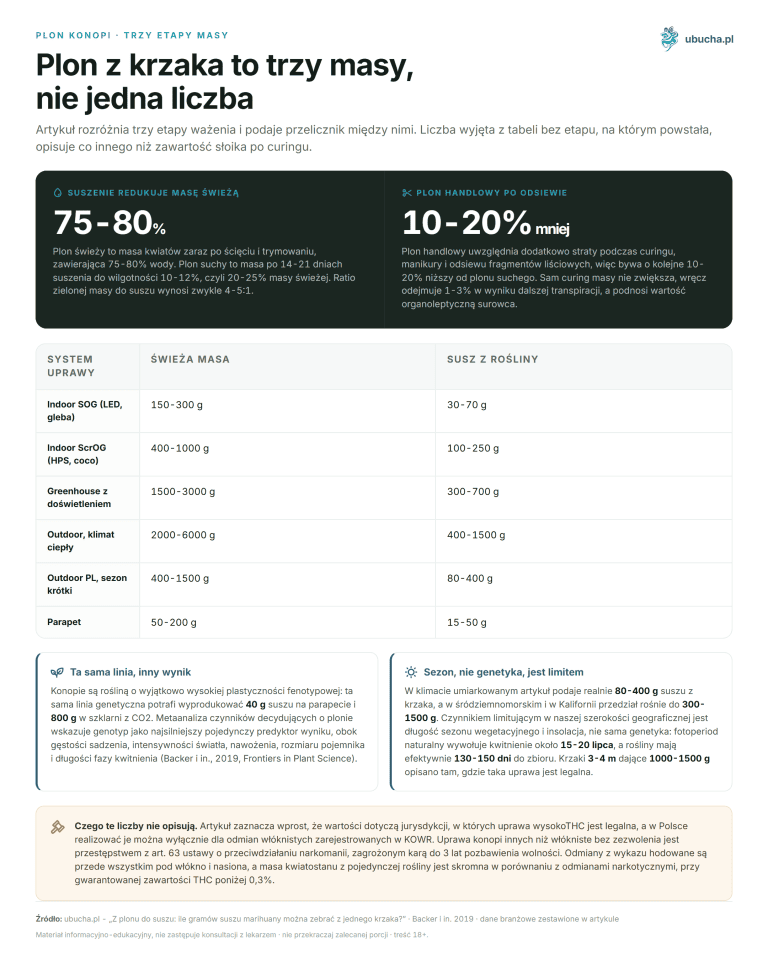
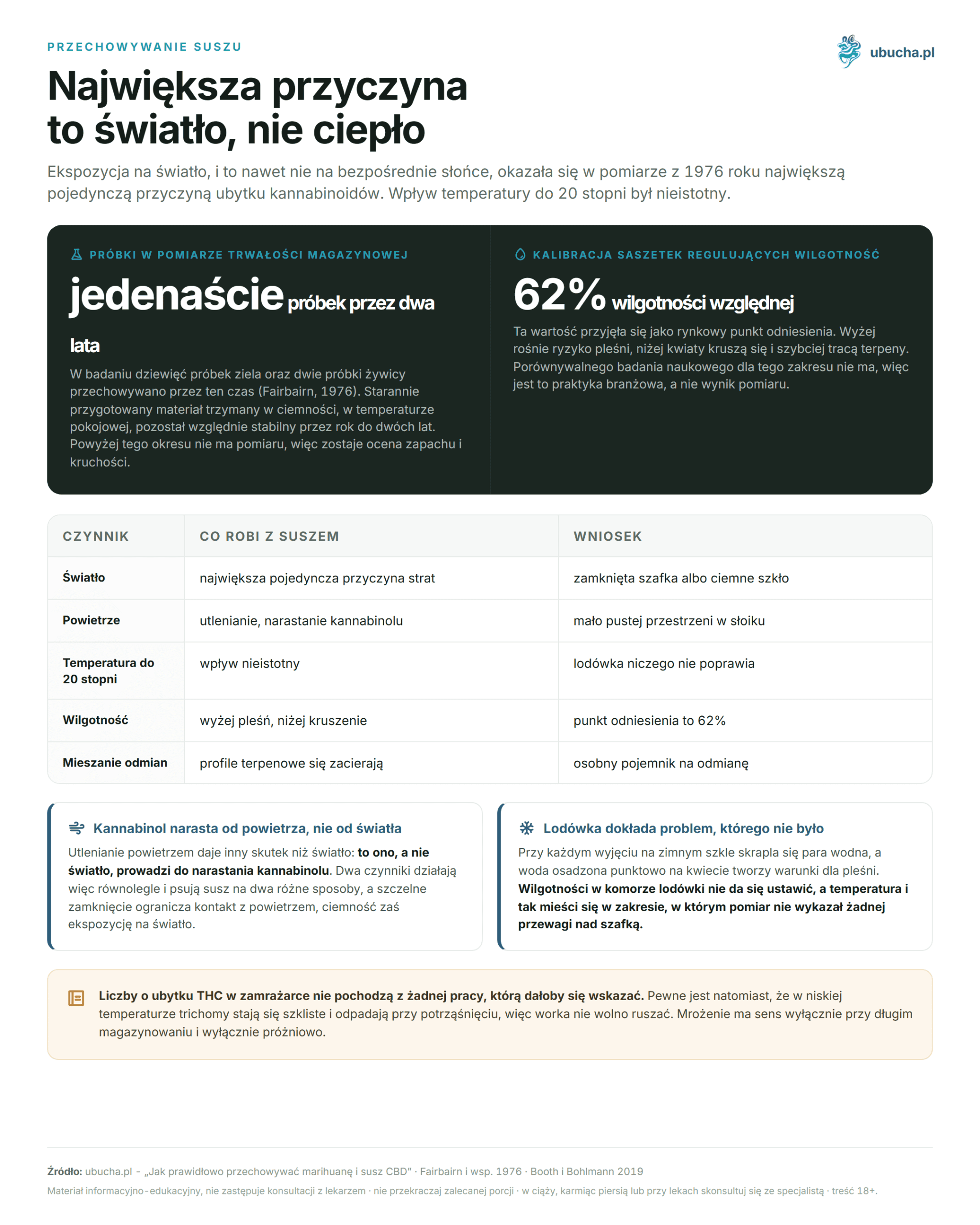
Hemp flower deteriorates slowly and quietly. There is no single day when it becomes unusable: the aroma gradually fades, the flowers crumble more easily, and the effect after a few months can be different from the day of purchase. The most frequently cited work on the durability of cannabis in storage was published in 1976, and to this day, no one has replaced it with a better measurement. It reveals something that contradicts most guides on the internet: with reasonable storage, the flower maintains decent quality for a year or two, and the single biggest cause of loss is not heat or moisture, but light. This guide shows what has actually been measured in this regard, what is just a repeated number without backing, and how to translate one into a jar standing in your cupboard.
KEY INFORMATION
• Fairbairn et al. (1976) stored nine samples of herb and two samples of resin for two years: carefully prepared material kept in darkness, at room temperature, remained relatively stable for one to two years.
• Exposure to light, not even direct sunlight, turned out to be the single biggest cause of cannabinoid loss in this study.
• Oxidation by air has a different effect than light: it is air, not light, that leads to the accumulation of cannabinol (CBN).
• The effect of temperature up to 20 degrees Celsius was insignificant in this study, so a cool cupboard is sufficient, and a refrigerator is not needed.
• Humidity control packs sold for flower are calibrated to 62% relative humidity.
• Hemp flower is legal in Poland when the sum of delta-9-THC and THCA does not exceed 0.3% of dry mass.
Why does the way of storing flower matter so much?
Because almost all the value of the flower resides in a layer just a fraction of a millimeter thick. Cannabinoids and terpenes are produced in glandular trichomes, which are microscopic glands on the surface of the flower. Anything that damages them or opens them to air takes away the aroma and potency of the flower faster than time itself.
How specialized this layer is was shown in the study by Livingston et al. (2020). The authors separated two types of trichomes. Stalked trichomes have blue autofluorescence correlated with high cannabinoid content, built from 12-16 secretory cells, and their terpene profile is strongly dominated by monoterpenes. Sessile trichomes are smaller, have eight secretory cells, and a poorer profile. It is the first type that determines how the flower smells and how it works.
This same relationship has a purely practical side. The authors of the 1976 study on the durability of cannabis in storage noted that cannabinoid losses could be minimized if only the glands were not damaged, which they described as well-filled and well-sealed containers (Fairbairn et al., 1976). The plant packed its cannabinoids itself, and your task is not to unpack them prematurely.
Hence all the other recommendations. Shaking the jar, transferring the flower between bags, grinding in advance, or keeping the flowers in a ziplock bag where they rub against the plastic does exactly what should not be done. What hemp flower is and how it differs from marijuana is explained separately in our guide to CBD flower.
Which factors destroy flower the fastest?
The single biggest cause of cannabinoid loss is light, and not direct sunlight, but ordinary room light. The second is oxygen from the air. Temperature up to 20 degrees Celsius had no significant effect in the measurement, and humidity determines something else: safety and the fragility of the flowers.
This order is not intuitive, so it is worth comparing it with the data behind each factor. The first three rows below are based on the measurement by Fairbairn et al. from 1976, the fourth on market practice, as there is simply no comparable study for humidity.
| Factor | What it does to the flower | What to do about it |
|---|---|---|
| Light | the single biggest cause of cannabinoid loss in the 1976 measurement, even without direct sunlight | closed cupboard or opaque container, never a windowsill or open shelf |
| Oxygen | oxidation by air caused significant losses, and in darkness, it leads to the accumulation of CBN | tight seal and as little empty space above the flower as possible |
| Temperature | up to 20 degrees Celsius had an insignificant effect; above this range, the work does not provide answers | cool place away from the oven, radiator, and window |
| Humidity | too much promotes mold, too little dries the flowers to powder and accelerates the evaporation of terpenes | pack calibrated to 62% relative humidity plus hygrometer in the container |
It is worth remembering one correction, as the opposite circulates online. Popular guides say that ultraviolet radiation converts THC into cannabinol. Fairbairn et al. measured something contrary: THC loss after exposure to light did not correlate with an increase in CBN, while oxidation by air conducted in darkness did. The sedative profile of old flower thus comes mainly from air, not light.
How to measure and maintain humidity in the jar?
Two things are needed: a small hygrometer placed in the container and a two-way humidity control pack calibrated to 62% relative humidity. The hygrometer indicates which way the jar has deviated, and the pack releases moisture when the flower is too dry and absorbs it when there is too much.
The reading makes sense only after the air has stabilized in the closed container, that is, after an hour or two of being closed. A reading clearly above the target value means that the flower needs to be aired out: simply open the jar for several minutes and close it again with the pack. A reading clearly lower is a signal that the pack is used up. You will also recognize it by touch, as the pack hardens and stops bending.
Homemade substitutes are better avoided. An orange peel, a piece of bread, or rice do indeed release water, but they do so without any control of the target value, and they also introduce foreign odors and mold spores into the jar. The flower readily absorbs aromas from the environment, so a citrus note will remain in the flowers long after the peel is removed.
We have gathered hygrometers, airtight containers, and humidity regulators in the storage accessories category. As of August 10, 2026, there were eight items in this category ranging from 4.50 to 189 PLN, so entering the topic does not require significant expenses.
What container to choose for storing CBD flower?
Glass with a seal works best: it is chemically inert, does not transfer odors, can be sterilized, and seals tightly. All other materials perform worse for reasons that are easy to overlook when purchasing, as they concern not so much durability as air exchange and electrostatics.
| Material | Strong point | Where it fails |
|---|---|---|
| Glass with a seal | chemically inert, airtight, easy to clean, accommodates hygrometer and pack | clear glass lets in light, so it requires a closed cupboard or a dark version |
| Ceramics and stoneware | completely blocks light, holds temperature well | contents are not visible, and airtightness depends solely on the quality of the lid |
| Food-grade silicone | light and drop-resistant, sensible for small portions on the go | cheap versions transfer odors and do not close tightly enough to maintain humidity |
| Plastic and ziplock bag | practically none except for price | static charge pulls trichomes to the walls, and flowers rub against the plastic |
| Aluminum foil | completely blocks light | after the first opening, it does not close tightly, and the edges damage the glands |
| Vacuum-sealed bag | blocks light, air, and moisture at once, best for long-term storage | crushes flowers, and each opening requires resealing |
The same rule applies to filling any container. Leave above the flower as much space as needed to fit the pack, but no more, as empty space is a reserve of oxygen sealed with the flowers. Sterilize and dry new containers thoroughly before first use.
Is it worth freezing hemp flower?
Only for truly long-term storage and only in vacuum packaging. It must be stated directly that the Fairbairn et al. measurement covered room temperature and up to 20 degrees Celsius, so the circulating numbers about THC loss in the freezer do not come from this work or any other that can be pointed to by the author’s name.
The argument for freezing is chemical and general: lowering the temperature slows oxidation reactions. The argument against is mechanical and well-documented in the same 1976 study. Losses increase when glands are damaged, and at low temperatures, trichomes become glassy and fall off the flower with the slightest shake. Therefore, a frozen bag should be treated like glass.
If you decide to use the freezer, vacuum-pack the flower, place it in the chamber, and do not move it until you really need it. After removal, leave the bag closed at room temperature for a day or two. Opening a cold package results in condensation forming on the flowers, and moisture deposited on the flower is the simplest path to mold.
Where to keep CBD flower at home?
The best place is a closed cupboard in a cool room, away from the oven, dishwasher, and window. It does not have to be cold, but it must be dark and stable. The following table shows why the two most popular home ideas perform the worst on the entire list.
| Place | Rating and justification |
|---|---|
| Closed cupboard in a cool room | best solution: dark, stable, without temperature fluctuations when opening doors |
| Refrigerator | not recommended: each time you take it out, condensation forms on the cold glass, and humidity in the chamber is uncontrollable |
| Windowsill and glass shelf | worst possible: combines full lighting with heating the jar on a sunny day |
| Cupboard above the oven or next to the radiator | not recommended despite darkness: temperature regularly exceeds the range in which anything was measured |
| Safe, closed drawer, humidor | good, as long as there is a humidity control pack inside; the safe itself does not regulate anything |
| Car | excluded for longer than a drive: in summer, the interior of a closed car heats up extremely |
A separate note applies to homes with children and pets. Regardless of how low the THC content in hemp flower is, the container should be kept out of reach and preferably locked. Eating flower by a dog or small child is a situation requiring contact with a doctor or veterinarian, not just observation on your own.
Does the flower mature during storage?
Yes, although not in the sense that cheese or wine matures. In a closed jar, slow chemical changes occur: acidic forms of cannabinoids gradually lose their carboxyl group, chlorophyll breaks down, and some terpenes evaporate with each opening. The result is a milder smell and a different profile of effects.
The best-documented of these changes concerns cannabinol. Fairbairn et al. showed that CBN increases when the material oxidizes in darkness, not when it is exposed to light. Hence the sedative character of older batches of flower. Some users intentionally store flower longer for this reason, while most prefer fresh material with a more pronounced terpene profile.
Home curing, or slow maturing of freshly dried flowers in a jar with daily airing, makes sense when you buy material directly from the grower. Store-bought flower has already gone through this stage, and additional airing will only release terpenes. A separate topic is intentional decarboxylation before culinary use, which is broken down in detail in our guide to decarboxylation. When vaporizing, the same is determined by the set temperature, and its selection is described in a separate guide on vaporization temperature.
How long can hemp flower be stored?
The only measurement on which an answer can be based indicates one to two years. Fairbairn et al. stored nine samples of herb and two samples of resin for up to two years and considered carefully prepared material kept in darkness, at room temperature, to be relatively stable during this time.
The percentage tables circulating in Polish internet that attribute a 16% loss of potency to the flower after one year and 26% after two years refer to a work that does not exist under the given identifier. We checked each of these numbers while editing this text, and none leads to a study on cannabis. The table below therefore provides what is known and does not pretend to precision that does not exist.
| Period | What to expect | Basis |
|---|---|---|
| Up to 12 months | under good conditions, aroma and potency remain close to the initial state | period covered by the measurement from 1976 |
| 12-24 months | material still usable, aroma noticeably milder, CBN content increases | upper limit of the period covered by the measurement |
| Over 24 months | no data from this work; assessment is purely sensory, inspect the flowers under a magnifying glass before use | beyond the range of any available measurement |
Storage conditions shift these boundaries in both directions and do so more strongly than time itself. The same flower kept for a year in a dark cupboard and a year on a lit shelf is practically two different products, as light was the single cause of the greatest losses in the measurement.
How to tell if the flower is old or spoiled?
Old flower can be recognized by its smell and fragility, spoiled flower by coating and mustiness. These are two different situations with two different decisions: stale material is only weaker, while moldy material is only fit for disposal.
Signs of aging are mild and gradually increase. The aroma shifts from fruity-resinous to hay-like, the flowers lose their elasticity and crumble in your fingers, and trichomes fall off instead of sticking. The color shifts from green to brownish. None of this makes the flower dangerous; it only lowers the quality of the experience.
Mold looks different and smells different. The coating is matte, fluffy, and white or gray, unlike trichomes, which are shiny and adhere to the surface. It is accompanied by a smell of ammonia, wet basement, or musty cloth. In case of doubt, inspect the bud through a magnifying glass magnifying dozens of times.
The decision when suspecting mold is unequivocal and non-negotiable. The review by Montoi et al. (2020) lists cannabis contaminants including pesticides, heavy metals, and microbiological pathogens and indicates that the greatest risk is borne by individuals with reduced immunity reaching for cannabis for medical purposes. The authors conclude with a call for universal cultivation standards and product testing, as without them, consumers have no way to check what they are buying.
What to do with flower that has lost its aroma?
If it has no coating or musty smell, it does not need to be thrown away. Stale flower ceases to be attractive for vaporization, as it is the terpenes that are responsible for flavor and the feeling of freshness, but the cannabinoid material is still present. Its profile has changed, however.
The direction of this change results from the measurement discussed above. Oxidation by air leads to the accumulation of cannabinol, so an older batch works more gently and more sedatively than the same batch from a year ago. For some people, this is a disadvantage; for others, an advantage, and it is worth making a conscious decision rather than attributing the difference to a seller’s mistake.
The most sensible use of such material is in products where aroma is secondary: infusions, baked goods, herbal butters, and oils. They require prior heating of the material, as without it, acidic forms of cannabinoids will not convert to active forms. The procedure is described in detail in a separate guide on decarboxylation, linked in the section on maturing.
One caveat applies without exception. The principle regarding stale material ends the moment any coating or unusual smell appears. Then there are no rescue applications, as heat treatment does not remove the byproducts of mold metabolism from the plant material.
Everything above applies to flower, the definition, composition, and THC threshold of which we break down separately in the guide to CBD flower.
Is it legal to possess CBD flower in Poland?
Yes, as long as it comes from industrial hemp. The Polish definition states that in the flowering or fruiting tops of plants, from which the resin has not been removed, the sum of delta-9-THC and tetrahydrocannabinolic acid (THCA) does not exceed 0.3% when calculated on dry mass, and the result is rounded to one decimal place.
This distinction has practical significance, as it changes the result of laboratory testing. The threshold does not apply to delta-9-THC itself, but to the sum of the two compounds, so material with a low THC reading can still exceed the limit if it contains a lot of the acidic form. The basis is Article 4 point 5 of the Act of July 29, 2005 on Counteracting Drug Addiction as amended by the Act of March 24, 2022, effective from May 7, 2022.
The value of 0.3% is the same as in EU agricultural regulations, but these are two separate regulations. The national threshold corresponds to the EU threshold and does not derive from it. The previous limit was 0.20% and ceased to be in effect on May 6, 2022, so older guides stating this number as current are simply outdated.
Verifiability starts with the certificate of analysis provided by the seller. The cannabinoid content is determined chromatographically, and one of the recognized methods is described in the standard ASTM D8442, which is the standard method for determining cannabinoids in hemp raw material by gas chromatography with flame ionization detection. Lack of a certificate, lack of strain, and lack of harvest date are three reasons to set the package aside.
How to store flower outside the home and alongside other products?
When traveling, airtightness, protection against crushing, and stable temperature matter. The best option is a small airtight container for one or two portions, hidden in luggage, not in a jacket pocket or on the dashboard. A closed car on a sunny day heats up so much that the flower loses its aroma within one afternoon.
Crossing borders is a separate matter and is not resolved by Polish regulations. The legality of hemp flower varies between EU countries, even within the Schengen area, so the regulations of the destination country should be checked before traveling, not after.
At home, there is one simple rule: a separate container for each strain. The flower absorbs odors from the environment, and each strain has its own terpene profile, which becomes indistinguishable after a few weeks of shared storage. The same note applies to spices and coffee standing in the same cupboard.
The differences between strains are greater than suggested by their trade names. The review by Booth and Bohlmann (2019) points out that cannabis resin contains hundreds of different terpenoid and cannabinoid metabolites, many of which have not been clearly identified, and the composition of two batches sold under the same strain name can diverge. Mixing them in one container blurs the information for which you paid.
Oils, concentrates, and flower require completely different conditions, so they should not be combined in one container or even in one box. Oils prefer dark glass and coolness, and the conditions for them are broken down in detail in our text on storing CBD oil.
Frequently Asked Questions
What humidity is appropriate for hemp flower?
Two-way humidity control packs sold for flower are calibrated to 62% relative humidity, and this value has become the market benchmark. Higher increases the risk of mold, lower causes the flowers to crumble and lose terpenes faster. There is no comparable scientific study for this range, so treat it as industry practice.
At what temperature should hemp flower be stored?
Room temperature in a cool room is sufficient. In the Fairbairn et al. study from 1976, the effect of temperature up to 20 degrees Celsius was found to be insignificant, so cooling does not improve anything. Stability is important: avoid places next to the oven, radiator, and window, where conditions change throughout the day.
Is the refrigerator a good place for flower?
No. Each time you take it out, condensation forms on the cold glass, and water deposited on the flower creates conditions for mold. The humidity in the refrigerator cannot be set, and the temperature is still within the range where the measurement showed no advantage over a cupboard.
Can hemp flower be frozen?
Only for long-term storage and only vacuum-sealed. The circulating numbers about THC loss in the freezer do not come from any work that can be pointed to. It is certain, however, that at low temperatures, trichomes become glassy and fall off with the slightest shake, so the bag must not be moved.
What container works best?
A glass jar with a seal, sterilized before first use, with a hygrometer and a humidity control pack inside. Glass is chemically inert and does not transfer odors. However, clear glass lets in light, so keep it in a closed cupboard or choose an opaque version. Leave as little empty space above the flower as possible.
How long does the flower maintain quality?
One to two years when stored in darkness and at room temperature. This is the conclusion from the Fairbairn et al. study from 1976, which included eleven samples over a period of up to two years. Beyond this time, there is no measurement, so the assessment is based on aroma, color, and fragility of the flowers.
How to recognize moldy flower?
By a matte, fluffy coating that is white or gray and by a smell of ammonia or mustiness. Trichomes, on the other hand, are shiny and adhere to the surface. Material with such a coating should be discarded entirely, as microbiological contaminants are particularly dangerous for individuals with reduced immunity.
Is it worth keeping several strains in one jar?
No, if you care about aroma. The flower absorbs odors from the environment, and the terpene profiles of mixed strains become indistinguishable after a few weeks. A separate small container for each strain solves the problem and also reduces the number of openings of the main jar, meaning less contact with air.
Containers with hygrometers, humidity regulators, and other accessories have been gathered in the storage category, and the flowers themselves in the hemp flower category.
This article is for informational and educational purposes only and does not constitute medical advice. Before starting to use cannabis or CBD for therapeutic purposes, consult a doctor, especially if you are taking other medications, are pregnant, or breastfeeding.
Author: Michał Waluk · Published: 2026-05-11 · Updated: 2026-08-24