
Where Is the Best Place to Store CBD Oil? Complete Guide 2026
Where is the best place to store CBD oil: temperature, light, and humidity in practice, differences between MCT and hemp oil, and signs that oil has gone bad.
Dark cabinet or bright kitchen? For CBD oil, this is not a matter of aesthetics but chemistry. The classic study by Fairbairn et al. from 1976 showed that light, not temperature, is the biggest single factor causing cannabinoid loss during storage (Journal of Pharmacy and Pharmacology, 1976). The question “where is the best place to store CBD oil” regularly comes up in conversations with store customers. Answers circulating on the Polish internet are often too general: “cool and dry” sounds good but does not explain why the fridge can be a worse choice than a regular cabinet, nor why MCT oil behaves differently than hemp-based oil. In this guide, we break down the topic into factors: light, temperature, oxygen, and humidity, as well as specific places in a typical Polish apartment to avoid.
KEY INFORMATION
- Optimal conditions: dark cabinet, temperature 15-21°C, bottle upright, original packaging.
- Light is the strongest factor in cannabinoid degradation, stronger than moderate room temperature (Journal of Pharmacy and Pharmacology, 1976).
- The fridge is not necessary for daily use and introduces the risk of water vapor condensation each time it is opened.
- MCT oil is generally considered the most stable carrier, hemp base oil the least stable due to polyunsaturated acid content.
- Freshness should be assessed by smell, taste, and appearance, not just the date on the label.
Why does the storage place of CBD oil matter?
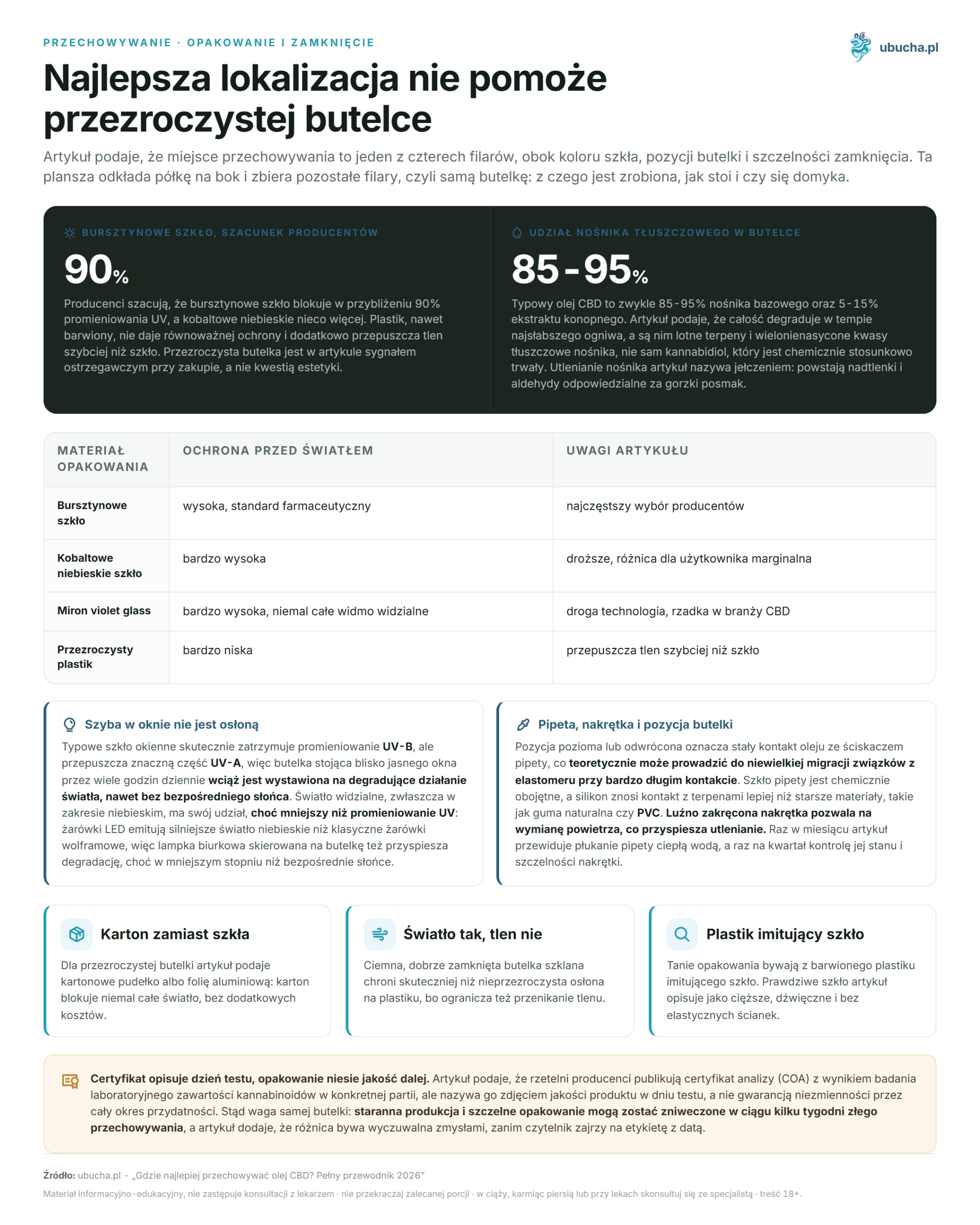
Typical CBD oil usually consists of 85-95% base carrier oil, such as MCT, hemp, or olive oil, and 5-15% hemp extract carrying cannabinoids and terpenes, plus trace amounts of plant waxes. The fat carrier dissolves cannabinoids, which are hydrophobic, enabling their absorption in the digestive tract. Each component has different susceptibility to degradation, so “CBD oil” as a whole degrades at a rate dependent on the weakest link: usually volatile terpenes and polyunsaturated fatty acids of the carrier, not cannabidiol itself, which is chemically relatively stable.
Besides cannabidiol, the oil carries minor cannabinoids like CBG and CBN, terpenes, and flavonoids. Terpenes are the most volatile and evaporate already at room temperature, cannabinoids degrade under light and oxygen, and the fat carrier undergoes hydrolysis and oxidation in the presence of moisture. A study comparing CBD stability in powder form and oil solution showed that the powdered form is clearly more stable than the oil form under the same temperature and humidity conditions (Pharmaceutics, 2021). This is an important hint: CBD oil, precisely because it is a solution, is naturally more sensitive than a supplement in capsule or powder form.
Poor storage has three practical consequences. First, potency: cannabinoid degradation products do not have the same activity as the original substance. Second, taste and aroma, because volatile terpenes disappear first. Third, the quality of the fat itself, as rancid carrier contains free fatty acids and peroxides that can irritate mucous membranes. CBD oil prices in the store range from 65 to 240 PLN, depending on concentration and cannabinoid type (as of August 2026). A spoiled product at this price is a real loss, and the most common cause of premature spoilage is poor storage location, not product defect.
Reliable manufacturers publish a certificate of analysis (COA) with laboratory test results of cannabinoid content in a specific batch. This is a snapshot of product quality on the test day, not a guarantee of unchanged quality throughout the shelf life. Therefore, home storage conditions matter regardless of how well the bottle was prepared at purchase: careful production and tight packaging can be undone within weeks of poor storage, and the difference can be sensed before even checking the date label.
What factors degrade CBD oil?
The four main enemies of CBD oil are light, atmospheric oxygen, temperature, and humidity. The classic Fairbairn study from 1976 showed that light exposure was the biggest single factor in cannabinoid loss, especially in solutions, while temperature up to 20°C was not significant, and oxidation in air also caused measurable losses (Journal of Pharmacy and Pharmacology, 1976). These factors do not act alone: high temperature accelerates chemical reactions, oxygen oxidizes sensitive bonds, and moisture hydrolyzes lipids. Exposure to all four at once, such as a typical kitchen windowsill, is the worst possible scenario.
| Factor | How it harms | How to prevent |
|---|---|---|
| Light, especially UV | Breaks bonds in cannabinoid structure, strongest single degradation factor | Dark glass, cabinet instead of windowsill |
| Atmospheric oxygen | Oxidizes cannabinoids and fat carrier, causes rancidity | Tight cap, limit number of openings |
| Temperature | Accelerates all decomposition reactions, especially above 25°C | Stable 15-21°C, away from stove and heater |
| Humidity and condensation | Water droplet in oil promotes microbial growth | Avoid large temperature fluctuations around the bottle |
CBD oil itself is less sensitive to air humidity than hemp flower, but condensation inside the bottle is a real, though rarer, problem. It mainly occurs with large and sudden temperature changes, for example when the bottle returns from a cold fridge to a warm room and briefly becomes cooler than the surrounding air. A drop of condensed water entering the oil creates a local medium for yeast and mold growth, although the oil itself under normal conditions does not favor their development. Therefore, avoiding sudden temperature jumps is often more important than maintaining specific room humidity.
Does window glass protect CBD oil from light?
Not fully. Window glass itself is not sufficient protection. Typical window glass effectively blocks UV-B radiation but lets through a significant part of UV-A, so a bottle standing near a bright window for many hours daily is still exposed to degrading light effects, even without direct sunlight.
Visible light, especially in the blue range, also contributes, though less than UV radiation. Modern LED bulbs emit stronger blue light than classic tungsten bulbs, so a desk lamp directed at the bottle for many hours daily also accelerates degradation, though less than direct sun. The fat carrier oxidizes independently of cannabinoids: this process is called rancidity and leads to formation of peroxides and aldehydes responsible for bitter taste.
In the Polish climate, seasonality also matters: in winter, heated apartments often have very dry air; in summer, non-air-conditioned interiors can maintain temperatures above 25°C for weeks. Both scenarios accelerate chemical reactions that would proceed much slower under moderate conditions, so choosing a stable indoor place is more important than it might seem at first contact with the product.
Dark glass or plastic: which to choose?
Dark glass, amber or cobalt, is the standard packaging for CBD oil, and this is not an aesthetic coincidence. Manufacturers estimate that amber glass blocks approximately 90% of UV radiation, and cobalt blue blocks slightly more. Plastic, even colored, does not provide equivalent protection and additionally lets oxygen through faster than glass, accelerating oxidation. If you see CBD oil in a transparent bottle, treat it as a warning sign.
| Packaging material | Light protection | Notes |
|---|---|---|
| Amber glass | High, pharmaceutical standard | Most common choice of CBD producers |
| Cobalt blue glass | Very high | More expensive than amber, marginal difference for user |
| Miron violet glass | Very high, blocks almost entire visible spectrum | Expensive Swiss technology, rare in CBD industry |
| Transparent plastic | Very low | Avoid, or keep in cardboard box |
If you bought oil in a transparent bottle, the simplest solution is to keep it in the original cardboard box or wrap it in aluminum foil. Cardboard blocks almost all light, practically solving the problem without extra cost. Ultimately, it is worth choosing products from manufacturers who pack oil in dark glass from the start, as this signals they take product stability seriously.
When buying, also pay attention to the material description, not just the bottle color. Some cheap packages are made of colored plastic imitating glass, which looks similar at first glance but does not provide the same protection against oxygen or light. Real glass can be recognized by weight, sound when gently tapped with a fingernail, and lack of wall flexibility. A dark, well-closed glass bottle protects more effectively than even a solid, opaque cover placed on transparent plastic, because it also limits oxygen penetration, which the light cover alone does not stop.
The cost difference between glass variants is usually small per bottle: amber glass is cheaper to produce than cobalt, and both are clearly cheaper than the rarely seen Miron glass in the CBD industry. For the average buyer, this difference should not be the main product choice criterion, as both standard options, amber and cobalt, provide comparable high light protection. It is more important that the glass is dark at all than the specific tint used by the manufacturer.
Fridge or cabinet: where to place the bottle?
For daily use, a CBD oil bottle should stand in a dark cabinet at room temperature 15-21°C, not in the fridge. The fridge, usually 4-7°C, slows oxidation but introduces problems: condensation of water vapor each time the bottle is taken out, MCT oil solidifying at low temperatures, and significant humidity fluctuations inside the fridge depending on other contents. Some store customers keep oil in the fridge believing “cool always means better,” but for a daily bottle used within a few weeks, this is an unnecessary step.
The fridge makes sense in two specific situations: when you have a large stock that will not be used within six months, or when the apartment in summer constantly exceeds 28°C and you have no cooler cabinet. In such cases, keep the bottle in the original box and allow it to return to room temperature for several minutes before dosing to avoid MCT oil solidification. For the vast majority of users who consume a bottle in one or two months, a regular cabinet in the bedroom or living room provides stable temperature without daily fluctuations typical of kitchens or bathrooms, and without the condensation risk characteristic of the fridge.
Pharmaceutical definitions of storage temperatures are conventional: “cool” usually means 8-15°C, and “room temperature” means 15-25°C, with so-called controlled room temperature set at 20-25°C and allowable short deviations to 15-30°C. The recommended 15-21°C for CBD oil falls in the lower part of this range, closer to “cool” than “warm.” This also explains why MCT oil may thicken in the fridge: saturated medium-chain fatty acids solidify at lower temperatures more distinctly than typical vegetable oils, which is often mistakenly perceived as spoilage, though after warming to room temperature the oil usually returns to its original consistency without quality loss.
MCT, hemp oil, or olive oil: which is more stable?
The choice of base carrier affects CBD oil shelf life. MCT oil, i.e., medium-chain triglycerides, has few double bonds, so it oxidizes slowly and is generally considered the most stable choice. Hemp base oil contains more polyunsaturated omega-3 and omega-6 acids, which oxidize much faster, making it the least stable, though nutritionally richer. Olive oil, rich in monounsaturated oleic acid and natural antioxidants, usually falls between these two variants.
| Carrier | Stability | Taste | Absorption |
|---|---|---|---|
| MCT | Highest | Neutral | Fast |
| Hemp base oil | Lowest | Herbal, distinct | Slower |
| Olive oil | Intermediate | Mediterranean | Moderate |
For a new user just starting and wanting the most predictable product, MCT is usually the best choice. Those valuing additional nutritional benefits and natural hemp profile may choose hemp oil but should buy smaller bottles and consume them faster. If you wonder which carrier to choose not only for stability but also absorption speed, see our comparison MCT vs olive oil as CBD carrier, where we break down absorption differences.
The stability difference also reflects in absorption rate. Medium-chain fatty acids in MCT enter the bloodstream mainly via the portal vein, bypassing the lymphatic system, so the effect usually appears faster than with hemp oil or olive oil, which are metabolized more slowly via the lymphatic route. For some users, taste and nutritional profile matter more than speed: hemp oil has a distinct herbal character and additional omega acids, and olive oil is associated with Mediterranean cuisine. Carrier choice is thus a compromise between stability, speed of action, and taste preferences; there is no universally “best” answer for everyone.
Product price rarely depends solely on carrier type: concentration, extraction method, and whether the oil is an isolate or full spectrum have greater cost impact. Still, choosing a less stable carrier like hemp base oil makes sense mainly for smaller packages consumed quickly. Buying a large hemp-based bottle to save money long-term can be a false economy if the product loses quality before you finish it.
CBD oil shelf life: how long does it really last?
An unopened MCT-based CBD oil bottle, properly stored in dark glass at 15-21°C, usually retains declared potency for the period stated on the label, most often 12-24 months from production date. After opening, stability is shorter because air contact with each use accelerates degradation. If you are choosing oil and wondering about concentration or extract type, start with our guide Which CBD oil to choose, as product choice also affects how long it maintains full quality.
The production date on the label is the filling moment from which shelf life is counted. Batch number, if provided, allows finding the COA on the manufacturer’s website, usually via QR code on the packaging. Some producers provide only a “best before” date without production date, complicating freshness assessment: in such cases, evaluate product by smell and appearance. Distinguishing these two dates can be confusing: “date of manufacture” is when the oil was actually made, and “best before” is the producer’s estimate of how long the product retains full declared quality under recommended storage. The “best before” date alone does not indicate how long the oil has been on the shelf, so checking both fields is advisable. After expiry, the oil is usually not “spoiled” in a dangerous sense but loses some potency. If it passes sensory check, it can be used technically, though effects may be weaker than fresh product. Products much older than declared shelf life, especially with clear rancidity signs, should be discarded.
Real consumption rate also matters. A standard 10 ml bottle dosed two to three drops daily usually lasts four to six weeks, so for most daily users, product stability is not a real problem if storage conditions are reasonable. The situation changes with larger packages, e.g., 100 ml, bought less often and used over six months or more: there, choosing a stable carrier like MCT and careful storage are much more important, as the product spends more time on the shelf than in daily use. Before buying a larger package to save money, honestly assess your consumption rate: a bottle open for eight months due to irregular dosing rarely costs less than two smaller bottles bought sequentially.
How to tell if CBD oil has gone bad?
Sensory check is the simplest way to assess CBD oil freshness and requires no equipment. Sight, smell, and taste suffice. Spoiled oil usually has three clear signals: bitter, fatty taste; cloudy appearance, sometimes with sediment at the bottom; and color change from light greenish-yellow to dark brown. If any of these signals seem clear, trust your intuition: discarding the bottle is cheaper than risking digestive irritation. It is useful to compare a newly opened bottle with how it looked and smelled in the first week of use: this is the simplest reference point, as sensory memory quickly fades for gradual changes over months.
| Sense | Fresh oil | Spoiled oil |
|---|---|---|
| Sight | Clear, light greenish-yellow to amber | Cloudy, dark brown or gray, sediment |
| Smell | Herbal, hempy, no solvent notes | Bitter, reminiscent of old fat or rancid butter |
| Taste | Slightly bitter, herbal, “vegetal” | Clearly sour or fatty, lingers in mouth |
Small sediment at the bottom in full-spectrum oils is normal and indicates plant waxes or chlorophyll presence: just shake the bottle before use. The problem is large sediment or suspension floating throughout the oil volume. Solvent smell in fresh, just opened oil is a different matter: it indicates poor extraction quality by the producer, not storage problem, and is a reason for product return.
Behind these signals is specific chemistry. Oxidation of cannabinoids and lipids leads to free fatty acids and peroxides, which have no taste or smell of the original oil and cause bitterness and “heavy” taste of spoiled product. A simple check takes less than a minute: look at the oil under light checking clarity, smell it with the bottle open, then take one drop on the tongue. If all three tests are normal, the product can be safely used further, regardless of how many months have passed since opening.
How to travel with CBD oil?
Traveling with CBD oil requires extra attention due to temperature, light, and baggage regulations. Cabin baggage limits for liquids apply EU-wide: container max 100 ml, placed in a transparent zip bag with other liquids. The legality of the product itself in a given country is separate from baggage limits: it is regulated by the country’s drug laws, not airport rules, so always check local regulations before traveling, especially outside the EU.
| Situation | Risk | Recommendation |
|---|---|---|
| Car in summer | Car interior quickly heats up in sun to high temperatures | Always take the bottle with you, do not leave in car |
| Cabin baggage | Liquid limit 100 ml per container | Smaller bottle, original packaging with label |
| Checked baggage | Low temperature in luggage hold during flight | Short flight time usually harmless, oil returns to form after warming |
| International trip | Drug laws differ between countries | Check local laws before trip, carry COA |
How to transport CBD oil by car and across borders?
On short trips, oil withstands air-conditioned car without problems. On hot days, during longer stops, consider an insulated bag with cooling insert. Bring the original packaging with label and, if possible, COA certificate photo on your phone: this helps during checks and product identification.
Train or car travel within Poland and neighboring EU countries rarely involves baggage checks, so main risk is thermal conditions, not regulations. For travel abroad, especially outside the EU, laws can differ drastically: some countries allow THC products below a set threshold like Poland, others ban all hemp products without exception. Before packing CBD oil for international travel, check current laws of destination and transit countries, as this is local drug law jurisdiction, not general aviation safety rules.
Practical checklist for travel: original bottle with clear label, COA photo on phone, tightly closed cap, and if traveling on a hot day, a small insulated bag with cooling insert. For shorter trips, smaller bottles like 10 ml work better than full 30 or 100 ml: they take less space, fit cabin baggage limits, and minimize potential loss if leakage occurs.
How to secure CBD oil from children and pets?
The American Academy of Pediatrics reported an increase in child poisoning cases with edible cannabis products from 207 in 2017 to 3054 in 2021 (Pediatrics, 2023). Data mainly concern edible forms like gummies, but the risk mechanism is the same for oil: a child may confuse a pipette bottle with other edible oils. Securing from children and pets is a duty, not an option, regardless of product form.
Three rules work in practice. First: keep the bottle above 150 cm height or in a locked cabinet, as small children cannot reach that high unaided. Second: do not transfer oil to anonymous containers, as medical personnel must quickly identify composition and concentration in case of accidental ingestion, and original label facilitates this. Third: remember pets, especially dogs with strong smell who may be attracted to oil scent: keep the bottle in a closed cabinet, not on a countertop or table. If accidental ingestion by child or pet occurs, consult a doctor or vet and bring the bottle to help dose assessment.
Symptoms after large accidental ingestion of CBD oil in children or pets are similar: drowsiness, slowing, coordination disorders, sometimes nausea. Most healthy adult animals recover from small doses within hours, but severe symptoms like seizures or breathing difficulties require immediate veterinary help. Product format matters for risk: a pipette bottle requires conscious repeated action to consume large amounts, unlike sweet edible hemp forms a child may eat reflexively mistaking them for candy. This does not reduce the need to secure oil but helps assess real risk scale compared to other hemp products at home.
Bottle position and pipette role
The CBD oil bottle should stand upright, with the pipette pointing up. Horizontal or inverted position means constant contact of oil with rubber or silicone pipette bulb, which theoretically may cause slight migration of compounds from elastomer to product over very long contact. Glass pipette with silicone bulb is today the industry standard: glass is chemically inert, and silicone better withstands terpene contact than older materials like natural rubber or PVC.
Pipette hygiene matters practically. After dosing, wipe the pipette with paper towel before reinserting, and avoid touching it with fingers just above the opening. Screw the cap tightly after each use: a loosely screwed cap allows air exchange, accelerating oxidation. If the seal hardens, cracks, or the pipette loses elasticity, buy a replacement rather than continue using a leaky bottle.
A common overlooked mistake is keeping the bottle on its side in a drawer next to other items. Besides the risk of prolonged oil contact with the pipette, horizontal position increases chance of accidental cap loosening under pressure from other objects, and CBD oil leakage can permanently stain wood, fabric, or carpet, which is harder to remove than product loss. A simple organizational rule, i.e., a separate place just for the bottle, upright and away from other items, eliminates most such problems without extra cost.
Once a month, rinse the pipette with warm water and a small amount of dish soap and dry thoroughly before returning to the bottle. Avoid strong solvents like alcohol or acetone, which can damage the rubber or silicone bulb and accelerate wear. If the pipette remains wet after washing, wait until fully air-dried before dipping it back into oil: even small water amounts introduced this way promote microbial growth, as mentioned regarding humidity and condensation.
Which places in the home to avoid when storing CBD oil?
Some locations are chosen intuitively but are not good for CBD oil. The list below collects places combining high temperature, humidity, or direct light, i.e., exactly the factors accelerating cannabinoid degradation.
| Place | Main threat |
|---|---|
| Windowsill | Direct sunlight, biggest single degradation factor |
| Cabinet above stove | High temperature and steam during cooking |
| Bathroom | Steam from bath, large temperature and humidity fluctuations |
| Car in summer | Very high temperature in short time |
| Above fridge | Heat generated by compressor |
| Drawer near stove | Elevated temperature and risk of mechanical impacts |
| Car glove compartment | Cooler than cabin but still heats up significantly |
The common denominator is the combination of heat, moisture, and light in one place. The kitchen without a dedicated cool cabinet and the bathroom are practically the two most often chosen yet worst locations in a typical apartment: temperature there fluctuates much more during the day than in the bedroom or living room, where conditions are usually stable.
The kitchen windowsill is often chosen for convenience during cooking, but this convenience most harms the product: direct sun most of the day, proximity to the stove, and humidity fluctuations during cooking combine in one place. Similarly, the car glove compartment seems safe as it is shielded from direct sun, but in a closed, sunlit car, the cabin temperature rises enough that the difference between glove compartment and dashboard loses practical significance. If the apartment really lacks a neutral cabinet away from these zones, a small lockable container placed in the least used part of the apartment, e.g., hallway, can be a solution instead of a compromise in the kitchen or bathroom.
Above the fridge and in the drawer near the stove, the problem is underestimated because these places seem neutral until you check hand temperature there. The fridge compressor generates heat continuously, so the surface above the fridge is noticeably warmer than the rest of the kitchen, even if it looks like a regular free shelf. A simple test before choosing a new bottle place: place your hand there for a few seconds at different times of day. If you feel noticeable heat or direct sun, exclude that location regardless of daily convenience.
Home scenarios: specific recommendations
Every apartment is different. Below are three typical Polish CBD user situations and recommendations adapted to conditions, maintaining the same general rule: dark cabinet, temperature 15-21°C, bottle upright.
| Situation | Recommendation |
|---|---|
| Studio or small apartment | Cabinet in living room, away from kitchen and window, a simple box suffices |
| Single-family home with children | Dresser in parents’ bedroom or locked cabinet in wardrobe, never living room |
| Frequent business travel | Dedicated case with foam padding, transfer oil to cabinet after return |
In practice, solutions are cheap and simple. Original cardboard box with bottle upright inside, next to a note with opening date written with a marker, is sufficient for most households. More elaborate solutions like dedicated travel cases are worth considering only with frequent product transport.
A special case is a shared apartment with roommates or a household with an older resident taking other medications regularly. In both cases, it is worth labeling the bottle clearly and keeping it in a place all household members recognize as “private,” e.g., a specific person’s nightstand drawer, not a shared bathroom or kitchen. This reduces the risk of confusion with other products and accidental intake by someone for whom the oil is not intended, which matters especially when prescription drugs are taken simultaneously.
The common denominator of all three scenarios is that a good storage place need not be expensive or complicated. A regular cabinet, dresser, or locked drawer if children are present suffices in most cases. Investing in specialized containers or climate control devices makes sense only for very large stocks or special housing conditions like lack of stable temperature year-round.
How to store CBG oil and CBN oil?
CBG oil, CBN oil, hemp flower, and full-spectrum extracts share some storage rules but each has its requirements. General rule: the more minor cannabinoids and terpenes, the more sensitive the product. Flower, unlike oil, additionally requires humidity control.
| Product | Conditions | Notes |
|---|---|---|
| CBG oil | Dark cabinet, 15-18°C, airtight cap | Chemically less stable than CBD, consume faster after opening |
| CBN oil | Dark, cool, airtight, like for CBD | Usually packed in smaller bottles due to lower dosing |
| Hemp flower | Glass jar, humidity control, 15-21°C | Humidity is an additional factor not present in oil |
| Full-spectrum extracts (RSO) | Cool, refrigerated for long storage | Thick paste in syringe, warm in hand before dosing |
Cannabigerol (CBG) and cannabinol (CBN) differ chemically from CBD, and CBN additionally forms as a natural THC degradation product in aging flower, so in some respects it is already “chemically older” from extraction. Both minor cannabinoids are generally considered less stable than CBD, so for CBG and CBN oils a stricter regime is advisable: more rigorously ensure cap tightness and do not postpone consumption of opened bottles indefinitely, even if the producer declares a long shelf life before opening.
How does storing flower and extracts differ from oil?
For those combining flower with oil, a good solution is one cabinet with separate containers for both: a jar with flower and humidity pack next to the upright oil bottle. If you want to delve deeper into flower storage, including humidity control and container selection, see our guide How to properly store marijuana and CBD flower.
Hemp flower requires attention to humidity in a narrower range than oil, as too dry flower crumbles and loses terpenes, and too moist promotes mold and microbial growth, which oil in a sealed bottle practically does not have to fear. Therefore, two-way humidity packs that release or absorb moisture to maintain stable conditions inside the jar regardless of room conditions are popular. Full-spectrum extracts like RSO are thick as tar and contain trace amounts of solvent used in extraction, which gradually evaporates at room temperature. This is normal, not a product defect, and is why RSO is often kept refrigerated for longer: low temperature slows evaporation and extends the period during which the product retains original consistency.
How often to check CBD oil condition?
We recommend a short monthly review of CBD oil: smell, color, clarity, and taste of one drop. It takes about half a minute and catches most problems before they become serious. Also check opening date, pipette condition, and cap tightness quarterly.
- Smell: herbal, hempy, no rancid fat notes.
- Color: from light greenish-yellow to amber, no brown tint.
- Clarity: clear or slightly opalescent, no cloudiness.
- Consistency: fluid at room temperature, no lumps.
- Pipette and cap: flexible rubber, tightly screwed cap.
If all points are good, the product is suitable for use. With one worrying signal, look closer; with two or more, better discard the bottle without hesitation. Record the first opening date and planned replacement date with a marker on the label or a phone note: with several bottles at once, it is easy to lose track of which is freshly opened.
The easiest way to establish this habit is to link it with another regular activity, e.g., paying bills at the start of the month or changing bed linen. If the monthly check fails, do not pour large amounts directly into the sink or toilet: a small amount, a few drops, is not a problem, but for larger residues better absorb oil in paper towel and dispose with mixed waste, like other used cooking oils, instead of pouring directly into sewage or compost.
Comparison table: storage locations
The table below organizes previous recommendations in one place. Ratings are approximate and based on general cannabinoid storage chemistry principles described in this guide, not on a specific numerical measurement.
| Location | Light | Temperature stability | Overall rating |
|---|---|---|---|
| Bedroom cabinet | None | High | Very good |
| Living room dresser | None | High | Very good |
| Fridge | Minimal | High, but condensation on opening | Good for stock |
| Bathroom | Minimal | Low, large fluctuations and moisture | Poor |
| Kitchen windowsill | High UV | Low | Very poor |
| Car in summer | High | Very low | Worst |
The practical conclusion is simple: a cabinet in the bedroom or dresser in the living room provides the most stable conditions among typical apartment places, without needing the fridge. Storage location choice is a matter of seconds at first bottle opening, not a constant obligation.
This table rating works only together with other guide rules. Even the best location won’t help if the bottle is transparent, lying on its side, or the cap is not fully closed after each use. Storage place is one of four pillars, alongside glass color, bottle position, and closure tightness, and only all together make a real difference in how long the oil retains quality.
Summary: four rules for good CBD oil storage
Proper CBD oil storage boils down to four rules: dark glass, temperature 15-21°C, bottle upright, and original packaging. These four elements protect against main enemies of cannabinoids: light and oxygen, plus heat and humidity fluctuations. Applying them takes a few minutes of attention at first bottle opening, with no extra cost.
Also remember safety. Keep CBD oil out of reach of children and pets, preferably in a locked cabinet or above 150 cm height. Original packaging with label enables quick product identification in case of accidental ingestion, and a pipette bottle clearly communicates product nature. Do not transfer CBD oil to anonymous containers.
Most users consume a smaller bottle within a few to several weeks, so even average storage conditions won’t significantly harm the product. The same simple rules, applied consistently, increase the chance that oil retains full quality to the last drop, not just half the bottle.
It is worth returning to the starting point of this guide: light, not temperature, is the main enemy of cannabinoids during storage. If you must choose only one change in your habits, let it be moving the bottle from the windowsill or visible kitchen place to a closed, dark cabinet. The rest of the rules - temperature, position, and tightness - add to this one decision, but it has the greatest single impact on how long the oil keeps its original quality.
Frequently Asked Questions
Where is the best place to store CBD oil at home?
The best place is a dark cabinet in the bedroom or living room, at a temperature of 15-21°C, away from windows, stove, and heater. The bottle should stand upright, preferably in the original box. Avoid windowsills, kitchen countertops, and bathrooms: these are places with the greatest fluctuations in light, heat, and humidity in a typical apartment.
Can CBD oil be kept in the fridge?
It can, but it is not necessary for daily use. The fridge slows oxidation but introduces condensation of water vapor each time the bottle is opened, and MCT-based oil may thicken below 15°C. It makes sense for large, rarely opened stocks kept for more than six months.
How long can CBD oil be stored after opening?
Manufacturers usually declare 6-12 months after opening if the bottle is kept in a dark, cool place, and 12-24 months before opening. The carrier matters: MCT oil tolerates longer storage than hemp-based oil. Always check the smell, taste, and clarity before use, regardless of the date on the label.
Why is a dark bottle important for CBD oil?
Amber or cobalt glass significantly limits UV radiation penetration into the bottle. The study by Fairbairn et al. (Journal of Pharmacy and Pharmacology, 1976) showed that light, more than moderate room temperature, is responsible for cannabinoid loss during storage. Transparent glass does not provide this protection.
How to recognize rancid CBD oil?
Spoiled CBD oil has a bitter, fatty taste, cloudy appearance, sometimes sediment at the bottom of the bottle or a dark brown color instead of greenish-yellow. Healthy oil smells herbal and hempy, without solvent or old fat notes. If you smell rancid fat, do not use the product.
Does CBD oil lose potency at high temperatures?
Yes. Higher temperature generally accelerates chemical decomposition reactions, including oxidation of cannabinoids and carrier lipids. A car parked in the sun in summer can reach temperatures well above 40°C within an hour, which is clearly a bad environment for CBD oil. The optimal storage range is 15-21°C.
Can CBD oil be frozen?
It is not recommended for daily CBD oil. Freezing and thawing promote phase separation, and MCT oil may become cloudy and form lumps after thawing. Freezing makes sense only for large, unopened stocks kept for a very long time. For daily use, a dark cabinet at 15-21°C is sufficient.
What is the difference in storing MCT and hemp oil?
MCT oil has shorter fatty acid chains and fewer double bonds, so it oxidizes more slowly. Hemp base oil contains more polyunsaturated omega-3 and omega-6 acids, which oxidize faster and shorten shelf life. Olive oil usually falls between these two carriers.
We collected the full offer on this topic in the hemp oils category.
This article is informational and educational and does not constitute medical advice. Before starting CBD for therapeutic purposes, consult a doctor, especially if you take other medications, are pregnant, or breastfeeding. Keep all hemp products, including CBD oils, out of reach of children and animals. Accidental ingestion of large amounts of CBD oil by a child or animal requires medical or veterinary consultation. CBD oil is not a medicine and does not replace therapy recommended by a doctor.
Author: Michał Waluk · Published: 2026-05-04 · Updated: 2026-08-10