
Ketamine and Esketamine: The Only Legal Psychedelic in Depression Therapy
Esketamine has FDA registration and approval in the European Union for treatment-resistant depression. We check what clinical studies have measured and who qualifies.
On March 5, 2019, the American FDA registered esketamine in a nasal spray under the name Spravato for the treatment of treatment-resistant depression, and on December 18 of the same year, the preparation was approved for marketing throughout the European Union. Psychiatry then received the first drug in decades targeting the glutamatergic system instead of monoamines, and one that changes mood in hours, not weeks. However, many simplifications have arisen around this registration: ketamine cannot be classified as a classic psychedelic, its mechanism is still a subject of dispute among researchers, and the effect of a single infusion fades faster than popular descriptions suggest. Below we show what clinical studies have measured, what therapy looks like, and where its limits lie.
KEY INFORMATION
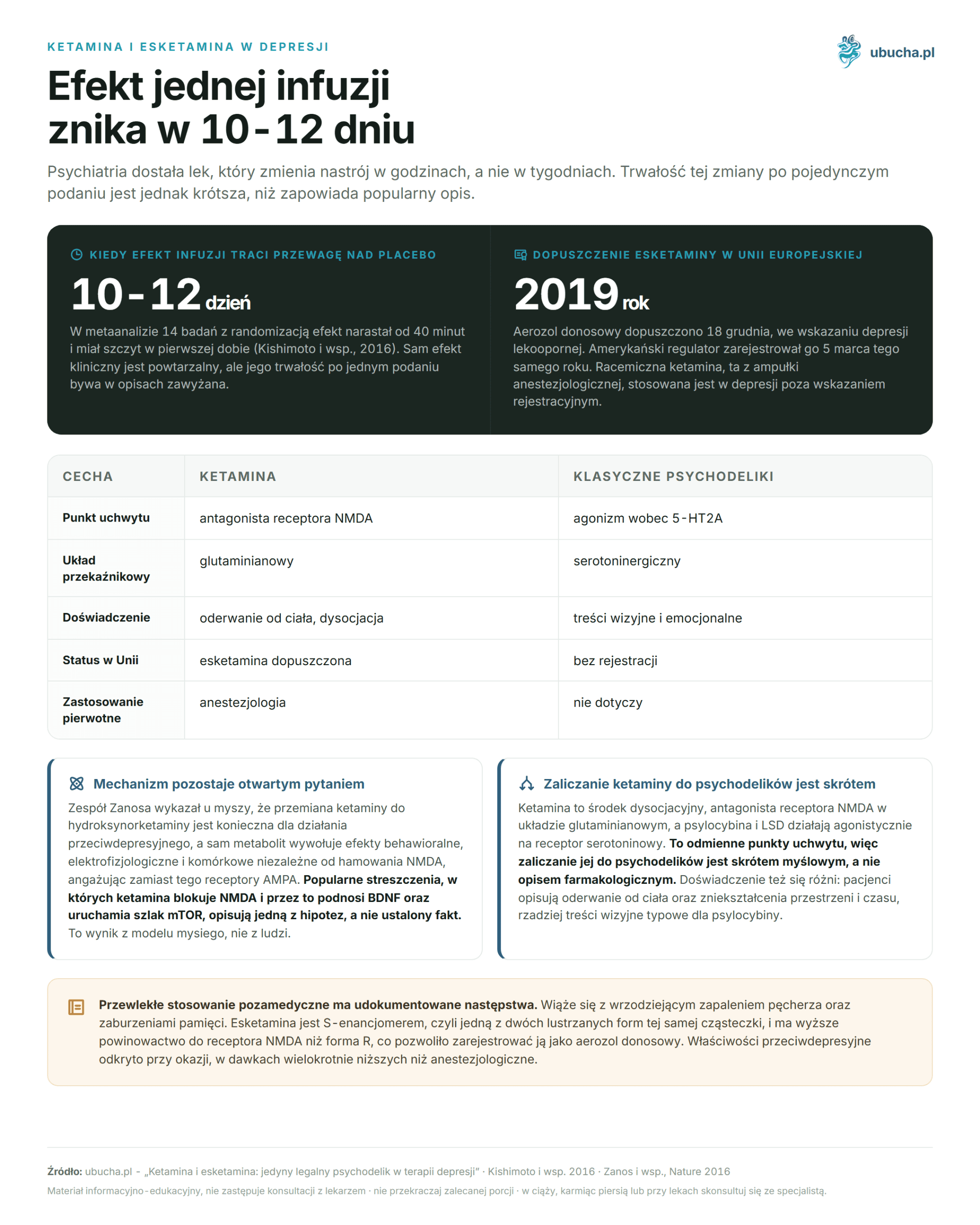
• In a meta-analysis of 14 randomized studies, the effect of a single infusion of ketamine increased from 40 minutes, peaked on the first day, and lost its advantage over placebo on the 10th-12th day (Kishimoto et al., Psychological Medicine, 2016).
• Esketamine nasal spray was approved in the European Union on December 18, 2019, for treatment-resistant depression.
• Ketamine is a dissociative agent, not a classic serotoninergic psychedelic.
• Chronic non-medical use is associated with ulcerative cystitis and memory impairments.
What is ketamine and how does it differ from classic psychedelics?
Ketamine is a dissociative agent, an NMDA receptor antagonist in the glutamatergic system. Classic psychedelics, such as psilocybin and LSD, act agonistically on the serotonin receptor 5-HT2A. These are different points of action, so classifying ketamine as a psychedelic is a simplification, not a pharmacological description.
In anesthesiology, ketamine has been in use since the 1960s, mainly where respiratory and circulatory stability is crucial: in emergency medicine, in field conditions, and in children. Its antidepressant properties were discovered incidentally, at doses many times lower than anesthetic doses, and this opened its second life in psychiatry.
Esketamine is the S-enantiomer of ketamine, meaning one of the two mirror forms of the same molecule. It has a higher affinity for the NMDA receptor than the R form, which allowed it to be registered as a nasal spray. Racemic ketamine, the one from the anesthetic ampoule, is used off-label in depression.
The experience after ketamine also differs from the psychedelic one. Patients describe a detachment from the body, distortions of space and time, and less frequently visual and emotional content typical of psilocybin. This difference has practical significance, as it affects how much supervision a session requires and how long a patient stays in the office.
How do ketamine and esketamine work in depression?
The starting point is the blockade of the NMDA receptor, but that is where the agreement ends. The most prominent work of the last decade claims that the antidepressant effect is not due to ketamine itself, but to its metabolite, and this is independent of NMDA inhibition. The mechanism remains an open question, even though the clinical effect itself is repeatable.
The Zanos team showed in mice that the conversion of ketamine to hydroxynorketamine (2R,6R-HNK) is necessary for the antidepressant action, and the metabolite itself induces behavioral, electrophysiological, and cellular effects independent of NMDA inhibition. Instead, it engages AMPA receptors, and this occurs early and persistently. The work adds that 2R,6R-HNK does not produce the side effects typical of ketamine (Zanos et al., Nature, 2016). This result comes from a mouse model, not from humans, and should be read as such.
Popular summaries of the mechanism, in which ketamine blocks NMDA and thereby increases BDNF and activates the mTOR pathway, describe one of the hypotheses, not an established fact. Zanos challenges the NMDA link. If you are interested in where the idea that a psychoactive substance can remodel neural connections came from, we have described it separately in a text about neuroplasticity and BDNF.
The practical consequence is that the speed of action of ketamine does not result from the same pathway as the action of serotoninergic drugs. However, this does not mean that it is already known which exact pathway it takes. Research is ongoing into hydroxynorketamine itself as a drug that would provide an effect without dissociation.
What have clinical studies shown about ketamine and esketamine?
The registration of esketamine is based, among other things, on a phase III study conducted in 39 outpatient centers. Of 435 patients screened, 227 were randomized, and 197 completed the 28-day blinded phase. All had moderate to severe depression and no response to two antidepressant medications.
Patients were randomly assigned to nasal esketamine at a dose of 56 or 84 mg twice a week along with a newly introduced oral medication or to the new oral medication alone with a placebo spray. After 28 days, the difference in the MADRS scale was 4.0 points in favor of esketamine, with a 95% confidence interval from 0.64 to 7.31 points, and the most common side effects were dissociation, nausea, dizziness, taste disturbances, and vestibular dizziness. Due to side effects, 7% of patients in the esketamine group discontinued treatment compared to 0.9% in the comparison group, and symptoms appeared shortly after the dose and subsided within one and a half hours (Popova et al., American Journal of Psychiatry, 2019).
For intravenous infusions, a meta-analysis of 14 randomized studies, including nine with ketamine involving 234 individuals, is decisive. Ketamine reduced the severity of depression more clearly than placebo from the 40th minute, peaked on the first day (Hedges g equal to minus 1.00; 95% confidence interval from minus 1.28 to minus 0.73), and lost its advantage between the 10th and 12th days. The response rate was higher than in the placebo group from the 40th minute to the 7th day, and remission from the 80th minute to the 3rd-5th day (Kishimoto et al., Psychological Medicine, 2016).
This last number is more important than it seems. Popular descriptions talk about an effect lasting for weeks; the meta-analysis measures it in days. This is where the protocols for series of administrations and maintenance treatment come from.
| Parameter | Intravenous Ketamine | Nasal Esketamine |
|---|---|---|
| Route of administration | Intravenous infusion in the office | Nasal spray, self-administered under supervision |
| Registration status | Off-label (anesthetic drug) | FDA March 5, 2019, European Union December 18, 2019 |
| Time to effect in studies | From 40 minutes, peak on the first day | Difference from placebo measured after 28 days |
| Duration after a single administration | Advantage over placebo disappears on the 10th-12th day | The scheme assumes repeated doses, not a single administration |
| Supervision after administration | Monitoring of blood pressure and consciousness | Observation in the facility, symptoms subside within 1.5 hours |
What does ketamine therapy look like in practice?
The session takes place in a medical facility, not at home. The patient lies down, has their blood pressure and pulse monitored, and the staff stays with them until the dissociation subsides. In the registration study of esketamine, symptoms appeared shortly after the dose and subsided within one and a half hours, and this interval defines the length of observation.
During the administration itself, most people experience dissociation: feelings of detachment from the body, distortions of space, sometimes taste disturbances and dizziness. This is not a complication, but an expected effect that passes on its own. After the session, driving is not allowed, so one must arrive with someone or plan a different way to return.
The therapy does not end with the administration of the drug. In the registration study, esketamine was always used together with a newly introduced oral antidepressant, never alone. Since the advantage of a single infusion over placebo disappears within two weeks, maintenance treatment is not an addition but a condition for maintaining the effect.
Combining infusions with psychotherapy is sometimes described separately. While preparing this text, we did not find in the reviewed works a measurement indicating how much such a combination prolongs the effect, so we present it as a research direction, not as a determination. We have gathered organizational details on the Polish side in a separate text about ketamine therapy in Poland.
Who qualifies for ketamine therapy, and who does not?
The registration indication for esketamine is treatment-resistant depression, defined in the registration study as a lack of response to at least two antidepressant medications in the current episode, with the response to one of them assessed prospectively. Qualification is conducted by a psychiatrist and cannot be bypassed or expedited.
The second registered indication in the United States concerns depression with active suicidal thoughts. The FDA approved it on July 31, 2020, as an extension of efficacy to the original registration from 2019. The indication includes depressive symptoms, not suicide prevention. The product characteristics state explicitly that the efficacy of esketamine in preventing suicide or reducing suicidal thoughts and behaviors has not been demonstrated, and administration of the drug does not exempt from hospitalization if clinically indicated (ChPL Spravato, EMA). In both registration studies for this indication, all participants were hospitalized, and the improvement in the severity of suicidal tendencies after 24 hours did not differ significantly between esketamine and placebo. If such thoughts concern you, the way to seek help is through a psychiatrist or an emergency department, not a substance: free and available 24/7 are the numbers 116 123 and 800 70 2222, and in case of immediate life-threatening danger, call 112.
Contraindications are mainly cardiovascular and psychiatric. Ketamine temporarily raises blood pressure, so uncontrolled hypertension and serious vascular disease exclude or postpone treatment. Caution is also required for individuals with psychotic disorders, bipolar affective disorder, and a history of addiction. Pregnancy and breastfeeding require a separate discussion with the attending physician.
If you are looking for a dose for yourself, you will not find it here, and this is not an oversight. The numbers given above describe specific clinical studies and make sense only together with their protocol, population, and supervision. Outside the office, they do not translate into anything.
How does ketamine differ from psilocybin and MDMA?
The most practical difference is regulatory. Esketamine has FDA registration in two indications: in treatment-resistant depression in adults and in depressive symptoms in adults with a severe episode and active suicidal thoughts or behaviors, in the latter case only together with an oral antidepressant. It also has approval throughout the European Union.
Psilocybin and midomafetamine, or MDMA, are not currently listed in the American register of approved drugs for any indication. Therefore, outside of clinical research, they remain legally unavailable, regardless of how promising reports may be. What this means for patients is outlined in the text about the FDA decision on MDMA.
The second difference is pharmacological and has practical consequences. Ketamine acts on the glutamatergic system, psilocybin on the 5-HT2A receptor, and MDMA through the release of monoamines. Different points of action mean different drug interaction profiles and different contraindications, which is why an institution’s experience with one substance does not automatically transfer to another.
The third is time. A session with ketamine and observation afterward takes place within a few hours, and in the registration study of esketamine, symptoms subsided within one and a half hours after the dose. Sessions with classic psychedelics last significantly longer and require the presence of staff for the entire day, which directly translates into the cost and availability of such treatment.
Frequently Asked Questions
Is ketamine a psychedelic?
Not in the pharmacological sense. Ketamine is a dissociative agent acting as an NMDA receptor antagonist in the glutamatergic system, while classic psychedelics, such as psilocybin and LSD, stimulate the serotonin receptor 5-HT2A. It is colloquially included in this group due to altered consciousness during administration, but the point of action is different.
How quickly does ketamine work in depression and how long does it last?
In a meta-analysis of 14 randomized studies, involving nine trials with ketamine and 234 individuals, the effect began to increase from the 40th minute and peaked on the first day. The advantage over placebo disappeared between the 10th and 12th day (Kishimoto et al., Psychological Medicine, 2016). Therefore, protocols assume a series of administrations and maintenance treatment.
Is it known how exactly ketamine affects mood?
Not entirely. The work of Zanos’ team showed in mice that the antidepressant effect is attributed to the ketamine metabolite, hydroxynorketamine, independent of NMDA receptor inhibition, through AMPA receptors (Zanos et al., Nature, 2016). The popular description involving NMDA, BDNF, and mTOR is a hypothesis, not a determination.
Is esketamine registered in the European Union?
Yes. Esketamine in a nasal spray received marketing authorization valid throughout the European Union on December 18, 2019, for treatment-resistant depression. The American FDA registered it earlier, on March 5, 2019. The availability of a specific center and reimbursement is determined by national regulations, not the registration itself.
What are the risks of using ketamine outside of treatment?
A review of the literature on ketamine harms indicates ulcerative cystitis as the main physical harm, particularly associated with chronic and frequent use. Frequent use is also associated with impairments in working and episodic memory, and many users report unsuccessful attempts to quit (Morgan and Curran, Addiction, 2012).
This article is for informational and educational purposes. It describes clinical studies in which the substance is administered under medical supervision after participant qualification; using it on your own does not replicate these conditions. These substances are controlled in Poland under the Act on Counteracting Drug Addiction. If you have suicidal thoughts, call the free, 24-hour numbers 116 123 or 800 70 2222. In case of life-threatening danger: 112.
Author: Michał Waluk · Published: 2026-08-09 · Updated: 2026-08-16