
CBD in Sports 2026: WADA, POLADA Regulations and New Clinical Studies
The WADA 2026 list excludes only cannabidiol. Find out why broad and full spectrum are not compliant and what THC threshold applies in an athlete's urine.
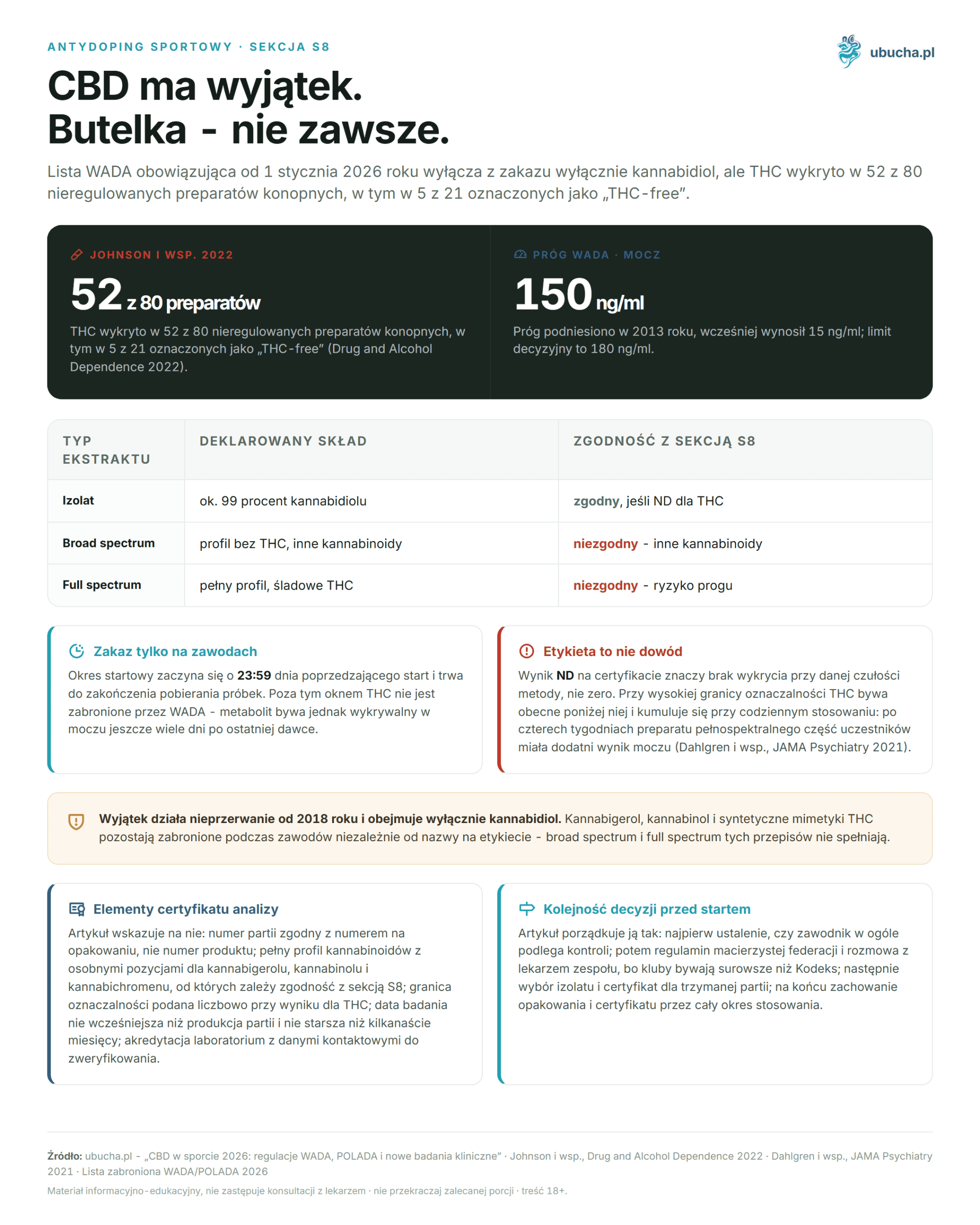
The exception allowing an athlete to legally use hemp concerns exactly one molecule. The prohibited list effective from January 1, 2026, excludes cannabidiol from section S8 and nothing else. Cannabigerol, cannabinol, and tetrahydrocannabinol remain among substances prohibited during competitions, so products labeled broad spectrum or full spectrum do not comply with these rules, although they are legal for sale in Poland. Laboratory data add to this. THC was detected in 52 of 80 tested products, and after four weeks of full-spectrum product use, half of the study participants had a positive urine test. Below you will find the regulatory status as of August 15, 2026, a review of studies from 2016-2026, and a product selection procedure that avoids disqualification.
KEY INFORMATION
• THC was detected in 52 of 80 hemp products, including 5 labeled “THC-free” (Johnson et al., Drug and Alcohol Dependence 2022).
• The WADA 2026 list excludes only cannabidiol from section S8, so broad spectrum and full spectrum are not compliant.
• The THC ban applies during competitions, not year-round.
• The threshold for carboxy-THC in urine is 150 ng/ml, with a decision limit of 180 ng/ml.
Is cannabidiol allowed by WADA in 2026?
Yes. Cannabidiol is the only substance excluded from section S8 of the Prohibited List effective from January 1, 2026. The exception has been continuously in effect since 2018 and the 2026 edition did not change it. It covers the molecule itself, not hemp extracts containing it.
The Polish version of the list, published by the Polish Anti-Doping Agency, in section S8 contains a short and strict statement. The header reads “PROHIBITED IN COMPETITION,” followed by “All natural and synthetic cannabinoids are prohibited,” then lists substances present in hemp and hemp products, natural and synthetic tetrahydrocannabinols, and synthetic cannabinoids mimicking THC. At the end of the section is one entry under “EXCEPTIONS”: cannabidiol.
This wording has a serious practical consequence. The list does not say “products with cannabidiol are allowed,” but exempts one chemical compound from the ban. WADA already noted this in the 2018 changes summary, warning that cannabidiol derived from hemp plants may contain varying THC levels, which remains prohibited. In other words, compliance depends on the composition of the specific bottle, not the ingredient name on the label.
| Section S8 Wording (2026 list) | Status for Athlete |
|---|---|
| Substances present in hemp and hemp products | Prohibited in competition |
| Natural and synthetic tetrahydrocannabinols | Prohibited in competition, threshold 150 ng/ml |
| Synthetic cannabinoids mimicking THC | Prohibited in competition |
| Cannabidiol | Exception, not prohibited |
Which cannabinoids besides cannabidiol remain prohibited?
All of them. Section S8 prohibits natural and synthetic cannabinoids without naming them individually, with cannabidiol as the sole exception. Cannabigerol, cannabinol, and cannabichromene fall under this description as natural cannabinoids present in hemp products. A product containing them is not compliant for an athlete.
This is where athlete guides often get confused. They commonly recommend choosing broad spectrum because “it contains no THC.” Removing THC alone does not solve the issue, as the rest of the cannabinoid profile remains banned. Broad spectrum is by definition a multi-cannabinoid product, so its compliance with section S8 is excluded based on declared composition.
A separate group is synthetic THC mimetics, sold under names like JWH-018 or HU-210. The list treats them exactly like plant cannabinoids. The wording also covers modified tetrahydrocannabinol forms, as it refers to tetrahydrocannabinols in plural, not only delta-9. Products advertised as outside regulations gain no special status because of this.
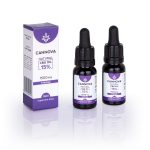
An athlete subject to anti-doping control thus has one option: an isolate, i.e., cannabidiol purified to about 99 percent, with a certificate of analysis for the specific batch.
| Extract Type | Declared Composition | Compliance with Section S8 |
|---|---|---|
| Isolate | Pure cannabidiol, about 99% purity | Compliant if batch shows ND for THC |
| Broad spectrum | Cannabinoid profile without THC | Non-compliant, contains other cannabinoids |
| Full spectrum | Full cannabinoid profile with trace THC | Non-compliant, plus risk of exceeding threshold |
When does the THC ban apply and what is the urine threshold?
The ban applies only during competitions, not year-round. The competition period starts at 23:59 the day before the event in which the athlete is scheduled to participate and lasts until the end of the event and sample collection. The laboratory reports an adverse analytical finding when carboxy-THC concentration in urine exceeds 150 ng/ml.
This value is accompanied by a decision limit of 180 ng/ml, accounting for measurement uncertainty. The threshold was raised in 2013 from 15 ng/ml to reduce positive results from use outside the competition period. This change was introduced by a technical document on decision limits effective May 11, 2013. The effect was clear: the explanatory note for section S8 reported a drop in adverse analytical findings for cannabinoids from an average of 400-500 annually in 2009-2012 to fewer than 100 in 2021.
Since 2021, THC is classified in the Code as a substance of abuse. The standard suspension period is three months, reducible to one month if the athlete proves use occurred outside competition and was unrelated to performance, and completes an approved program. However, this does not save the competition result: under Article 9 of the Code, the result, medal, and prize from that event are forfeited.
The 150 ng/ml threshold applies within the WADA system. Outside it, rules may differ, as professional leagues and sports commissions write their own regulations, sometimes more lenient, sometimes stricter. The USADA agency reminds in its marijuana material that results above the threshold must be reported regardless of timing. Checking your federation’s regulations is thus part of preparation, not a formality.
How does POLADA apply these rules in Poland?
POLADA implements the World Anti-Doping Code without exceptions and publishes the Polish translation of the prohibited list effective January 1, 2026. The agency does not maintain its own register of safe hemp products, so product composition assessment rests with the athlete. The principle of strict liability applies: the person who provides the sample is responsible for the presence of prohibited substances.
In educational materials, POLADA relies on the Australian Institute of Sport’s supplement classification and notes that even products from the best-documented group are not free from the risk of a positive result. There is no separate path for hemp. For the athlete, this means no institution will pre-approve the safety of a specific bottle.
It is also worth remembering that the Polish document is a translation. The official WADA list is published in English and French, and in case of discrepancies, the English version is binding. In disputes over wording, the Polish file is not the reference point.
National law operates in parallel, regulating different matters than anti-doping rules. The Act of July 29, 2005, on counteracting drug addiction, consolidated text Dz.U. 2023 item 1939, as amended by the Act of March 24, 2022 effective May 7, 2022, defines industrial hemp as Cannabis sativa L. varieties where the sum of delta-9-THC and tetrahydrocannabinolic acid in flowering tops or fruiting parts, from which resin has not been removed, does not exceed 0.3 percent dry weight. The sum is rounded to one decimal place. Previously, the limit was 0.2 percent.
This distinction also matters practically for the athlete. The threshold refers to the plant, not the content in the finished product, and counts the sum of two compounds, not just delta-9-THC. A certificate showing only “total THC” calculated with a 0.877 factor answers a different question than the law.
Legality of sale and compliance with sports rules are thus two different things. Full-spectrum oil bought in a Polish store is legal and does not violate the law, yet remains a high-risk product for an athlete during the competition period. This thought division underpins the rest of this text.
How high is the risk of THC contamination in products?
Measurable and well documented. Johnson et al. tested 80 unregulated hemp products by liquid chromatography-mass spectrometry and detected THC above the limit of quantification in 52 samples, concentrations ranging from 0.008 to 2.071 mg/ml (Drug and Alcohol Dependence 2022).
The most concerning part concerns labels. Of 21 products labeled “THC-Free,” five contained detectable THC, concentrations from 0.015 to 0.656 mg/ml. The manufacturer’s declaration is thus not composition information unless backed by a batch-specific lab result.
A second study shows the urine test consequence. Dahlgren et al. conducted an open study of a full-spectrum product containing 9.97 mg/ml cannabidiol and 0.23 mg/ml THC, taken sublingually three times daily. Participants averaged 34.73 mg cannabidiol and 0.80 mg THC daily, doses a layperson would consider trace. After four weeks, 7 of 14 had a positive urine screening for THC metabolite (JAMA Psychiatry 2021).
The labeling problem extends beyond sports. A 2026 systematic review by Ovata et al. summarizes twelve studies and notes that even when concentrations did not exceed cutoffs, trace values near detection limits regularly appeared (International Journal of Legal Medicine 2026). For how long such traces remain in the body, see the text on detection times in blood and urine.
| Study | What was tested | Result |
|---|---|---|
| Bonn-Miller et al., JAMA 2017 | 84 internet-sold extracts | 30.95% correctly labeled, THC in 18 samples (21.43%) |
| Johnson et al., Drug Alcohol Depend 2022 | 80 unregulated products | THC in 52 samples, including 5 of 21 labeled THC-free |
| Spindle et al., JAMA Netw Open 2022 | 105 topical products | THC in 37 products, 4 labeled THC-free |
| Dahlgren et al., JAMA Psychiatry 2021 | 4 weeks full-spectrum product, 14 participants | 7 positive urine screening results |
What does cannabidiol do for post-exercise recovery according to studies?
Less than marketing promises. Randomized trials from 2021-2026 show inconsistent results: some find small effects on muscle damage markers, others find none. None included athletes under anti-doping control, and most had small sample sizes.
Isenmann et al. administered 60 mg cannabidiol immediately after resistance training and noted small but significant differences after 72 hours in creatine kinase, myoglobin, and squat strength recovery (Nutrients 2021). The same team repeated the protocol over six days with 17 trained subjects; this time myoglobin decrease occurred only after oil, not solubilizate, and only in some participants (Journal of the International Society of Sports Nutrition 2024).
On the other hand, Crossland et al. gave 24 trained female athletes 5 mg/kg around a 100 eccentric repetition protocol and found no difference versus placebo in inflammation, muscle damage, or perceived fatigue (Healthcare 2022). Topical gel performed similarly: Mendes et al. found no reduction in muscle pain or myoglobin (Journal of Cannabis Research 2026).
We noticed a recurring pattern: effects appear mainly in subjective measures and small groups, disappearing in objective power and strength tests. This is too weak a basis to prioritize cannabinoids over sleep and load planning. We discuss these studies in detail in the text on cannabidiol in post-workout recovery.
Do topical products help with muscle and joint pain?
Evidence in humans is weak, and athletes face the same composition risk as with oils. The most cited topical cannabidiol study was on an animal model, and the only randomized post-exercise trial did not reduce muscle pain or damage markers.
Hammell et al. applied cannabidiol gel to rats with induced knee joint inflammation for four days, doses from 0.6 to 62.3 mg/day. Joint circumference, immune cell infiltration, and pain behaviors decreased dose-dependently, with the two highest doses effective (European Journal of Pain 2016). This is a mechanistic premise, not human evidence, often misused in cosmetic descriptions.
Human data come from Mendes et al. Fifteen physically active participants applied gel to thighs immediately after drop jumps and for 72 hours after. Myoglobin concentration and pain scores did not differ from placebo. The only positive signal was quadriceps isometric moment from 24 to 72 hours post-exercise, which authors did not consider evidence of accelerated recovery.
Changing administration route does not remove anti-doping risk. Topicals can be contaminated like oils, and skin absorption leads to measurable plasma concentrations, as shown by Hammell’s experiment.
Does cannabidiol improve sleep and reduce pre-competition anxiety?
Data on anxiety are stronger than on sleep, but none come from athletes. The best-controlled anxiety trial gave 600 mg cannabidiol before a simulated public speaking test and showed reduced anxiety, discomfort, and cognitive impairment versus placebo. Participants were patients with social phobia, not athletes before competition.
This study, by Bergamaschi’s team with Crippa, included 24 previously untreated patients and a single dose 1.5 hours before the test (Neuropsychopharmacology 2011). Note the scale: 600 mg is 6 to 20 times higher than doses used in cited sports studies. Extrapolating this effect to 25 mg at night is overinterpretation.
Sleep data are weaker. Shannon et al. retrospectively analyzed records of 72 psychiatric clinic patients: 66.7% reported sleep improvement in the first month, but results fluctuated later; anxiety reduction in 79.2% was stable (The Permanente Journal 2019). There was no randomization, placebo, or blinding, so this is observation, not proof.
For athletes with competition stress, one regulatory detail is worth adding. Beta-blockers, used in such situations, are prohibited in selected precision sports: billiards, darts, golf, archery, minigolf, underwater sports, motorsports, and shooting. In archery and shooting, the ban applies year-round, not just competition period. The same applies to underwater sports. Cannabidiol is not subject to this restriction, which can be its only real advantage in this context. What athletes can take under control is compared in a separate text on anti-doping compliant supplements.
Does cannabidiol improve athletic performance?
There is no evidence. No available trial has shown increased oxygen capacity, peak power, or maximal strength after cannabidiol. From a regulatory perspective, this is favorable information, as lack of performance enhancement is one criterion for placing a substance on the prohibited list.
Sahinovic et al. gave nine trained runners 300 mg cannabidiol 1.5 hours before a 60-minute run and exhaustion test. Time to exhaustion and max heart rate did not differ from placebo. Authors noted weak signals of increased oxygen uptake and greater exercise enjoyment, but the study was pilot with 85% confidence intervals, meaning preliminary results (Sports Medicine Open 2022).
A broader picture comes from McCartney et al.’s narrative review, which gathered preclinical evidence and few clinical trials in non-athlete populations. Their conclusion is clear: studies directly on cannabidiol and sports performance are lacking, and available data do not allow recommendations for athletes (Sports Medicine Open 2020). Since that review, newer trials focus on recovery, not performance.
The practical conclusion is simple. If someone sells cannabinoids as a way to improve time or load, they contradict the data. Reasonable expectations end with well-being and possibly perceived pain.
How to choose dose and form to avoid increasing risk?
There is no established cannabidiol dosing protocol for athletes. McCartney’s review does not provide one, and individual trials used doses differing by over tenfold. Starting points are thus doses actually studied, not numbers invented for labels.
Administration form matters doubly. It affects absorption, but more importantly for athletes, whether batch composition can be verified. Dried flower and vaporization products are excluded by definition, as they contain full cannabinoid profiles. Topicals are not a safe loophole either, as Spindle et al. detected THC in 37 of 105 tested topical products (JAMA Network Open 2022).
The newest trial shows how cautiously to read such numbers. Stauffer et al. gave 29 healthy participants 67 mg cannabidiol daily sublingually in two doses for 15 days and noted less pain and strength loss 48 hours after induced quadriceps injury (Journal of Cannabis Research 2026). Authors call it a feasibility study and note effect size requires confirmation in larger groups.
The dosing principle is boring but proven: start low, change one parameter at a time, note effects. For competition, however, an additional condition applies: each product change means a new composition to verify in the lab.
| Study | Dose and Protocol | Effect |
|---|---|---|
| Isenmann et al. 2021, 16 subjects | 60 mg single dose post resistance training | Small differences after 72 h |
| Stauffer et al. 2026, pilot, 29 subjects | 67 mg daily sublingual, two doses, 15 days | Less pain and strength loss 48 h post injury |
| Crossland et al. 2022, 24 female athletes | 5 mg/kg body weight | No difference vs placebo |
| Sahinovic et al. 2022, 9 runners | 300 mg 1.5 hours pre-exercise | No effect on time to exhaustion |
How to read a batch certificate of analysis?
The certificate of analysis is the only document turning the manufacturer’s declaration into data. For an athlete, what matters is not just having it, but batch number matching the packaging and presence of numbers where marketing slogans usually stand. Without these, the certificate is decoration.
Also know what the certificate does not guarantee. ND means not detected at a given method sensitivity, not zero content. If the limit of quantification is high, THC may be present below it and still accumulate with daily use, as Dahlgren et al. showed. Thus, the number near the limit is more important than the ND abbreviation.
- Batch number matching the number stamped on packaging, not a general product number
- Full cannabinoid profile with separate entries for cannabigerol, cannabinol, and cannabichromene, as these determine compliance with section S8
- Limit of quantification numerically stated for THC result, preferably with detection limit
- Test date not earlier than batch production date and not older than several months
- Laboratory accreditation with verifiable contact details
If the manufacturer provides only an old sample certificate, treat it as no certificate. We analyze such documents point by point in a separate text on how to read a CBD certificate of analysis.
Where to start if you compete?
Start by determining if you are subject to testing. A national team athlete, a championship competitor, and a recreational marathon runner have very different risks. Only after this answer does product discussion make sense, as for most recreational runners section S8 restrictions do not apply.
If you are tested, the steps are strict. First, check your federation’s regulations and consult your team doctor, as club policies may be stricter than the Code. Then choose an isolate and obtain the certificate for the exact batch you have. Finally, keep the packaging and certificate throughout use, as in disputes these are your only evidence.
Our store observations show the most common mistake is not choosing the wrong concentration but changing products mid-season without rechecking the certificate. A new batch means a new lab result, even if the label and name remain the same.
If unsure about product composition, it is safer to stop use during competition periods than seek confirmation afterward. THC metabolite can be detected in urine many days after last dose, especially with daily use, so a decision made a day before competition cannot reverse anything.
Also honestly weigh the balance. On one side are effects small and unstable in studies; on the other, risk of losing competition results and a three-month suspension. Given these proportions, abstaining from hemp products during competition is a reasonable, not cautious, decision.
Frequently Asked Questions
Is cannabidiol allowed by WADA in 2026?
Yes. The prohibited list effective January 1, 2026, lists cannabidiol as the only exception in section S8. The exception has been continuously in place since 2018. It covers the molecule itself, not hemp extract containing it. All other natural and synthetic cannabinoids remain prohibited during competitions.
Is a broad spectrum product safe for an athlete?
No. Broad spectrum by definition contains cannabigerol, cannabinol, and cannabichromene, and section S8 prohibits all natural cannabinoids except cannabidiol. Removing THC alone does not make the product compliant. An athlete subject to anti-doping control has one compliant option: an isolate with a certificate of analysis for the specific batch.
Is THC prohibited all year round?
No. Cannabinoids are listed as prohibited substances during competitions. The competition period starts at 23:59 the day before the event and ends with sample collection. Outside this period, THC is not prohibited by WADA, but its metabolite remains in urine long enough that use before competitions can be detected.
What is the THC threshold in an athlete’s urine?
The laboratory reports an adverse analytical finding when carboxy-THC concentration exceeds 150 ng/ml, with a decision limit of 180 ng/ml. The threshold was raised in 2013 from 15 ng/ml. Outside the WADA system, separate rules apply, so athletes should check their federation’s regulations, not just the WADA list.
How high is the risk of THC contamination in hemp products?
Measurable. Johnson et al. detected THC in 52 of 80 tested products, including 5 of 21 labeled as THC-free (Drug and Alcohol Dependence 2022). In Dahlgren et al.’s study, after four weeks of full-spectrum product use, 7 of 14 participants had a positive urine screening result (JAMA Psychiatry 2021).
Does cannabidiol speed up post-workout recovery?
Evidence is weak and inconsistent. Isenmann et al. noted small effects on creatine kinase and myoglobin after 72 hours (Nutrients 2021), but Crossland et al. found no difference versus placebo (Healthcare 2022). None of these effects justify the risk of disqualification from choosing the wrong product.
Does cannabidiol improve athletic performance?
There is no evidence. In a pilot study, Sahinovic et al. found that 300 mg before exercise did not change time to exhaustion or maximum heart rate (Sports Medicine Open 2022). McCartney et al.’s review states that studies on cannabidiol and sports performance are simply lacking (Sports Medicine Open 2020).
What to look for in a certificate of analysis before purchase?
Batch number matching the packaging, a full cannabinoid profile with separate entries for cannabigerol and cannabinol, ND result for THC with the limit of quantification provided, test date not earlier than the batch production date, and laboratory accreditation. The label ‘THC-free’ alone without numbers means nothing.
If you do not compete under the Code, your choices are much broader and you can safely compare available hemp oils and hemp cosmetics based on your needs, not anti-doping rules.
This article is for informational and educational purposes and does not constitute legal or medical advice. The regulatory status described is as of August 15, 2026, based on the Prohibited List effective January 1, 2026. Regulations change annually, and individual federations may apply their own thresholds, so before using any hemp product, check the current list at wada-ama.org and antydoping.pl and consult your team doctor.
Author: Michał Waluk · Published: 2026-05-11 · Updated: 2026-08-15