
Vaporization Temperature: What to Set and Why
185-210 degrees for cannabis herb, and the lowest setting does not provide the cleanest vapor. What measurements say, where myths about boiling points of terpenes come from.
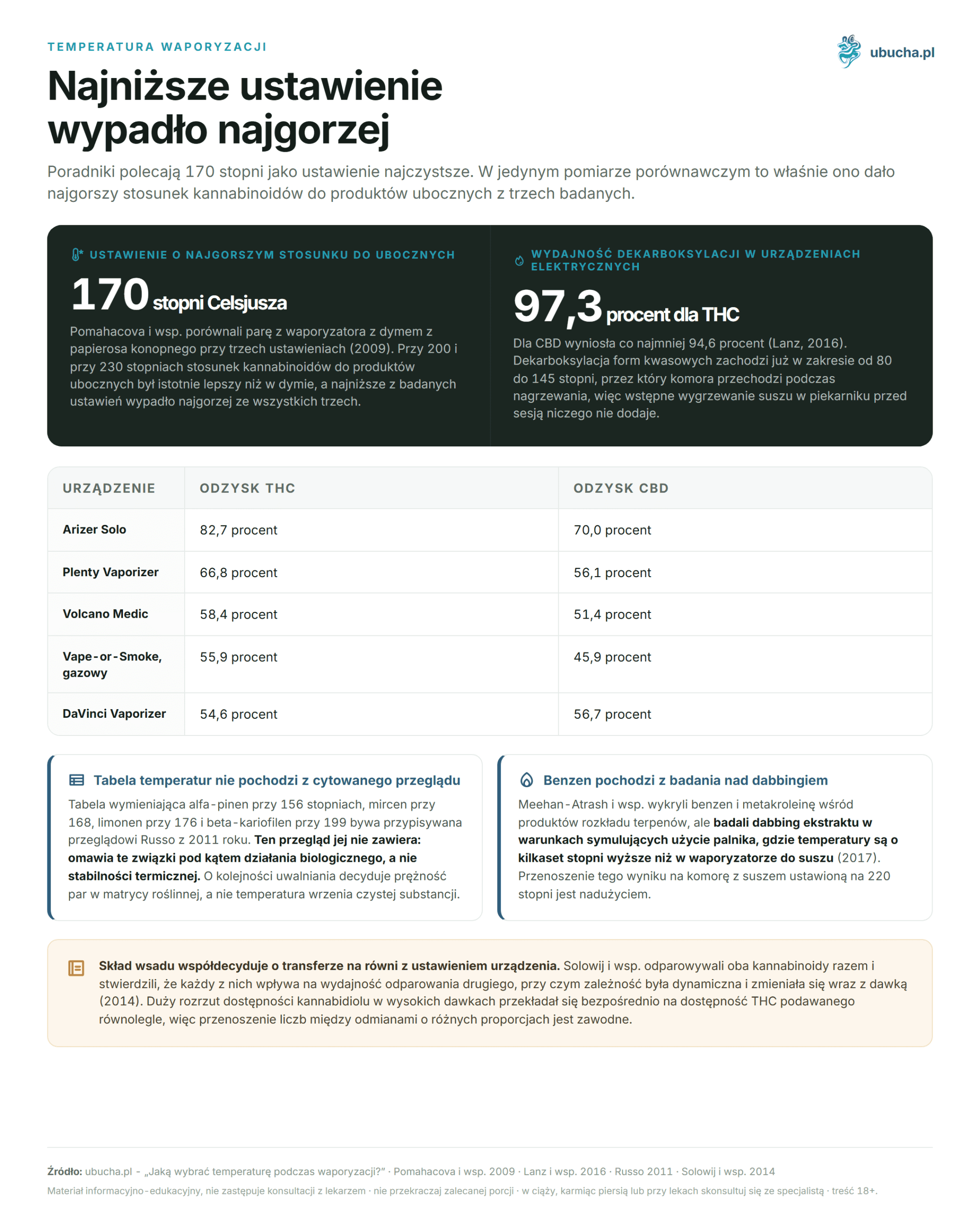
For sessions with cannabis herb, set 185 to 210 degrees Celsius, not the lowest available value: in the only comparative measurement, the 170-degree setting performed the worst. A lower setting does not mean cleaner vapor. Temperature determines how many active substances transfer from the herb to the vapor and how clean that vapor will be. However, more myths than hard data have accumulated around this parameter. Popular tables of boiling points for cannabinoids and terpenes, repeated in hundreds of guides, do not come from any scientific work, and the burning threshold usually given as 230 degrees Celsius is not confirmed by the study it is most often associated with. This text is based solely on works verified for identity and content: measurements of cannabinoid transfer in vaporizers, decarboxylation studies, and comparisons of vaporization with smoking. Instead of pseudoprecise thresholds regarding degrees, you will find here ranges actually used in studies and what was measured in them.
KEY INFORMATION
- Tables of boiling points for cannabinoids and terpenes circulating in guides have no basis in literature; the order of release is determined by vapor pressure, not boiling temperature (Eyal et al., 2023).
- In the only comparative measurement, the ratio of cannabinoids to by-products was better at 200 and 230 degrees than in smoke, and the WORST at 170 degrees (Pomahacova et al., 2009).
- Cannabinoid recovery in electric vaporizers ranges from 51 to 83 percent depending on the device (Lanz et al., 2016).
- Decarboxylation of acidic forms occurs already in the range of 80 to 145 degrees, and THCA decomposes twice as fast as CBDA (Wang et al., 2016).
- Vaporization reduces carbon monoxide concentration in exhaled air compared to smoking at comparable THC concentrations in plasma (Abrams et al., 2007).
- Monoterpenes evaporate first, so you inhale terpenes before cannabinoids regardless of the setting.
Why does temperature determine the composition of vapor?
Temperature controls the order in which individual molecules transition from the herb to the aerosol. Lighter volatile compounds evaporate first, heavier ones require a higher setting. The practical effect is that the same 0.2 grams of herb gives a different vapor composition at the beginning of the session and another at the end, even when the dial remains in one place.
The mechanism that organizes this is the vapor pressure of individual components at a given temperature, not their boiling point. Eyal and colleagues (PMC10249740, 2023) analyzed changes in the composition of cannabis products at various stages of processing and showed that the relative evaporation rate results from vapor pressure, and monoterpenes are lost first. Their conclusion regarding vaporization is clear: terpenes are inhaled before cannabinoids.
This same work points out something more significant for the reader of guides. Materials directed to patients and medical staff contain, as the authors put it, incorrect data regarding evaporation, including boiling temperatures of cannabinoids, and confuse the concepts of boiling, vaporization, and evaporation. In other words, the problem is not that someone misquoted one number, but that an entire category of data circulating on this topic has been misunderstood at the source.
Therefore, the further part of the text does not provide thresholds regarding degrees for individual molecules. It provides ranges that someone actually set in the device and measured what came out of it.
Do boiling point tables for terpenes have research support?
No, they do not. A table listing alpha-pinene at 156 degrees, myrcene at 168, limonene at 176, and beta-caryophyllene at 199 is repeated in hundreds of guides and is sometimes attributed to Russo’s review from 2011. This review does not contain it.
Russo’s work (PMC3165946, 2011) is a pharmacological review dedicated to the synergy of cannabinoids and terpenoids. It discusses limonene, myrcene, alpha-pinene, linalool, and beta-caryophyllene in terms of biological action and possible synergy with cannabinoids. However, it does not contain either a compilation of boiling temperatures or any data on the thermal stability of vaporizers. Attributing to it a table of temperatures and a tolerance of plus or minus 5 degrees is quoting something that is not in this text.
The problem goes deeper than the lack of a citation. The boiling temperature of a pure substance at atmospheric pressure does not indicate at what temperature that substance will leave the plant matrix, in which it is dispersed in fractions of a percent. The sometimes cited value of 52 degrees for cannabigerol comes from a measurement at reduced pressure and has no bearing on the vaporizer chamber. Setting the device to this value will not release anything.
The practical conclusion is the opposite of the intuition built by the table. You cannot select a single molecule by setting the dial. However, you can influence the proportions: at a lower setting, you will get relatively more of the volatile fraction and aroma, and at a higher setting, relatively more of the heavy fraction. We have gathered more similar misunderstandings in a post about myths about vaporizing herb.
What do terpenes actually do in vapor?
They act at concentrations much lower than would be suggested by their content in the herb, but their interaction with cannabinoids remains a hypothesis, not an established fact. This distinction is lost in most guides, which present synergy as a proven fact.
Russo’s review discusses eight terpenoids present in cannabis: limonene, myrcene, alpha-pinene, linalool, beta-caryophyllene, caryophyllene oxide, nerolidol, and phytol. All are flavor and aroma components common in the human diet, recognized by the American Food and Drug Administration as safe. They also share a biosynthetic precursor with cannabinoids, which explains why they occur in the same plant in related proportions.
The most interesting number in this review concerns the strength of action. Terpenoids influence the behavior of animals and even humans at serum concentrations of single nanograms per milliliter, achieved even when inhaling from the surrounding air. These are orders of magnitude below the doses discussed for cannabinoids, and therefore the losses of terpenes during the session are significant despite their small share in the mass of the herb.
However, the author explicitly states that cannabinoid-terpenoid synergy still requires proof. He formulates it as a hypothesis worth investigating and proposes methods for future experiments, not as an established mechanism. Any guide that promises to tailor the effect of the session by controlling the terpene profile therefore jumps ahead of the state of knowledge by several steps.
Why does the herb lose aroma before it reaches the chamber?
Because evaporation begins long before the session. Eyal and colleagues traced the composition of cannabis products at various stages of production and found that changes related to evaporation occur already at drying and curing temperatures, intensifying during decarboxylation.
The order of losses is predictable and results from the same mechanism that governs the session. Monoterpenes, the lightest and most aromatic, are lost the fastest. The cumulative effect is described unequivocally by the authors: available medical cannabis products are depleted of terpenes, primarily monoterpenes, compared to the plants from which they were produced.
Hence the conclusion that strikes at the language of commercial descriptions. Terms like full spectrum or whole plant are misleading because no product replicates the composition of the original plant. It is not about the dishonesty of a specific manufacturer, but about the physics of the process through which the raw material must pass.
For the user, this means two things. First, lowering the session temperature will not recover the aroma that is no longer present in the herb. Second, the storage conditions between purchase and session have an impact on the aroma profile comparable to the device setting, as the same process continues in the jar all the time, just more slowly.
How many cannabinoids actually make it to the vapor?
From 51 to 83 percent, depending on the device. Lanz and colleagues (PMC4718604, 2016) examined five commercial vaporizers with THC and CBD type herb, measuring recovery in vapor using gas chromatography coupled with mass spectrometry. The variation between models turned out to be greater than the differences usually sought in temperature settings.
| Device | Total THC Recovery | Total CBD Recovery |
|---|---|---|
| Arizer Solo | 82.7 percent | 70.0 percent |
| Plenty Vaporizer | 66.8 percent | 56.1 percent |
| Volcano Medic | 58.4 percent | 51.4 percent |
| Vape-or-Smoke (gas) | 55.9 percent | 45.9 percent |
| DaVinci Vaporizer | 54.6 percent | 56.7 percent |
Two things from this table are worth remembering. First, no vaporizer releases the entire contents of the herb, so the rest remains in the chamber regardless of how long you draw. Second, the only gas-powered device performed the worst, and it was in this one that the authors observed burning of the material. Temperature control turned out to be more important than its value.
Solowij and colleagues (PMC4274767, 2014) reached similar orders of magnitude, working on pure substances applied to the insert in the Volcano vaporizer. The availability of THC in the vapor phase was 55 percent, and at high doses of cannabidiol about 40 percent. Their device operated at 230 degrees.
This same work brought an observation that complicates the picture more than any temperature table. When both cannabinoids were evaporated together, each influenced the evaporation efficiency of the other, with the relationship being dynamic and changing with the dose. The large variation in the availability of cannabidiol at high doses directly affected the availability of THC administered simultaneously. Thus, the composition of the load co-determines the transfer equally with the device setting, meaning that transferring numbers between strains with different cannabinoid ratios is unreliable.
What temperature range should I choose for the session?
Separately, the question returns about the setting for materials with HHC, and here the answer is different than a number. HHC has been a controlled substance in Poland since May 2023, so materials containing it are not a legal raw material for vaporization, and we do not provide ranges for them. All temperatures in this text refer to cannabis herb within the 0.3 percent threshold and herbs outside drug regulation. Transferring them to anything else is guesswork, as the thermal profile of a semi-synthetic derivative is not the same as that of a plant cannabinoid.
The range from 180 to 210 degrees is the setting at which most studies and medical devices operate, and it is worth starting from there. Not because some molecule boils at this point, but because a sensible recovery without signs of burning material was measured in this range.
The following table shows what was specifically measured at each setting in works that have been verified. This is not a boiling point table, but a list of measurements made.
| Setting | What was measured | Source |
|---|---|---|
| 80 to 145 degrees | Decarboxylation of acidic forms, first-order kinetics | Wang et al., 2016 |
| 170 degrees | Worst ratio of cannabinoids to by-products from three studied settings | Pomahacova et al., 2009 |
| 200 degrees | Ratio of cannabinoids to by-products significantly better than in smoke | Pomahacova et al., 2009 |
| 230 degrees | Ratio significantly better than in smoke; working setting for evaporating cannabidiol | Pomahacova et al., 2009; Solowij et al., 2014 |
The practice resulting from this data is simple. Start around 185 degrees, and after two or three draws, raise the setting by 15 to 20 degrees to extract the heavier fraction. Gradation makes sense because the composition of the vapor changes during the session by itself as lighter components are depleted. However, there is no basis to claim that such a protocol increases total transfer by a specific percentage, as no one has measured that.
The second pass at a higher temperature is justified by the recovery data itself. Since the best of the tested devices yields just over four-fifths of the THC content, and most are closer to half, a real portion of the material remains in the chamber after a session conducted in the lower range. Therefore, raising the setting at the end is not about squeezing out the leftovers forcefully, but reaching for a fraction that had no chance to evaporate at a lower temperature. Pomahacova also checked different amounts of raw material in the chamber, reminding us that the size of the load is a separate variable, not a detail without significance.
We have gathered ranges for herbs other than cannabis in a separate guide on vaporizing herbs.
Does burning start above 230 degrees?
No, in light of the work usually cited for this thesis. The claim that above 230 or 235 degrees, the production of benzene and toluene rises sharply is attributed to Pomahacova’s study from 2009. This study measured something else and reached the opposite conclusion.
Pomahacova and colleagues (PMID 19852551, 2009) compared the Volcano vaporizer with smoke from a cannabis cigarette, analyzing the composition using high-performance liquid chromatography at three settings. The ratio of cannabinoids to by-products at 200 and 230 degrees was significantly better than in smoke. The worst result was obtained at the 170-degree setting, which guides usually recommend as the cleanest.
So where does benzene come from in texts about vaporization? From another context. Meehan-Atrash and colleagues (PMC5623941, 2017) detected benzene and metacrolein among the products of terpene degradation, but they studied dabbing extracts under conditions simulating real use of a torch, where temperatures are several hundred degrees higher than in a dry herb vaporizer. Transferring this result to a chamber with herb set at 220 degrees is an abuse.
The difference between these methods is not cosmetic. Dabbing involves evaporating an extract from a heated surface, not washing the herb with a stream of air at a controlled temperature, so the material is exposed to incomparably harsher conditions. The degradation products of terpenes that arise under these conditions do not automatically transfer to the vaporization of herb. We have detailed the differences between these techniques in a post about what dabbing is and how it differs from vaporization.
What does this mean practically? Caution regarding high settings remains justified, but for a different reason than usually stated. The risk is not exceeding a sharp numerical threshold, but losing control over the temperature in a device that does not maintain it. Burning was observed in Lanza’s gas-powered model, not in electric models with regulation.
Convection or conduction: what does the heating type change?
The type of heating determines whether the set value corresponds to the temperature that the herb actually experiences. In convection, the material is washed by hot air and does not touch the heating element. In conduction, the herb lies directly on the heated wall, so the layer near the heater is warmer than the rest of the load.
This difference has a consequence that is visible in the data. In Lanza’s study, burning of the material occurred in the only device without electronically regulated heating, even though the other models operated in similar ranges. It was not about a higher setting, but about the lack of stable control. The same phenomenon on a smaller scale applies to cheap conduction designs.
Hence a practical correction for conduction: set the value a few degrees lower than what you like in convection, and mix the load after the second or third draw. Mixing equalizes the exposure of layers because in conduction, the lower part of the chamber heats up faster than the upper part. In convection, this step is not necessary.
Hybrids combine rapid heating with airflow during inhalation and behave more like convection in practice. If you are wondering which design suits your usage style, we have broken them down in detail in a post about convection, conduction, and hybrid vaporizers.
Is vaporization less harmful than smoking?
Data indicates that it is, although they are more modest than the popular narrative suggests. The strongest single result comes from a clinical study in which vaporization delivered a comparable dose with lower exposure to combustion products.
Abrams and colleagues (PMID 17429350, 2007) compared the Volcano vaporizer with a cigarette in eighteen individuals in a hospital setting, in a design with random assignment of three strengths of raw material over six days. The peak THC concentration in plasma and the area under the curve over six hours were similar for both methods, while the carbon monoxide concentration in exhaled air was lower with vaporization. No adverse events were reported.
The second pillar is methodologically weaker, and this must be stated clearly. Earleywine and Barnwell (PMC1853086, 2007) analyzed a large sample collected online and found that using a vaporizer was associated with fewer reported respiratory symptoms after controlling for age, sex, smoking cigarettes, and the amount of cannabis used. The effect increased with the amount. However, these are declarative data from a cross-sectional study, so they show a correlation, not a sequence.
What is not present in this literature, despite being cited: percentage reductions in markers of respiratory inflammation after a month of vaporization or multiples of toxin reductions expressed as a number. Such measurements were not performed in these works.
What does heating do to the acidic forms of cannabinoids?
It breaks them down into active forms, and this occurs much lower than the typical session setting. In raw herb, cannabinoids mainly occur as acids: THCA, CBDA, and CBGA. Only the removal of the carboxyl group yields forms that bind efficiently to receptors.
Wang and colleagues (PMC5549281, 2016) studied this process at 80, 95, 110, 130, and 145 degrees, over times up to sixty minutes. The concentration-time relationship turned out to be exponential, corresponding to first-order kinetics. The rate constants for THCA were twice as high as for CBDA and CBGA, and THCA decomposition occurred without by-products, while for CBDA and CBGA, the authors noted unexplained losses.
For vaporization, this has one consequence. Since the process occurs already at 145 degrees, every working setting of the vaporizer passes through this range during heating and decarboxylates the material along the way. This is confirmed by measurements from Lanza, where the decarboxylation efficiency in electric devices was at least 97.3 percent for THC and at least 94.6 percent for CBD. Pre-heating the herb in the oven before the session is therefore unnecessary.
We have written more broadly about the process itself and its applications beyond vaporization in a post about decarboxylation of cannabis.
What mistakes most often ruin a session?
Most unsuccessful sessions can be reduced to four repeatable mistakes, none of which require expensive equipment to fix. The following table connects them with what actually lies behind them.
| Error | What happens | Correction |
|---|---|---|
| Setting maximum temperature immediately | The volatile fraction evaporates in the first seconds before you can inhale it | Start lower and raise the setting during the session |
| Inhaling before the chamber is heated | Vapor poor in active substances, the session seems ineffective | Wait for the device’s readiness signal |
| Not mixing the load in conduction | The layer near the heater overheats, the upper part remains unused | Mix after the second or third draw |
| Evaluating the session by vapor density | Visibility of the aerosol depends on temperature and humidity, not on dose | Evaluate by effect and the color of the material in the chamber |
It is also worth mentioning the material. Over-dried herb crumbles and passes through the screen, while moist releases water first, making the first draws seem empty. However, there is no verified measurement linking a specific percentage of moisture with a specific temperature correction, so treat this as an observation from usage, not a laboratory rule.
Material after a well-conducted session has a color from golden to brown and is brittle. Black, charred load and a bitter aftertaste indicate that the device has exceeded the range in which it was supposed to operate, and then the setting needs to be lowered regardless of what the display shows.
Frequently Asked Questions
What vaporization temperature of the herb is best supported by research?
The range from 180 to 210 degrees Celsius. In Pomahacova’s study, the ratio of cannabinoids to by-products at 200 degrees was significantly better than in smoke from a cannabis cigarette, and the devices used in the other studies operated in similar ranges. This is a working setting, not a threshold resulting from boiling temperature.
Does a low temperature always give cleaner vapor?
No. Pomahacova and colleagues measured three settings and found the worst ratio of cannabinoids to by-products at 170 degrees, the lowest of those studied. A low temperature provides more aroma and a smaller dose, but it is not automatically safer for the aerosol composition.
Do boiling points of terpenes allow for the selection of a specific compound?
No, they do not. Tables circulating in guides do not come from literature, and the order of release is determined by the vapor pressure in the plant matrix, not the boiling temperature of the pure substance. Eyal and colleagues directly indicate that materials for patients contain incorrect data in this regard.
Above what temperature does the herb start to burn?
There is no verified numerical threshold for herb in a vaporizer. Burning was observed in a device without electronically regulated heating, while models with temperature control operated without this effect. The risk is determined by the stability of heating, not by exceeding a specific value on the display.
How many cannabinoids transfer from the herb to the vapor?
In Lanza’s study, the total THC recovery ranged from 54.6 to 82.7 percent, and total CBD from 45.9 to 70.0 percent, depending on the device. No vaporizer releases the entire contents of the chamber, so some material remains in it after the session.
Do I need to decarboxylate the herb before vaporization?
No, it is not necessary. Decarboxylation occurs already in the range of 80 to 145 degrees, which the chamber passes through during heating. In electric devices, an efficiency of at least 97.3 percent for THC and 94.6 percent for CBD was measured, so pre-heating in the oven adds nothing.
Is vaporization less harmful than smoking?
Available data indicates so. Abrams and colleagues obtained comparable THC concentrations in plasma with lower carbon monoxide concentrations in exhaled air. Data on fewer respiratory symptoms come from a cross-sectional study based on declarations, so they show a correlation, not a sequence.
Is convection better than conduction?
It provides greater control over temperature because the herb does not touch the heating element. In conduction, the layer near the heater is warmer than the rest of the load, so it is worth setting a value lower by several degrees and mixing the material during the session. Hybrids behave more like convection in practice.
You can find herb and equipment for it in the categories cannabis herb and vaporizers.
This article is for informational and educational purposes and does not constitute medical advice. Before starting to use cannabis or CBD for therapeutic purposes, consult a doctor, especially if you are taking other medications, are pregnant, or breastfeeding.
Author: Michał Waluk · Published: 2026-05-11 · Updated: 2026-08-24