
Decarboxylation in the Oven: What Temperature and How Long
110 degrees Celsius for 30 minutes for THCA and about 60 minutes for CBDA. Measured times, terpene losses, and errors that spoil the whole process. Also sous-vide.
Set your oven to 110 degrees Celsius and count about 60 minutes for hemp flower rich in CBDA or about 30 minutes for material rich in THCA. That is the whole answer; the rest of the text explains where these numbers come from and what spoils them. Decarboxylation is one of the few stages of home cannabis processing that can be verified with laboratory numbers. Wang and colleagues measured in a vacuum dryer how many minutes it takes for THCA-A acid to disappear at a given temperature: 30 minutes at 110°C, 9 minutes at 130°C, 6 minutes at 145°C, and below 100°C the reaction does not finish within an hour (Wang et al., Cannabis and Cannabinoid Research, 2016). The same measurements show the other side of the process, which guides omit: part of the material simply disappears. Here you will find a procedure for hemp flower, a temperature table straight from measurements, a list of errors, and an explanation why the home process does not allow calculating how many cannabinoids finally end up in the jar of oil.
KEY INFORMATION
• At 110°C THCA-A disappeared after 30 minutes, at 130°C after 9 minutes (Wang et al., PMC 2016).
• CBDA and CBGA react about twice as slowly as THCA-A.
• Even in a vacuum dryer, 8 to 53% of the total moles of cannabinoids were lost.
• The guide concerns hemp, i.e., plants with a sum of delta-9-THC and THCA up to 0.3% dry weight (art. 4 point 5 of the Act on Counteracting Drug Addiction).
• The home process does not allow predicting the content of the finished product.
What is decarboxylation and what exactly does it change in the flower?
Decarboxylation is the removal of the carboxyl group from the acidic cannabinoid under heat. CBDA converts to CBD, CBGA to CBG, THCA-A to THC, and the byproduct is carbon dioxide. The reaction follows first-order kinetics starting from 80°C (Wang et al., 2016).
In the living plant, cannabinoids occur almost exclusively in acidic form. Kim and colleagues sampled the contents of secretory cavity trichomes of the Cherry Wine cannabis strain, rich in CBD, using glass microcapillaries and compared it with the same plant’s inflorescence dried for 15 days in darkness at room temperature. In the cavity itself, the CBD to CBDA ratio was about 1:99, and after two weeks of drying about 1:20 (Kim et al., Scientific Reports, 2024). In other words: the reaction starts on its own, but very slowly. We explained the chemistry of the transformation more extensively in the post about what decarboxylation is.
Why does this matter practically? Acidic and neutral forms behave differently toward receptors, so raw flower and heated flower are pharmacologically two different raw materials. The chemistry of the process has been known for a long time and was used analytically even before the cannabis market developed, to convert acids into neutral derivatives before chromatographic separation (Veress et al., Journal of Chromatography, 1990). Filer’s 2022 review summarizes current knowledge on the mechanism and kinetics of this transformation and concludes with a practical insight: for anyone collecting or storing raw material, it matters not only how to trigger the reaction but also how to prevent it (Filer, Cannabis and Cannabinoid Research, 2022). If you wonder where the terms raw and decarboxylated on oil labels come from, that is the difference, described more fully in the post about raw and decarboxylated oils.
The same chemistry explains how labs report raw material test results. The acidic molecule is heavier than the neutral one by the mass of the removed carbon dioxide, so when converting acidic form to neutral, it is multiplied by a factor derived from the ratio of molecular masses, approximately 0.877. The sum of neutral and converted acidic forms is the value reported on certificates as the total content of a given cannabinoid.
What temperatures and times come from laboratory measurements?
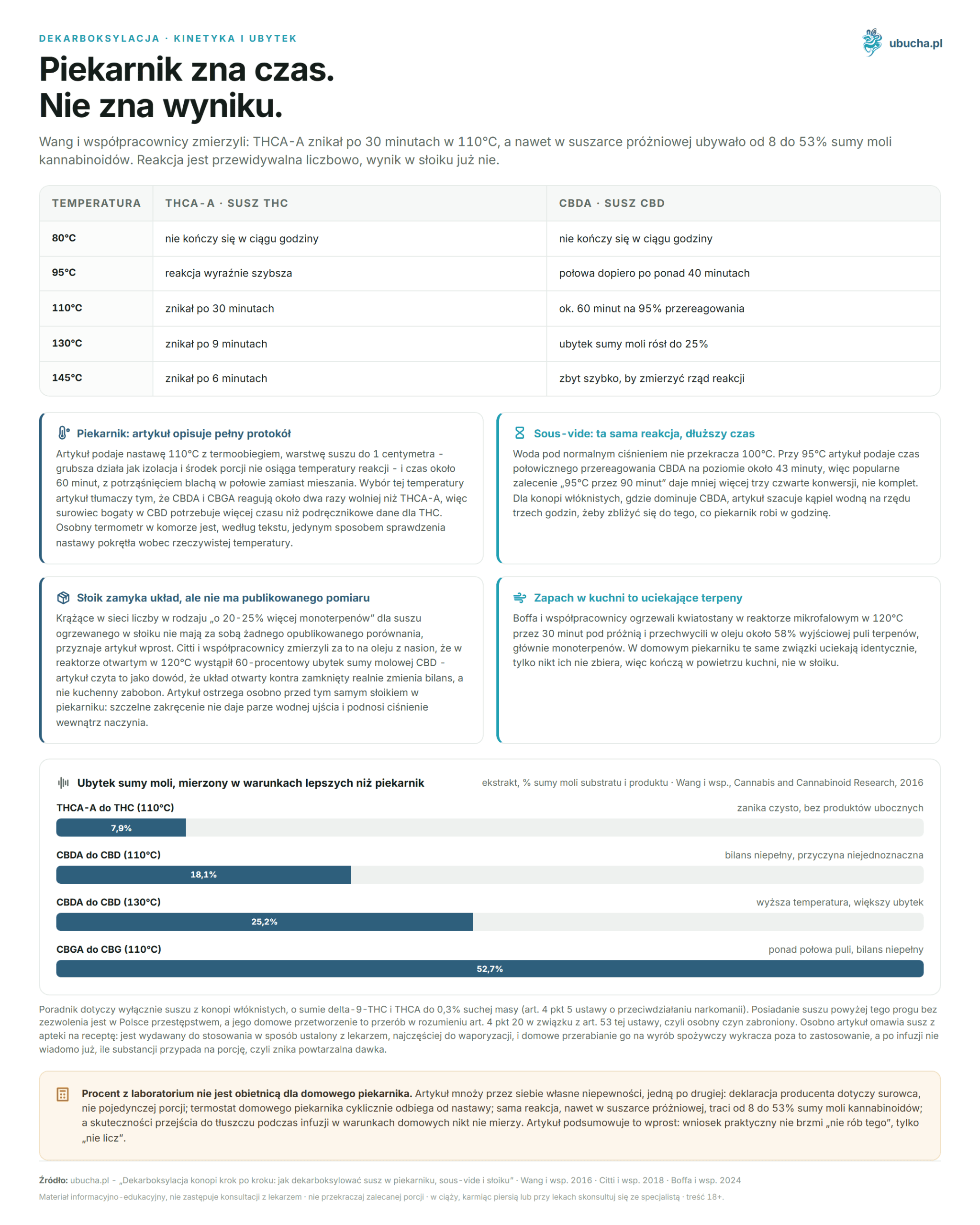
The reference point is the work of Wang and colleagues. Cannabis sativa extracts were heated in a vacuum dryer at 80, 95, 110, 130, and 145°C for up to 60 minutes, and the content of nine cannabinoids was measured by mass-detection chromatography. Below 100°C the reaction did not complete within an hour.
| Temperature | Time for THCA-A to disappear | Implications and cautions |
|---|---|---|
| 80°C | over an hour, reaction does not complete | Reaction proceeds but does not finish within an hour. Not worth starting. |
| 95°C | over an hour | Upper limit for water bath. For CBDA, half converts only after more than 40 minutes. |
| 110°C | 30 minutes | THCA-A disappeared after 30 minutes. For CBDA count about 60 minutes. Mole loss: 8% for THCA-A, 18% for CBDA. |
| 130°C | 9 minutes | THCA-A disappeared after 9 minutes, but loss for CBDA rose to 25%. |
| 145°C | 6 minutes | THCA-A disappeared after 6 minutes, reaction was so fast its order could not be determined. |
From the temperature dependence of rate constants, the authors calculated activation energies: 88 kJ/mol for THCA-A, 112 kJ/mol for CBDA, and 109 kJ/mol for CBGA. This numerically justifies the rule repeated by every guide, usually without source: material rich in CBD needs higher temperature or longer time than material rich in THC. The difference is about one quarter of the energy.
First-order kinetics has one convenient property. The time needed for half of what remains to react is always the same, regardless of how much has already reacted. So you can calculate mentally from the table: since at 110°C half of CBDA disappears in about 14 minutes, after an hour more than four such intervals pass and about five percent acid remains. The table says nothing about oxidation, as measurements were done without oxygen and light. In an oven full of air, side reactions run alongside the main reaction.
Is it legal in Poland to decarboxylate hemp flower?
Heating hemp flower, i.e., material from plants within the 0.3% threshold, is legal. Flower with higher content is a different matter: possession without permission is a crime, and giving it a new form at home is processing under art. 4 point 20 in connection with art. 53 of the Act of July 29, 2005 on Counteracting Drug Addiction, consolidated text Dz.U. 2023 pos. 1939. It is worth distinguishing two concepts often confused: processing is giving a substance a new form, and transformation is converting one substance into another. Making butter or infusion from flower is processing.
The consequence for this guide is simple. All parameters described below concern hemp flower meeting the 0.3% threshold, legally available for sale. We do not provide procedures for material whose possession is punishable in Poland, nor do we advise temperature or time for it. Kinetic data for THCA-A are cited because they set the lower temperature limit for the whole cannabinoid acid family, not as processing instructions.
A separate matter is pharmacy flower on prescription. It is dispensed for use as agreed with a doctor, usually for vaporization, and home processing into an edible product goes beyond that use. The raw material itself also changes: after infusion it is unknown how much substance is in a serving, so the most important thing for a prescription drug, a repeatable dose, disappears.
How is the 0.3% threshold calculated and what about the finished product?
One thing worth emphasizing about the threshold itself, as it determines this whole section. The law counts the sum of delta-9-THC and tetrahydrocannabinolic acid in flower or fruiting tops of plants from which resin has not been removed, calculated on dry weight and rounded to one decimal place, not just the neutral form in the finished product. The basis is art. 4 point 5 of the Act as amended by the March 24, 2022 law, Dz.U. 2022 pos. 763, effective May 7, 2022. Heating raw material does not change its status either way, as it shifts the ratio between forms within the same sum. Material legal before processing remains legal after, and illegal material does not become legal.
It is worth adding that cannabidiol itself is assessed differently than THC. The WHO Expert Committee on Drug Dependence’s June 2018 critical review stated that CBD does not show effects indicating abuse or dependence potential in humans, and as of the report date there is no evidence of public health problems related to pure CBD use (WHO, CBD critical review, 2018). This does not override food regulations or the 0.3% threshold for raw material.
There is also a thread guides forget: the status of the product, not the raw material. Processing legal flower for personal use is different from placing such a product on the market as food, because in the latter case novel food regulations and labeling requirements apply. If you think about selling anything made at home, it stops being a culinary question and becomes a legal one.
How to prepare flower before heating?
Preparation boils down to three things: grinding the material, spreading it in a thin layer, and measuring the real temperature in the chamber. None of these are cosmetic. Particle size and layer thickness determine whether the center of the portion even reaches reaction temperature in the assumed time.
- Grind flower to pea-sized fragments, about 3-5 mm. A manual grinder with medium grind gives a more uniform fraction than a knife or electric grinder.
- Do not grind to powder. The finest particles overheat first and lose volatiles before the rest of the portion heats up.
- Spread material in a layer up to 1 centimeter thick. A thicker layer acts as insulation and the center remains underheated.
- Check that flower is dry. Moist material first releases water, then starts heating, so the real reaction time shortens by several minutes without warning.
- Place a separate thermometer in the chamber. The oven dial shows the setting, not the material temperature.
The last point deserves a separate sentence. A home oven thermostat cycles: it turns the heater on, overshoots the setpoint, turns it off, and lets the temperature drop. Readings mid-cycle and at the peak can differ enough that a 110°C setting does not mean 110°C all the time. Without your own thermometer you cannot notice this, and all numbers from studies cease to be a reference.
We also noticed a trap easy to fall into. It is tempting to weigh the portion before and after the process and treat mass loss as a measure of conversion. This does not work. The theoretical loss from carbon dioxide release concerns only the part of the mass that is cannabinoid acids, a few percent of the raw material. The rest of the weight difference is evaporated water and volatiles, whose share depends on how moist the flower was initially. Weight mainly measures drying, not the reaction.
How does decarboxylation in the oven proceed step by step?
An oven with convection is the simplest tool you have at hand. For hemp flower rich in CBDA, a sensible setting is 110°C for about 60 minutes, because from the published rate constant for CBDA at this temperature, about 95% conversion results. Below is the full procedure.
- Preheat the convection oven to 110°C and wait 15 minutes for the chamber to stabilize. The fan reduces hot spots near the heater.
- Place a thermometer in the chamber at tray height and check if the reading matches the setting. Adjust the dial if not.
- Spread ground flower on parchment paper in a layer up to 1 centimeter and loosely cover with aluminum foil. Do not wrap tightly, as steam then has no outlet and the material steams.
- Bake about 60 minutes. About halfway through, pull out the tray for a few seconds and shake it instead of stirring with a spatula.
- Remove the tray, wait 5 minutes under foil, transfer flower to a glass jar and seal. Cooling closed for half an hour allows some steam to condense back on the material.
Why 110°C if 130°C would shorten the process? From the table above: going from 110 to 130°C increases mole loss for CBDA from 18 to 25%. You pay with material for every saved minute. For CBD-rich raw material this trade rarely pays off, as speed is not the problem here.
A few organizational notes about the device itself. Ovens usually overshoot the setting after preheating before the thermostat first acts, so insert the tray only when the chamber thermometer stabilizes around the set value. Place the tray on the middle rack, away from the bottom heater, as radiation close by raises material temperature above the air thermometer reading. Also prepare for the smell. The process releases volatile raw material compounds throughout the apartment, so turn on the hood and open a window before starting, not halfway through the hour.
What to do with the finished decarboxylated flower is shown in the recipe for hemp butter.
Does sous-vide really give full decarboxylation?
Not under typical conditions. A water bath at normal pressure does not exceed 100°C, and at 95°C the rate constant for CBDA is 0.27 thousandths per second. We calculated the half-life from this value: about 43 minutes. The popular recommendation “95°C for 90 minutes” thus gives about three quarters CBDA conversion, not complete.
For THCA-A the arithmetic looks different, as it reacts about twice as fast and after 90 minutes only a few percent remains. This explains discrepancies between guides: instructions written for THC-rich material are transferred unchanged to hemp flower dominated by CBDA and stop working. For hemp, a water bath simply requires longer time, about three hours, to approach what the oven does in an hour.
The method has one real advantage. A circulator holds the set water temperature much more stably than a cycling oven thermostat, and the bag isolates the material from air and light. This is not trivial: Wang and colleagues conducted their measurements in a vacuum dryer precisely to exclude oxygen and light, and under those conditions observed no significant oxidation of THC to CBN. Closing the system limits side reactions, but does not replace temperature.
From the equipment side, consider two things. The bag must withstand several hours in hot water, so sandwich bags are out as their seal leaks. The material must also be kept submerged, easiest by weighting the bag, as a part pushed above the water surface does not see the set temperature. After removal, the flower will be wet from condensed steam, so spread it on parchment and dry before transferring to a jar.
What does a jar instead of an open tray give?
A jar closes the system, and that is the only thing that can be said about it with certainty. We found no published controlled comparison of terpene content in flower heated in a jar versus on parchment, so circulating numbers like “20-25% more monoterpenes” have no measurement backing.
What can be said: Citti and colleagues studied CBDA degradation kinetics in parallel in open and closed reactors to assess hemp seed oil stability under different storage conditions (Citti et al., Journal of Pharmaceutical and Biomedical Analysis, 2018). The reaction was first order in both systems, but the material balance diverged in one: during oil decarboxylation in an open reactor at 120°C, a 60% mole loss of CBD was noted.
This number concerns seed oil, not flower on a tray, so do not transfer it directly to your oven. However, it says exactly what is needed to decide on a lid: the distinction between open and closed systems is a factor changing the process balance in literature, not a kitchen superstition. Closing the vessel limits air access and vapor escape, the two ways material leaves the balance.
Practice looks like this. Fill a 250-500 ml jar with flower up to one third, screw the lid only finger-tight, and place on a tray lined with parchment. Tight screwing is dangerous as steam has no outlet. Extend time by several minutes compared to parchment, as glass itself buffers heat and material inside heats more slowly. After removal, leave the jar closed to cool.
Pay attention to the container itself. Glass does not tolerate sudden temperature changes well, so do not place a hot jar on a cold countertop or wet cloth, but on a board or cork pad. Avoid vessels with visible scratches or chips. If the jar has an old worn lid, covering with aluminum foil alone may be safer: it protects terpenes less but will not seal the vessel tighter than you want.
Is a dedicated decarboxylator worth its price?
For most people, no. You buy a dedicated device for repeatability, not better chemistry: the reaction is the same, only the accuracy of temperature control changes, and you do not have to watch the clock. A regular oven with a separate chamber thermometer does the same, provided you actually insert that thermometer.
A sensible calculation looks like this. If you prepare product occasionally, the expense pays off only in convenience. If you do it regularly and in larger batches, the value is not automation itself but that each cycle proceeds identically, so batches can be compared at all. Without this, each portion is a separate experiment.
We also noticed something easy to overlook in device descriptions. Factory programs are often set for THC-rich material, i.e., acid reacting twice as fast as CBDA. For hemp flower, such a program can finish before the reaction completes. If the device allows setting your own temperature and time, that is usually more useful than a preset button. Prices of specific models change often, so it makes no sense to record them here; check directly with the seller.
Some devices combine heating raw material with later fat infusion in one cycle without transferring. Convenience is real, but it does not affect chemical results: you still do not know how much substance passed into fat, as the device does not measure that. The machine controls temperature and time, not composition. If you expect consistent content in the finished product, you are buying something the device does not do.
How many terpenes escape during heating?
A lot, and it can be shown with a number. Boffa and colleagues heated inflorescences in a microwave reactor at 120°C for 30 minutes under light vacuum, directing released vapors into oil. The raw material initially contained 91,325 mg terpenes per kilogram of dry inflorescences, and after heating in oil about 58% of that amount was found, mostly monoterpenes; only the next stage, extracting inflorescences with collected oil at 60 and 100°C, raised recovery to nearly 100% and added sesquiterpenes (Boffa et al., Molecules, 2024).
Note what this number really means. It is not the percentage retained in flower but the percentage captured from vapors by a specially built setup. In a home oven, the same compounds leave the material the same way, only no one collects them, so they end up in the kitchen. The characteristic smell during the process is literally the raw material’s aroma profile escaping. The main volatile components in this study were alpha-pinene, beta-pinene, beta-myrcene, limonene, and trans-beta-caryophyllene.
Is this a problem? It depends on why you process the flower. Terpenes are responsible for aroma and flavor and, according to the entourage effect hypothesis, modulate cannabinoid perception (Russo, British Journal of Pharmacology, 2011). If you care about the finished product’s aroma, lower temperature and closed system reduce losses. If only acid conversion matters, terpene loss is a cost you consciously pay. More about these compounds is in the post about hemp terpenes.
The compromise is unavoidable and should be named plainly. Lowering temperature saves volatiles but lengthens acid conversion time, and with longer heating some aroma still escapes. Raising temperature shortens the process but blows out monoterpenes faster and increases cannabinoid loss. You cannot have both, so the choice depends on whether you make raw material for further infusion or care about the finished product’s aroma.
How much material is lost in the reaction itself?
More than chemical balance suggests. Carbon dioxide loss alone is about 12% of the molecule’s mass, but Wang and colleagues measured how much the sum of reagent and product moles dropped after the process. The results, remember, come from a vacuum dryer, i.e., better conditions than any oven.
| Reaction | Material form | Temperature | Mole loss |
|---|---|---|---|
| THCA-A to THC | extract | 110°C | 7.9% |
| CBDA to CBD | extract | 110°C | 18.1% |
| CBDA to CBD | extract | 130°C | 25.2% |
| CBDA to CBD | pure standard | 110°C | 14% |
| CBGA to CBG | extract | 110°C | 52.7% |
The authors describe THCA-A conversion as clean, without byproducts. For CBDA and CBGA the balance does not close: some reagent disappears and product does not increase correspondingly. Possible explanations are evaporation under vacuum or formation of unidentified compounds. For someone using an oven, the conclusion is the same regardless of mechanism. The missing cannabinoid does not end up in the finished product, and for CBGA we talk about over half the pool.
How do we know something disappeared? Because the method measures acidic and neutral forms in one assay without prior acid breakdown. You can add moles of reagent and product before and after the process and compare sums. Older methods required acid breakdown before measurement, hiding loss in the analytical procedure and making it invisible.
Why can’t the potency of a homemade product be predicted?
Because in the home process none of the factors determining the result are measured. Let’s say it plainly: home decarboxylation does not allow predicting cannabinoid content in finished butter, oil, or infusion. Every milligram-to-serving conversion you find online is an unsupported estimate.
Let’s list uncertainties one by one. The producer’s declaration concerns raw material, not your portion. Real chamber temperature differs from setting, and the thermostat cycles. Mole loss in the reaction ranged from 8 to 53% depending on acid. Efficiency of cannabinoid transfer to fat during infusion depends on temperature, time, carrier, and grind, and no one measures it at home. Multiply these uncertainties and the possible result range is wider than any reasonable dose.
The practical conclusion is not “don’t do it” but “don’t count on it.” If you need known content, get a product with batch test results, as only there the number comes from chromatography, not arithmetic. Treat homemade product like food of unknown composition: start with a small portion and wait instead of adding more.
Even the starting point is less certain than it seems. The declared content on raw material packaging is a batch analysis result with measurement uncertainty, not an identical value for every gram in the package. Cannabinoids are unevenly distributed in the plant, so two fragments of the same batch can differ in content. To this difference you add everything your oven and infusion do to the raw material.
What to do with decarboxylated flower?
Transfer cannabinoids to fat, as they absorb better in that form. In a phase 1 study arm on food effect, twelve healthy volunteers received a single 1500 mg oral CBD dose; a high-fat meal increased maximum plasma CBD concentration 4.85 times and area under the curve 4.2 times compared to fasting, with no change in time to max concentration or half-life (Taylor et al., CNS Drugs, 2018). This is a study description, not a dose recommendation. Dry flower eaten directly uses this mechanism weakest.
| Carrier | Approximate infusion conditions | Cautions |
|---|---|---|
| Clarified butter | 70-80°C, 2-3 hours | Regular butter contains water and burns more easily. Do not exceed 90°C. |
| Coconut oil | 70-80°C, 2-4 hours | Solidifies at room temperature, making portioning easier. |
| Olive oil | 70-80°C, 2-4 hours | Distinct flavor that will dominate delicate dishes. |
| Whole milk | below boiling, 15-20 minutes | Short shelf life, prepare only what you will consume that day. |
After infusion, strain everything through cheesecloth or coffee filter and press lightly. Too strong pressing transfers chlorophyll to fat and gives a bitter taste. The conditions given are kitchen practice, not study parameters, so treat them as a starting point for your own trials. It is worth remembering the state of knowledge here. A systematic review of 24 human CBD pharmacokinetic studies found absolute bioavailability measured only for inhalation, where it was 31%; for no other route was it determined, despite intravenous forms being available (Millar et al., Frontiers in Pharmacology, 2018). The same review confirms the direction described above: maximum concentration rises after a meal and with fat-based forms. Precise oral absorption multipliers circulating in guides thus have no human measurement basis.
Pour finished fat into a jar, seal, and keep in the fridge away from light. Label the container with the date, as after a week you will not distinguish it from regular butter in the same fridge, which is a bigger problem than it seems at the cooking stage. Other ideas for using raw material are collected in the hemp food category.
What errors most often spoil decarboxylation?
They all boil down to one: the process is run at a temperature no one checked, for a time chosen for different raw material. Below is a summary of what really changes the result, with the consequence of each error.
| Error | What happens | How to avoid |
|---|---|---|
| Setting 150°C or higher | Reaction finishes in minutes, but mole loss and terpene loss increase with temperature. | Stick to 110°C and make up time. |
| Setting below 100°C | In Wang’s measurements, reaction did not finish within 60 minutes. A mixture of acidic and neutral forms remains. | Do not go below 105°C in the oven. |
| Time chosen for THCA-A | CBDA reacts twice as slowly, so 30 minutes leaves a significant part unconverted. | For hemp flower count about 60 minutes at 110°C. |
| Trusting the dial | Thermostat cycles around the setting, and real material temperature can differ from displayed. | Insert a separate thermometer at tray height. |
| Layer thicker than 1 cm | Material acts as insulation and center does not reach reaction temperature. | Do two cycles instead of one with a thick layer. |
| Grinding to powder | Finest particles overheat first and lose volatiles. | Aim for 3-5 mm fragments with a manual grinder. |
| Tightly sealing the jar | Steam has no outlet and pressure rises inside the vessel. | Screw only finger-tight. |
Sensory control after the process makes sense only as a warning signal. The smell of burnt grass instead of raw material aroma means it was too hot. No change in color or smell means it was too cold or too short. None of these sensations replaces measurement or tells you what percent of acids converted.
How to store decarboxylated flower?
Cool, dark, and without air access. Neutral cannabinoid forms oxidize in contact with oxygen and light, which is why Wang and colleagues conducted heating in a vacuum dryer in darkness and only under those conditions observed no significant THC to CBN conversion. Storage conditions work the same way, just slower.
In practice, a dark glass jar, tightly closed, kept in the fridge or a cool cupboard works well. Amber glass blocks some visible and UV radiation, which is its only advantage over a regular jar kept in darkness. Avoid plastics for longer storage, as lipophilic compounds tend to penetrate polymer surfaces.
Label each jar with the process date, set temperature, and time. This is the only way to compare batches without lab analysis. We do not provide shelf life in months here, as such numbers circulate online without a supporting study. Storage accessories are in the storage category.
Better avoid freezing material intended for further processing. Brittle glandular hairs break off easily when transferring frozen flower, and moisture condenses on cold material when exposed to air. If you must make a large batch, better divide it immediately into smaller jars and open them one by one instead of repeatedly airing one large container.
Summary: what to remember from this guide
Decarboxylation boils down to one reaction and a few numbers someone already measured. Acidic cannabinoid forms convert under heat to neutral, and the reaction follows first-order kinetics, measurable from 80°C. At 110°C THCA-A disappeared after 30 minutes, and CBDA, reacting about twice as slowly, requires about an hour at the same temperature.
The second number is more important practically and almost never mentioned. Even in a vacuum dryer, the mole sum dropped by 8% for THCA-A, 18% for CBDA, and over half for CBGA. To this add volatiles, over half of which were captured in a specialized setup but which simply escape into the kitchen in an oven.
Hence the conclusion we started and end with. Home decarboxylation allows the reaction but not calculating the result. If you need known content, you need a lab, not a calculator. And again about the legal limit: this all concerns hemp flower, i.e., plants where the sum of delta-9-THC and tetrahydrocannabinolic acid does not exceed 0.3% dry weight. Material above this limit is illegal to possess in Poland, and giving it a new form at home is processing, a separate criminal offense.
Frequently Asked Questions
How long do you need to heat hemp flower for the acids to react?
In measurements by Wang and colleagues, the concentration of THCA-A dropped to zero after 30 minutes at 110°C. CBDA reacts roughly twice as slowly, so from published rate constants it comes out to about 60 minutes at the same temperature for approximately 95% conversion (Wang et al., 2016).
Can you decarboxylate flower in a microwave?
A home microwave does not measure the material’s temperature and heats unevenly, so it is impossible to replicate the conditions from studies. Laboratory microwave reactors with temperature control work well, as shown by the 2024 study by Boffa and colleagues, but that is a completely different device than a kitchen microwave.
How can you tell if decarboxylation was successful?
The flower darkens, becomes brittle, and smells weaker than before heating because some volatile compounds have escaped. These are clues, not measurements. The only confirmation is chromatographic analysis, the same one used for batch testing certificates of raw material.
Does decarboxylation increase THC content in hemp flower?
No new molecules are created. Heating converts the acidic form to the neutral form and releases carbon dioxide, causing mass loss, and the sum of acidic and neutral forms does not increase. The ratio between them changes, not the total cannabinoid pool present in the raw material.
Do you need to decarboxylate flower again after vaporization?
The vaporizer has already carried out part of the reaction, and how much depends on the set temperature and session length. Reheating won’t harm, but at home there is no way to check how much acid remains. We described uses for such material when using flower after vaporization.
Is it possible to calculate how much CBD will be in homemade oil?
No. The loss in the reaction itself ranged from 8 to 53% of the total moles under laboratory conditions, and no one measures the efficiency of cannabinoid transfer to fat in home kitchens. Any milligram-to-serving conversion in this situation is a guess, not a calculation.
If you prefer raw material with known origin and batch test results, browse the hemp flower category or ready-made oils where acid conversion was already done under controlled conditions.
This article is informational and educational and does not constitute legal advice. The legal status described applies as of publication date, and cannabis regulations may change. Consult a lawyer or current legal acts before making decisions.
Author: Michał Waluk · Published: 2026-05-11 · Updated: 2026-08-24