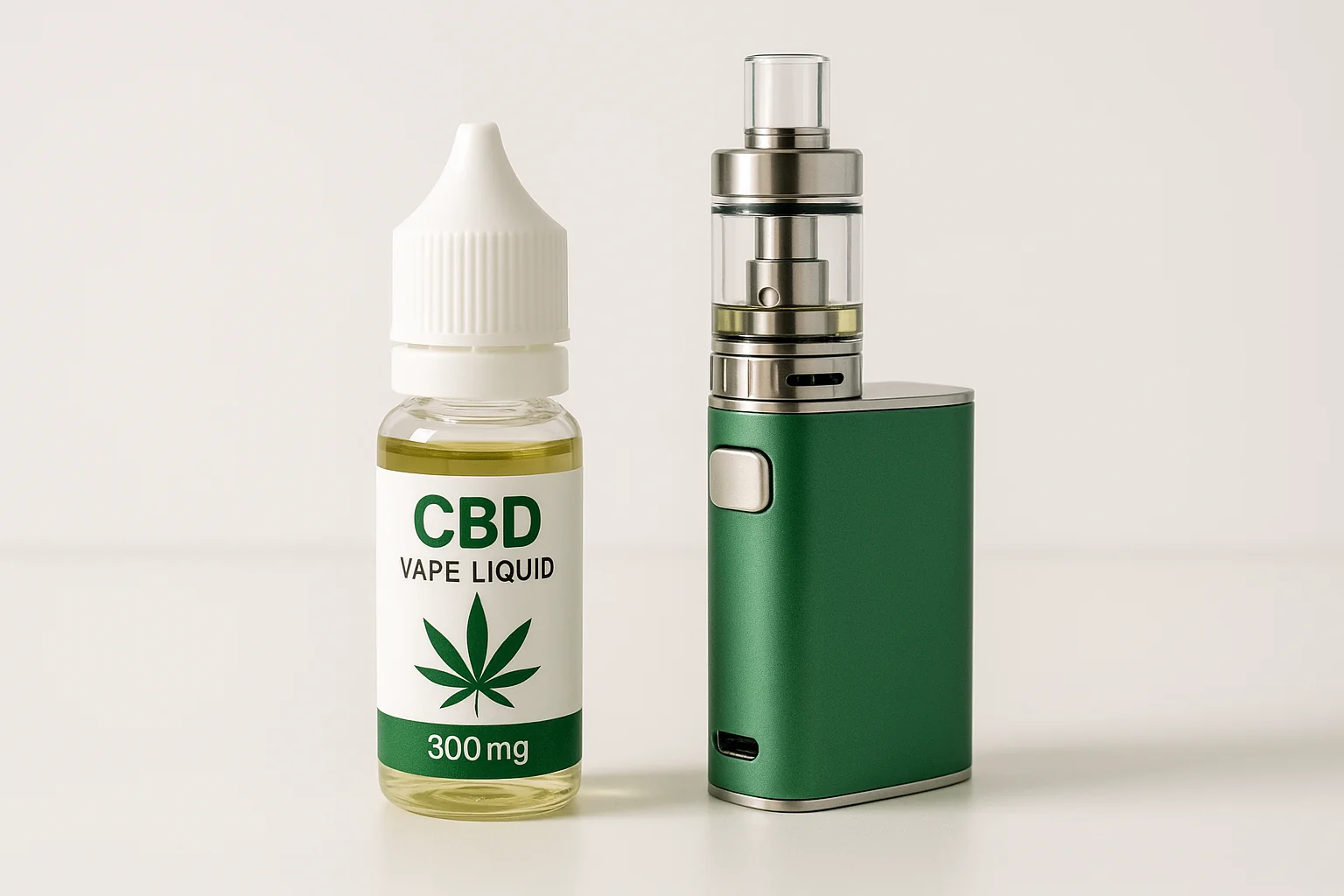

Liquid CBD for E-Cigarettes: How to Choose and Is It Safe (FAQ)
Liquid CBD for e-cigarettes: what is really known about absorption, where the EVALI risk comes from, how liquid differs from oil, and what the certificate of analysis should contain.
Liquid CBD for e-cigarettes tempts with the promise of quick action: the vapor goes from the lungs straight into the bloodstream, bypassing the liver. Popular guides support this promise with tables of bioavailability percentages laid out for all routes of administration. The problem is that such measurements in humans have mostly simply not been performed. A systematic review of the pharmacokinetics of cannabidiol reports absolute bioavailability only once, for the inhalation route, and directly notes a lack of data (Millar et al., Frontiers in Pharmacology, 2018, PMC6275223). Below is gathered what can be verified at the source: the difference between liquid and oil, the state of knowledge about absorption, the origin of EVALI risk, and the content of the certificate of analysis. Every number in this text comes from a paper that can be opened and read independently, and where no measurement was made, it is stated directly instead of filling the gap with an estimate.
KEY INFORMATION
• The absolute bioavailability of CBD in humans has been marked only once: 31% after smoking. No study has done this for oral and sublingual routes (Millar et al., 2018).
• CBD oil with MCT oil should not be vaped in an e-cigarette. It is a different product on a different carrier.
• Vitamin E acetate, linked by the CDC to the EVALI epidemic, has no place in the composition of any liquid.
• Propylene glycol and glycerin decompose at high temperatures to formaldehyde and acetaldehyde, and the amount increases with the power of the device (Kosmider et al., 2014).
• Vaping liquids performed the worst in a label compliance study: 87.5% of them were described inconsistently with their content (Bonn-Miller et al., JAMA, 2017).
What is CBD liquid and why should oil not be vaped?
CBD liquid is a fluid intended for vaporization in an e-cigarette or in a liquid vaporizer. The carrier is usually a mixture of propylene glycol and vegetable glycerin, which are the same substances as in liquids without cannabidiol. CBD is added in the form of isolate or extract without THC.
CBD oil for sublingual use is built differently. Its carrier is fat: MCT oil, olive oil, or hemp seed oil. Fat does not evaporate in the e-cigarette heater like glycol; it thermally decomposes, and no one has studied the products of this decomposition for inhalation. Confusing these two categories is the most common mistake among beginners and the only one we describe in this article as an absolute prohibition.
The third group of products is terpene-based liquids, without glycol and glycerin. They are sometimes chosen by people who poorly tolerate propylene glycol, but require checking what specific terpenes are included and whether the manufacturer declares their suitability for inhalation. The mere fact that a substance is of plant origin and safe to eat says nothing about what will happen to it when heated.
How much CBD from an e-cigarette reaches the blood?
The reliable answer is: exactly known only for one route of administration. A systematic review by Millar and colleagues searched 792 papers and found 24 with pharmacokinetic data in humans. The absolute bioavailability of cannabidiol was reported in them only once, for the inhalation route, and was 31%. No measurement has been made for any other route, even though intravenous forms were available.
This leads to an uncomfortable fact for shopping guides: four-field tables with percentages for inhalation, sublingual, and oral administration have no support in human data. The review confirms, however, what pertains to the rate, not the amount. Peak concentration and area under the curve increase with dose, and the peak is reached faster after inhalation than after oral or mucosal administration. The time to peak ranges from zero to four hours, and peak concentration is higher after a meal and in lipid forms.
| Route of Administration | Absolute Bioavailability in Humans | Half-Life |
|---|---|---|
| Inhalation (smoking) | 31%, the only published measurement | 31 hours |
| Oral mucosal spray | not marked | 1.4-10.9 hours |
| Oral, chronic administration | not marked | 2-5 days |
| Intravenous | reference point | 24 hours |
The authors of the review conclude with a statement about the lack and discrepancy of data despite the widespread use of cannabidiol in humans. More about the differences between routes of administration can be found in the text about methods of consumption and time of action.
What is known about the risks of inhaling liquids?
The reference point is the EVALI epidemic, or lung injuries associated with vaping, which broke out in the United States in 2019. The CDC describes vitamin E acetate as strongly linked to this epidemic: the substance was found in product samples and in the lungs of sick individuals, and it was not found at all in individuals without EVALI. Most cases were associated with liquids containing THC, sourced from the informal market. Among sick individuals using such products, 78% reported obtaining them exclusively through this route (CDC).
The second risk has nothing to do with cannabidiol and concerns the carrier itself. Propylene glycol and glycerin decompose at high temperatures to volatile carbonyl compounds, including formaldehyde and acetaldehyde. In measurements by Kosmider and colleagues, the highest concentrations were given by glycol-based liquids, and increasing the power supply voltage from 3.2 to 4.8 V increased the amount of formaldehyde, acetaldehyde, and acetone from four to over two hundred times (Nicotine and Tobacco Research, 2014, PMC4838028). At low voltage, formaldehyde was on average 13 times less, and acetaldehyde 807 times less than in tobacco smoke.
This picture, however, requires a caveat that the authors of the later review themselves considered significant. Farsalinos and Gillman reviewed 32 papers on the emission of carbonyl compounds and found a large discrepancy in methods and a lack of control of so-called dry puffs, i.e., conditions in which the heater operates without sufficient liquid. When conditions matched real use, emissions were significantly lower than in cigarette smoke (Frontiers in Physiology, 2017, PMC5769337). The practical conclusion therefore pertains to the power of the device, not the liquid itself. A similar distinction between the carrier and the active substance has been described in herbal cigarettes.
What to look for when choosing CBD liquid?
Start with a certificate of analysis from an independent laboratory. The reason is measured: in a label compliance study of 84 products sold online, only 30.95% were correctly labeled, and vaping liquids performed the worst in this group, with 87.5% described inconsistently with their actual content (Bonn-Miller et al., JAMA, 2017, PMC5818782). The certificate should confirm the content of cannabinoids, the absence of vitamin E acetate, and the absence of pesticide and heavy metal residues.
The second point is the composition of the carrier: the ratio of glycol to glycerin, the presence of terpenes, and whether the flavors used are declared by the manufacturer as suitable for inhalation. Not every flavor approved for food behaves safely when heated. The third point is the manufacturer itself: address, contact details, and presence in the European Union. An anonymous supplier from social media will not answer any of the above questions.
It is also worth knowing the limits of legality. The threshold of 0.3% applies to the plant, not the finished product, and is counted as the sum of delta-9-THC and tetrahydrocannabinolic acid, rounded to one decimal place (Article 4 point 5 of the Act of July 29, 2005 on counteracting drug addiction, consolidated text Journal of Laws 2023 item 1939, as amended by the Act of March 24, 2022, Journal of Laws 2022 item 763). A separate matter is the food status: cannabidiol has not been approved in the EU as a novel food, and a sanitary notification does not replace such authorization. The expiration date is provided by the manufacturer on the packaging, and any liquid that has changed color, smell, or clarity should be discarded, not used in the heater.
CBD liquid or dry herb for a vaporizer?
Hemp flower vaporized in a vaporizer carries the full plant profile: cannabinoids, terpenes, and flavonoids. This gives rise to the argument of the entourage effect, according to which the action of the entire mixture is different from that of a single molecule. It is worth knowing what this argument is: a review and the author’s position, not the result of a clinical study. Russo formulates it as strong enough to believe that one substance cannot match the potential of the whole plant (Frontiers in Plant Science, 2018, PMC6334252). Liquid with isolate delivers only cannabidiol, and there is nothing to discuss here.
On the side of liquid is convenience. There is no need to grind the raw material or clean the chamber after a session, and the device is usually smaller and cheaper. On the side of dry herb is control over temperature and the full composition of the plant. The principle of operation of both types of devices is described in a separate text about how a vaporizer works.
If you are looking for a quick grab of a product during the day, a simpler device for liquids is more convenient. If you care about the full plant profile and setting the temperature yourself, choose a dry herb vaporizer.
Frequently Asked Questions
Is CBD liquid for e-cigarettes legal in Poland?
Cannabidiol itself is not a controlled substance in Poland. The threshold of 0.3% applies to the plant and is counted as the sum of delta-9-THC and THCA, not just delta-9-THC alone. Separately: cannabidiol does not have the status of approved novel food in the EU, and a sanitary notification of this authorization does not replace it.
How much CBD is absorbed from an e-cigarette?
The absolute bioavailability of cannabidiol in humans has been published only once and was 31% after smoking. No study has marked it for oral or sublingual administration, so the circulating percentage tables for these routes are not supported by data (Millar et al., 2018).
How quickly does CBD inhaled from an e-cigarette work?
A pharmacokinetic review states that peak concentration after inhalation is reached faster than after oral or mucosal administration, and the time to peak ranges from zero to four hours. More precise numbers for e-cigarettes are not available from the data.
What should be avoided when choosing CBD liquid?
Vitamin E acetate, which the CDC links to the EVALI epidemic. Additionally, liquids without a certificate of analysis, of unknown extract origin, and from suppliers without an address. Caution is also required with high-power devices, as the emission of carbonyl compounds increases with power supply voltage.
Is CBD liquid different from CBD oil?
Yes, and fundamentally so. Oil is built on a fat carrier, most often MCT oil, olive oil, or hemp seed oil, which thermally decomposes in the e-cigarette heater instead of evaporating. Liquid uses propylene glycol with glycerin or a terpene base. These products are not interchangeable in any direction.
Does the certificate of analysis really make a difference?
It does. In a study of 84 products sold online, only 30.95% were correctly labeled, and among 24 tested vaping liquids, the percentage incorrectly described reached 87.5%. Without a report from an independent laboratory, you are buying a declaration from the label, not verified content (Bonn-Miller et al., 2017).
Devices for hemp flower are collected in the category of vaporizers.
This article is for informational and educational purposes only and does not constitute medical advice. Before starting to use cannabis or CBD for therapeutic purposes, consult a doctor, especially if you are taking other medications, are pregnant, or breastfeeding.
Author: Michał Waluk · Published: 2026-08-09 · Updated: 2026-08-15