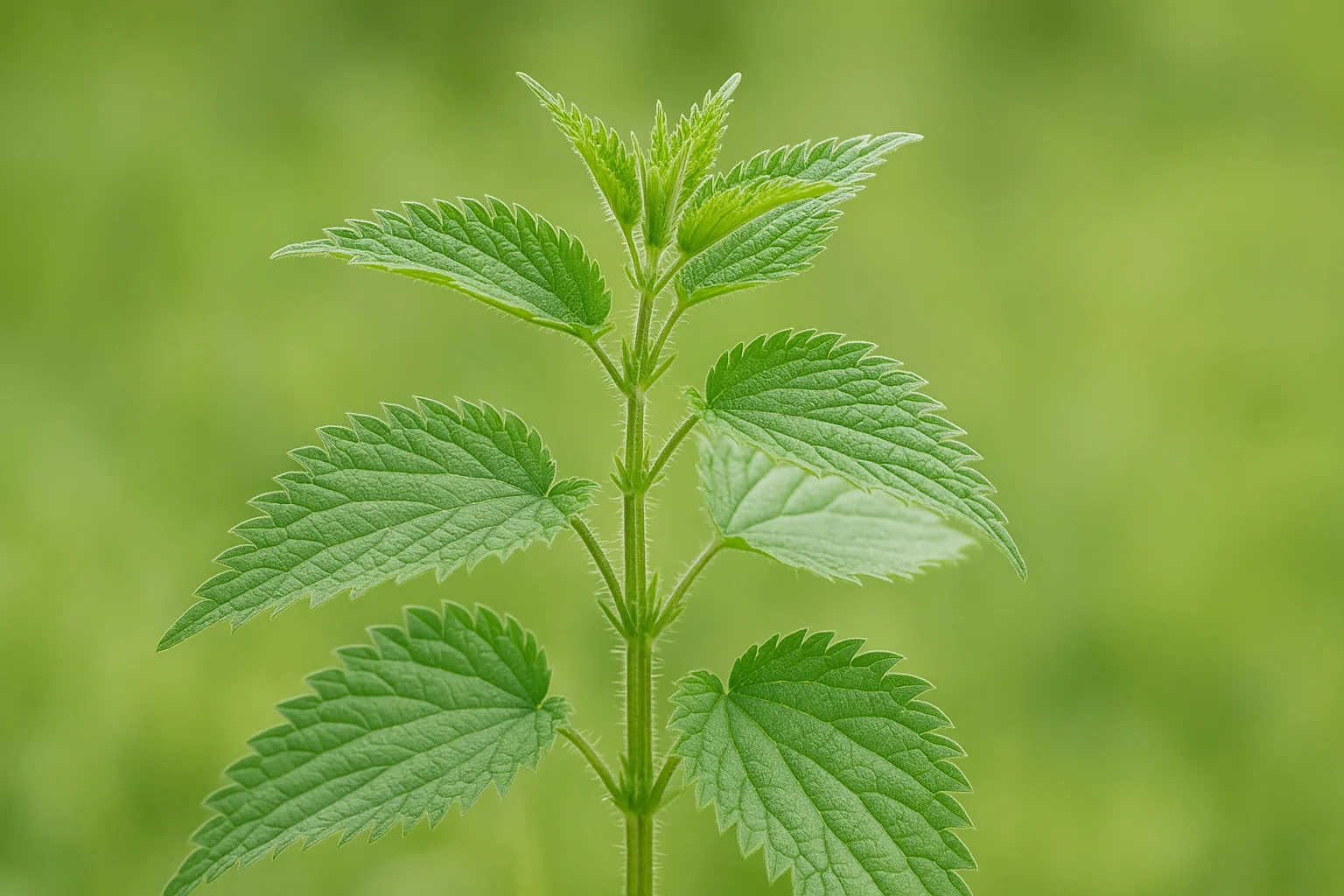

Nettle for Benign Prostatic Hyperplasia (BPH): What Studies Say
Nettle root for benign prostatic hyperplasia. What exactly did the study on 620 men show, what the EU monograph allows, and when a urologist is needed.
Benign prostatic hyperplasia presents symptoms that are hard to overlook: frequent trips to the bathroom, weak urine stream, feeling of incomplete bladder emptying. Up to 50% of men over fifty and up to 80% over eighty experience lower urinary tract symptoms for this reason (Lokeshwar et al., Translational Andrology and Urology, 2019). Nettle root is one of the more commonly chosen herbal raw materials in this situation in Europe and has its own monograph from the European Union. We checked what the largest clinical study of this raw material really showed, where its evidence power ends, and why the regulator allows nettle only after excluding more serious causes by a doctor. Along the way, we clarify two statements circulating in Polish internet that are the opposite of what is stated in the source: about the effect of nettle on gland size and its alleged hormonal mechanism.
KEY INFORMATION
• In Safarinejad’s study (620 men, 6 months), the IPSS score decreased from 19.8 to 11.8 with nettle root and from 19.2 to 17.7 with placebo (Safarinejad, Journal of Herbal Pharmacotherapy, 2005).
• The same work noted a slight decrease in gland size, from 40.1 to 36.3 cm3, not no change.
• The European Union monograph covers the root, not the leaf, and allows it only after excluding serious causes by a doctor.
• The authors of the study themselves state that the result requires confirmation before nettle can be considered effective.
What is benign prostatic hyperplasia and who does it affect?
This is a non-malignant enlargement of the prostate gland, which with age compresses the urethra and gives symptoms from the lower urinary tract. Up to half of men over the age of fifty and up to 80% over eighty experience such ailments; the increasing frequency is associated, among other things, with obesity and metabolic diseases (Lokeshwar et al., 2019).
Medicine has established options here: alpha-blockers, 5-alpha-reductase inhibitors, and procedures, from classic transurethral electroresection to laser enucleation. Each has its own side effects, and the decision on choice belongs to the urologist after assessing gland volume, urinary retention, and flow.
The symptoms themselves do not indicate what causes them. Difficulty starting urination and a weak stream accompany both benign enlargement and prostate cancer, and they can only be distinguished by testing. Therefore, any herbal recommendation in this area is conditional: first diagnosis, then preparation. If you are looking for a broader context, we have a separate text on what really works in supplementation for men over forty.
What did the largest study of nettle root show?
The largest trial remains the randomized, double-blind study by Safarinejad involving 620 patients, conducted over 6 months with a partially crossover design. It was completed by 558 individuals, or 90% of participants. After six months, 232 out of 287 men in the nettle group (81%) reported improvement in symptoms compared to 43 out of 271 in the placebo group (16%).
The numbers supporting the raw material are concrete. The IPSS score decreased from 19.8 to 11.8 with nettle and from 19.2 to 17.7 with placebo. The maximum urinary flow improved by 8.2 ml/s in the treated group and by 3.4 ml/s in the placebo group. The volume of residual urine decreased from 73 to 36 ml, with no change in the placebo group. The levels of PSA and testosterone remained unchanged in both groups, and the authors reported no adverse effects in anyone (Safarinejad, Journal of Herbal Pharmacotherapy, 2005).
It is worth reading the conclusion of this work literally. The authors state that further clinical studies should confirm this result before nettle is considered effective. This is one study from one team, conducted in Iran and never repeated on this scale elsewhere. The response rate of 81% versus 16% is unusually high in phytotherapy for lower urinary tract issues, and in most trials in this area, the response of the placebo itself is often much stronger.
Does nettle root reduce the prostate gland?
Contrary to what many Polish guides repeat, Safarinejad’s study noted a reduction in the gland. Transrectal ultrasound measurement showed a decrease from 40.1 to 36.3 cm3 in the nettle group, described as statistically significant, with no change in volume in the placebo group (Safarinejad, 2005).
The statement “nettle only works symptomatically and does not affect the gland” is therefore inconsistent with the work it usually refers to. A more honest phrasing is more cautious in the other direction: the change was about four cubic centimeters after six months, comes from one trial, and has not been repeated. There is no basis to place it alongside the effect of 5-alpha-reductase inhibitors, for which gland reduction is a documented and repeated endpoint.
The practical difference for the reader is that neither the symptomatic result nor the one regarding volume exempts from testing. Gland volume, residual urine after urination, and PSA levels are parameters that determine the risk of acute urinary retention and the choice of treatment. They are established in the office, not based on feelings or perceived improvement.
How would nettle root work on the prostate?
The mechanism is not established, and the review that is usually cited here states this explicitly. Only some components responsible for the action have been identified, and the contribution of individual pathways remains unclear (Chrubasik et al., Phytomedicine, 2007).
The authors of this review consider the involvement of sex hormone-binding globulin, aromatase, epidermal growth factor, and steroid membrane receptors of the prostate to be probable. However, they consider the involvement of 5-alpha-reductase and androgen receptors to be less likely. This is an important reversal of the popular description, in which nettle is often presented as a milder equivalent of finasteride: the review points to this pathway as unlikely.
Other laboratory observations are documented. Extracts and polysaccharide fractions showed anti-inflammatory effects, and the methanol extract of the root and selected fractions inhibited cell proliferation. Isolated lectins turned out to be promising immunomodulating substances, with antiviral and antifungal activity. However, the authors themselves caution that it is unknown whether data from cell cultures and animal models translate into clinical effect. Clinical evidence is mainly based on open studies, and a small number of randomized trials concern one proprietary methanol extract.
Does a preparation with saw palmetto say anything about nettle itself?
No, and this is one of the more commonly confused things on this topic. The most frequently cited comparison of herbs with finasteride concerns a combined preparation, that is, a fixed combination of saw palmetto fruit with nettle root, referred to in the literature as PRO 160/120.
Subgroup analysis involving 431 patients from a trial of 543 individuals showed that after 24 weeks, maximum urine flow increased by 1.9 ml/s with the combined preparation and by 2.4 ml/s with finasteride, with no significant difference between groups. Symptom scores improved in both arms, also without significant difference. More adverse effects were reported in the finasteride group (Sökeland, BJU International, 2000).
The problem is that in such a setup, it is impossible to say how much nettle contributes to the effect and how much saw palmetto. There was no arm with a single raw material. The same difficulty arises in the Cochrane review from 2023, which evaluated studies on mixtures with saw palmetto separately and assigned them low certainty of evidence, while assigning high certainty to the analysis of a single raw material. Separately, it is worth knowing that for saw palmetto itself, large studies have yielded different results than for this combination, which we describe in the text on what studies have shown about saw palmetto.
What does the European Union monograph allow?
The monograph covers the root of common nettle and lesser nettle and classifies it solely as a traditional herbal medicinal product. The column “well-established use”, reserved for raw materials with recognized efficacy, remains empty. The indication reads: alleviation of lower urinary tract symptoms associated with benign enlargement of the prostate after excluding serious conditions by a doctor (EMA monograph, Urticae radix, revision 1 from 2025).
The last part of this sentence is a condition, not an ornament. The monograph adds that with worsening symptoms or the appearance of fever, blood in urine, pain during urination, or urinary retention, one should consult a doctor. It is not applicable to individuals under 18 years of age. Long-term use is permitted. In the drug interaction section, there is an entry about a lack of reports, and the pregnancy and lactation section is described as irrelevant. However, gastrointestinal disturbances and allergic reactions of unknown frequency have been noted, and no genotoxicity, reproductive toxicity, or carcinogenicity studies have been conducted.
The distinction of the raw material has practical significance here. The monograph concerns the root; the leaf of nettle has a separate document and different indications. Before reaching for a nettle supplement, check the packaging to see which part of the plant the ingredient refers to, as the generic name does not resolve this.
Frequently Asked Questions
Does nettle root help with benign prostatic hyperplasia?
The largest trial, involving 620 men over 6 months, showed a decrease in IPSS from 19.8 to 11.8 compared to 19.2 to 17.7 with placebo (Safarinejad, 2005). However, the authors request confirmation of the result in further studies, as this is a single trial from one center.
Does nettle reduce the prostate gland?
In Safarinejad’s study, the volume of the gland decreased from 40.1 to 36.3 cm3 in the nettle group, with no change in the placebo group. The change is small, comes from a single trial, and has not been repeated, so do not place it alongside the documented effect of 5-alpha-reductase inhibitors.
Does nettle falsify PSA test results?
In Safarinejad’s study, the levels of PSA and testosterone did not change in either group. Normal PSA does not exclude prostate cancer, and the symptoms of hyperplasia and cancer are indistinguishable without testing. The European monograph requires exclusion of serious causes by a doctor.
Root or leaf of nettle for prostate issues?
Root. These are two different raw materials with separate monographs and indications; the document regarding the lower urinary tract in gland enlargement describes only the root of common nettle and lesser nettle. Check the supplement packaging to see which part of the plant is specified.
How long can preparations with nettle root be used?
The European monograph allows for long-term use and does not set a strict weekly limit. It also stipulates that worsening symptoms or the appearance of fever, blood in urine, or urinary retention requires contacting a doctor. The preparation is not applicable to individuals under 18 years of age.
Does nettle interact with urological medications?
The European monograph notes a lack of reports in the interaction section. This is not the same as evidence of safety in combination: no genotoxicity or reproductive toxicity studies have been conducted for this raw material. With alpha-blockers and 5-alpha-reductase inhibitors, the decision to combine should be made with a doctor.
If you are looking for other herbal leads described with the prostate, we have gathered evidence also in the text about lycopene for the prostate and heart. Preparations with nettle sold as supplements are in the supplement category.
This article is for informational and educational purposes and does not constitute medical advice. Before starting supplementation, consult a doctor, especially if you are taking medications regularly, are pregnant or breastfeeding, or have chronic illnesses.
Author: Michał Waluk · Published: 2026-08-09 · Updated: 2026-08-16