
Lutein and zeaxanthin for vision: dosage and who it’s for (table)
Lutein and zeaxanthin for vision without marketing: what the AREDS2 study really measured, who these carotenoids help, and why the dosage is determined by an ophthalmologist.
Lutein and zeaxanthin are the only carotenoids that the body deposits in the macula of the eye, which is why they have been included in ophthalmic preparations. However, the largest study in this field yielded a more complex result than suggested by the packaging. In the AREDS2 study involving 4203 individuals aged 50-85, observed for a median of five years, the addition of lutein and zeaxanthin to the supplementation formula did not significantly reduce the risk of progression to advanced age-related macular degeneration compared to placebo (hazard ratio 0.90; 98.7% confidence interval 0.76-1.07; P = 0.12) (Age-Related Eye Disease Study 2 Research Group, JAMA, 2013). The real benefit of these carotenoids lies elsewhere and is well documented. This article shows what the studies really measured, who belongs to the high-risk group, and why the decision about supplementation is made together with an ophthalmologist.
KEY INFORMATION
• In AREDS2, lutein with zeaxanthin did not significantly reduce the risk of progression to AMD compared to placebo (4203 individuals, median 5 years, JAMA 2013).
• Their documented role is to safely replace beta-carotene, after which more lung cancers were reported among former smokers.
• Both carotenoids form the macular pigment, which is a filter that absorbs blue and ultraviolet light.
• They are absorbed with fat: adding avocado to a salad increased lutein absorption by 5.1 times.
• In diagnosed AMD, the ophthalmologist decides on supplementation, not the product leaflet.
What are lutein and zeaxanthin and how do they work in the eye?
These are two carotenoids from the xanthophyll group that the body cannot produce on its own. They must come from food. After absorption, they selectively deposit in the retina, primarily in the macula, which is the area responsible for central vision and reading.
In the macula, they form a pigment described by the acronym MPOD, which stands for macular pigment optical density. It serves two functions. It acts as a filter that absorbs blue and ultraviolet light before it reaches the cones. It also neutralizes free radicals generated in photochemical reactions in the retina, a tissue with an exceptionally high rate of oxidative metabolism.
The two compounds differ in their distribution. Lutein accumulates mainly at the periphery of the macula, while zeaxanthin is found in the central fovea, where the density of cones is highest. They occur together in the retina and are studied together, which is why clinical studies almost always refer to them as a pair rather than separately.
It is worth immediately separating two things that marketing usually combines. The fact that carotenoids build the macular pigment is indisputable and well measured. Whether their addition in a capsule changes the fate of a diseased eye is a separate question, and the answer to it has proven to be more cautious.
What did the AREDS2 study really show?
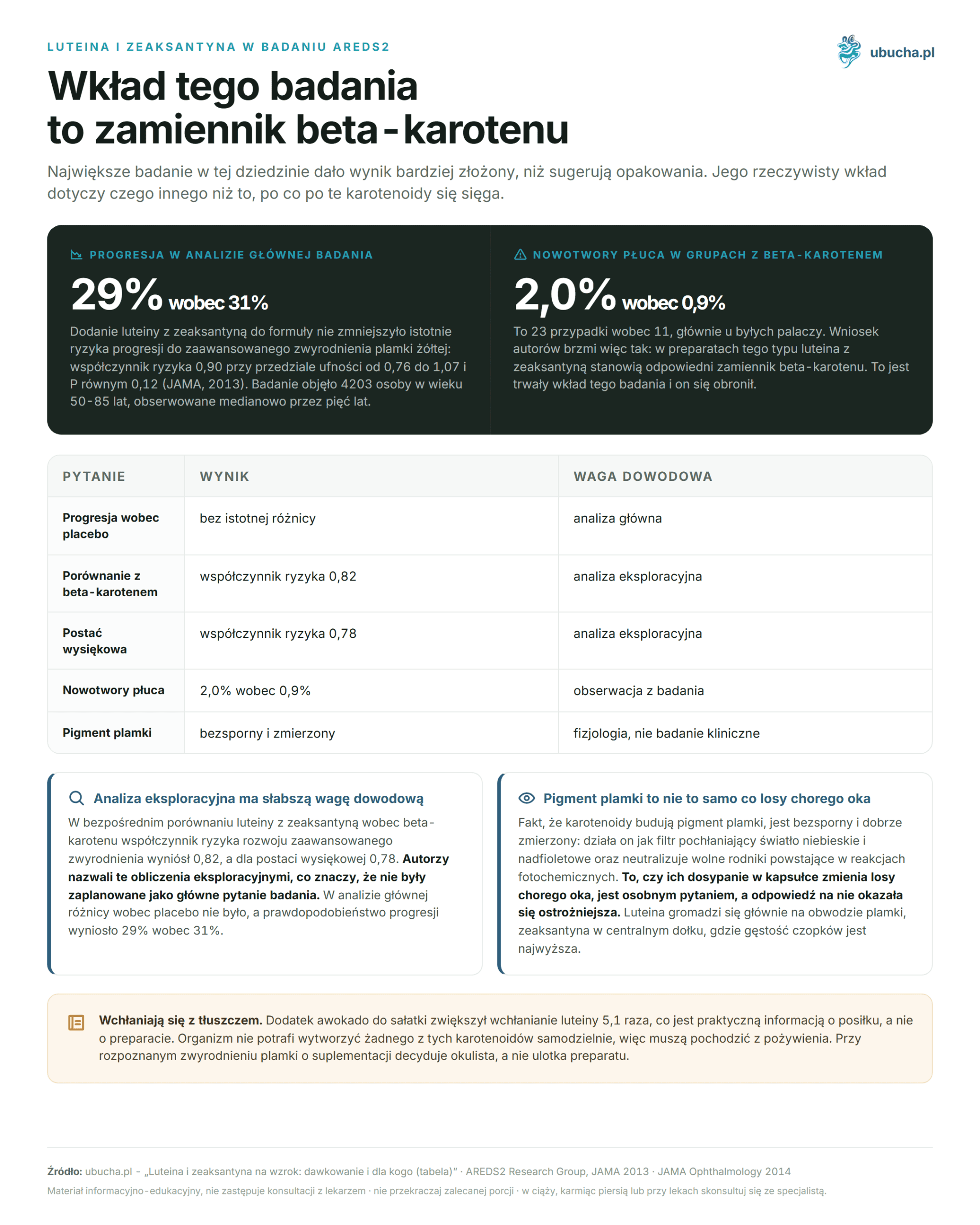
AREDS2 was a multicenter, randomized, double-blind study with a placebo group, conducted from 2006 to 2012 with 4203 participants aged 50-85 years at risk of developing advanced AMD. In the main analysis, the addition of lutein with zeaxanthin to the AREDS formula did not significantly reduce the risk of progression: the probability of progression after five years was 29% in the carotenoid group compared to 31% in the placebo group (JAMA, 2013).
The study answered a different question, and that is its lasting contribution. The original AREDS formula contained beta-carotene, and in AREDS2, more lung cancers were reported in the groups with beta-carotene than without it (23 cases, or 2.0%, compared to 11, or 0.9%), mainly among former smokers. The authors’ conclusion is therefore: in AREDS-type preparations, lutein with zeaxanthin are an appropriate substitute for beta-carotene.
Additional analyses published a year later went further. In a direct comparison of lutein with zeaxanthin against beta-carotene, the hazard ratio for the development of advanced AMD was 0.82 (95% confidence interval 0.69-0.96), and for the exudative form, it was 0.78 (0.64-0.94) (Age-Related Eye Disease Study 2 Research Group, JAMA Ophthalmology, 2014). The authors called these calculations exploratory, meaning they were not planned as the main question of the study and carry weaker evidential weight.
The difference between the main analysis and the exploratory one determines how strongly one can speak about effectiveness. If you want to be able to read such distinctions independently, we described them in our guide on how to evaluate supplements on the scale of evidence strength.
How much lutein was used in studies and with what effect?
The table below compares the doses used in specific studies along with what makes them a description of the study: who was studied, for how long, and what the outcome was. These are not recommendations for the reader. The preparation is selected based on the condition of the eye, not based on a row in the table.
| Study | Who and how many | Time | What was given | Outcome |
|---|---|---|---|---|
| AREDS2, main analysis (JAMA 2013) | 4203 individuals, 50-85 years, at risk of AMD | median 5 years | 10 mg lutein and 2 mg zeaxanthin | no significant reduction in progression compared to placebo (HR 0.90; P = 0.12) |
| AREDS2, additional analyses (JAMA Ophthalmology 2014) | same group | median 5 years | same, comparison with beta-carotene | lower risk than with beta-carotene (HR 0.82; 95% CI 0.69-0.96) |
| Renzi-Hammond 2017 (Nutrients) | 51 healthy individuals aged 18-30 | 12 months | lutein with zeaxanthin versus placebo | increase in MPOD; improvement in spatial memory, reasoning, and complex attention |
| Unlu 2005 (The Journal of Nutrition) | 11 healthy individuals, crossover design | measurement over 9.5 h after a meal | salad with or without avocado | lutein absorption 5.1 times greater with avocado |
Note how different these populations are. The ophthalmic study was conducted on individuals over fifty with already damaged maculas, the cognitive study on twenty-year-olds without any eye disease, and the absorption study on eleven healthy volunteers after a single meal. Transferring conclusions from one row to another is precisely the error that creates empty promises.
Who is at increased risk of AMD?
Age-related macular degeneration is one of the leading causes of vision loss in developed countries, and the strongest risk factor is age. The AREDS2 study included individuals aged 50 to 85 who had large drusen in both eyes or large drusen in one eye and advanced AMD in the other.
The second group includes smokers and those who have smoked in the past. For them, the result of AREDS2 has very practical significance: it was among former smokers that an excess of lung cancers was reported in the groups receiving beta-carotene. An ophthalmic preparation with beta-carotene is a poor choice for this group, while lutein with zeaxanthin does not carry this signal. Similar traps in other ingredients have been gathered in our guide on which supplements are dangerous in excess.
The third group consists of individuals with a poor intake of leafy green vegetables, as these are the main source of both carotenoids in the diet. It is important to maintain proportions here: a diet low in lutein is a factor whose impact has been observed in cohort studies, not a diagnosed disease. An ophthalmologist diagnoses AMD based on a retinal examination, not on a diet.
It is also worth mentioning screens. This is a common reason why people reach for eye supplements, but eye fatigue from computer use is primarily related to less frequent blinking and drying of the tear film, not a deficiency of carotenoids. A lutein supplement does not address this mechanism.
Is diet enough to provide lutein?
According to a review dedicated to food sources and the bioavailability of both carotenoids, levels described in the literature as effective can be achieved through diet alone, provided it is varied (Eisenhauer et al., Nutrients, 2017). The authors emphasize that it is not one product that matters, but the diversity of sources.
This same review points out that dark green leafy vegetables are not the only route. Eggs and pistachios also have high bioavailability, and the method of food preparation and the presence of fat are significant. Carotenoids are lipophilic, so without fat in the meal, a large portion of the intake passes through the digestive tract unused.
The scale of this phenomenon has been measured directly. In a crossover study with eleven healthy volunteers, adding 150 g of avocado to a salad increased lutein absorption by 5.1 times compared to the same salad without fat, measured as the area under the curve of concentration in triglyceride-rich lipoprotein fractions (Unlu et al., The Journal of Nutrition, 2005). For alpha-carotene and beta-carotene, the effect was even greater. Avocado oil worked the same as the fruit, so the issue is with fat, not with a specific product.
The practical conclusion from both studies is consistent: a salad drizzled with oil or a meal with an egg does more for absorption than increasing portions of vegetables without fat. If you still reach for a supplement, check the declared content on the label and compare it with the dose from the study, not with the slogan on the packaging. We described how to read such labels in a separate guide on how to read a dietary supplement label.
Does lutein affect brain function?
Carotenoids deposit not only in the retina. In brain tissue taken from 47 centenarians in the Georgia Centenarian Study, a dietary pattern rich in carotenoids was associated with better performance in language functions (r = 0.42; P = 0.046) among individuals without dementia, and for memory and global cognitive performance, the relationship went in the same direction but did not reach the threshold of significance (Tanprasertsuk et al., Frontiers in Nutrition, 2021).
It should be added immediately that two caveats are necessary, as without them this work sounds stronger than it deserves. The analysis without dementia was based on 23 individuals, which is a very small group. It is also a correlational study on tissue taken post-mortem, so it does not determine whether carotenoids protect the brain or rather accompany better overall health.
The only interventional trial on this topic involved young and healthy individuals. Fifty-one volunteers aged 18-30 received lutein with zeaxanthin or placebo for a year; supplementation increased macular pigment density, and along with it, spatial memory, reasoning ability, and complex attention improved (Renzi-Hammond et al., Nutrients, 2017).
Putting these studies together gives a cautious picture. The signal is repeatable and biologically sensible, but it is based on small groups, and the best-controlled study was conducted on twenty-year-olds, a population far removed from those who most often ask about lutein for memory. This is too little to recommend it as a means for mental performance.
Frequently asked questions
Does lutein stop the progression of AMD?
In the main analysis of AREDS2, the addition of lutein with zeaxanthin did not significantly reduce the risk of progression to advanced AMD compared to placebo (hazard ratio 0.90; P = 0.12) in 4203 individuals observed for a median of five years. The documented benefit is that both carotenoids safely replace beta-carotene in AREDS-type formulations.
How much lutein was used in the AREDS2 study?
Participants in AREDS2 received 10 mg of lutein and 2 mg of zeaxanthin daily for a median period of five years. This is a description of the study protocol, not a recommendation. In cases of diagnosed macular degeneration, the composition and purpose of supplementation is determined by an ophthalmologist who knows the condition of the retina and other medications taken.
What is the difference between lutein and zeaxanthin?
They are isomers differing in the position of one double bond, and in the eye, they differ in distribution. Lutein accumulates mainly at the periphery of the macula, while zeaxanthin is found in the central fovea, where the density of cones is highest. Together, they form the macular pigment that absorbs blue and ultraviolet light.
Should lutein be taken with fat?
Yes, because both carotenoids are fat-soluble. In a crossover study with eleven volunteers, adding avocado to a salad increased lutein absorption by 5.1 times compared to a salad without fat (Unlu et al., The Journal of Nutrition, 2005). Avocado oil worked just as well as the fruit.
Can smokers use eye supplements?
Smokers and former smokers should avoid eye supplements containing beta-carotene. In AREDS2, there were 23 lung cancers in the beta-carotene groups compared to 11 in the groups without it, mainly among former smokers. Lutein with zeaxanthin did not carry this signal and therefore replaced beta-carotene in the formula.
This article is for informational and educational purposes only and does not constitute medical advice. Before starting supplementation, consult your doctor, especially if you are taking medications regularly, are pregnant or breastfeeding, or have a chronic illness.
Author: Michał Waluk · Published: 2026-08-09 · Updated: 2026-08-16