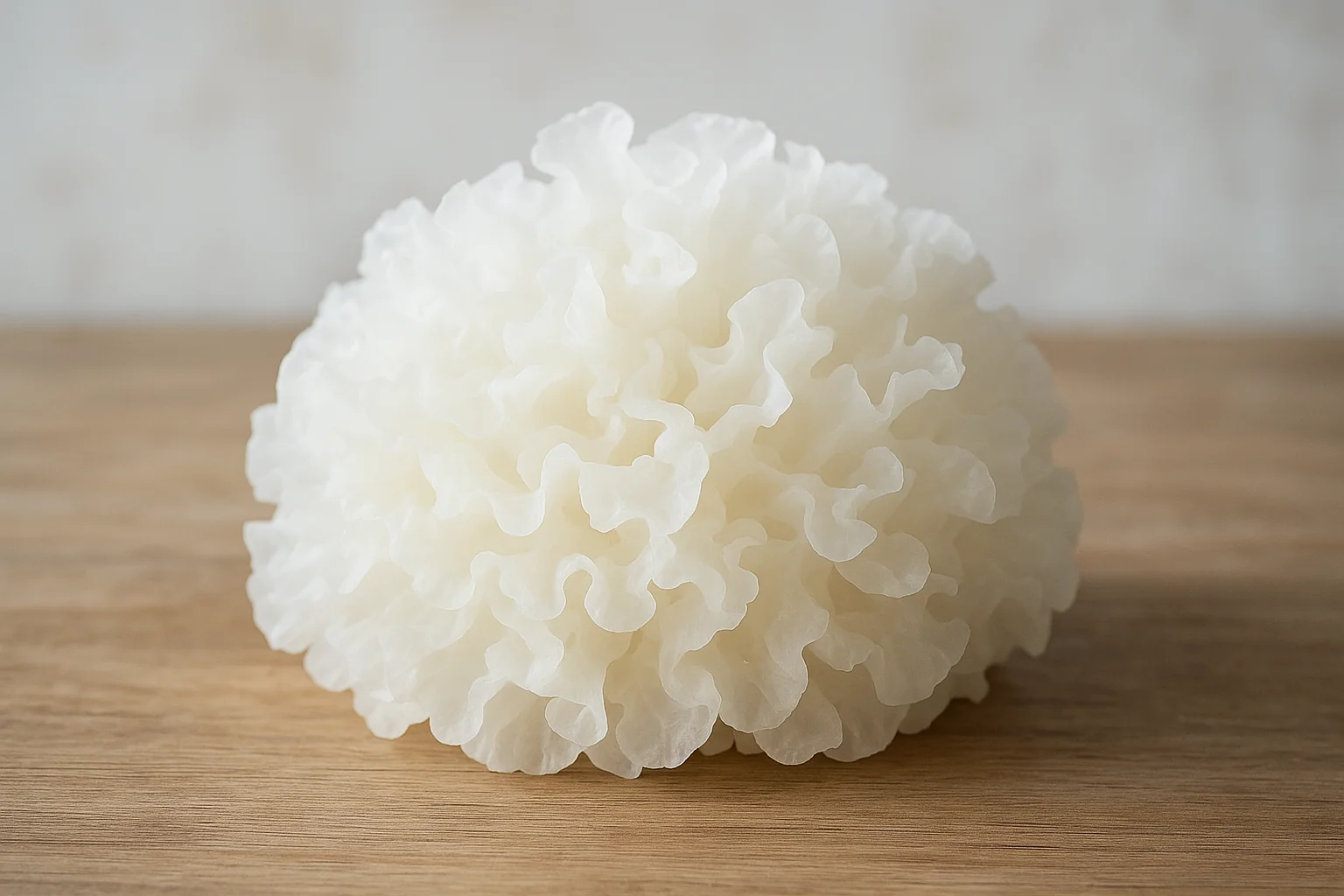

Tremella, the beauty mushroom: what it is and why it is associated with collagen
Tremella is often called vegan hyaluronic acid. Check what studies have really shown about its polysaccharides and why it is associated with collagen.
Tremella fuciformis looks like white jelly growing from dead wood and has been included in Chinese desserts, soups, and infusions for centuries. Today, it is sold as a beauty supplement, often under the slogan of vegan hyaluronic acid, with labels promising to hydrate the skin from within. Some of these promises are supported by research, while others are based on comparisons that, upon verification, turn out to be reversed. This article separates one from the other and shows what is known about the polysaccharides of tremella from scientific works, where these works were conducted, and what conclusions should not be drawn from them. We start with the raw material itself, then check the comparison with hyaluronic acid, and finally return to the connection with collagen, on which most tremella products on the Polish market are based.
KEY INFORMATION
• The main active ingredient of tremella is polysaccharides of the glucuronoxylomannan type, not beta-glucans known from other medicinal mushrooms.
• The comparison with hyaluronic acid is often stated in reverse. In the measurement by Lin and Tsai (Molecules, 2019), the molecular weight of tremella polysaccharides reached 2.41 × 10⁷ Da, which is an order of magnitude greater, not smaller than that of hyaluronic acid.
• In human skin fibroblasts, the extract from tremella protected cells from oxidative stress by increasing the expression of SIRT1 (Shen et al., Molecular Medicine Reports, 2017).
• In a mouse model of atopic dermatitis, oral administration of tremella polysaccharides worked significantly better than topical application (Xie et al., Frontiers in Pharmacology, 2022).
• There are no clinical studies involving humans on oral tremella and skin. All described results below come from cell cultures and animal studies.
What is tremella and where does it grow?
Tremella fuciformis, known as snow fungus or tremella, grows on dead wood of deciduous trees in the tropical and subtropical zones. Its fruiting body has a jelly-like and multi-lobed structure, white or cream in color, and is almost transparent when fresh. When dried, it shrinks to a stiff, paper-like flake that regains its original volume when soaked.
In Chinese cuisine, tremella has been an ingredient in sweet soups and infusions consumed as a daily element of beauty diet for centuries. Tradition attributes its merits to maintaining the complexion of Yang Guifei, a court beauty from the Tang dynasty, and this story still drives product descriptions. It is worth treating it as a legend, because it is one, and not as an argument for its effects.
Modern interest has a different source. A review by Ma et al. published in International Journal of Immunopathology and Pharmacology summarizes twenty years of work on tremella polysaccharides and describes them as compounds with an unusual structure, studied for applications in the food industry, household chemistry, and medicine. This is a literature review, not a clinical study, and should be read as such.
Are tremella polysaccharides smaller than hyaluronic acid?
No, and the contrary claim is the most commonly repeated error in descriptions of this raw material. The popular version goes like this: tremella polysaccharides have a mass of about 100-400 kDa compared to 1500 kDa of hyaluronic acid, so they penetrate deeper into the skin. Measurement says otherwise.
The team of Lin and Tsai compared in Molecules tremella polysaccharides obtained by three drying methods: cold air at 18 degrees, hot air at 50 degrees, and freeze-drying. The highest molecular weight was achieved by cold air drying, reaching 2.41 × 10⁷ daltons, with a moisture content of 13.05%. This is about 24,000 kDa, which is an order of magnitude higher than that given for native hyaluronic acid, not several times lower.
The consequence is significant for the reader choosing between a supplement and a serum. The argument for deeper penetration, built on an allegedly smaller molecule, has no basis in measurement. It makes more sense to describe tremella by what has actually been studied: the ability of the polysaccharide to bind water and its effect on skin cells. A comparison with oral hyaluronic acid, along with what has been shown about it in humans, is presented in a separate entry on oral hyaluronic acid for skin hydration.
What have studies shown about tremella and skin cells?
The most concrete work regarding skin was done on human fibroblast cultures. The team of Shen described in Molecular Medicine Reports a model in which cells were damaged by hydrogen peroxide, thus inducing oxidative stress leading to decreased viability and apoptosis. The polysaccharide extract from tremella was administered before the damage.
The result was unequivocal in several measurements at once. The extract itself at concentrations up to 400 micrograms per milliliter, used for 48 hours, did not change cell viability, meaning it was not toxic to them. Administered before hydrogen peroxide, it limited oxidative stress and apoptosis, reduced the expression of proteins p16, p21, p53, and caspase 3, while simultaneously activating the ERK and Akt kinase pathways.
The authors attributed the mechanism to the SIRT1 protein, whose expression increased after the extract was administered. This was confirmed by a control experiment: when SIRT1 was blocked with nicotinamide, the protective effect of the extract disappeared. This is a well-designed mechanistic proof, but it is important to remember what it concerns. Fibroblasts in a culture dish are not skin, and hydrogen peroxide is not aging, so this work does not imply that oral tremella smooths wrinkles.
Does tremella help with dry and atopic skin?
The most interesting answer comes from a study on mice, in which atopic dermatitis was induced by dinitrofluorobenzene. The team of Xie compared in Frontiers in Pharmacology two routes of administration of tremella polysaccharides: topical application and oral administration, and this comparison is the most important value here.
Both routes improved three measured parameters: transepidermal water loss, thickening of the epidermis, and swelling of the ear pinna. However, oral administration performed significantly better than topical application, which reverses the intuition suggesting that skin acts through the skin. The authors went further and checked what happens in the body during this.
They found two clues. In the mesenteric lymph nodes, the percentage of CD4+ CD25+ Foxp3+ regulatory T cells increased, which are cells that inhibit excessive inflammatory response. The composition of the gut microbiota and the metabolite profile in feces also changed. The authors’ conclusion is cautious: oral tremella may be a new way to treat atopic dermatitis, and the mechanism is related to the immune system and the intestines. This is a mouse study and should be read as such.
Why is tremella associated with collagen?
The connection makes commercial sense and partially substantive sense, but the evidence stands unevenly on both sides. For collagen, there are studies involving humans, while for tremella in this comparison, there are none.
On the collagen side, the most frequently cited work is by Proksch in Skin Pharmacology and Physiology. It involved 114 women aged 45-65, randomly assigned to two groups of 57, who took either 2.5 g of bioactive collagen peptides or a placebo daily for 8 weeks. After 8 weeks, the volume of wrinkles around the eyes decreased by 20% compared to placebo, and the effect lasted another four weeks after stopping intake. In skin biopsies taken from a selected subgroup of participants, a 65% higher content of type I procollagen and an 18% higher content of elastin were found; for fibrillin, the difference was 6% and did not reach statistical significance (Proksch et al., 2014).
On the tremella side, we have the protective effect on fibroblasts described above and the result in the atopic mouse model. Fibroblasts are the same cells that synthesize collagen in the dermis, so the hypothesis that one ingredient provides building blocks while the other improves the working conditions of the cells is biologically coherent. However, a coherent hypothesis is not the same as a demonstrated effect: no study has compared collagen alone with collagen administered together with tremella. Differences between types of collagen are described in an entry about collagen types I, II, and III.
How to choose a tremella supplement?
The first criterion concerns the raw material. Valuable products declare the fruiting body, not the mycelium grown on a grain substrate. Mycelium on grain carries starch from the substrate, which lowers the content of the substances for which this raw material is sought. Look for wording about the fruiting body extract on the label.
The second criterion is the declared content of polysaccharides. A product that provides this information numerically can be compared with another, while a product without this information cannot be compared with anything. The third criterion concerns the extraction method: tremella polysaccharides are water-soluble, so water extraction is the appropriate method for this raw material, and more expensive double extracts do not have the advantage they have with mushrooms containing fat-soluble ingredients.
The fourth thing arises from the work on drying. Since the drying method changes the molecular weight of the polysaccharide and its thermal properties, the way the raw material is prepared is not a technical detail without significance for the product. Manufacturers rarely provide this information, making it difficult to use as a purchasing criterion, but it is worth knowing that such variability exists. Tremella is also an ingredient in preparations combined with collagen, and other mushrooms with well-described effects on immunity are compared in an entry about shiitake and maitake.
What is still unknown about tremella?
The list is longer than the list of things studied, and it is fair to present it. Not a single study involving humans has been conducted to check the effect of oral tremella on skin hydration, elasticity, or appearance. It is unknown how much polysaccharide is absorbed from the digestive tract or whether it reaches the dermis in an active form. There is also no data on the safety of long-term use or interactions with medications, so silence on this topic is not confirmation that there is no problem.
The following table organizes the state of evidence for individual claims circulating around this raw material. The column on the right indicates the material on which the result was obtained, as it determines how far the conclusion can be drawn.
| Claim | Based on | Level of evidence |
|---|---|---|
| Protects fibroblasts from oxidative stress | Shen 2017, SIRT1 pathway, control with inhibitor | Human cell culture |
| Relieves symptoms of atopic dermatitis | Xie 2022, oral route better than topical | Mouse model |
| Binds water, and drying method changes its properties | Lin and Tsai 2019, measurement of mass and stability | Physicochemical measurement |
| Molecule smaller than hyaluronic acid | Measurement shows a value an order of magnitude greater | Claim debunked |
| Smooths wrinkles in humans after oral administration | No study | Unstudied |
| Works synergistically with collagen | Coherent hypothesis, no comparative study | Unstudied |
Frequently asked questions
What is tremella and why is it called the beauty mushroom?
Tremella fuciformis is a jelly-like white mushroom that grows on dead wood in the tropical zone, present in Chinese cuisine for centuries. The commercial name comes from the tradition that associated it with the beauty of court beauties, not from clinical research results.
Is tremella a vegan hyaluronic acid?
This is a marketing term. The main polysaccharide of tremella belongs to glucuronoxylomannans and has a different structure than hyaluronic acid. The measurement of molecular weight yielded a value an order of magnitude higher than that given for hyaluronic acid, so the argument about a smaller and deeper penetrating molecule is unfounded.
What have studies shown about tremella and skin?
In human fibroblasts, the extract protected cells from oxidative damage by increasing SIRT1 expression. In a mouse model of atopic dermatitis, it improved transepidermal water loss and epidermal thickness, with oral administration being more effective than topical application.
Does tremella work on dry and atopic skin in humans?
This has not been tested. Available results come from mouse models and cell cultures. In atopic dermatitis, treatment is conducted by a dermatologist, and the supplement does not replace therapy or emollients recommended by a doctor.
Why is tremella associated with collagen?
Because the mechanisms seem complementary: collagen provides building amino acids, while tremella protects fibroblasts, the cells that synthesize collagen in the skin. However, no study has compared collagen alone with collagen administered together with tremella, so synergy remains a hypothesis.
Who should be cautious with tremella?
Pregnant and breastfeeding women, those taking medications regularly, and those with chronic illnesses should discuss supplementation with a specialist. There is little data on the safety of oral tremella in humans, and the absence of reported adverse effects is not the same as confirmed safety.
Preparations combining collagen with tremella can be found in the collagen category.
This article is for informational and educational purposes and does not replace consultation with a doctor. If you are pregnant, breastfeeding, taking medications, or have chronic conditions, consult the use of supplements or herbs with a specialist.
Author: Michał Waluk · Published: 2026-06-22 · Updated: 2026-08-11