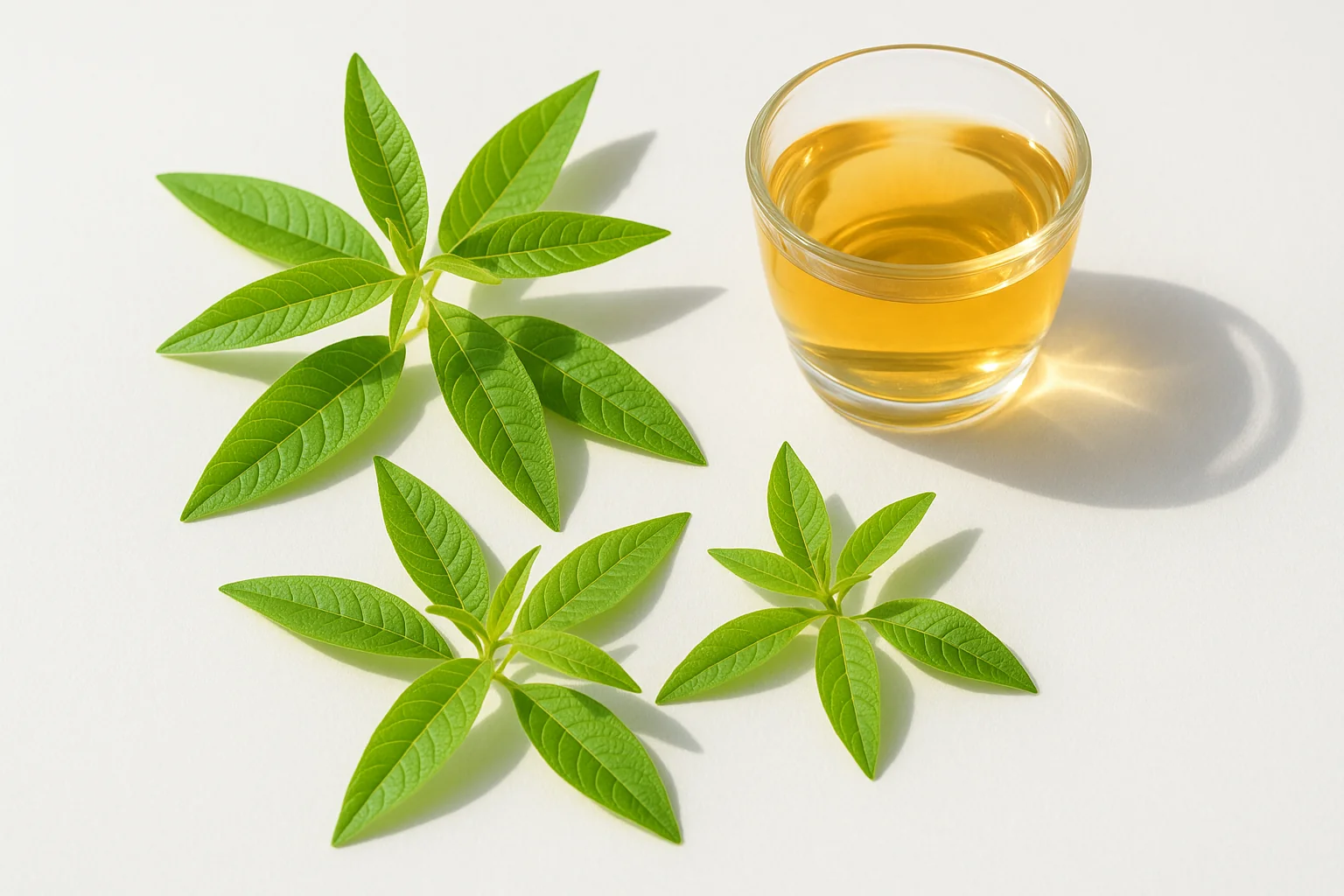

Lemon Verbena: properties for relaxation, weight loss and aroma
Lemon verbena (Aloysia citrodora) has the purest lemon aroma among herbs. Check what has been measured in studies, how to brew the leaves, and who should be cautious.
Lemon balm, lemongrass, and lemon verbena smell similarly, but they belong to three unrelated plant families. Verbena (Aloysia citrodora) has the purest aroma among them: in the essential oil from its leaves, two isomers of citral make up about one third of the total. The shrub was brought to Europe in the 18th century from South America, and its leaves first reached pharmacies and confectioneries. Today, lemon verbena is returning as an evening tea and an addition to desserts, sometimes also as a promise of weight loss. This article separates these threads. It shows what has really been measured in studies involving humans, what remains at the cell culture stage, how to brew the leaves so that the infusion does not become bitter, and who the essential oil may harm.
KEY INFORMATION
• Geranial and neral, two isomers of citral, make up about 34-37% of the composition in lemon verbena oil (Sprea et al., Molecules 2023).
• Studies involving humans concern recovery after physical exertion, not weight loss or sleep.
• The effect of citral on fat cells has only been measured in cell cultures of mice.
• Essential oil is phototoxic, so do not apply it before going out in the sun.
What is lemon verbena and what distinguishes it among lemon herbs?
Lemon verbena is Aloysia citrodora, a shrub from the verbena family originating from Argentina and Chile. It is distinguished by the composition of the essential oil from its leaves: the two isomers of citral, geranial and neral, together make up about one third of the volatile fraction. Hence the purely citrus aroma, without the herbal background audible in lemon balm.
This was measured by Sprea and colleagues (Molecules, 2023): the oil from lemon verbena leaves contained 18.7-21.1% geranial and 15.3-16.2% neral, depending on the distillation method. However, the composition changes with the origin of the raw material and the time of harvest, so treat these values as an order of magnitude for one well-described sample, not a constant of the species.
The word “lemon” appears on the labels of several unrelated plants, so the Latin name is decisive, not the Polish one.
| Plant | Botanical family | Aroma character |
|---|---|---|
| Lemon verbena (Aloysia citrodora) | verbenaceae | pure citrus, without bitterness |
| Lemon balm (Melissa officinalis) | lamiaceae | lemony with herbal background |
| Lemongrass (Cymbopogon citratus) | poaceae | lemony with a grassy note |
| Lemon myrtle (Backhousia citriodora) | myrtaceae | very intense citrus |
What have studies shown about lemon verbena in humans?
Studies involving humans concern one area: recovery after physical exertion. Two randomized trials examined the extract from lemon verbena leaves in physically active individuals, and both measured markers of oxidative stress and muscle performance. Neither studied sleep or body weight.
The first was described by Carrera-Quintanar and colleagues (Scandinavian Journal of Medicine and Science in Sports, 2012). Fifteen men around the age of twenty-one began a 21-day aerobic training program conducted three times a week. Some received 1.8 g of leaf extract daily, while the rest received a placebo. In the group with the extract, the activity of glutathione reductase increased in lymphocytes and erythrocytes, and markers of oxidative damage decreased in plasma. The authors attribute this effect mainly to verbascoside, which constitutes 10% of the extract’s mass.
The second trial, Buchwald-Werner et al. (Journal of the International Society of Sports Nutrition, 2018), included 44 physically active individuals aged 22-50. For 15 days, they took 400 mg of a branded lemon verbena extract or placebo, and in the middle of this period, they underwent an exhausting jump protocol. The group with verbena lost less muscle strength (p = 0.0311). The activity of glutathione peroxidase and perceived pain changed only at the trend level, and creatine kinase and interleukin 6 did not differ between groups.
Both studies tested branded, standardized extracts in groups of a dozen to several dozen individuals over two to three weeks. This is too little to claim proven effects of the infusion from the leaves. A dose of 1.8 g of extract corresponds to a multiple of what passes into a cup of tea, and the results describe a specific preparation in a specific protocol, not the herb as such.
Does lemon verbena help with weight loss?
There is no study that has verified this in humans. The effect of citral on fat cells has been described in cell cultures and at concentrations that the infusion does not reach. Verbena can, however, replace a sweetened drink, and that is its real contribution to the calorie balance.
The basis of the entire story about weight loss is the work of Sri Devi and Ashokkumar (Indian Journal of Clinical Biochemistry, 2018). The researchers differentiated mouse preadipocytes of the 3T3-L1 line into fat cells and checked what citral does to them. The accumulation of triglycerides decreased depending on the concentration, and the expression of factors responsible for the formation of fat tissue, including PPAR-gamma and SREBP-1c, was suppressed. The viability of the cells did not change.
This is a result from a culture plate, obtained on a mouse cell line. Between it and human weight loss lies a path that no one has yet traversed: from the absorption of citral from the digestive tract, through its concentration in fat tissue, to measuring body weight in people drinking the infusion. None of these stages have been described.
What remains practically? A cup of unsweetened infusion instead of sweetened tea or soda is a real caloric difference, independent of any pharmacology. The aroma of verbena is so distinct that the infusion stands up without sweetening, and that is its advantage over herbs with a bland profile. Calling verbena a fat burner goes beyond what anyone has measured.
We noticed when comparing descriptions of lemon herbs that the Polish trade name almost never clarifies what is in the package. The four plants in the table above have the same adjective in their Polish name, yet they come from four distinct botanical families and differ not only in aroma but also in how they withstand boiling water and how long they retain their scent after drying. If you are buying dried herbs for infusion, look for the Latin name on the packaging. It is the only information that does not change meaning between producers.
How to brew lemon verbena and what to do with it in the kitchen?
Pour water at a temperature of about 85-90 degrees Celsius over the leaves of lemon verbena and steep covered for 7-10 minutes. Boiling water washes out bitter tannins from the leaf faster than the volatile terpenes, so the infusion loses aroma and gains astringency. Covering retains steam, in which citral travels.
Shorter steeping gives a brighter and more citrusy infusion, while longer extraction brings out more phenolic compounds and blurs freshness. Two teaspoons of dried herb for a large cup is a typical starting point for fresh raw material that still smells strongly through the packaging. Faded and odorless herb will not regain potency through longer steeping, only become bitter.
In the kitchen, verbena behaves like lemon zest without the acidity. Chopped fresh leaves go into fruit salads and homemade lemonade. Dried leaves add aroma to fish and poultry sauces, and when placed in a jar with sugar for a week, they make citrus sugar for baking. An infusion of leaves in alcohol, macerated for two weeks in a dark place, is sometimes served after dinner.
Growing in a pot is easy under one condition: plenty of sunlight, well-draining soil, and moderate watering. The plant does not tolerate frost, so it moves indoors for the winter. Harvest leaves in the morning when the dew has dried, and dry them in the shade at room temperature. Store the dried raw material in an airtight jar away from light.
How to use lemon verbena in the evening?
Lemon verbena is not a sedative herb, and no study attributes an effect on sleep to it. In the evening, it works for a different reason: an infusion without caffeine and sugar, with a distinct aroma, nicely closes the day as a repetitive ritual. The ritual itself has significance for falling asleep independent of the composition of the infusion.
This difference is important when choosing an herb. Valerian and hops have clinical trials measuring sleep onset. Lemon verbena has trials measuring muscle recovery. If you are looking for an herb with documented effects on sleep, reach for herbal blends for sleep. If you are looking for a drink that you can consume daily without getting tired of it, lemon verbena has a flavor advantage over them.
Practically, it looks like this: prepare the infusion 30-40 minutes before going to bed, dim the screens, and have something to read. Repeated at the same time for two to three weeks, it becomes a signal for the body that the day is ending. Verbena is also sometimes combined with lemon balm in proportions adjusted to taste, as both plants provide a citrus note, but lemon balm brings a gentler, more herbal background.
It is worth separating two things that are easily confused. The pleasant aroma of the infusion is not evidence of pharmacological action, and the lack of pharmacological evidence does not invalidate the sense of an evening ritual. Verbena falls into the second category and there is no need to promote it to the first.
Who should be cautious with lemon verbena?
The infusion from the leaves and the culinary use of verbena are applications with a long tradition of consumption and do not raise concerns among healthy adults. Caution is required with essential oil, as citral acts phototoxic: applied to the skin and exposed to sunlight, it can cause inflammatory reactions and discoloration.
Always dilute the oil in a carrier oil and do not apply it to exposed areas if you plan to go out in the sun within the next day. Before the first use, do a patch test on a small area of skin on your forearm and wait a day. In a diffuser, the oil is suitable without dilution, but do not leave it on in a closed room with a small child.
Pregnancy and breastfeeding are situations in which concentrated extracts and oil are better set aside. Not because anyone has demonstrated harm, but because no one has studied safety in these groups, and the extract from sports studies was given only to healthy adults. The infusion in moderate amounts remains in the category of a regular herbal drink.
Allergy to verbena plants is rare but possible, just like with any new herb. Itching, rash, or shortness of breath after drinking the infusion is a signal to stop and talk to a doctor. If you are on permanent medication, consult with a pharmacist before introducing a concentrated extract, as it delivers ingredients in incomparably higher doses than the infusion.
Frequently Asked Questions
What is the difference between lemon verbena, lemon balm, and lemongrass?
All three smell like lemon, but they belong to three different botanical families. Verbena belongs to the verbena family and has the purest aroma, without the herbal background of lemon balm or the grassy note of lemongrass. The Latin name on the packaging is decisive, as Polish trade names are often used interchangeably by producers of dried herbs.
Does lemon verbena help with weight loss?
No study involving humans has verified this. Citral inhibited the formation of fat cells in the mouse 3T3-L1 line (Sri Devi and Ashokkumar, 2018), but that is a result from cell culture. The real benefit is simpler: an unsweetened infusion replaces a sweetened drink and lowers daily calorie intake.
How to brew lemon verbena so that the infusion does not become bitter?
Use water at a temperature of about 85-90 degrees Celsius instead of boiling water and steep covered for 7-10 minutes. Boiling water washes out bitter tannins faster than the volatile terpenes responsible for the aroma. Covering retains steam, along with which citral escapes, which is what you reach for lemon verbena for.
Can lemon verbena be consumed daily?
The infusion from the leaves has a long tradition of consumption and does not raise concerns among healthy adults when consumed daily. The situation is different with concentrated extracts, the safety of which has not been studied outside of several-week trials in healthy athletes. If you are on permanent medication or are pregnant, consult the extract with a pharmacist or doctor before starting regular use.
Is lemon verbena essential oil safe for the skin?
Only diluted and not before going out in the sun. Citral acts phototoxic, so contact with light after application poses a risk of inflammatory reactions and discoloration. Dilute the oil in a carrier oil, and before the first wider use, do a patch test on a small area of skin on your forearm and wait a day. In a diffuser, the oil does not require dilution.
Does lemon verbena have a sedative effect?
There are no studies attributing an effect on sleep to lemon verbena. Clinical trials with this herb concerned recovery after physical exertion, not falling asleep. In the evening, lemon verbena acts as a repetitive ritual and a caffeine-free drink, which in itself promotes relaxation, but this is a different mechanism than pharmacological.
Ready herbal compositions for brewing can be found in the teas category. If you want to compare lemon verbena with another herb of similar aroma, check out the entry about lemongrass, and for a comparison of herbs supporting concentration, refer to the guide on herbs for concentration.
This article is for informational and educational purposes and does not replace consultation with a doctor. If you are pregnant, breastfeeding, taking medications, or have chronic conditions, consult the use of supplements or herbs with a specialist.
Author: Michał Waluk · Published: 2026-05-19 · Updated: 2026-08-16