
Shiitake and maitake for immunity: properties and dosage (table)
Shiitake and maitake and immunity: what did the study on 52 individuals really show, how does AHCC perform in a study involving 50 women, and how do the two mushrooms differ.
Shiitake and maitake are both a part of the cuisine and a raw material for traditional medicine in East Asia, and for several decades they have also been the subject of laboratory research. This is a convenient combination since we are talking about edible mushrooms, not extracts with an unknown safety profile. The problem is that supplement descriptions mix results obtained on mice with results involving humans, and doses from studies are presented as recommendations. This article separates one from the other: it shows which studies were actually conducted, on whom, for how long, and with what effect, as well as where the statements about both mushrooms end without going beyond the data. It turns out that the strongest result concerns not an expensive extract, but ordinary dried mushrooms bought by weight.
KEY INFORMATION
• In a study involving 52 healthy individuals aged 21-41, consuming 5 g or 10 g of dried shiitake daily for 4 weeks increased the proliferation of gamma-delta T lymphocytes by 60% and NK-T cells doubled (Dai et al., Journal of the American College of Nutrition, 2015).
• In the same study, the concentration of secretory immunoglobulin A in saliva increased, while the concentration of C-reactive protein in serum decreased.
• AHCC, a standardized extract from shiitake mycelium, was tested in a randomized study involving 50 women with chronic high-risk HPV infection (Smith et al., Frontiers in Oncology, 2022).
• Among orally administered extracts, the strongest effect was observed with a mixture of maitake and shiitake, not with either of them alone (Vetvicka and Vetvickova, Annals of Translational Medicine, 2014).
• Raw or undercooked shiitake can cause characteristic skin inflammation. Cooking and extracts do not have this problem.
What are shiitake and maitake and what connects them?
Shiitake, in Latin Lentinula edodes, is one of the most widely cultivated edible mushrooms in the world, originating from the forests of East Asia and present in traditional medicine there for centuries. Maitake, Grifola frondosa, grows at the base of old oaks in Japan, China, and eastern North America, and its name means dancing mushroom in Japanese. Maitake fruiting bodies can be impressive and are considered a delicacy in Japanese cuisine.
They are connected by the presence of beta-glucans, which are branched polysaccharides that have been studied for decades for their impact on the immune response. In shiitake, the best-described representative of this group is lentinan, a beta-1,3-glucan. In maitake, the so-called D-fraction, a beta-1,3/1,6-glucan with characteristic branching, and a related MD-fraction are distinguished.
The practical difference concerns what has actually been studied in humans for each of them. For shiitake, there is a study involving healthy volunteers and a randomized study on a standardized extract from the mycelium. For maitake, the data primarily comes from laboratory and comparative studies. A broader background for the entire group is provided by the entry on medicinal mushrooms and clinical studies on them.
What did the study on shiitake in healthy people show?
The most frequently cited work on this topic is the controlled nutritional study by the Dai team, published in Journal of the American College of Nutrition. It involved 52 healthy individuals of both sexes aged 21-41, who ate 5 g or 10 g of dried shiitake mushrooms daily for four weeks. Blood, saliva, and serum were collected before and after the observation period.
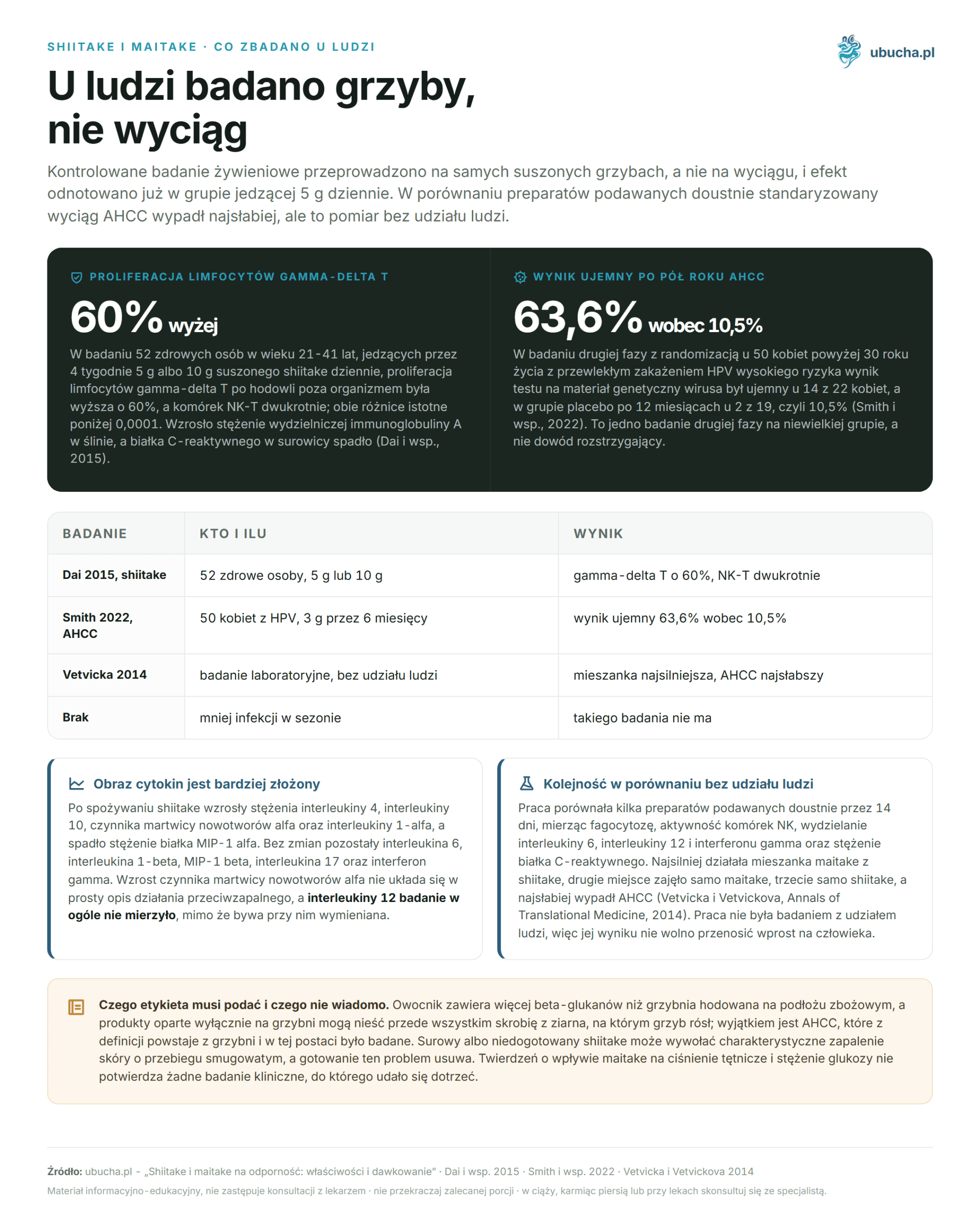
Changes affected several indicators simultaneously. The proliferation of gamma-delta T lymphocytes after cultivation outside the body was 60% higher, and NK-T cells were twice as high; both differences were statistically significant at a level below 0.0001. Both populations also showed a greater ability to present activation receptors, which the authors interpreted as an improvement in cell efficiency. The concentration of secretory immunoglobulin A in saliva, an indicator of mucosal immunity, increased, while the concentration of C-reactive protein in serum decreased.
The cytokine profile is more complex than it is usually presented. After consuming shiitake, the concentrations of interleukin 4, interleukin 10, tumor necrosis factor alpha, and interleukin 1-alpha increased, while the concentration of MIP-1 alpha decreased. The concentrations of interleukin 6, interleukin 1-beta, MIP-1 beta, interleukin 17, and interferon gamma remained unchanged. It is worth noting this because the increase in tumor necrosis factor alpha does not fit into a simple description of anti-inflammatory action, and interleukin 12 was not measured in the study at all, even though it is sometimes mentioned in this context.
What distinguishes maitake and how does it compare?
The most useful reference point is the work of Vetvicka and Vetvickova from Annals of Translational Medicine, which compared several preparations administered orally over 14 days. It measured phagocytosis, NK cell activity, and the secretion of interleukin 6, interleukin 12, and interferon gamma, as well as the concentration of C-reactive protein. AHCC served as a reference point.
The results form a clear order. The mixture of maitake and shiitake had the strongest effect, maitake alone came in second, shiitake alone was third, and AHCC was the weakest. The authors summarize that short-term oral administration of glucans from both mushrooms stimulated both the cellular and humoral branches of the immune response, and that this activity was significantly higher than the activity of AHCC.
From this comparison, two conclusions emerge, both worth remembering. The first: combining both mushrooms is supported by measurement, not just the intuition that more ingredients means better. The second: the advantage of a standardized, expensive extract over ordinary glucans is not obvious and in this particular comparison was to the disadvantage of the extract. The work was not a study involving humans, so its results cannot be directly transferred to humans.
What is AHCC and what clinical confirmation does it have?
AHCC is a standardized extract from cultivated shiitake mycelium, produced in Japan and sold as a supplement to support immunity. It has undergone a clinical study with randomization and a placebo group, which is rare in the category of mushroom preparations, so it is worth knowing its details.
The Smith team published in Frontiers in Oncology the results of a phase two randomized, double-blind, placebo-controlled study registered as NCT02405533. It involved 50 women over 30 years old with confirmed chronic high-risk human papillomavirus infection lasting longer than two years. Half received AHCC at a dose of 3 g once daily on an empty stomach for 6 months, followed by placebo for another 6 months; the other half received placebo for 12 months. 41 participants completed the study.
In the group receiving AHCC, after 6 months, the test result for the virus’s genetic material was negative in 14 out of 22 women, or 63.6%, and 9 of those 14 maintained the effect for six months after stopping the preparation. In the placebo group, after 12 months, 2 out of 19 participants had a negative result, or 10.5%. The authors also noted that lowering the concentration of interferon beta below 20 picograms per milliliter was associated with the elimination of the infection. The preparation was well tolerated, with no significant adverse effects. This is one phase two study on a small group, not a conclusive proof.
What was studied, on whom, and with what result
The following table organizes the three studies discussed above. The numbers in the study course column describe what was administered to the study participants and are not recommendations for the reader. The amount and form of the supplement should be determined by a doctor or pharmacist, especially in the case of chronic disease or medications taken.
Note the second column, as it determines the weight of the result. The first two rows describe studies involving humans, with only the second having a placebo group and randomization. The third row describes a laboratory measurement, the results of which cannot be directly transferred to humans, although it is sometimes cited as if it concerned patients. None of these studies checked whether supplementation translates into fewer infections in the autumn-winter season, as such a study for these mushrooms simply does not exist.
| Study | Who and how many | Course | Result |
|---|---|---|---|
| Dai 2015, shiitake | 52 healthy individuals, 21-41 years | 5 g or 10 g of dried mushrooms daily for 4 weeks | Gamma-delta T lymphocytes +60%, NK-T doubled, increased sIgA, decreased CRP |
| Smith 2022, AHCC | 50 women over 30 with chronic HPV | 3 g on an empty stomach for 6 months versus placebo, 12 months observation | Negative result in 63.6% versus 10.5% in the placebo group |
| Vetvicka 2014, comparison | Laboratory study, no human participation | Oral administration for 14 days, several preparations side by side | Mixture of maitake and shiitake the strongest, AHCC the weakest |
Is it enough to eat mushrooms instead of a supplement?
For shiitake, the answer is unusually specific, as the Dai study was conducted on the mushrooms themselves, not on an extract. The immunological effect was noted even in the group eating 5 g of dried mushrooms daily, which is an amount achievable through regular cooking. Dried shiitake, after soaking, can be added to soups, sauces, and one-pot dishes without any special procedures.
A supplement gains an advantage in two situations. The first is the need for a standardized preparation with a repeatable composition, like AHCC in the study described above, where a specific extract was tested in a specific amount. The second is more mundane: not everyone likes the taste of mushrooms, and not everyone will eat them regularly for several weeks.
However, there is an important culinary caveat. Raw or undercooked shiitake can cause characteristic skin inflammation with a streaky course, described as shiitake dermatitis. A component that breaks down at high temperatures is responsible for this, so cooking eliminates the problem, just like using an extract. This is the only commonly reported issue with this mushroom and is easy to avoid. The species itself, its nutritional value, and culinary applications are discussed separately in the entry on the properties of shiitake.
How to choose a good product and what to watch out for?
The first criterion is the raw material. The fruiting body contains more beta-glucans than mycelium grown on grain substrate, and products based solely on mycelium may primarily carry starch from the grain on which the mushroom grew. An exception is AHCC, which by definition is made from mycelium and was studied in this form, so here the declaration of mycelium is not a disadvantage.
The second criterion is standardization. The label should state the content of beta-glucans or, in the case of AHCC, the content of the extract in milligrams per capsule. A formulation that only mentions mushroom powder does not allow for comparison between two products. The third criterion is independent confirmation of the composition, provided by some manufacturers as a certificate of analysis.
Finally, caution that does not stem from marketing but from a lack of data. Maitake is sometimes described as affecting blood pressure and glucose levels, but no clinical study confirming these claims has been found. Therefore, individuals taking medications for hypertension or diabetes should discuss supplementation with their doctor, rather than assuming it has no effect. The same applies to immunosuppressive medications and the period of pregnancy and breastfeeding. Another mushroom with a profile aimed at the skin is described in the entry on tremella and its connection with collagen.
Frequently asked questions
What are shiitake and maitake and what connects them?
These are two species of edible mushrooms from East Asia, also used in traditional medicine there. They are connected by the presence of beta-glucans studied for their impact on immunity: in shiitake, the best-described is lentinan, and in maitake, the so-called D-fraction with branching 1,3/1,6.
What did the study on shiitake in humans really show?
In a study involving 52 healthy individuals, eating 5 g or 10 g of dried mushrooms daily for 4 weeks increased the proliferation of gamma-delta T lymphocytes by 60%, and NK-T cells doubled. The concentration of sIgA in saliva increased, while the concentration of CRP in serum decreased.
Does maitake work stronger than shiitake?
In one comparative study without human participation, the strongest effect was observed with a mixture of both mushrooms, followed by maitake alone, then shiitake alone, and the weakest was AHCC. This is a laboratory measurement, so it does not directly translate to humans, but it supports the combination of both species.
Does AHCC have confirmation in clinical studies?
Yes, one. In a phase two randomized study involving 50 women with chronic high-risk HPV infection, AHCC taken for 6 months resulted in a negative outcome in 63.6% of participants compared to 10.5% in the placebo group. The preparation was well tolerated.
Are shiitake and maitake safe?
As food, they have a good safety profile. Raw shiitake can cause characteristic skin inflammation, which is prevented by cooking. If you are on medications for hypertension, diabetes, or immunosuppressants, and during pregnancy and breastfeeding, discuss supplementation with your doctor.
Do you need to take a supplement, or is it enough to eat mushrooms?
The study on healthy volunteers was conducted on dried mushrooms alone, not on an extract, and the effect was noted even in the group eating the smaller of the tested portions. A supplement has an advantage where a standardized preparation with a repeatable composition is needed.
Products with vital mushrooms available in the store at Bucha can be found in the adaptogens category.
This article is for informational and educational purposes and does not replace consultation with a doctor. If you are pregnant, breastfeeding, taking medications, or have chronic conditions, consult the use of supplements or herbs with a specialist.
Author: Michał Waluk · Published: 2026-07-15 · Updated: 2026-08-11