
Chaga: a mushroom from birch for immunity and antioxidants
Chaga (Inonotus obliquus): what studies have shown about extracts, why oxalates are a real risk for the kidneys, and what is still unknown about immunity.
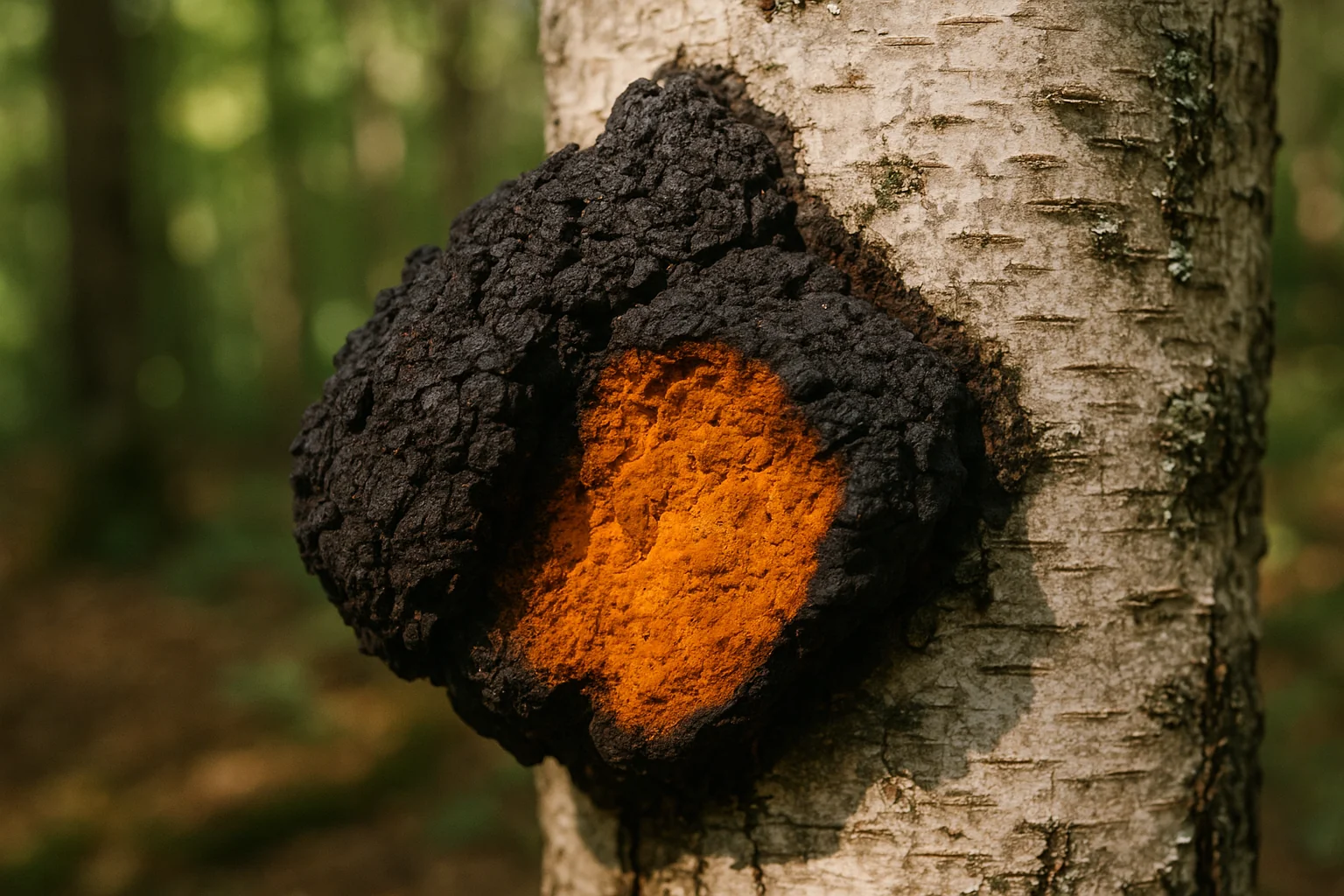
Chaga looks like a lump of coal stuck to a birch: black, hard, and cracked on the outside, with a warm orange interior. Siberian hunters and Finnish gatherers have brewed it for generations as an infusion for immunity and longevity, and today it is sold as a mushroom with record antioxidant strength. The problem is that the most commonly repeated number describing this strength does not come from the study it refers to. At the same time, in the same work that is cited regarding chaga, there is a finding that is much more important for someone who intends to drink it daily, and practically no one mentions it. This article shows what has actually been measured in chaga extracts, what has not been studied in humans, and why kidneys are discussed separately in relation to this mushroom.
KEY INFORMATION
• In the analysis of chaga extracts from Finland, Russia, and Thailand, the main organic acid turned out to be oxalic acid, and it was most abundant in the aqueous extract, which is what is produced when brewing (Glamočlija et al., Journal of Ethnopharmacology, 2015).
• Two cases of kidney failure after prolonged intake of powdered chaga in large amounts have been described.
• Chaga extracts were toxic to four lines of cancer cells and not to normal porcine liver cells.
• No randomized studies have been conducted in humans regarding chaga and immunity or chaga and cancer.
• The authors of the composition analysis themselves caution that quantitative conclusions require further purification of the raw material.
What is chaga and where does it really grow?
Inonotus obliquus is a fungus that parasitizes trees in cold climates: in Siberia, Scandinavia, Poland, and Canada. It forms a black, cracked growth that draws substances from the bark and wood of its host for several to many years. The dark outer layer is melanin, and the interior is orange, where most of the described components are concentrated.
It is often claimed that chaga only grows on birch and never on any other species. This is not true: in medical descriptions, Inonotus obliquus is explicitly defined as a parasite of birch and other tree species. Birch is the most common and valued host because some of the compounds the fungus takes come specifically from its bark, but exclusivity is a sales simplification, not a botanical fact.
This distinction has practical significance when purchasing. If a seller bases the entire value of the raw material on the fact that it comes from birch, it would be appropriate for them to provide the species of the tree and the place of collection, not just the term. It is also worth remembering that under the name chaga, cultivated fungi are also traded, which differ in composition from wild growths. A broader comparison of species has been gathered in the post about chaga as a mushroom adaptogen.
What has been measured in chaga extracts?
The most frequently cited analysis of composition is the work of Glamočlija’s team (Journal of Ethnopharmacology, 2015), and it is worth quoting it accurately, as it circulates in a heavily modified version. The researchers took aqueous and ethanolic extracts from raw material sourced from three countries: Finland, Russia, and Thailand. They identified organic acids and phenolic compounds, measured antioxidant and antimicrobial activity, and finally checked the effects on cancer cells.
The most important result of the composition is also the least frequently repeated: the main organic acid in chaga turned out to be oxalic acid, and its highest concentration was found in the aqueous extract from Russian raw material. All samples also contained gallic acid, protocatechuic acid, and p-hydroxybenzoic acid. The extracts showed high antioxidant and antimicrobial activity, and additionally disrupted quorum sensing communication in Pseudomonas aeruginosa, which the authors considered a premise for broader infectious protection than just action on immunity.
The authors’ conclusions are clearly more cautious than their summaries on the internet. The work ends with the statement that the content of Inonotus obliquus in the growths is limited, so to draw quantitative conclusions, the raw material must first be more thoroughly purified. In other words: the researchers did not provide a number describing the antioxidant strength of chaga as a product, but measured the activity of specific laboratory extracts and noted that translating this to a wild growth is premature.
Does chaga strengthen immunity?
It is unknown, as no randomized controlled study has been conducted in humans. What can be said honestly today concerns the cellular and animal level, not the effect that a reader would feel in winter.
The mechanism that most descriptions refer to is based on polysaccharides of the beta-glucan type, recognized by receptors on phagocytic cells. This pathway is well described for fungi as a group, but describing it is not the same as demonstrating that chaga infusion reduces the number of infections in humans. Between the action on cell culture and a lower number of sick days lie several levels of evidence, which no one has built in the case of chaga.
It is also worth noting that the antimicrobial activity and quorum sensing inhibition measured by Glamočlija’s team is something different from strengthening immunity. This action is directed at bacteria, not at the host’s immune system, and it is this that has been measured directly. If you are looking for a mushroom with broader clinical documentation, more data is available for reishi, or Ganoderma lucidum.
What is known about chaga and cancer?
A lot is known about cells in culture and about mice, but nothing certain is known about humans. This distinction determines everything, so let’s describe both levels separately.
In cell cultures, the aqueous extract of chaga halted the division of hepatocellular carcinoma cells in the G0/G1 phase and triggered their programmed death, with the HepG2 line reacting more strongly than Hep3B (Youn et al., World Journal of Gastroenterology, 2008). Glamočlija’s team obtained a similar picture on four cancer lines and, importantly, found no toxicity towards primary cultures of normal porcine liver cells.
There is one animal study, which is often described inaccurately. Youn and colleagues (Journal of Ethnopharmacology, 2009) administered an aqueous extract to Balb/c mice with implanted B16-F10 melanoma for ten days, via injections into the peritoneal cavity. Tumor mass growth was inhibited threefold compared to the positive control. Two things should be stated clearly: the administration was by injection, not orally, and the result was given as a multiple compared to control, not as a percentage reduction of the tumor.
In humans, there are no randomized studies evaluating chaga in oncology. Only descriptions of individual cases are available. Chaga is not an anti-cancer drug and does not replace oncological treatment, and the decision to use it during therapy should be discussed with the attending physician, among other reasons described in the next section.
Can chaga damage the kidneys?
Yes, and this is the best-documented risk associated with this mushroom. It directly results from its composition: since the main organic acid in chaga is oxalic acid, and it is most abundant in the aqueous extract, daily infusion is simultaneously a daily dose of oxalates.
The first case report (Kikuchi et al., Clinical Nephrology, 2014) comes from 2014. A 72-year-old Japanese woman, one year after being diagnosed with liver cancer and three months after the removal of the left lobe, had been taking powdered chaga for six months. Her kidney function deteriorated to a level requiring dialysis. A biopsy revealed diffuse atrophy of the tubules and interstitial fibrosis, and oxalate crystals were found in the tubules and urine sediment. The authors described this as the first such case associated with chaga consumption.
The second report (Kwon et al., Medicine, 2022) concerns a 69-year-old man who took powdered chaga together with vitamin C for three months. He developed acute kidney injury with a picture of nephrotic syndrome, and calcium oxalate deposits were found in the tubules. After dialysis and steroid treatment, kidney function returned to normal within a month. The accompanying vitamin C is not an insignificant detail here, as it is a source of oxalates in the body.
The practical conclusion is simple and does not require specifying any grams: if you have a history of oxalate kidney stones, kidney disease, or are taking large amounts of vitamin C, discuss chaga with your doctor before introducing it permanently. We have also separately gathered what to know about herbs and supplements for the kidneys.
What medications can chaga interact with?
Three groups of medications require attention here, with the basis of evidence being different for each, and it is worth knowing this rather than treating warnings as equally strong.
With anticoagulant medications, caution arises from pharmacological premises, not from documented cases in people taking chaga. The same goes for glucose-lowering medications: hypoglycemic action has been demonstrated for chaga polysaccharides in cultures and in animals, so adding it to metformin or insulin is a theoretical additive risk, not a clinical determination. If you are taking such medications, monitor your blood glucose and inform your doctor.
The third group is different because here the evidence is solid. It concerns high doses of vitamin C and anything that burdens the kidneys, as the oxalate load adds up regardless of the source. The case described in 2022 specifically involved such a combination. It is worth knowing this because chaga and vitamin C are often sold together as an immunity set, and this combination is the least fortunate from the kidney’s perspective.
How to brew chaga tea?
Traditionally, pieces of the growth are poured with hot water and left for several minutes, and in the Russian version, it is boiled for several hours as a decoction. The infusion has a dark brown color and a mild, slightly earthy taste with a hint of vanilla, without a distinct bitterness, so it can be drunk without sweetening.
The same pieces are usually used several times, as water extracts the components gradually. However, it should be noted that the proportions, temperature, and brewing time described in guides come from practice, not comparative studies: no one has measured at which temperature the chaga extract retains the most active ingredients and at which it loses them. Claims about specific degrees Celsius, repeated in many places, lack measurement support.
One note arises directly from the composition and is more important than the technique. Since oxalates are most abundant in the aqueous extract, the infusion is not a milder form of chaga than a capsule, but exactly the one where the discussed risk is the highest. Daily drinking of a strong decoction for many months is a different scenario than having a cup occasionally, and it is this first scenario that occurs in both described cases of kidney damage.
Frequently Asked Questions
What is chaga and where does it come from?
Inonotus obliquus is a fungus that parasitizes birches and other trees in cold climates: in Siberia, Scandinavia, Poland, and Canada. It forms a black growth that draws substances from the bark and wood of its host. In Russian folk medicine, an extract from it was used as an anti-cancer and diuretic agent.
Does chaga have the highest antioxidant activity of all mushrooms?
There is no study that proves this. The work most often cited as evidence for this claim measured the antioxidant activity of specific extracts, and its authors noted that quantitative conclusions require prior purification of the raw material. The numbers comparing chaga to other products do not come from this work.
Does chaga help with immunity?
In humans, no randomized controlled study has been conducted, so there is no answer. The described mechanism concerns polysaccharides acting on phagocytic cells in laboratory conditions. However, the antimicrobial activity of extracts was directly measured, which is something different from strengthening the host’s immunity.
Is chaga safe for the kidneys?
Not always. Two cases of kidney failure after prolonged intake of powdered chaga have been described: in a woman after six months and in a man after three months, in the latter case together with vitamin C. The cause was oxalate deposits in the renal tubules. If you have kidney disease, consult your doctor.
Does chaga cure cancer?
No. Extracts inhibited the growth of cancer cells in culture, and in mice with implanted melanoma, injection into the peritoneal cavity inhibited tumor growth threefold compared to control. In humans, there are no randomized studies. Chaga does not replace oncological treatment.
Can chaga be combined with medications?
Caution is advised with anticoagulant and glucose-lowering medications, although this is based on pharmacological premises rather than documented cases. However, there is hard evidence regarding the combination of chaga with vitamin C, as the oxalate load then adds up. Consult this with your doctor.
How many times can the same pieces of chaga be brewed?
In practice, they are used several times, as water extracts the components gradually. However, there is no study that measured how many active substances remain after subsequent brews or how water temperature affects this. The ranges provided in guides come from custom, not measurement.
Plant and mushroom extracts available in the store have been gathered in the herbs category.
This article is for informational and educational purposes and does not constitute medical advice. Before starting supplementation, consult your doctor, especially if you are taking medications regularly, are pregnant or breastfeeding, or have chronic illnesses.
Author: Michał Waluk · Published: 2026-06-22 · Updated: 2026-08-16