
Collagen Type I II III: What Are the Differences and Which Collagen to Choose
Collagen types I, II, and III: what studies say about the absorption of peptides, how UC-II differs from collagen hydrolysate, and how to read a supplement label.
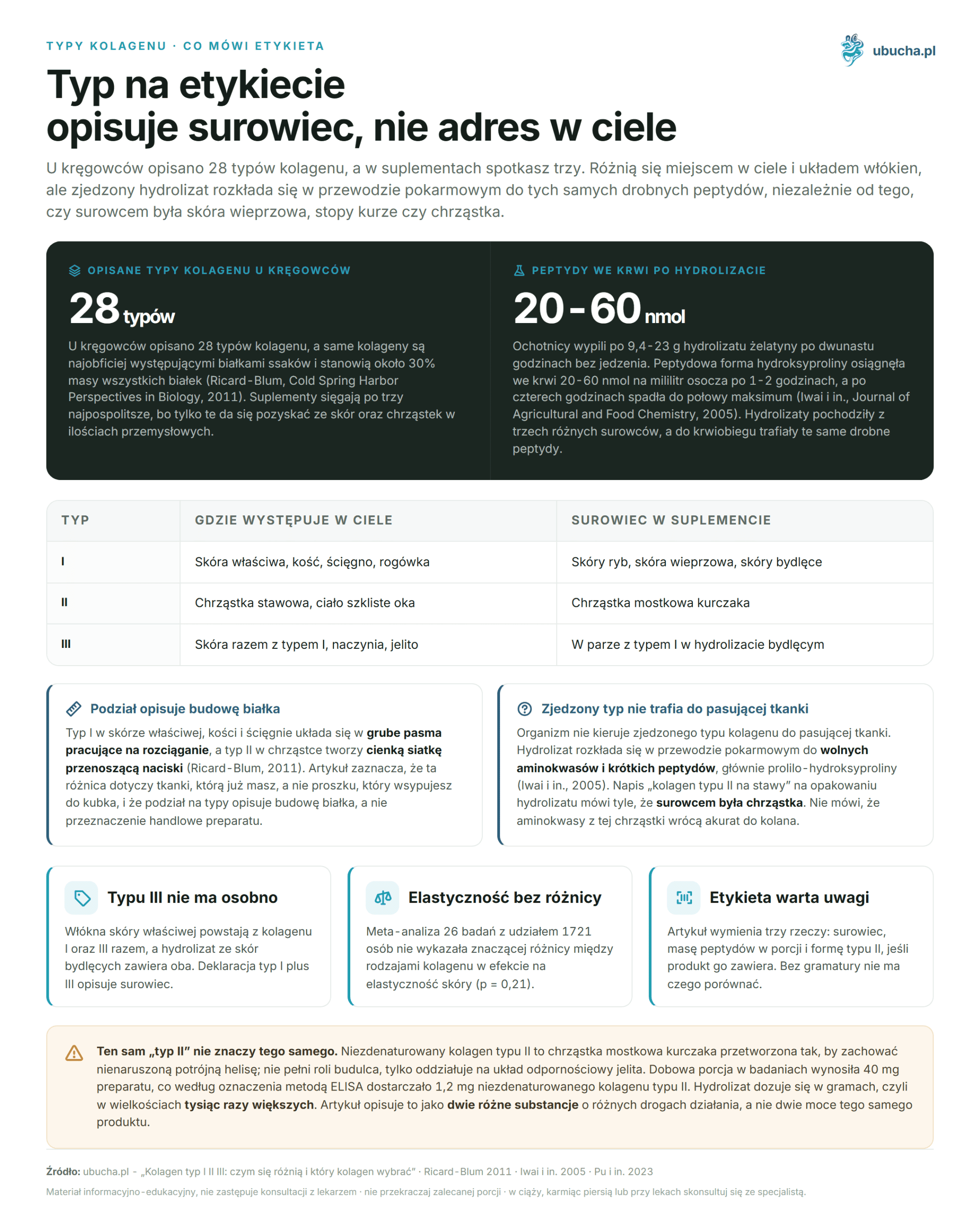
On supplement labels, the type of collagen is sometimes indicated as if it determines the target location in the body: type I for skin, type II for joints, type III for blood vessels. In vertebrates, 28 types of collagen have been described, and collagens are the most abundant proteins in mammals, constituting about 30% of the mass of all proteins (Ricard-Blum, Cold Spring Harbor Perspectives in Biology, 2011). Three of these types actually build the tissues mentioned in advertisements. The problem lies elsewhere. Protein consumed orally does not return to the tissue from which it came, as the digestive tract breaks it down beforehand. Below you will find how collagen types differ in the body, what studies on their supplementation have really shown, who funded these studies, and how to make use of this when reading labels.
KEY INFORMATION
• In vertebrates, 28 types of collagen have been described, and the fibers of the dermis are formed together by type I and type III (Ricard-Blum, 2011).
• Hydrolysate breaks down into amino acids and short peptides, mainly prolyl-hydroxyproline (Iwai et al., 2005).
• Collagen peptides and undenatured type II are two different mechanisms, not two doses of the same.
• A meta-analysis of 26 studies involving 1721 people found no difference between sources in terms of skin elasticity (Pu et al., 2023).
• The raw material producer funded or co-funded most of the studies described below.
How many types of collagen are there and how do they differ?
In vertebrates, 28 types of collagen have been described, but in supplements, you will encounter three. Type I builds the dermis, bone, and tendon. Type II is the main collagen in articular cartilage. Type III co-forms skin fibers together with type I, and outside the skin, it is part of the walls of blood vessels and hollow organs (Ricard-Blum, 2011).
| Type | Where it occurs in the body | Source in the supplement |
|---|---|---|
| I | Dermis, bone, tendon, cornea | Fish skins, pork skin, bovine skins |
| II | Articular cartilage, vitreous body of the eye | Chicken sternal cartilage |
| III | Skin together with type I, blood vessels, intestine | Always paired with type I in bovine hydrolysate |
The division makes anatomical sense and promises nothing beyond that. Type II differs from type I in the way the fibers are arranged. In cartilage, it forms a thin mesh that transmits pressure. Type I in skin and tendon is arranged in thick strands that work under tension. This difference concerns the tissue you already have, not the powder you pour into a cup.
It is also worth remembering that the division into types describes the structure of the protein, not the commercial purpose of the preparation. Ricard-Blum describes a family of 28 proteins, each of which has at least one triple helix domain; four of them additionally occur as membrane proteins released from the cell surface. Supplements reach for the three most common types, as only these can be obtained from skins and cartilages in industrial quantities. The rest of the family is not inferior, it just cannot be made from anything.
Does type II collagen go straight to the joints, and type I to the skin?
No. The body does not direct ingested type collagen to the corresponding tissue. The hydrolysate breaks down in the digestive tract into free amino acids and short peptides. Volunteers in Iwai’s study consumed 9.4-23 g of gelatin hydrolysate after twelve hours without food. The peptide form of hydroxyproline reached the blood at 20-60 nmol per milliliter of plasma after 1-2 hours, and after four hours, it dropped to half of the maximum (Iwai et al., Journal of Agricultural and Food Chemistry, 2005). The main component of this fraction was the dipeptide prolyl-hydroxyproline.
The most interesting aspect of this study is what is not visible in advertisements. Volunteers received hydrolysates from three different sources: from pork skin, chicken feet, and cartilage. The same small peptides with hydroxyproline entered the bloodstream, alongside prolyl-hydroxyproline, also alanine-hydroxyproline, and several longer fragments. Therefore, the name of the type describes the starting material, not the target address in the body.
What does this mean practically? The label “type II collagen for joints” on the hydrolysate package says that the source was cartilage. It does not say that the amino acids from that cartilage will return specifically to your knee. This is confirmed by the comparison of sources: a meta-analysis of 26 studies involving 1721 people found no significant difference between types of collagen in terms of skin elasticity (p = 0.21; Pu et al., Nutrients, 2023). For skin hydration, subgroups performed differently, both according to the source and the duration of supplementation. We noticed that this part of product descriptions often diverges from the literature, regardless of the brand.
What have studies shown about collagen peptides for skin and bones?
The effects are measurable but more modest than advertising suggests. In a study by Proksch and colleagues, 69 women aged 35-55 took 2.5 g or 5 g of pork collagen hydrolysate daily for 8 weeks, with 23 people in each group. Skin elasticity improved significantly in both dosage groups compared to placebo (Skin Pharmacology and Physiology, 2014). By what percentage, the summary does not provide, and the full text is not openly available from the publisher, so any specific number circulating in product descriptions remains unverifiable.
Skin hydration and water loss through the epidermis favored the hydrolysate in subgroup analysis, but did not achieve statistical significance. Four weeks after discontinuation, only older participants maintained higher elasticity. Two authors of the study are associated with the CRI Collagen Research Institute in Kiel, which is a research institute in the same industry.
For bones, the picture is similar. König and colleagues administered 5 g of collagen peptides or placebo to 131 postmenopausal women for 12 months; 102 people completed the study, but the analysis included all 131. The T-score of the spine changed by +0.1 compared to -0.03 in the control group (p = 0.030), and the neck of the femur by +0.09 compared to -0.01 (p = 0.003). The bone formation marker P1NP increased in the study group (p = 0.007), while the bone resorption marker CTX-1 increased in the control group (p = 0.011) (König et al., Nutrients, 2018). The preparation came from GELITA AG, which partially funded the study; the authors note that planning and data analysis were conducted independently, and declare no conflict of interest.
The aforementioned meta-analysis from 2023 confirmed the improvement in hydration and elasticity of the skin after hydrolysate, but reported a risk of error due to missing outcome data in thirteen of the 26 included studies. This is half of the evidence on which the entire product category stands.
How does undenatured type II collagen differ from peptides?
By mechanism, not dose. UC-II is chicken sternal cartilage processed to retain the intact triple helix. It does not serve as a building block but interacts with the intestinal immune system. The daily dose in studies was 40 mg of the preparation, which according to ELISA measurement provided 1.2 mg of undenatured type II collagen.
In comparison, hydrolysate is dosed in grams, which is a thousand times larger amounts. These are not two powers of the same product, but two different substances with different modes of action. Mixing them in one product description leads the reader to conclude that 10 g of cartilage hydrolysate will replace 40 mg of UC-II.
In a study by Lugo and colleagues, 191 volunteers with knee osteoarthritis took UC-II, glucosamine with chondroitin at a dose of 1500 mg plus 1200 mg, or placebo for 180 days. The WOMAC score improved in the UC-II group compared to placebo (p = 0.002) and compared to glucosamine with chondroitin (p = 0.04), and the subscales of pain, stiffness, and physical function went in the same direction (Lugo et al., Nutrition Journal, 2016). Safety did not differ between groups.
Who funded this study matters. The sponsor was InterHealth Nutraceuticals, the producer of UC-II; two authors were its employees, and a third provided consulting services for it. The study itself was conducted independently by an external company, and the statistical analysis was performed by an independent statistician. The authors state directly that the mechanism of action of the preparation requires further research, so the explanation through food tolerance remains a working hypothesis.
How to choose a preparation and what to look for on the label?
Start with the goal. Then check the source and the dose used in studies. For skin, the hydrolysate was studied at doses of 2.5-5 g daily for 8 weeks, for bones at a dose of 5 g for 12 months, and for the knee joint, 40 mg of UC-II was administered for 180 days. This is a description of studies, not a recommendation for you.
You do not need to look for type III separately, as it is not sold separately. The fibers of the dermis are formed from both type I and type III collagen together, so the hydrolysate from bovine skins contains both. How important type III is structurally is shown by genetics: mutations in the COL3A1 gene cause the vascular form of Ehlers-Danlos syndrome, which risks dissection and rupture of arteries, the gastrointestinal tract, and the pregnant uterus (Omar et al., Matrix Biology Plus, 2021). This is an argument for not omitting type III in the description of physiology, not for a separate supplement.
A noteworthy label provides three things: the source, the mass of peptides in the dose, and the form of type II, if the product contains it. When the manufacturer writes only “marine collagen” without a gram weight, you cannot compare it with any study. Our observations from browsing offers are that the lack of gram weight on the front label almost always goes hand in hand with a dose below the studied amounts.
The difference between hydrolysate and unprocessed collagen is broken down in the text Collagen Peptides vs Collagen. The question of the source, i.e., fish versus bovine, is resolved in the text Grass-Fed vs Marine Collagen. If you are looking for a preparation for joints, not for skin, the comparison of collagen with glucosamine can be found in the text Supplements for Joints.
Frequently Asked Questions
What is the difference between type I and type II collagen?
They differ in location in the body and the structure of the fibers. Type I forms thick strands that work under tension in the dermis, bones, and tendons. Type II arranges itself in a thin mesh that transmits pressure and is the main collagen in articular cartilage (Ricard-Blum, 2011). The difference concerns the tissue, not the powder in the cup.
Does type II collagen really reach the joints?
There is no mechanism that directs ingested type collagen to the corresponding tissue. After drinking the hydrolysate, free amino acids and short peptides with hydroxyproline appear in the blood, regardless of whether the source was pork skin, chicken feet, or cartilage (Iwai et al., 2005).
What dose of UC-II was used in joint studies?
Participants took 40 mg of UC-II daily for 180 days, providing 1.2 mg of undenatured type II collagen. The WOMAC score improved compared to placebo (p = 0.002) and compared to glucosamine with chondroitin (p = 0.04). The study was sponsored by the raw material producer (Lugo et al., Nutrition Journal, 2016).
Does marine collagen work better than bovine?
A meta-analysis of 26 studies involving 1721 people found no significant difference between collagen sources in terms of skin elasticity (p = 0.21; Pu et al., Nutrients, 2023). For skin hydration, subgroups differed, but the authors reported a risk of error in thirteen of the 26 studies.
Do I need to buy type III collagen separately?
You cannot and there is no need. The fibers of the dermis are formed from both type I and type III collagen together, and the hydrolysate from bovine skins contains both (Ricard-Blum, 2011). Separate type III preparations are not available for sale, so the declaration of type I plus III describes the raw material, not an additional ingredient.
Collagen preparations available in the store can be found in the collagen category.
This article is for informational and educational purposes only and does not constitute medical advice. Before starting supplementation, consult your doctor, especially if you are taking medications regularly, are pregnant or breastfeeding, or have a chronic illness.
Author: Michał Waluk · Published: 2026-06-22 · Updated: 2026-08-15