
Oral Hyaluronic Acid for Skin Hydration and Knee Pain: Evidence
Oral hyaluronic acid improves skin hydration in randomized studies. For knee pain, the evidence is weaker than usually presented.
Hyaluronic acid is associated with fillers and joint injections, so the idea of swallowing it in a capsule raises justified doubts. The intestine breaks down this polysaccharide into fragments. Nevertheless, randomized studies show a measurable effect on the skin: after twelve weeks of taking 120 mg daily, hydration of the stratum corneum, skin elasticity, and wrinkle assessment improved in forty healthy individuals (Hsu et al., Nutrients, 2021). For knees, the evidence is much weaker than usually presented. Below you will find what exactly was measured in each of these areas, how much of the oral dose is actually absorbed, and where popular descriptions diverge from the studies they cite.
KEY INFORMATION
• A twelve-week randomized study in 40 individuals showed improved hydration of the stratum corneum and skin elasticity at 120 mg daily (Hsu et al., Nutrients, 2021).
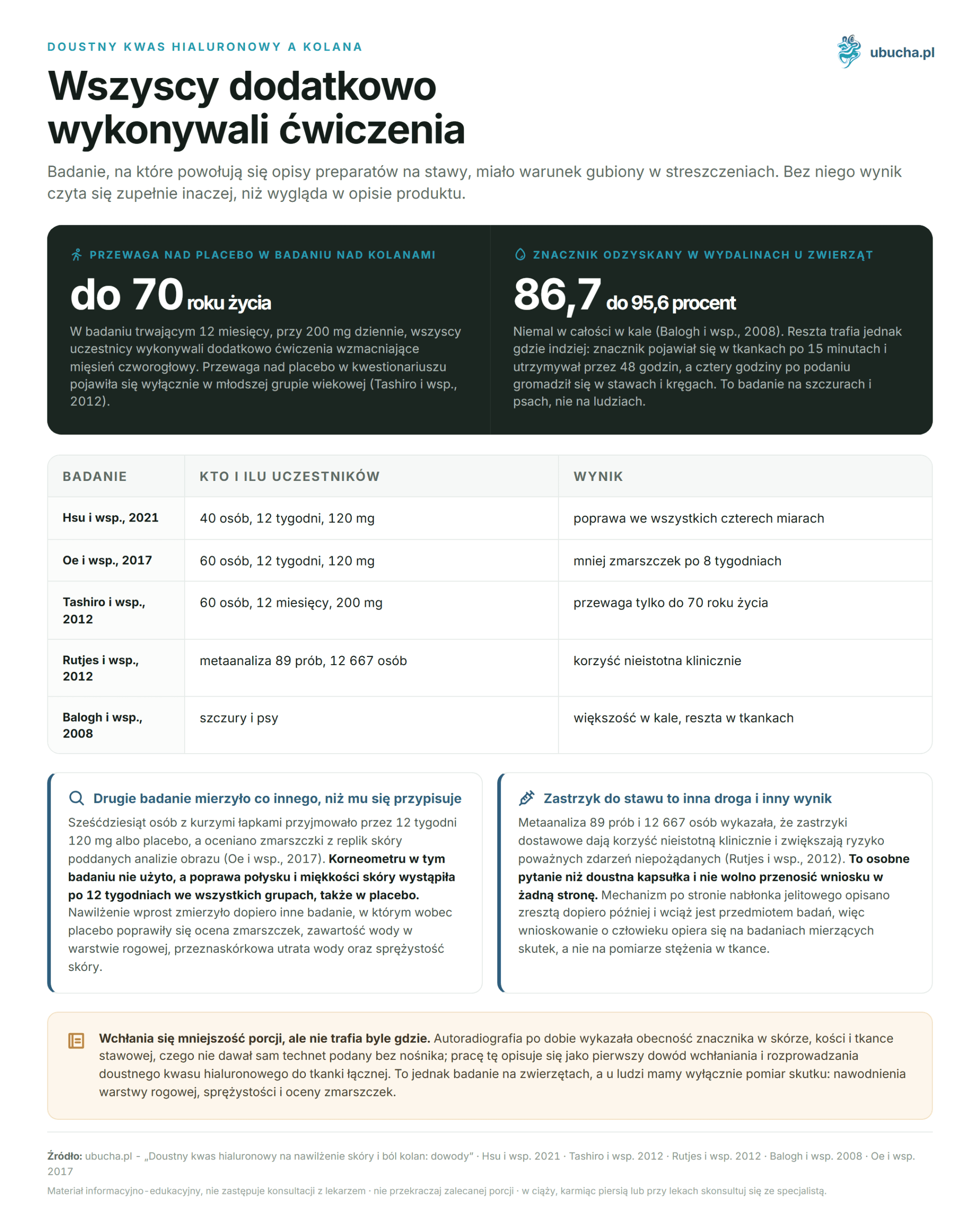
• In the knee study, all participants also performed quadriceps strengthening exercises, and the advantage over placebo appeared only in individuals under 70 years of age (Tashiro et al., TheScientificWorldJournal, 2012).
• Joint injections provide a clinically insignificant benefit and increase the risk of serious adverse events (Rutjes et al., Annals of Internal Medicine, 2012).
• After oral administration in animals, 86.7 to 95.6 percent of the marker was recovered in excreta, almost entirely in feces (Balogh et al., Journal of Agricultural and Food Chemistry, 2008).
Does oral hyaluronic acid get absorbed at all?
Partially yes, although most of the dose passes through the digestive tract without absorption. The most direct data comes from a study on rats and dogs, where high molecular weight hyaluronic acid labeled with technetium was administered orally. From 86.7 to 95.6 percent of the marker was recovered in excreta, almost entirely in feces (Balogh et al., Journal of Agricultural and Food Chemistry, 2008).
However, the rest goes somewhere, and not by chance. The marker appeared in tissues as early as 15 minutes and remained for 48 hours, accumulating in joints and vertebrae four hours after administration, as well as in salivary glands. Autoradiography after one day showed its presence in the skin, bones, and joint tissue, which was not achieved by technetium alone without a carrier. This work is described as the first evidence of absorption and distribution of oral hyaluronic acid to connective tissue.
Two caveats must be made immediately. This is an animal study, not a human one, and the mechanism on the side of the intestinal epithelium was only described later and is still under investigation (Oe et al., Nutrition Journal, 2016). Therefore, conclusions about humans are based on clinical studies measuring effects, not on measuring concentrations in tissue.
What do studies say about skin hydration?
One study measured hydration directly, and the result was favorable. Forty healthy individuals aged 35 to 64 took 120 mg of hyaluronic acid or placebo for 12 weeks. Compared to placebo, the following improved: wrinkle assessment, water content in the stratum corneum, transepidermal water loss, and skin elasticity (Hsu et al., Nutrients, 2021).
| Study | Who and how many | What was measured | Result |
|---|---|---|---|
| Hsu et al. 2021 | 40 individuals, 12 weeks, 120 mg | hydration, water loss, elasticity, wrinkles | improvement over placebo in all four |
| Oe et al. 2017 | 60 individuals, 12 weeks, 120 mg | wrinkles from skin replicas, survey | reduction of wrinkles after 8 weeks in the 300 kDa group |
| Tashiro et al. 2012 | 60 individuals, 12 months, 200 mg | JKOM questionnaire in knee osteoarthritis | advantage over placebo only under 70 years of age |
| Rutjes et al. 2012 | meta-analysis of 89 trials, 12,667 individuals | knee pain after joint injections | clinically insignificant benefit, more adverse events |
| Balogh et al. 2008 | rats and dogs | fate of labeled hyaluronic acid | most in feces, the rest in skin, bones, and joints |
The second often-cited study measured something different than it is attributed. Sixty individuals aged 22 to 59 with crow’s feet took 120 mg of hyaluronic acid or placebo for 12 weeks, and wrinkles were assessed from skin replicas analyzed by image (Oe et al., Clinical Cosmetic and Investigational Dermatology, 2017). A corneometer was not used in this study, and improvements in skin gloss and softness occurred after 12 weeks in all groups, including placebo. Hydration was only measured in the 2021 study. A similar problem of separating effect from placebo was described in our article on oral collagen.
Does oral hyaluronic acid help with knee pain?
The evidence is much narrower than popular descriptions suggest. In a randomized study, 60 individuals with knee osteoarthritis of the second or third degree on the Kellgren and Lawrence scale took 200 mg of hyaluronic acid or placebo for 12 months (Tashiro et al., TheScientificWorldJournal, 2012).
Three details determine the interpretation. First, all participants in both groups also performed quadriceps strengthening exercises, so the study examined the association of the supplement with rehabilitation, not the supplement alone. Second, the JKOM questionnaire scores improved over time in both groups, including placebo. Third, the advantage over placebo achieved statistical significance only in individuals under 70 years of age and only in the second and fourth months of observation.
This last sentence is important because a reverse version circulates, stating that the effect increases throughout the year. The authors’ conclusion is cautious: oral hyaluronic acid may alleviate symptoms of knee osteoarthritis in individuals under 70 years of age when accompanied by strengthening exercises. A review collecting trials from 2008-2015 describes benefits more broadly, including knee pain and reduced effusion, but is mostly signed by the same research team that conducted the clinical trials described above (Oe et al., Nutrition Journal, 2016).
How does oral hyaluronic acid differ from joint injections?
Primarily in that much more is known about injections, and that knowledge is not encouraging. A meta-analysis of 89 trials involving 12,667 adults evaluated viscosupplementation, or the administration of hyaluronic acid directly into the knee joint (Rutjes et al., Annals of Internal Medicine, 2012).
The result depended on the quality of the study, and that is the whole point. In a pool of 71 trials with 9,617 patients, the effect size was -0.37 with a 95% confidence interval from -0.46 to -0.28. However, in 18 large trials with blinded outcome assessment, involving 5,094 patients, the effect size dropped to -0.11 with a range from -0.18 to -0.04, which the authors directly call a clinically insignificant benefit. In five unpublished trials, the effect size was -0.03, and the confidence interval included zero.
Additionally, there is safety. In 14 trials involving 3,667 patients, viscosupplementation increased the risk of serious adverse events, with a relative risk of 1.41 and a confidence interval from 1.02 to 1.97. The authors’ conclusion is clear: small and clinically insignificant benefit with increased risk. Therefore, comparing an oral preparation with an injection as a more reliable method has no support in this work.
Does the molecular weight of hyaluronic acid matter?
Data suggest that it does, although there are few comparisons. The only direct comparison in a skin study involved two forms with masses of about 2 kDa and about 300 kDa, administered in the same amount of 120 mg daily. A significant reduction in wrinkles compared to placebo after eight weeks was achieved by the group taking the 300 kDa form (Oe et al., Clinical Cosmetic and Investigational Dermatology, 2017).
The biological basis for this difference is known from immunology. Short fragments of hyaluronic acid, produced in tissue during inflammation, stimulate dendritic cell maturation through the TLR4 receptor; in mice with a defective TLR4 gene, this effect did not occur, and the absence of the TLR2 receptor did not hinder it (Termeer et al., Journal of Experimental Medicine, 2002). Therefore, the size of the molecule is not a technical detail, as it determines whether the immune system will perceive the signal of tissue damage.
However, the practical implications remain uncertain, as digestive enzymes still alter the initial molecular weight. Manufacturers usually provide the weight of the raw material, not the fragments that are actually absorbed, and the latter has not been measured in any of the described clinical studies. If you are looking for a related ingredient studied for hydration, we have separately described the case of tremella and its connection to collagen.
Frequently Asked Questions
Does oral hyaluronic acid really work for the skin?
In randomized studies, yes. In 40 individuals aged 35 to 64, a twelve-week intake of 120 mg daily improved skin hydration, transepidermal water loss, skin elasticity, and wrinkle assessment compared to placebo (Hsu et al., Nutrients, 2021).
How much oral hyaluronic acid is absorbed?
Not much. In a study on rats and dogs, 86.7 to 95.6 percent of the labeled hyaluronic acid was recovered in excreta, almost entirely in feces. However, the remaining portion reached the skin, bones, and joint tissue and remained there for 48 hours (Balogh et al., Journal of Agricultural and Food Chemistry, 2008).
Does oral hyaluronic acid help with knee pain?
Only to a limited extent. In a year-long study of 60 individuals with knee osteoarthritis, the advantage over placebo occurred only in those under 70 years of age and only in the second and fourth months, with all participants also performing quadriceps strengthening exercises (Tashiro et al., TheScientificWorldJournal, 2012).
Do hyaluronic acid injections into the joint work better?
Not as assumed. In a meta-analysis of 89 trials involving 12,667 adults, large studies with blinded outcome assessment yielded an effect size of -0.11, indicating a clinically insignificant benefit, and the risk of serious adverse events was increased (Rutjes et al., Annals of Internal Medicine, 2012).
Does the molecular weight of hyaluronic acid matter?
In the only direct comparison on the skin, a significant effect compared to placebo was achieved by the form with a mass of about 300 kDa, not the one with a mass of about 2 kDa (Oe et al., Clinical Cosmetic and Investigational Dermatology, 2017). Short fragments of hyaluronic acid stimulate dendritic cell maturation through the TLR4 receptor, not through TLR2 (Termeer et al., Journal of Experimental Medicine, 2002).
Oral preparations for skin and joints can be found in the supplements category.
This article is for informational and educational purposes and does not constitute medical advice. Before starting supplementation, consult your doctor, especially if you are taking medications regularly, are pregnant or breastfeeding, or have chronic illnesses.
Author: Michał Waluk · Published: 2026-08-09 · Updated: 2026-08-11