
Salad with Orange, Arugula and Hemp Seeds
Salad with orange, arugula, and hulled hemp seeds in a honey-hemp dressing. Ready in 10 minutes, no cooking, with nutritional values from the USDA database.
Orange with arugula is a combination that stands strong throughout winter and early spring: the juicy sweetness of the citrus contrasts with the sharp, slightly bitter leaf. Hulled hemp seeds complete this recipe, providing crunch, a nutty flavor, and the highest protein content of all the ingredients on the plate. The dressing made with hemp seed oil adds fat that helps absorb carotenoid pigments from the arugula and orange. The whole process takes 10 minutes and does not require turning on the stove, making it suitable for a day when the kitchen is meant to be busy with something else. I will show you how to filet oranges without membranes, how to shake up the dressing in a jar, and how many calories this portion really weighs.
KEY INFORMATION
• Hulled hemp seeds contain 31.6 g of protein and 48.8 g of fat per 100 g (USDA, record 170148).
• In hemp oil, the omega-6 to omega-3 ratio ranges from 2:1 to 3:1 (Callaway, Euphytica, 2004), while in the seeds themselves, it is about 3:1 (USDA, record 170148).
• Do not heat hemp oil: over 80% of its fatty acids are polyunsaturated, the most prone to oxidation.
• A serving provides over 80 mg of vitamin C, mainly from the orange.
Why does hemp oil pair well with the salad with orange?
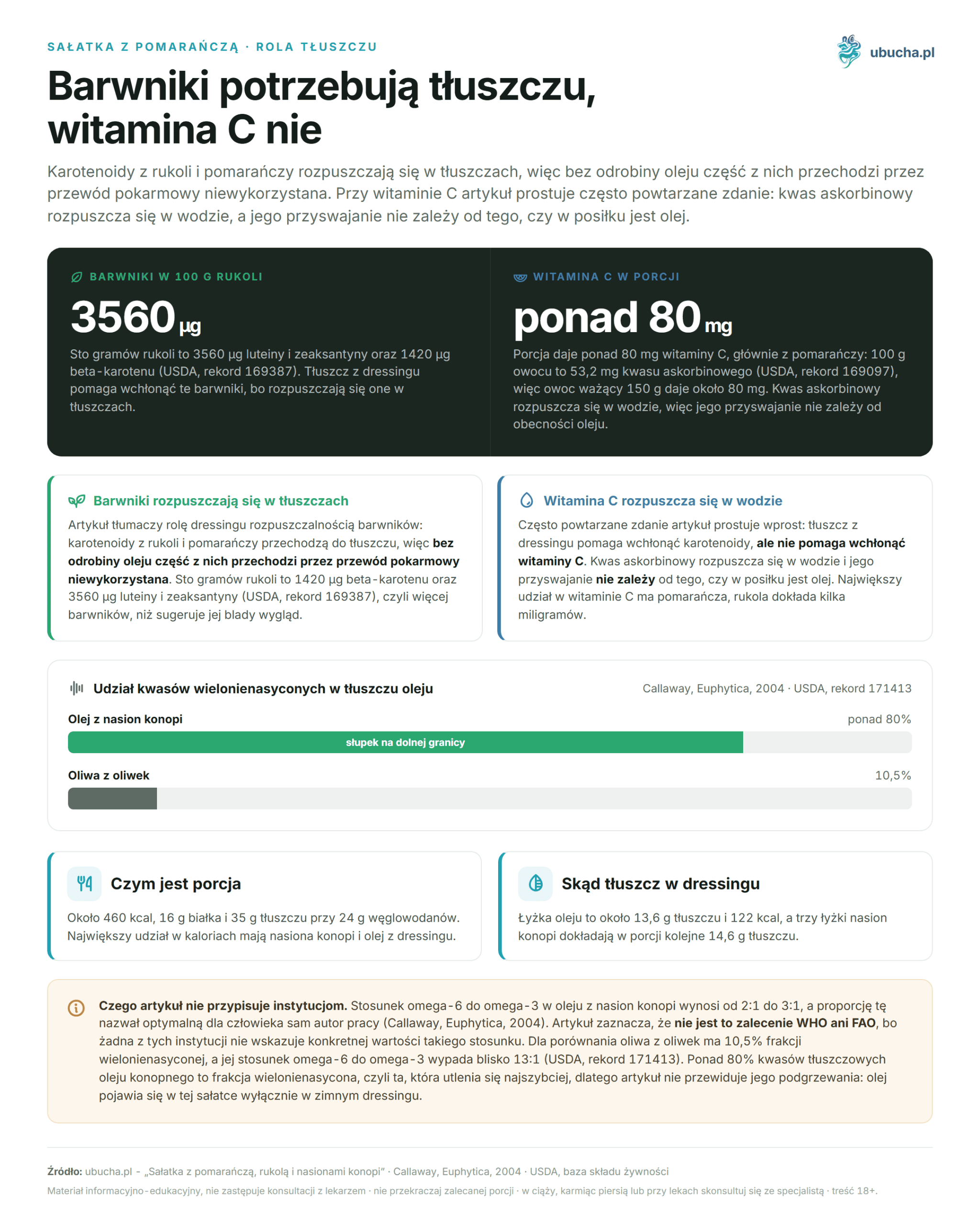
Because it adds fat where needed and does not overpower the citrus. Carotenoids from arugula and orange dissolve in fats, so without a bit of oil, some of them pass through the digestive tract unused. One hundred grams of arugula contains 1420 µg of beta-carotene and 3560 µg of lutein and zeaxanthin (USDA, record 169387), which is more pigments than its pale appearance suggests.
The oil itself is over 80% made up of polyunsaturated fatty acids, and the omega-6 to omega-3 ratio typically ranges from 2:1 to 3:1. Callaway (Euphytica, 2004) describes this ratio as optimal for humans. This is the author’s own assessment, not a recommendation from WHO or FAO: neither of these institutions specifies a particular value for such a ratio. In comparison, olive oil has 10.5% of the polyunsaturated fraction, and its omega-6 to omega-3 ratio is close to 13:1 (USDA, record 171413).
Then there is the taste. The nutty note of hemp oil resonates with the bitterness of arugula and the sweetness of orange, resulting in a dressing that is rounded, without one dominant ingredient. We elaborated on these relationships more extensively in the salad with pear and blue cheese, where the same oil works with a different fruit.
What do hulled hemp seeds provide in this salad?
Primarily protein and fat, in amounts disproportionate to their volume. Three tablespoons, or 30 g, provide 9.5 g of protein, 14.6 g of fat, and 166 kcal (USDA, record 170148). No other ingredient in this salad comes close to such density, and the seeds are not visible on the plate except as a sprinkle.
The fat profile is also unusual. In 100 g of seeds, there are 27.4 g of linoleic acid, 8.68 g of alpha-linolenic acid, and 1.34 g of gamma-linolenic acid (USDA, record 170148), resulting in an omega-6 to omega-3 ratio of about 3:1. Additionally, there are 700 mg of magnesium and 7.95 mg of iron per 100 g, which means 210 mg of magnesium in a 30 g portion.
It should be noted about the quality of this protein. House et al. (Journal of Agricultural and Food Chemistry, 2010) found that lysine is the first limiting amino acid in all tested hemp seed products, and the PDCAAS score for hulled seeds is 63-66%. Therefore, hemp is a good protein addition, but it does not complete the amino acid profile of a meal on its own.
How many calories and vitamin C are in one serving?
About 460 kcal, 16 g of protein, and 35 g of fat with 24 g of carbohydrates. The highest calorie contributions come from the seeds and oil, while the highest vitamin C contribution comes from the orange: 100 g of fruit contains 53.2 mg of ascorbic acid (USDA, record 169097), so a 150 g fruit provides about 80 mg. Arugula adds a few milligrams.
The rest breaks down predictably. Thirty grams of feta is 80 kcal and 4.3 g of protein (USDA, record 173420), a tablespoon of oil adds about 13.6 g of fat and 122 kcal, and the orange contributes 71 kcal and 3.6 g of fiber. The entire portion contains over 5 g of fiber. The salad is naturally gluten-free, as none of its ingredients come from grains. If you strictly avoid gluten, check the cheese and any dressing additives for gluten.
One note on the often-repeated statement: the fat from the dressing helps absorb carotenoids, but it does not help absorb vitamin C. Ascorbic acid is water-soluble, and its absorption does not depend on whether there is oil in the meal.
Ingredients - what do you need?
The proportions yield two servings, and preparation takes 10 minutes. Keep the hemp seeds until the very end, as they soften in contact with the juice within minutes.
- 2 oranges, about 300 g total
- 2 large handfuls of arugula, about 80 g
- 1/2 red onion
- 60 g of feta or goat cheese
- 6 tablespoons of hulled hemp seeds, 3 tablespoons per serving
- 2 tablespoons of cold-pressed hemp seed oil
- 1 tablespoon of orange or lemon juice
- 1 teaspoon of honey or maple syrup
- pinch of salt and pepper
- optional handful of walnuts or pecans
The choice of oranges determines the entire salad. Dessert varieties, such as navel, are easier to filet than fruits intended for juice, as they have clearer membranes and few seeds. A fruit that is heavy for its size usually indicates that it is juicy. Buy hulled hemp seeds and store them in the fridge in an airtight jar, as fat makes up nearly half their weight and they can go rancid in heat. The same applies to the oil, which should return to the fridge after opening the bottle.
How to make the salad with orange step by step?
The only step requiring skill is filleting the orange, which means cutting the segments out from between the white membranes. After two fruits, it takes less than three minutes per piece, and the difference in the texture of the finished salad is noticeable.
- Cut off the top and bottom of the orange, place it on a board and remove the skin with a knife along with the white albedo, in strips from top to bottom. Holding the peeled orange over a bowl, cut the segments out from between the membranes. Save the juice that drips: a spoonful will go into the dressing. Alternatively, cut the fruit into slices about 8 mm thick.
- Slice the onion into very thin feathers. For a milder taste, soak it for 5 minutes in cold water and drain on a paper towel. The water washes away some of the sharp sulfur compounds that form when the onion is cut.
- Pour hemp oil into a jar, add a spoonful of orange juice, honey, salt, and pepper. Close and shake for 20 seconds until the dressing emulsifies. If it turns out too thick, add a few drops of water and taste: you can balance the acidity with a bit more juice.
- Rinse the arugula under cold water and dry it in a spinner or on a towel. Crumble the feta in your hands into irregular pieces, as larger chunks resonate better than fine crumbles.
- On two plates, lay out the arugula, arrange the orange segments, onion, and crumbled cheese. Drizzle the dressing evenly and add nuts if using.
- Just before serving, sprinkle each portion with three tablespoons of hulled hemp seeds. Not earlier, as they lose their crunch after a few minutes in contact with the juice and dressing. Serve immediately while the arugula is crisp.
The same combination of fruit plus cheese plus hemp dressing also works in the salad with beetroot and feta, where the sweet element is taken over by roasted beetroot.
How to modify this recipe?
The base is flexible: you can swap the fruit, cheese, or protein addition, while the dressing remains unchanged. The only rule you should not change concerns the oil, which in every variant remains cold. The hemp seeds also stay at the end, regardless of what you add earlier.
| Variant | What you change | Effect |
|---|---|---|
| Vegan | Feta is replaced with avocado slices, honey with maple syrup | The salad remains filling thanks to the fats from the seeds and avocado |
| With grapefruit | One orange is replaced with grapefruit | Distinct bitterness, so sweeten the dressing with a bit of honey |
| Dinner | Grilled chicken breast, about 120 g per person | The salad turns into a full dinner, with a significantly higher protein content |
| Without cheese | More nuts and seeds instead of feta | Less salt and calcium, more plant fats |
The salad can be assembled in advance, but in parts. The filleted oranges and chopped onion can be stored in the fridge for a day in a closed container, and the dressing in a sealed jar for the same amount of time. The arugula, cheese, and seeds wait separately until serving.
The dinner variant has been elaborated separately as salad with chicken and hemp seeds, along with marinade proportions.
Frequently Asked Questions
What do hemp seeds add to the salad with orange?
Three tablespoons, or 30 g, provide 9.5 g of protein, 14.6 g of fat, and 166 kcal (USDA, record 170148). Additionally, there are 210 mg of magnesium in the same portion. Besides nutritional values, they add crunch and a nutty flavor that contrasts with the juicy citrus.
Why does arugula pair well with orange and hemp seeds?
Its bitterness cuts through the sweetness of the fruit and the nutty note of the seeds, so no flavor dominates. One hundred grams of arugula also contains 109 µg of vitamin K, 1420 µg of beta-carotene, and 160 mg of calcium (USDA, record 169387). Pigments are better absorbed in the presence of fat from the dressing.
Can hemp oil be heated?
No. Over 80% of its fatty acids are polyunsaturated (Callaway, Euphytica, 2004), which oxidize the fastest. In this salad, the oil is used only in the cold dressing. For frying, use olive oil, clarified butter, or canola oil.
How many calories are in a serving of this salad?
About 460 kcal, with 16 g of protein and 35 g of fat. The highest contributions come from the hemp seeds, which provide 166 kcal in a 30 g portion, and a tablespoon of oil, which adds about 122 kcal. The orange contributes 71 kcal, and 30 g of feta adds another 80 kcal (USDA, records 170148, 169097, and 173420).
How long can this salad be stored?
Do not store the assembled salad at all, as arugula wilts within an hour of being dressed. Keep the orange segments and dressing separately in the fridge for up to two days, in airtight containers. Always add the hemp seeds just before serving.
The hemp food products we have on offer today are hemp teas and herbal blends: we have gathered them in the food category. You will not find seeds or hemp oil in it.
This article is for informational and educational purposes and does not replace consultation with a doctor. If you are pregnant, breastfeeding, taking medications, or have chronic conditions, consult the use of supplements or herbs with a specialist.
Author: Michał Waluk · Published: 2026-06-22 · Updated: 2026-08-16