
The Endocannabinoid System in the Menstrual Cycle: Why Anandamide Rises to Ovulation
Anandamide peaks around ovulation and drops in the luteal phase. What has been measured in humans, what in mice, and why the direction of dependence can be misleading.
The concentration of anandamide in plasma is not constant in women. It changes in rhythm with the menstrual cycle, with the highest values occurring around ovulation. This was shown in a study that measured anandamide and sex hormones and gonadotropins in five phases of the cycle, in two independent groups of participants (El-Talatini et al., Fertility and Sterility, 2010). Anandamide is one of the two main transmitters of the endocannabinoid system, and the receptors of this system are located, among other places, in the uterus, ovaries, and placenta. However, there are many simplifications surrounding the ovulatory peak, especially regarding what is the cause and what is the effect. This article shows what exactly has been measured in humans, what comes from animal studies, and where the known information ends.
KEY INFORMATION
• The peak of anandamide occurs around ovulation, and the lowest values are in the late luteal phase (El-Talatini et al., 2010).
• The concentration of anandamide positively correlated with estradiol, LH, and FSH, but not with progesterone.
• The authors of the study conclude that it is the hormones that may regulate the level of anandamide, not the other way around.
• In the endometrium, the expression of the CB1 receptor is highest in the luteal phase, and progesterone stimulates it.
• In women with endometriosis, the expression of CB1 in the endometrial lining is minimal, while the lesions themselves show strong expression.
How does anandamide change during the menstrual cycle?
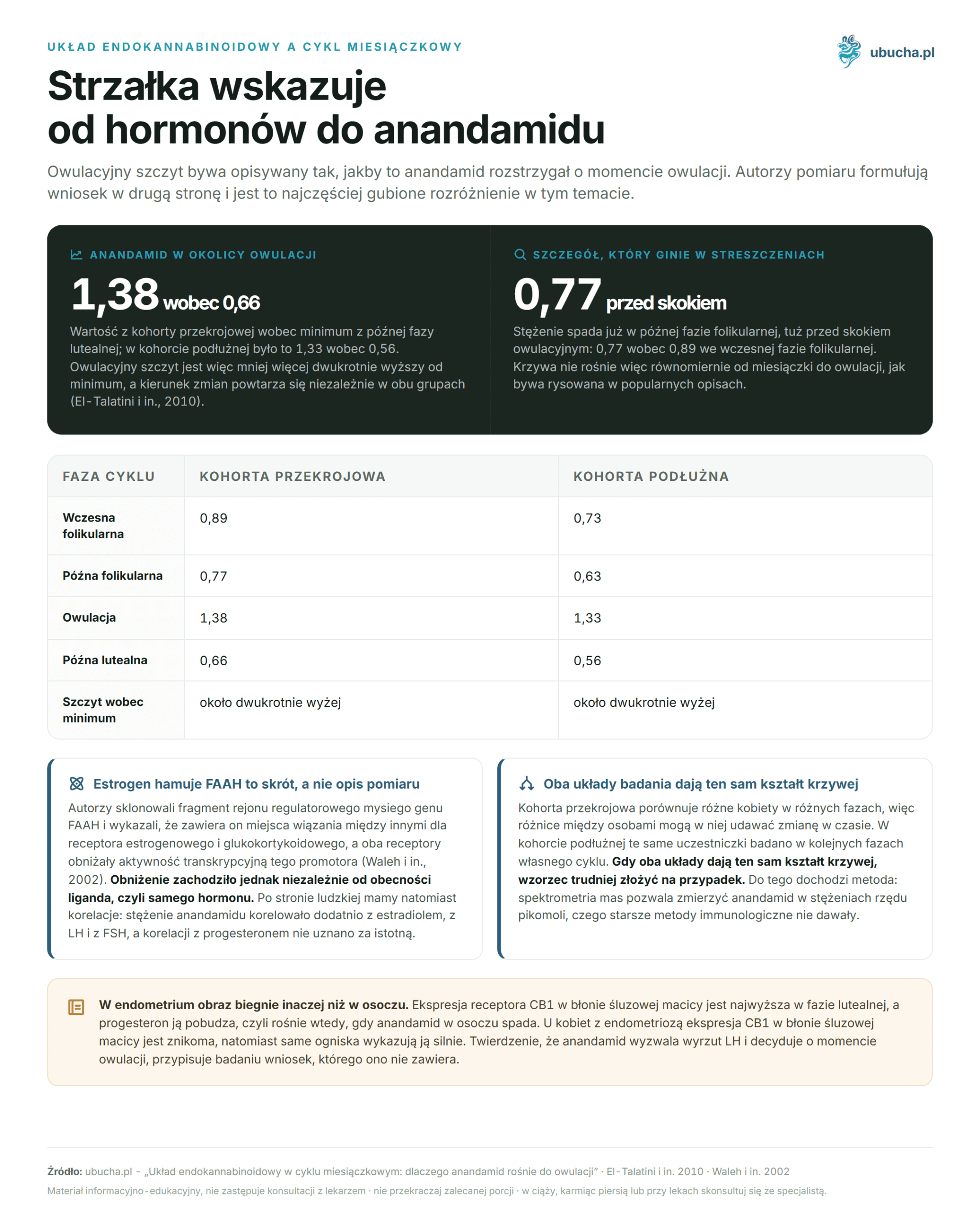
It rises to ovulation and falls afterwards. In a study conducted at the University Hospital in Leicester, the concentration of anandamide in plasma was measured using liquid chromatography coupled with mass spectrometry, while simultaneously measuring FSH, LH, estradiol, and progesterone. Participants were studied in two setups: cross-sectional and longitudinal, in premenopausal and postmenopausal women.
The course turned out to be repeatable in both groups. The values given below are averages with standard error, separately for the cross-sectional and longitudinal cohorts, in the order corresponding to the phases of the cycle.
| Cycle Phase | Cross-Sectional Cohort | Longitudinal Cohort |
|---|---|---|
| Early Follicular | 0.89 ± 0.06 | 0.73 ± 0.03 |
| Late Follicular | 0.77 ± 0.09 | 0.63 ± 0.08 |
| Ovulation | 1.38 ± 0.14 | 1.33 ± 0.16 |
| Late Luteal | 0.66 ± 0.07 | 0.56 ± 0.06 |
The ovulatory peak is therefore roughly twice as high as the minimum from the late luteal phase, and the direction of changes is repeated independently in both cohorts. It is worth noting one detail that gets lost in summaries: the concentration begins to drop already in the late follicular phase, just before the ovulatory spike. The curve does not rise uniformly from menstruation to ovulation, as is often depicted.
The reliability of these numbers is supported by two elements of the study design. The first is the measurement method: mass spectrometry allows for the measurement of anandamide at concentrations in the picomole range, which older immunological methods could not achieve. The second is the presence of a longitudinal cohort, in which the same participants were studied in subsequent phases of their own cycle. The cross-sectional cohort compares different women in different phases, so differences between individuals may masquerade as changes over time. When both setups yield the same curve shape, it is harder to attribute the pattern to chance.
Why is estrogen associated with higher anandamide?
The most commonly cited explanation is the effect of estrogen on the enzyme that breaks down anandamide. Fatty acid amide hydrolase (FAAH) is responsible for the degradation of anandamide, so its lower activity means slower breakdown and higher concentration. The basis for this explanation is work on the promoter of the FAAH gene.
The authors cloned a fragment of the regulatory region of the mouse FAAH gene and showed that it contains binding sites for the estrogen receptor and glucocorticoid receptor, among others. Both receptors reduced the transcriptional activity of this promoter (Waleh et al., Gene, 2002). However, there is a caveat that disappears in popular descriptions: the reduction occurred independently of the presence of the ligand, i.e., the hormone itself. The statement “estrogen inhibits FAAH” is therefore a shorthand, not a description of the measured mechanism.
On the human side, we have correlations. The concentration of anandamide positively correlated with estradiol, LH, and FSH, while the correlation with progesterone was not deemed significant. This aligns with the picture in which the level of anandamide follows the hormones of the follicular and peri-ovulatory phases. However, correlation does not determine direction, and mechanistic studies were conducted on mouse tissues, not human ones.
Does anandamide control ovulation, or does it just accompany it?
Data in humans speak of co-occurrence, not control. This distinction is often lost in descriptions of this topic, and it changes the meaning of the whole. The authors of the measurement formulated the conclusion cautiously: the peak of anandamide coincides with ovulation and positively correlates with estradiol and gonadotropins, suggesting that they may participate in regulating the level of anandamide.
The causal arrow in this sentence points from hormones to anandamide, not the other way around. The claim that anandamide triggers the release of LH and determines the timing of ovulation attributes a conclusion to the study that it does not contain. From the correlation between two variables changing in the same rhythm, it does not follow which one drives the other, and the observational study in humans was not designed to resolve this.
This does not mean that the endocannabinoid system is passive in reproduction. It only means that evidence of its agency comes from other studies and other species, and transferring it to humans requires caution. In practice, this means that anandamide is a well-documented marker of the cycle phase in women, while its causal role remains an open question.
What does the endocannabinoid system do during embryo implantation?
Here, evidence of agency exists, but it comes from mice. A study on animals lacking CB1 or CB2 receptors showed that embryo development before implantation ceases to be synchronized. The level of anandamide in the uterus and the CB1 receptor on the blastocyst decreases at the moment when the uterus becomes ready to accept the embryo.
In situations where implantation does not occur, both of these levels remained high: in the unprepared uterus, in dormant blastocysts during delayed implantation, and in mice lacking LIF factor. However, the decisive experiment was the external administration of a cannabinoid: maintaining a constant concentration inhibited implantation in healthy mice but not in those lacking both receptors (Paria et al., The Journal of Biological Chemistry, 2001). The effect therefore occurred through cannabinoid receptors, not alongside them.
For women planning pregnancy, the practical conclusion is one of caution. EFSA in its 2026 opinion stated that the safety of CBD cannot be established in pregnant and breastfeeding women, in individuals under 25 years of age, and in those taking medications (EFSA, EFSA Journal, 2026). The panel also pointed out the ability of CBD to cross the placenta as a separate reason for concern.
What is known about the ECS in endometriosis?
The picture is more complex than is often summarized, as the endometrial lining and endometriosis lesions behave differently. In the endometrial lining, the expression of the CB1 receptor was highest in the secretory phase, which is dominated by progesterone. In women with endometriosis, however, it was minimal, regardless of the phase of the cycle.
Progesterone stimulated the expression of CB1 in stromal cells taken from donors without endometriosis, and this effect was abolished by both TCDD dioxin and a progesterone receptor blocker (Resuehr et al., Fertility and Sterility, 2012). This reverses the popular notion that the luteal phase indicates weaker endocannabinoid signaling in the uterus: for the receptor itself, it is the opposite.
The lesions of endometriosis are a separate matter. In ovarian lesion tissue, the expression of CB1 and CB2 was intense, and in epithelial cells significantly higher than in the stroma of the same lesions (Allam et al., Journal of Immunology Research, 2022). The authors treated this as a premise that the lesions may respond to cannabinoids, and as a basis for planning a clinical study on a larger group. Such a study is not yet available, so nothing can be said about effectiveness. We discuss this in more detail in texts about CBD in endometriosis and about menstrual pain.
Frequently Asked Questions
When does anandamide reach its highest level in the cycle?
Around ovulation. The measured averages were 1.38 and 1.33 in two independent groups of participants, compared to 0.66 and 0.56 in the late luteal phase. The ovulatory peak is therefore roughly twice as high as the minimum, and the direction of changes was repeated in both cohorts of the study.
Does anandamide trigger ovulation?
It is unknown. A study in humans only showed that the concentration of anandamide positively correlates with estradiol, LH, and FSH. The authors conclude that it is the hormones that may regulate the level of anandamide. The opposite claim, that anandamide triggers the release of LH, goes beyond what was measured.
Does progesterone lower endocannabinoid signaling?
Not in the endometrium. The expression of the CB1 receptor was highest in the secretory phase, dominated by progesterone, and progesterone itself stimulated it in stromal cells. The concentration of anandamide in plasma is lowest at that time, so the receptor and ligand change in opposite directions during this phase.
Why should women planning pregnancy avoid cannabinoids?
In mice, constant external administration of cannabinoids inhibited embryo implantation, and the effect disappeared in animals lacking CB1 and CB2 receptors. EFSA states that the safety of CBD cannot be established in pregnant and breastfeeding women. The decision regarding any supplementation during this period is made by a doctor.
Does CBD relieve menstrual pain?
This has not been demonstrated. Endometriosis lesions show expression of CB1 and CB2 receptors, which the authors of these measurements treat as a premise for planning a clinical study. A study on a larger group has not yet been conducted, so the mechanism remains a hypothesis rather than proof of effectiveness.
The circadian rhythm of anandamide is described separately in the entry about how ECS regulates the sleep-wake rhythm.
This article is for informational and educational purposes only and does not constitute medical advice. Before starting to use cannabis or CBD for therapeutic purposes, consult a doctor, especially if you are taking other medications, are pregnant, or breastfeeding.
Author: Michał Waluk · Published: 2026-08-09 · Updated: 2026-08-16