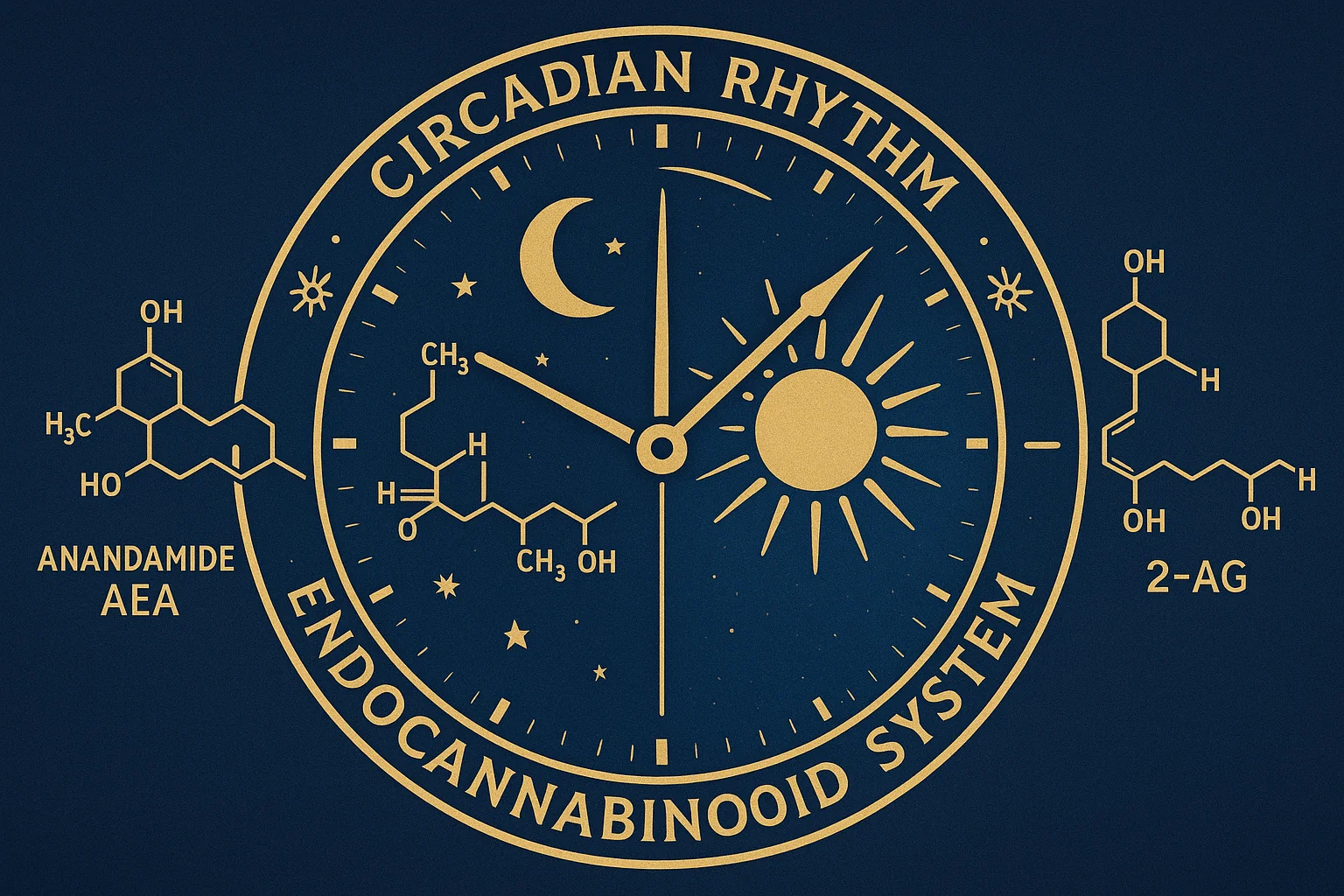

Anandamide at night, 2-AG during the day - how the ECS regulates the sleep-wake rhythm.
Anandamide at night, 2-AG during the day — the mechanism explained simply, based on research. u Bucha.
The endocannabinoid system does not operate uniformly throughout the day - it has its own rhythm synchronized with the biological clock. The study by Valenti et al. published in PNAS showed that anandamide (AEA) peaks at night, while 2-arachidonoylglycerol (2-AG) has an opposite pattern with a peak during the day (Valenti et al., PNAS, 2004). This anti-phase rhythm of the two main endocannabinoids is an integral part of regulating the sleep-wake cycle - not just a random biochemical background.
KEY INFORMATION
• Anandamide (AEA): peak at night - supports sleep and lowers body temperature; 2-AG: peak during the day - modulates activity, appetite, and motor functions.
• The ECS and circadian clock regulate each other: CLOCK/BMAL1 genes control CB1 expression; activation of CB1 feedbacks on clock genes.
• Mice lacking the CB1 receptor have disrupted circadian rhythms and altered sleep patterns (Albrecht et al., 2013).
• CBD may enhance the nighttime increase of anandamide by inhibiting FAAH - a potential mechanism for sleep support.
• Optimal time for taking CBD for sleep: 1-2 hours before bedtime (orally) or 30-60 minutes (sublingually).
Dwa endokannabinoidy, dwa rytmy - antyfazowy wzorzec dobowy
Anandamide and 2-AG are the two main endogenous ligands for cannabinoid receptors CB1 and CB2, but despite their structural similarity and common receptor targets, they serve different physiological functions - as reflected in their distinct diurnal patterns.
Anandamide (N-arachidonoylethanolamine, AEA) is a molecule produced "on demand" by neurons in response to activity. Its diurnal pattern in rats, measured in the hippocampus, striatum, and cortex, shows peak concentrations in the first half of the night (the dark phase for nocturnal rodents = active phase) - corresponding to late-night and early-morning hours in humans when deep sleep and REM dominate. The study by Valenti et al. measured AEA and 2-AG concentrations in 6-hour intervals over a full 24 hours in rat brains (PNAS, 2004). Result: AEA and 2-AG exhibit opposing, biologically significant circadian patterns.
2-arachidonoylglycerol (2-AG) is the quantitatively dominant endocannabinoid - its concentration in the brain is typically 170-800 times higher than AEA. 2-AG peaks during the day and early evening, with the lowest level in the middle of the night. It acts as a retrograde messenger at glutamatergic and GABAergic synapses - regulating the strength of excitatory and inhibitory signals in active circuits during the day. High 2-AG during the day supports learning processes, motor functions, and appetite - functions typically associated with daytime.
How does the nighttime peak of anandamide support sleep?
The nighttime increase of anandamide is associated with several mechanisms supporting sleep. First, AEA modulates the release of corticotropin-releasing hormone (CRH) through CB1 receptors in the hypothalamus and lowers core body temperature - one of the key signals initiating sleep. Body temperature begins to drop about 2 hours before falling asleep, and anandamide participates in this thermoregulatory process (Babson et al., Current Psychiatry Reports, 2017).
Second, anandamide modulates wakefulness neurotransmitters - norepinephrine and acetylcholine - through CB1 in the ventral tegmental area and brainstem structures. The nighttime increase of AEA supports the transition from wakefulness to sleep by suppressing activating noradrenergic systems. Third, AEA activates TRPV1 receptors, which play a role in regulating temperature and pain in a diurnal context - promoting body relaxation and falling asleep.
An interesting aspect: anandamide has a dual effect on sleep phases depending on the dose and phase of the sleep cycle. At low concentrations (typical for the natural nighttime rhythm), AEA promotes slow-wave sleep (N3). At higher concentrations, it may suppress REM through CB1. This explains why CBD - by raising anandamide only moderately (by inhibiting FAAH, not directly) - supports sleep without suppressing REM, while THC (high activation of CB1) strongly suppresses REM.
ECS and biological clock - bidirectional coupling
The diurnal rhythm of the ECS is not independent of the biological clock - both systems regulate each other. At the transcription level: the circadian clock genes CLOCK and BMAL1 (forming the core of the molecular clock) regulate the expression of FAAH and CB1 genes. This means that the biological clock itself programs the activity of the enzyme that breaks down anandamide and the availability of CB1 receptors - phase-synchronously aligning the ECS with the body's circadian rhythm.
In the opposite direction: activation of CB1 affects the expression of clock genes (PER1, PER2, CRY1). Mice lacking the CB1 receptor (CB1 knockout) exhibit altered daily activity rhythms, shortened slow-wave sleep, and reduced amplitude of body temperature rhythm (Albrecht et al., PLOS ONE, 2013). This is genetic evidence that CB1 is essential for proper circadian rhythm - it is not just a modulator at the periphery of the system.
The practical implications of this coupling are significant: circadian rhythm disorders (shift work, jet lag, irregular sleep) can disrupt the ECS rhythm, which in turn affects sleep quality - creating a vicious cycle. Substances that modulate the ECS (including CBD) taken at a consistent time can strengthen, rather than just modulate, the circadian rhythm signal.
Table: Circadian Rhythm of ECS and Sleep Regulation
The table below compares key ECS parameters in the context of the circadian rhythm and their connection to sleep and wake phases. The data is based on reviews by Valenti et al. (2004), Babson et al. (2017), and Albrecht et al. (2013).
| Parameter | Anandamide (AEA) | 2-AG |
|---|---|---|
| Circadian peak (time of day) | Night / early morning | Day / early evening |
| Daily minimum | Day | Midnight |
| Main functions at peak | Supporting sleep, lowering body temperature, nighttime analgesia | Activity, appetite, learning, motor skills |
| Main receptor | CB1, TRPV1, PPARγ | CB1, CB2 |
| Degrading enzyme | FAAH (inhibited by CBD) | MAGL (not inhibited by CBD) |
| The impact of CBD | Indirect increase (inhibition of FAAH) | No direct effect of CBD |
| Regulation by clock genes | Tak - ekspresja FAAH regulowana przez CLOCK/BMAL1 | Tak - ekspresja DAGL/MAGL rytmiczna |
| Effect on sleep phases | At low doses: N3 ↑; at high doses: REM ↓ | High 2-AG at night: sleep disorganization |
What disrupts the ECS rhythm and how it affects sleep
The diurnal rhythm of the ECS is sensitive to the same disruptions as the biological clock in general: irregular sleep hours, exposure to artificial light at night (blue light from screens blocks melatonin and disrupts the CLOCK/BMAL1 rhythm), shift work, and jet lag. When the biological clock is out of sync, the ECS rhythm loses its synchronized pattern - anandamide does not rise smoothly at night, and 2-AG remains elevated at the wrong time.
Chronic sleep deprivation leads to a global decrease in anandamide levels - the study by Hanlon et al. showed that sleep deprivation lowers anandamide levels in plasma and disrupts the diurnal rhythm of 2-AG in humans (Sleep, 2016). Reduced anandamide is associated with increased pain, irritability, and hunger - typical symptoms of sleep deprivation that thus have a partial endocannabinoid basis.
We observe among customers of u Bucha that individuals who regularly use CBD oil in the evening often report not only improved sleep onset but also better well-being in the morning. The mechanism of nighttime synergy of CBD (inhibition of FAAH) with the natural increase of anandamide may be one of the neurological explanations for this pattern, although direct studies in humans comparing these variables are still lacking.
Practical implications: how to support the ECS rhythm in the evening
A few simple interventions can enhance the natural nighttime increase of anandamide and synchronize the ECS rhythm:
Limiting blue light after dark: blue light from screens not only inhibits melatonin but can also disrupt the ECS rhythm by interfering with CLOCK/BMAL1 genes. Blue light-blocking glasses or the "night mode" on devices are simple interventions with potentially wide-ranging effects on circadian biology.
Consistent sleep time: regularity of sleep hours enhances the amplitude of circadian rhythms in general, including the ECS rhythm. Going to bed at the same time each night gives the BMAL1 gene a better signal to program the rhythmic expression of FAAH and CB1 for the next day.
CBD in the evening at a consistent time: taken at a consistent time, CBD can act as a "zeitgeber" (time giver) for the ECS rhythm - similar to how regular meals strengthen metabolic rhythms. The timing of administration 1-2 hours before sleep (orally) or 30-60 minutes (sublingually) allows CBD to reach therapeutic concentrations coinciding with the natural nighttime increase of anandamide.
Frequently Asked Questions
How do anandamide and 2-AG change throughout the day?
Anandamide has a nighttime peak, while 2-AG peaks during the day. The study by Valenti et al. in PNAS (2004) demonstrated these opposing patterns in brain structures, with biologically significant amplitudes (PNAS, 2004). Nighttime anandamide supports sleep and lowers body temperature; daytime 2-AG modulates activity, appetite, and learning. This antiphase pattern is an integral part of the regulation of the sleep-wake cycle, not a random biochemical phenomenon.
Is the ECS directly linked to the circadian clock?
Yes - the CLOCK and BMAL1 clock genes rhythmically regulate the expression of FAAH and CB1. Conversely, activation of CB1 affects the PER1/PER2/CRY1 clock genes. Mice lacking CB1 have disrupted circadian rhythms and altered sleep patterns (Albrecht et al., PLOS ONE, 2013). The ECS is an integral component of the biological clock, not an external modulator.
How does CBD affect the ECS circadian rhythm?
CBD inhibits FAAH - the enzyme that degrades anandamide. Taken in the evening, it may moderately raise nighttime anandamide, enhancing its natural increase. It may also reduce evening cortisol by inhibiting the HPA axis. Direct studies on CBD and the ECS rhythm in humans are still limited, but the biological mechanism is consistent with the observed assistance of CBD in falling asleep.
Why is 2-AG higher during the day?
2-AG performs functions related to daytime activity: it modulates glutamatergic and GABAergic neurotransmission active during the wake phase, regulates appetite and motor functions. High 2-AG at night disrupts sleep - substances that raise 2-AG (e.g., certain MAGL inhibitors) may be activating rather than calming. CBD does not inhibit MAGL (the enzyme that degrades 2-AG), so it does not raise 2-AG - which is beneficial for the diurnal profile.
What time is best to take CBD to support sleep?
When taken orally, peak CBD concentration in the blood occurs after 1-2 hours - the optimal time is 1-2 hours before planned sleep. With sublingual oil, the onset is faster (15-45 min) - just 30-60 minutes before sleep is sufficient. A consistent time of use every evening may strengthen the circadian signal for the biological clock, acting as a "zeitgeber" for the ECS rhythm.
This article is for informational and educational purposes and does not replace consultation with a doctor. If you are pregnant, breastfeeding, taking medications, or have chronic conditions, consult the use of supplements or herbs with a specialist.
Author: Michał Waluk · Published: 2026-05-04 · Updated: 2026-05-04