
Phytocannabinoids vs Endocannabinoids vs Synthetic: Differences (Table)
Plants, the body, and laboratories produce cannabinoids with completely different safety profiles. Comparison table, mechanisms, and legal status in Poland.
The word “cannabinoid” refers to three completely different classes of compounds: those produced by plants, those produced by your own body, and those synthesized in the laboratory. They are connected by one thing, namely that they all interact with the same receptor system. However, they differ in a way that determines safety: in how these receptors are stimulated. A review in Life Sciences describes this directly. Synthetic cannabinoids from “Spice” mixtures act as full agonists of CB1 and CB2 receptors, while THC is a partial agonist of CB1, and it is this difference that leads to the toxicity not observed with THC alone. This article shows what this difference is and what it means in practice.
KEY INFORMATION
• Synthetic cannabinoids are full agonists of CB1 and CB2, THC is only a partial agonist (Fantegrossi, Life Sciences 2014).
• Endocannabinoids are produced on demand and disappear in minutes, phytocannabinoids act for hours.
• CBD does not directly stimulate CB1 but inhibits the enzyme that breaks down anandamide.
• JWH-018, AM-2201, and UR-144 are specifically listed in the Polish register of controlled substances.
What is the endocannabinoid system and why does it concern all three classes?
The endocannabinoid system (ECS) is a set of receptors, their natural ligands, and the enzymes that produce and break down these ligands. It was discovered in the 1980s and 1990s somewhat by accident: while studying how THC works, it was established that the substance does not create a new pathway in the brain but enters an existing, evolutionarily old system.
There are three elements. Cannabinoid receptors CB1 and CB2, with CB1 being one of the most abundant receptors in the brains of mammals, and CB2 dominating in immune system cells and peripheral tissues. The endogenous ligands of these receptors, i.e., endocannabinoids. Finally, the enzymes that synthesize and break down endocannabinoids. The system is involved in regulating neurotransmission, immune response, energy metabolism, pain perception, and sleep.
All three classes of cannabinoids communicate with the same system but in different voices. Endocannabinoids are ligands for which this system was created: they appear locally, on demand, and are immediately removed. Phytocannabinoids are plant molecules that accidentally fit into these same receptors, though not precisely. Synthetic cannabinoids are designed to fit as closely as possible, and that is their problem, not an advantage. A broader discussion of the system itself can be found in the text Introduction to the Endocannabinoid System.
What are phytocannabinoids and how do they work?
Phytocannabinoids are cannabinoids produced by plants. Hemp produces many of them, but several have practical significance: THC, CBD, CBG, CBN, CBC, and THCV. Each has a different binding profile with receptors and different biological properties, so talking about “the action of cannabinoids” in the plural usually obscures what is most important.
THC is a partial agonist of the CB1 receptor. It binds to it and stimulates it, but not fully. This is where the psychoactive effects come from, and at the same time, this is where the ceiling comes from: above a certain dose, the effect stops increasing proportionally. This distinction between partial and full agonism returns below, with synthetics, and is the most important in this comparison.
CBD behaves differently. It does not directly stimulate CB1 or CB2 or does so very weakly. Instead, it modulates other targets: TRPV1, GPR55, and 5-HT1A receptors. Popular descriptions also add the inhibition of the FAAH enzyme here, but the work that compared human and rodent enzymes showed that cannabidiol does not inhibit human FAAH (Elmes, J Biol Chem, 2015). This explains the lack of psychoactive effects, because without stimulating CB1, there is none of what is responsible for THC’s action. CBD is also a negative allosteric modulator of CB1, meaning its presence weakens THC’s binding to the receptor.
The other phytocannabinoids are less well studied. CBN is formed from the degradation of THC and is a weak agonist of CB1. CBC and THCV have distinct profiles that cannot be summarized in one sentence without overinterpretation. Caution is warranted here: with CBG, the effect is well documented to be the opposite of the marketing claim, as discussed below.
What are the differences between these three classes in one table?
The following table organizes the differences according to seven characteristics of practical significance: origin, structure, type of CB1 receptor stimulation, metabolite activity, duration of action, legal status in Poland, and detectability in tests. The row about the type of agonism is the one from which all other results arise.
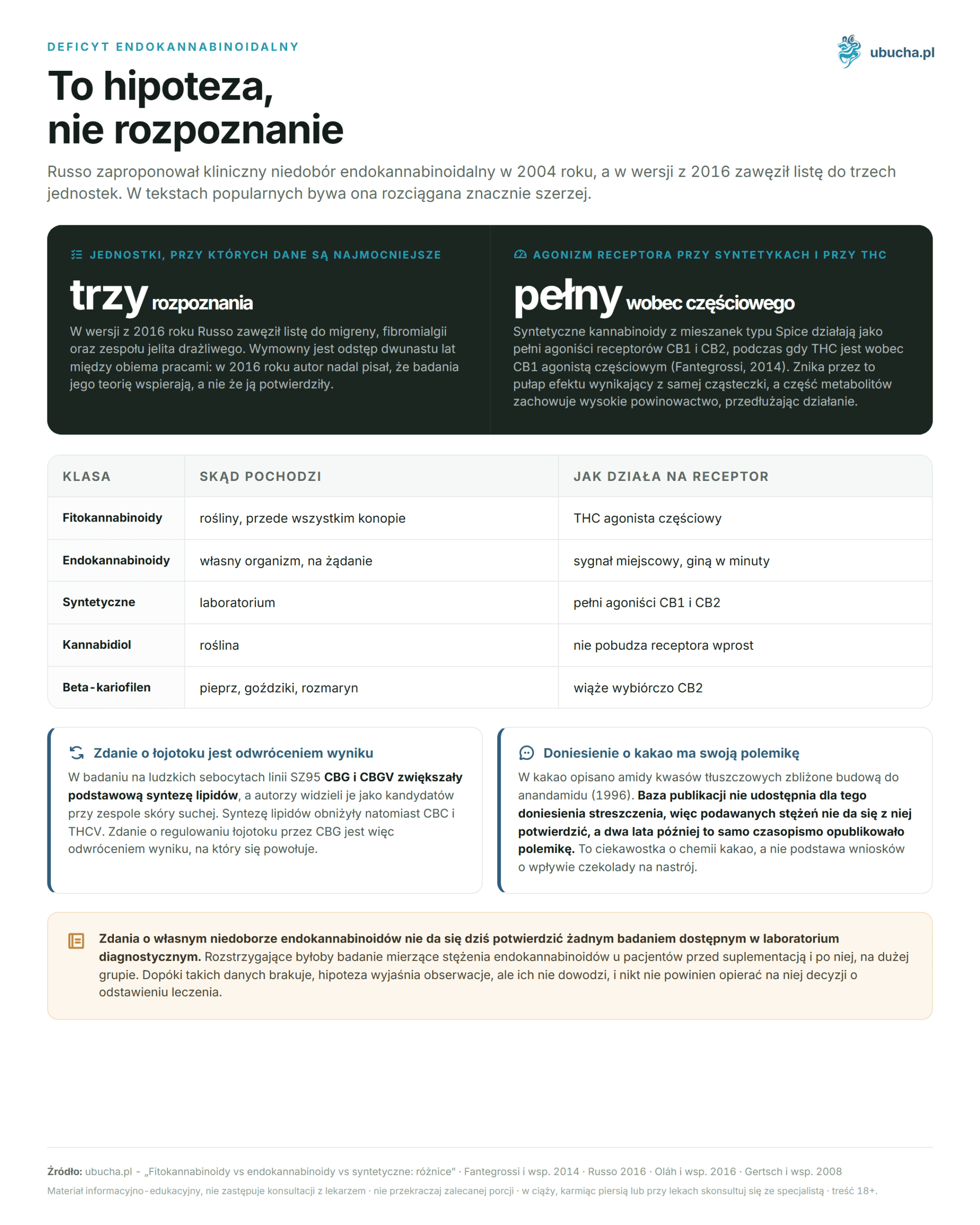
| Feature | Phytocannabinoids (CBD, THC, CBG) | Endocannabinoids (AEA, 2-AG) | Synthetic (JWH-018 and related) |
|---|---|---|---|
| Source | Plants | Human body | Laboratory synthesis |
| Structure | Terpenophenolic cannabinoids | Fatty acid amide (AEA), monoacylglycerol (2-AG) | Indoles, indazoles, and related scaffolds |
| Type of CB1 stimulation | Partial agonist (THC), modulator (CBD) | Partial agonist (AEA), full (2-AG) | Full agonist of CB1 and CB2 |
| Metabolites | Activity usually lower than the parent compound | Degraded to inactive components | Some retain high affinity for CB1 and CB2 |
| Duration of action | Hours | Minutes, degraded by FAAH and MAGL | Prolonged by active metabolites |
| Legal status in Poland | CBD is not listed; hemp flower by prescription | Endogenous, outside regulations | Controlled substances, specifically listed |
| Detectability in tests | THC detectable, CBD not in standard test | Not tested | Variable, new compounds may be outside the panel |
Sources for the receptor stimulation and metabolite rows: Fantegrossi et al., Life Sciences 2014. Legal row: register of psychotropic substances, narcotic drugs, and new psychoactive substances, Dz.U. 2024 poz. 1139, as of August 15, 2026.
What are endocannabinoids and how long do they act?
Anandamide (AEA) was the first discovered endocannabinoid. The name comes from the Sanskrit “ananda”, meaning bliss. It is a partial agonist of CB1, produced in neurons on demand, in response to cell depolarization. Once released into the synapse, it binds to CB1 receptors on the presynaptic neuron and inhibits further neurotransmitter release. This is retrograde signaling, meaning a message going against the usual direction of transmission.
After completing its task, anandamide is broken down by the FAAH enzyme into arachidonic acid and ethanolamine. Its lifespan in the synapse is measured in minutes. This enzymatic inactivation is what most distinguishes endocannabinoids from phytocannabinoids: CBD administered externally lasts in the body for hours, while anandamide disappears before it can spread.
The second important endocannabinoid is 2-AG, or 2-arachidonoylglycerol. It has been identified as an endogenous monoacylglycerol binding to cannabinoid receptors (Mechoulam et al., Biochemical Pharmacology 1995). Unlike anandamide, it is a full agonist at CB1, and it is broken down by the MAGL enzyme. We have separately discussed how both of these compounds react to stress in the text Endocannabinoids and Stress.
Why are synthetic cannabinoids so dangerous?
The reason is pharmacological, not legal. Synthetic cannabinoids act as full agonists of CB1 and CB2 receptors, while THC is a partial agonist at CB1. A full agonist does not have an inherent efficacy ceiling, which in a partial agonist arises from the molecule itself, making the body’s reaction much harder to predict (Fantegrossi et al., Life Sciences 2014).
Additionally, there is a second mechanism, less frequently described. The metabolism of THC leads to compounds with lower activity, while some metabolites of synthetic cannabinoids retain a high affinity for CB1 and CB2 and their own intrinsic activity. Thus, the body does not extinguish the signal but prolongs it with its own metabolism. The authors of the review associate this with toxicity, which is not observed with THC.
These compounds were originally created as research tools. John W. Huffman synthesized hundreds of them in the 1990s, and publications with exact formulas later served as ready instructions for producers of “Spice” mixtures. The abbreviation JWH in trade names simply stands for the initials of this chemist. A review in Progress in Neuro-Psychopharmacology notes that the number of people arriving at emergency departments due to these mixtures rose sharply, and standard procedures for testing humans for them were not validated at that time (Seely et al., Prog Neuropsychopharmacol Biol Psychiatry 2012).
In Poland, these are not “legal substitutes”. JWH-018, AM-2201, and UR-144 are specifically listed in the register of psychotropic substances, narcotic drugs, and new psychoactive substances (Dz.U. 2024 poz. 1139). We dedicated a separate text to recognizing these products: Synthetic Cannabinoids - What They Are and How to Recognize Them.
How do phytocannabinoids modulate endocannabinoids?
Phytocannabinoids are not neutral towards endocannabinoids. After cannabidiol, the concentration of anandamide in humans increases, but not through the degrading enzyme: unlike rodent FAAH, human FAAH is not inhibited by cannabidiol, and the increase is explained by competition for intracellular transport proteins from the FABP family, which deliver anandamide to this enzyme (Elmes, J Biol Chem, 2015). A busy carrier means slower removal, so anandamide remains in the synapses longer than it would without it. The effect is an enhancement of the signal that the body is already sending, not the imposition of a new signal.
This distinction has consequences. Since CBD enhances the existing signal, its effect depends on the state of the system in a specific person, not solely on the amount taken. Thus, two people may experience the same thing very differently, and it does not necessarily mean that one of them took “too little”. It is worth drawing the opposite conclusion to the intuitive one: the lack of a noticeable effect is not in itself a reason to increase the amount, because the mechanism does not rely on the strength of the stimulus but on prolonging what the system is already sending.
With CBG, a separate caveat applies, as cosmetic marketing says something contrary to the literature. In a study on human sebocytes of the SZ95 line, CBG and CBGV increased baseline lipid synthesis, and the authors saw them as candidates for dry skin syndrome. However, CBC and THCV reduced baseline lipid synthesis (Oláh et al., Experimental Dermatology 2016). The statement “CBG regulates sebum production” is therefore a reversal of the result it refers to.
What is “endocannabinoid deficiency” and is it proven?
This is a hypothesis, not a diagnosis. Ethan Russo proposed it in 2004 under the name of clinical endocannabinoid deficiency, suggesting that reduced activity of the system may underlie conditions difficult to explain by classical mechanisms (Russo, Neuro Endocrinology Letters 2004).
In the 2016 version, Russo narrowed the list to three conditions for which he considered the data strongest: migraines, fibromyalgia, and irritable bowel syndrome (Russo, Cannabis and Cannabinoid Research 2016). It is worth remembering this trio, as popular texts often stretch the list to include depression, insomnia, or chronic fatigue, which the author of the hypothesis does not do. The twelve-year gap between the two works is also telling: in 2016, Russo still wrote that research supports his theory, not that it has confirmed it.
The status remains hypothetical for a specific reason. A decisive study measuring endocannabinoid levels in patients before and after supplementation, in a large group, would be needed. Until such data is available, the hypothesis explains observations but does not prove them, and the difference between these two verbs is significant here. For the reader, this means one thing: the statement “I have an endocannabinoid deficiency” cannot be confirmed today by any test available in a diagnostic laboratory, so no one should base their decision to discontinue treatment on it.
Do other plants besides hemp contain phytocannabinoids?
Yes, although they are rarely the same molecules. The best-described example is beta-caryophyllene, a terpene present in cannabis, black pepper, cloves, and rosemary. A study in PNAS showed that it selectively binds to the CB2 receptor, and it was this study that introduced the term “dietary cannabinoid” (Gertsch et al., PNAS 2008). The name thus comes from scientific literature, not from any agency classification. Since the psychoactive effects of THC depend on CB1, not CB2, beta-caryophyllene does not induce them.
Another example is echinacea. Alkylamides from this plant have been described as a separate class of cannabimimetic compounds, acting depending on the CB2 receptor (Raduner et al., Journal of Biological Chemistry 2006). This is one of the proposed mechanisms for its immunomodulating action, but it has been studied much less than compounds from cannabis.
In cocoa, fatty acid amides similar in structure to anandamide have been described (di Tomaso et al., Nature 1996). However, this report should be approached with caution for two reasons. Europe PMC does not provide a summary for it, so the concentrations reported cannot be confirmed from this registry, and two years later, Nature published a rebuttal titled “Trick or treat from food endocannabinoids?” (Di Marzo, Nature 1998). Treat this observation as a curiosity about cocoa chemistry, not as a basis for conclusions about chocolate’s effect on mood.
Frequently Asked Questions
What are phytocannabinoids?
These are cannabinoids produced by plants, primarily by hemp. Several have practical significance: THC, CBD, CBG, CBN, CBC, and THCV. THC is a partial agonist of the CB1 receptor, while CBD acts differently: it modulates TRPV1, GPR55, and 5-HT1A receptors, and contrary to popular belief, it does not inhibit the human FAAH enzyme (Elmes, J Biol Chem, 2015).
What are endocannabinoids?
These are cannabinoids produced by your own body. The two most important are anandamide and 2-AG. They are produced on demand, act locally through CB1 and CB2 receptors, and are then broken down by FAAH and MAGL enzymes. Their lifespan in the synapse is measured in minutes, so they are responsible for signal regulation, not for its long-term maintenance.
Why are synthetic cannabinoids more dangerous than THC?
Because they fully activate CB1 and CB2 receptors, while THC only partially activates them, thus eliminating the effect ceiling that arises from the molecule itself. Additionally, some of their metabolites retain a high affinity for the receptors, prolonging their action. This set of properties is associated with toxicity, which is not observed with THC.
Does CBD increase the level of endocannabinoids?
Indirectly yes, but not through the FAAH enzyme, which the human form of CBD does not inhibit. Anandamide lasts longer because CBD competes for FABP transport proteins that deliver it to the degrading enzyme (Elmes, J Biol Chem, 2015). This is a signal enhancement that the body sends itself, not receptor stimulation.
Are synthetic cannabinoids legal in Poland?
No. JWH-018, AM-2201, and UR-144 are specifically listed in the register of psychotropic substances, narcotic drugs, and new psychoactive substances, announced by the Minister of Health (Dz.U. 2024 poz. 1139). The term ‘legal marijuana substitute’ used in the trade of these mixtures has no legal basis today.
Does the use of CBD weaken the body’s own production of endocannabinoids?
There is no data to show this, but there is also no study that excludes it in a large group and over a long horizon. The mechanism of CBD is different from that of THC: THC directly stimulates CB1, while CBD acts through the enzyme that breaks down anandamide. These are two different pathways, so do not transfer conclusions about THC tolerance to CBD.
Legally available hemp products, with known origin and composition, can be found in the oils category.
This article is for informational and educational purposes and does not constitute medical advice. Before starting to use cannabis or CBD for therapeutic purposes, consult a doctor, especially if you are taking other medications, are pregnant, or breastfeeding.
Author: Michał Waluk · Published: 2026-08-09 · Updated: 2026-08-17