
Curcumin and Gallstones and Gallbladder: When to Exercise Caution
Curcumin contracts the gallbladder, which poses a risk of colic with gallstones. We check Rasyid's studies, the EFSA limit, cases of liver damage, and drug interactions.
Curcumin, the pigment and main active ingredient of turmeric, is one of the most popular anti-inflammatory supplements. However, one of its properties is often overlooked in commercial descriptions, and for some individuals, it is a decisive factor: curcumin contracts the gallbladder. This has been measured in humans ultrasonographically, at doses lower than the content of a typical capsule. For a person with gallstones, this means a real risk of colic. This article describes the source of this effect and who it concerns. We also check what the European regulator says about safe amounts, why the American research network reported cases of liver damage after turmeric preparations, and in which direction curcumin actually shifts drug concentrations, as the common version of this last issue is reversed. This is not a text against turmeric, but a separation of situations in which it is safe from those in which it is not.
KEY INFORMATION
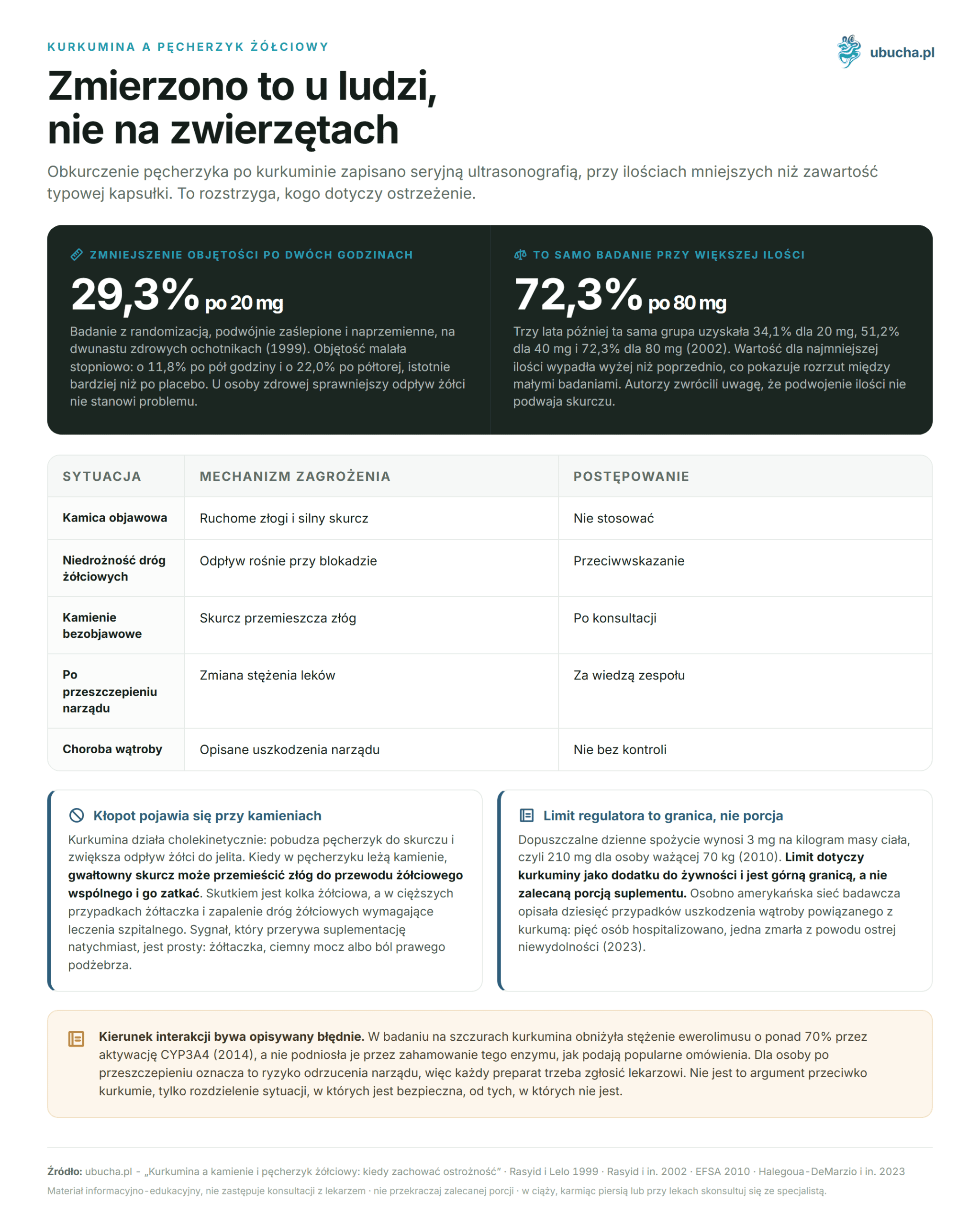
• A single dose of 20 mg of curcumin reduced the volume of the gallbladder by 29.3% within two hours in twelve healthy volunteers (Rasyid and Lelo, Alimentary Pharmacology and Therapeutics, 1999).
• In another study by the same group, 40 mg resulted in a contraction of 51.2%, and 80 mg by 72.3%, with the relationship not being directly proportional to the amount.
• EFSA established in 2010 the acceptable daily intake of curcumin as a food additive at 3 mg per kilogram of body weight, which is 210 mg for a person weighing 70 kg.
• The American DILIN network reported ten cases of liver damage associated with turmeric; five people were hospitalized, and one died due to acute liver failure (Halegoua-DeMarzio et al., The American Journal of Medicine, 2023).
• Individuals with gallstones, biliary obstruction, and those who have undergone organ transplants should not use curcumin without the decision of the attending physician.
How does curcumin affect the gallbladder?
Curcumin acts as a cholekinetic, meaning it stimulates the gallbladder to contract and increases bile flow to the intestine. This is not a conclusion from tradition or animal studies: it has been measured directly in humans using serial ultrasonography.
Rasyid and Lelo (Alimentary Pharmacology and Therapeutics, 1999) conducted a randomized, double-blind, and crossover study on twelve healthy volunteers, seven men and five women. The fasting volume of the gallbladder was similar in both conditions, approximately 15.7 ml after curcumin and 16.0 ml after placebo. After administering 20 mg of curcumin, the volume gradually decreased: by 11.8% after half an hour, 16.8% after one hour, 22.0% after one and a half hours, and 29.3% after two hours, significantly more than after placebo.
Three years later, the same group checked larger amounts. In the study Rasyid et al. (Asia Pacific Journal of Clinical Nutrition, 2002), also on twelve volunteers, the contraction after two hours was 34.1% for 20 mg, 51.2% for 40 mg, and 72.3% for 80 mg. The value for 20 mg was slightly higher than three years earlier, showing variability between small studies. The authors noted that doubling the amount does not double the contraction, so the relationship is not linear.
In a healthy person, a more efficient bile flow is not a problem. The trouble arises when stones lie in the gallbladder: a sudden contraction can displace a stone into the common bile duct and block it. The result is biliary colic, and in more severe cases, jaundice and cholangitis requiring hospital treatment.
Who should exercise particular caution with curcumin?
The following list organizes groups by the mechanism of risk, not by the strength of the product’s advertising. It does not replace medical assessment: supplementation for any chronic disease is decided by a doctor or pharmacist familiar with the entire treatment.
| Situation | Risk | Mechanism | Procedure |
|---|---|---|---|
| Symptomatic gallstones, previous colics | Very high | Mobile stones and strong gallbladder contraction | Do not use curcumin supplements |
| Narrowing or obstruction of the bile ducts | Very high | Increased bile flow with blocked outflow | Contraindication |
| Asymptomatic gallstones | High | Contraction may displace a stone into the bile duct | Only after gastroenterological consultation |
| Post-organ transplant state | High | Curcumin alters the concentration of immunosuppressive drugs | Only with the knowledge of the transplant team |
| Liver disease or abnormal liver tests | High | Documented cases of drug-induced liver injury | Do not use without medical supervision |
| Post-gallbladder removal state | Moderate | Bile flows constantly, possible diarrhea and discomfort | Monitor reaction, discuss with a doctor |
| Pregnancy | Caution | No randomized studies; EFSA limit derived from reproductive toxicity study | Avoid concentrated supplements, discuss diet with a doctor |
A signal that should immediately stop supplementation is easy to recognize: jaundice, dark urine, or pain in the right upper quadrant. Each of these requires discontinuation of the preparation and a doctor’s visit on the same day.
Why does the form of the preparation determine its action?
Curcumin is poorly absorbed from the gastrointestinal tract. A review by Hewlings and Kalman (Foods, 2017) indicates three reasons: poor absorption, rapid metabolism, and quick excretion. The authors state directly that simply taking curcumin does not bring the described health benefits precisely because of its bioavailability.
This is where modified preparations come in. Piperine, the main active ingredient of black pepper, combined with curcumin increases its bioavailability by 2000%, or twenty times; this is stated in the same review. Another route involves phospholipid complexes and liposomal forms that facilitate passage through the cell membrane.
This has a direct impact on reading studies. A study conducted on regular powder and a study conducted on a phospholipid complex describe two different biological interventions, despite the identical number of milligrams on the label. We have noticed that Polish descriptions of supplements rarely provide the form of bioavailability, which is why the purchase decision is based on price. A cheap powder without enhanced absorption may not produce any systemic effect, yet it can still act locally on the gallbladder, as the presence of curcumin in the gastrointestinal tract is sufficient for that. We write more about absorption in our post about turmeric and ways to enhance its absorption.
What do studies say about the anti-inflammatory action of curcumin?
The evidence is moderate and clearly dependent on the form of the preparation, which aligns well with the absorption issue described above. A meta-analysis by Sahebkar (Phytotherapy Research, 2014) included six clinical studies in which 172 people received curcuminoids and 170 received placebo.
Supplementation was associated with a significant reduction in C-reactive protein levels, averaging 6.44 mg/l. However, the decisive result of the subgroup analysis showed that the effect was maintained only where preparations of improved bioavailability were used and administered for at least four weeks. In subgroups without these characteristics, there was no effect. This is the same relationship described in the previous section, only viewed from the perspective of clinical outcome.
The second strong point is knee osteoarthritis. In a study by Kuptniratsaikul et al. (Clinical Interventions in Aging, 2014), 367 patients with knee pain were randomly assigned to ibuprofen at a dose of 1200 mg per day or to an extract of Curcuma domestica at a dose of 1500 mg per day for four weeks. In a test of non-inferiority, the extract proved to be no worse than ibuprofen on the WOMAC scale for total score, pain, and function. The number of individuals with adverse events was similar, but significantly more abdominal pain and discomfort were reported in the ibuprofen group.
What amount of curcumin is considered safe?
The reference point in the European Union is the EFSA opinion from 2010, issued during the re-evaluation of curcumin as a food additive numbered E 100. The panel established the acceptable daily intake at 3 mg per kilogram of body weight per day, derived from the level of no observed adverse effect ranging from 250 to 320 mg per kilogram, established in a reproductive toxicity study (EFSA, 2010).
For a person weighing 70 kg, this gives 210 mg of curcuminoids per day. It is worth comparing this number with the market: supplements sold in Poland usually contain from 500 to 1500 mg of curcuminoids in the daily dose declared by the manufacturer, which is a multiple of this value.
Two caveats organize the reading of this limit. The acceptable daily intake refers to curcumin as a food coloring and was not conceived as a limit for concentrated supplements with increased bioavailability. The value itself is a ceiling, not a recommendation: it indicates what should not be exceeded with regular consumption, not how much should be taken to achieve any effect. Data on long-term intake of large amounts is lacking.
Can curcumin damage the liver?
It can, and this is documented in humans, although it occurs rarely. The American Drug-Induced Liver Injury Network has collected cases of liver damage in which a turmeric product was deemed a causative factor.
Halegoua-DeMarzio et al. (The American Journal of Medicine, 2023) described ten such cases among reports from 2004-2022. All were included after 2011, and six after 2017. Eight individuals were women, with a median age of 56 years. In nine patients, the damage was hepatocellular. Five individuals were hospitalized, and one died due to acute liver failure. Chemical analysis confirmed the presence of turmeric in all seven examined products, and three of them also contained piperine. Seven patients had the HLA-B*35:01 variant, with a frequency in this group of 0.450 compared to 0.056 to 0.069 in the control population. The latency period ranged from one to four months.
The picture is therefore two-sided, as in other conditions, curcumin is beneficial to the liver. In a study by Rahmani et al. (Phytotherapy Research, 2016), patients with non-alcoholic fatty liver disease received curcumin preparation in the form of amorphous dispersion, 500 mg per day, corresponding to 70 mg of curcumin itself. The fat content in the liver improved in 78.9% of individuals compared to 27.5% in the placebo group, and aminotransferase activity and lipid parameters also decreased. More about plant preparations used for liver problems is discussed in our post about natural liver support.
How does curcumin behave with drugs?
Here, a common simplification needs to be corrected. Guides repeat that curcumin inhibits the CYP3A4 enzyme and thus raises drug concentrations, risking overdose. Available mechanistic studies indicate the opposite direction.
Hsieh et al. (Scientific Reports, 2014) administered everolimus, an immunosuppressive drug with a narrow therapeutic window, to rats both alone and together with curcumin. Curcumin reduced the area under the curve of everolimus concentration by over 70%, and its maximum concentration by 76.7%. Mechanistic studies showed that curcumin metabolites clearly activate CYP3A4, and this activation outweighed the inhibition of P-glycoprotein.
The practical conclusion is sharper, not milder, than the common version. For a transplant patient, a drop in the concentration of the immunosuppressive drug by seventy-some percent means a risk of transplant rejection, not poisoning. The result comes from a study on rats and does not directly translate to humans, but it is sufficient to consider independently combining curcumin with drugs that have a narrow therapeutic window as unpredictable behavior. A person taking medications chronically should inform their doctor about any preparation containing curcumin, regardless of which way the interaction shifts the concentration.
Frequently Asked Questions
Is curcumin dangerous with gallstones?
It poses a real threat. Curcumin contracts the gallbladder: 20 mg reduced its volume by 29.3% within two hours in twelve healthy volunteers (Rasyid and Lelo, 1999). In a person with cholelithiasis, such contraction can displace a stone and cause biliary colic.
Can curcumin be taken after gallbladder removal?
There is no absolute contraindication, but caution is advised. After the procedure, there is no gallbladder to contract, but curcumin still increases bile flow to the intestine. In some individuals, this causes diarrhea or digestive discomfort.
What consumption limit for curcumin has EFSA established?
The acceptable daily intake is 3 mg per kilogram of body weight per day, which is 210 mg for a person weighing 70 kg (EFSA, 2010). The limit applies to curcumin as a food additive E 100 and is an upper limit, not a recommended supplement dose.
Does curcumin interact with medications?
Yes, although the direction is often described incorrectly. In a study on rats, curcumin reduced the concentration of everolimus by over 70% by activating CYP3A4 (Hsieh et al., 2014). For a transplant patient, this means a risk of rejection, so every preparation must be reported to the doctor.
Does curcumin have anti-inflammatory effects according to studies?
A meta-analysis of six studies involving 342 people showed a reduction in C-reactive protein by 6.44 mg/l, but only with preparations of improved bioavailability used for at least four weeks (Sahebkar, Phytotherapy Research, 2014). Regular powder did not produce this effect.
This article is for informational and educational purposes and does not constitute medical advice. Before starting supplementation, consult your doctor, especially if you are taking medications regularly, are pregnant or breastfeeding, or have a chronic illness.
Author: Michał Waluk · Published: 2026-08-09 · Updated: 2026-08-11