
Supplements for Seniors: What is Safe, What Helps, and What to Absolutely Avoid
Which supplements have evidence for people over 65, and which change the action of medications: St. John's Wort, calcium, vitamin K, potassium, and B12 with references to studies.
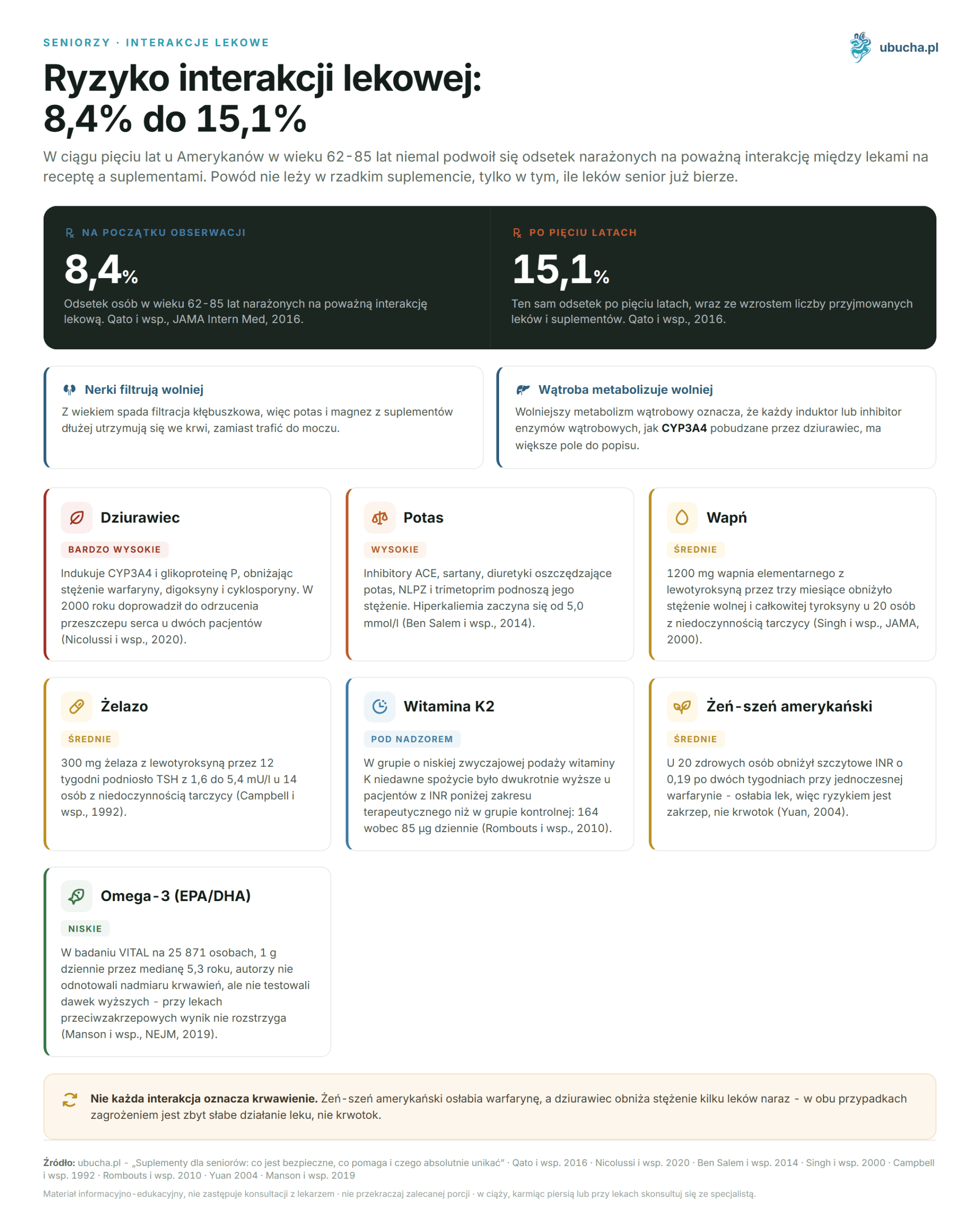
After the age of 65, it is rarely just about deficiency. More often, it is about what the supplement will do with the medications you are already taking. In a representative study of Americans aged 62-85, the percentage of people taking five or more prescription medications increased over five years from 30.6% to 35.8%, and the percentage using dietary supplements rose from 51.8% to 63.7%. During the same period, the percentage of individuals exposed to serious drug interactions doubled, from 8.4% to 15.1% (Qato et al., JAMA Internal Medicine, 2016). Below you will find what can be supported by research: where supplementation in seniors has evidence, where it changes drug concentrations in the blood, and what data does not confirm, despite circulating in guides.
KEY INFORMATION
• The percentage of individuals aged 62-85 exposed to serious drug interactions increased from 8.4% to 15.1% over five years (Qato et al., JAMA Intern Med, 2016).
• St. John’s Wort induces CYP3A4 and P-glycoprotein, thereby lowering the concentration of warfarin, digoxin, and cyclosporine (Nicolussi et al., 2020).
• Polish guidelines from 2023 recommend 1000-2000 IU of vitamin D daily for those aged 65-75 and 2000-4000 IU for those over 75 years.
• Vitamin E at 400 IU daily is associated with increased all-cause mortality in a meta-analysis of 19 studies (Miller et al., 2005).
Why are interactions a greater risk for seniors than deficiencies?
Because a supplement does not work in a vacuum. In the Qato et al. study from 2016, 35.8% of individuals aged 62-85 were taking at least five prescription medications, and 63.7% were using dietary supplements. The percentage exposed to serious drug interactions reached 15.1%.
A comparison from the same study shows why this is not a theoretical problem. Over five years, the use of statins increased from 33.8% to 46.2%, antiplatelet drugs from 32.8% to 43.0%, and fish oil from 4.7% to 18.6%. These three preparations are increasingly landing in the same drawer, and the first two have documented interactions with popular herbs.
Additionally, there is a change in pharmacokinetics. With age, glomerular filtration decreases, so substances excreted by the kidneys, including potassium and magnesium, remain in the body longer. A slower hepatic metabolism means that any inducers or inhibitors of liver enzymes have a greater field to operate. This is not an argument against supplementation, but rather for adding preparations one at a time.
We noticed while gathering materials that the method of investigation used by Qato is instructive. Interviewers did not ask for a list from memory but looked at the packages in the patient’s home. When visiting a doctor, it works the same way: a bag of packages says more than the answer “I take something for my heart and vitamins.”
Which supplements most often change the action of medications?
Six groups frequently return in the literature for older adults: St. John’s Wort, ginseng, potassium preparations, vitamin K, minerals that bind medications in the gastrointestinal tract, and omega-3 fatty acids. The table below compares the mechanism with a specific source.
| Supplement | Medications affected | What the source shows |
|---|---|---|
| St. John’s Wort | warfarin, digoxin, simvastatin, cyclosporine, oral contraceptives | induction of CYP3A4 and P-glycoprotein through PXR activation (Nicolussi 2020) |
| American ginseng | warfarin | randomized study in 20 healthy individuals: peak INR dropped by 0.19 after two weeks (Yuan 2004) |
| Potassium preparations | ACE inhibitors, sartans, potassium-sparing diuretics, NSAIDs, trimethoprim | potassium-containing preparations are a separate group causing drug-induced hyperkalemia (Ben Salem 2014) |
| Vitamin K, including K2 MK-7 | warfarin, acenocoumarol | changes in vitamin K supply translate to fluctuations in INR (Rombouts 2010) |
| Calcium and iron | levothyroxine, fluoroquinolone antibiotics | decrease in fT4 and increase in TSH with simultaneous intake (Singh 2000, Campbell 1992) |
| Omega-3 EPA and DHA | anticoagulants and antiplatelet drugs | with 1 g daily in the VITAL study, no excess bleeding was reported (Manson 2019) |
Two conclusions can be drawn from the table. Some items work both ways: ginseng weakens warfarin, so the risk is thrombosis, not hemorrhage, while with minerals, the problem may not be the substance but the timing of intake.
Why is St. John’s Wort a separate problem with many medications?
St. John’s Wort is one of the strongest plant enzyme inducers described in humans. It activates the PXR receptor, which in turn increases the activity of cytochrome CYP3A4 and P-glycoprotein. The effect is the opposite of what one might intuitively think: the drug does not work stronger, but weaker, because it disappears from the blood faster.
The scale of this phenomenon is known from hard cases. In 2000, the interaction of St. John’s Wort with cyclosporine led to acute transplant rejection in two patients after heart transplantation (Nicolussi et al., British Journal of Pharmacology, 2020). The same review mentions altered pharmacokinetics of digoxin, tacrolimus, indinavir, warfarin, alprazolam, simvastatin, as well as oral contraceptives. A broader systematic review, including 128 case reports and 80 clinical studies, adds atorvastatin, omeprazole, verapamil, and nifedipine to this list (Izzo and Ernst, Drugs, 2009).
There is also a catch that complicates assessing the risk on your own. The strength of CYP3A4 induction correlates with the content of hyperforin in the preparation, which varies between products. Two packages with the same plant name on the label may not work the same. More about herb-drug collisions can be found in the post about prohibited combinations between herbs and drugs.
How do calcium and iron affect drug absorption?
They bind the drug in the intestine before it can be absorbed. In a study of 20 individuals with hypothyroidism, taking 1200 mg of elemental calcium in the form of carbonate together with levothyroxine for three months lowered the average levels of free and total thyroxine (Singh et al., JAMA, 2000).
Iron does the same, and more clearly. In 14 patients with hypothyroidism, simultaneous intake of 300 mg of iron sulfate with thyroxine for 12 weeks raised the average TSH from 1.6 to 5.4 mU/l, and in nine of them, symptoms of hypothyroidism worsened (Campbell et al., Annals of Internal Medicine, 1992).
Fluoroquinolone antibiotics have the same problem, though with one surprising exception. A systematic review of 109 studies on 22 fluoroquinolones found that all fourteen substances analyzed in this regard clearly lost bioavailability when administered together with antacids and mineral supplements. The exception turned out to be calcium preparations themselves, for which such a decrease was not found. Calcium given in liquid behaves differently: milk reduced absorption in half of the studied fluoroquinolones, most notably with ciprofloxacin, and calcium-fortified orange juice worsened the bioavailability of ciprofloxacin and levofloxacin (Wiesner et al., Clinical Pharmacokinetics, 2024). For a specific interval between the drug and the mineral, ask your pharmacist, as it depends on the molecule and the form of the preparation.
When do potassium and vitamin K require a conversation with a doctor?
Always when there are medications for hypertension or anticoagulant treatment in the background. Hyperkalemia, or potassium levels in serum above 5.0 mmol/l, often has a drug-related cause in everyday practice, and potassium-containing preparations are listed in reviews as a separate group of its causes.
The mechanism concerns medications that seniors often take for years. Inhibition of the renin-angiotensin-aldosterone axis limits potassium excretion by the kidneys, so ACE inhibitors, sartans, and aldosterone antagonists raise its concentration. The same is true for potassium-sparing diuretics, non-steroidal anti-inflammatory drugs, heparins, and trimethoprim (Ben Salem et al., Drug Safety, 2014). Popular magnesium preparations with potassium fall into the same category, and potassium may be in fine print on the label.
With vitamin K, the situation is different than the common prohibition suggests. In a study of patients from a Dutch anticoagulation clinic, individuals with low habitual intake of vitamin K had an increased risk of INR below the therapeutic range, with the confidence interval including one (HR 1.33; 95% CI 0.79-2.25), so this difference was not statistically significant. However, another result was clear: in the group with low habitual intake, recent vitamin K intake was twice as high in patients as in controls, 164 vs. 85 µg daily. The authors conclude that a steady, sufficient supply stabilizes INR against random fluctuations (Rombouts et al., British Journal of Haematology, 2010). The problem is therefore the spike, and starting or stopping a K2 preparation is exactly such a spike.
What do Polish guidelines say about vitamin D after the age of 65?
They provide separate doses for two age groups. The 2023 guidelines recommend for individuals aged 65-75 years cholecalciferol at a dose of 1000-2000 IU daily throughout the year, and for those over 75 years 2000-4000 IU daily, in both cases considering body weight and dietary intake.
The justification is physiological. The skin of an older person synthesizes vitamin D less efficiently, and in the older age group, possible absorption disorders and altered metabolism add to this. The document also defines laboratory thresholds: a 25(OH)D level below 20 ng/ml indicates deficiency, 20-30 ng/ml indicates suboptimal status, and 30-50 ng/ml indicates optimal value (Płudowski et al., Nutrients, 2023). The popular online threshold of 60 ng/ml does not come from this consensus.
There is also a correction that is easy to forget. In obesity, defined in adults and seniors as BMI over 30, the document states that the usual dose is typically twice as high as for peers with normal body weight. This is an argument for measuring 25(OH)D instead of guessing. How to combine D3 with vitamin K2 is described separately in the post about vitamin D3 and K2.
Why is vitamin B12 deficiency in seniors often drug-related?
Because two very popular medications after the age of 65 impair its absorption. In the DPPOS study, low B12 levels after five years were found in 4.3% of those taking metformin compared to 2.3% in the placebo group, and low and borderline results together in 19.1% vs. 9.5%.
After thirteen years, the difference remained for low and borderline results, 20.3% vs. 15.6%. Each year of metformin use raised the chances of deficiency by 13% (OR 1.13; 95% CI 1.06-1.20), and neuropathy occurred more frequently in metformin-treated individuals with low B12 levels. The authors state directly that routine monitoring of B12 levels in patients on metformin deserves consideration (Aroda et al., Journal of Clinical Endocrinology and Metabolism, 2016).
The second group consists of medications that inhibit gastric acid secretion. In an analysis of 25,956 individuals with diagnosed B12 deficiency and 184,199 without it, taking proton pump inhibitors for at least two years was associated with an odds ratio of 1.65 (95% CI 1.58-1.73), and H2 receptor blockers with an odds ratio of 1.25 (Lam et al., JAMA, 2013). Symptoms of deficiency can be nonspecific, which we expand upon in the post about vitamin B12 deficiency.
Which supplements have data on effectiveness for seniors?
The most evidence exists for vitamin D and vitamin B12, for the reasons described above. For omega-3 fatty acids, the picture is mixed, and for collagen narrow, though specific. The rest of the popular geriatric preparations are based on observational data or narrative reviews, not on large randomized studies.
The VITAL study included 25,871 individuals taking 1 g of omega-3 daily for a median of 5.3 years. The primary endpoint, the number of serious cardiovascular events, did not differ from placebo, hazard ratio 0.92 (95% CI 0.80-1.06). Among secondary outcomes, the number of heart attacks was lower, hazard ratio 0.72 (95% CI 0.59-0.90), and the authors did not report excess bleeding (Manson et al., NEJM, 2019). It is worth remembering that the study tested one dose, so it says nothing about higher doses.
Collagen has a meta-analysis of randomized studies in osteoarthritis. It showed improvement in the total score on the WOMAC scale, its stiffness subscale, and pain assessment on the VAS scale, while the pain and function subscales in WOMAC did not differ from placebo in a statistically significant way (García-Coronado et al., International Orthopaedics, 2019). Two pain scales thus yielded divergent results, which suggests treating the effect as real but uncertain, and not as a substitute for treatment.
Do high doses of calcium burden the heart?
The data is conflicting, and that is a fair answer. A meta-analysis of 15 randomized studies found that calcium at a dose of 500 mg daily, given without vitamin D, was associated with a higher risk of heart attack: hazard ratio 1.31 (95% CI 1.02-1.67) with individual data and relative risk 1.27 (95% CI 1.01-1.59) with aggregate data. Both intervals end just above one, so the signal is weak.
This work (Bolland et al., BMJ, 2010) sparked a discussion that continues to this day. A later systematic review, including four randomized studies and 27 observational studies, found no difference in the number of cardiovascular events or mortality between groups taking calcium and placebo. The authors’ conclusion is that calcium intake within the upper acceptable limits, i.e., 2000-2500 mg daily, is not associated with cardiovascular risk in generally healthy adults (Chung et al., Annals of Internal Medicine, 2016). It is worth noting that the review was funded by the National Osteoporosis Foundation.
The practical difference between these results comes down to the sum. The risk signal appeared with the supplement given without vitamin D and disappeared when total intake was counted within normal limits. Two sensible conclusions are: count calcium from diet together with that from the tablet, and if you have heart disease, discuss the dose with your doctor instead of adding it as a precaution.
What to really avoid, and what studies do not confirm?
Four warnings have large randomized studies behind them, while one very popular one, as it turns out, does not. It is worth separating these two sets, as an unsupported prohibition undermines the credibility of those that do have support.
Vitamin E at doses of 400 IU daily performs the worst. A meta-analysis of 19 studies involving 135,967 individuals showed an increase in all-cause mortality of 39 deaths per 10,000 people (95% CI 3-74) and a dose-dependent relationship above 150 IU daily (Miller et al., Annals of Internal Medicine, 2005). In the SELECT study involving 35,533 men, the same dose was associated with a higher risk of prostate cancer, hazard ratio 1.17 (Klein et al., JAMA, 2011). Beta-carotene with vitamin A in smokers and those exposed to asbestos gave a relative risk of lung cancer of 1.28, leading to the CARET study being stopped 21 months ahead of schedule (Omenn et al., NEJM, 1996). Collectively, in 47 studies with a low risk of error, antioxidants increased mortality, relative risk 1.05 (Bjelakovic et al., JAMA, 2007). Ephedrine raises the chances of psychiatric symptoms and palpitations by 2.2 to 3.6 times with weight loss of about 0.9 kg per month (Shekelle et al., JAMA, 2003).
And now the prohibition that has not been confirmed. A meta-analysis of 18 randomized studies involving 1985 individuals did not show a significant effect of standardized extract of ginkgo biloba on platelet aggregation, fibrinogen levels, APTT, or prothrombin time, and the authors did not confirm an increased risk of bleeding (Kellermann and Kloft, Pharmacotherapy, 2011). Descriptions of individual cases exist, so the doctor should be aware of the preparation, but the hard “never with anticoagulants” does not arise from the data.
How to conduct a medication review and what to check on the label?
Start with the packages, not from memory. Bring everything you take at least once a week, including over-the-counter preparations and herbs, to your appointment. Ask your doctor or pharmacist to check three things: potassium, vitamin K, and minerals requiring a time gap from the medication.
On the label, check the content per serving, not per capsule, as a serving may consist of two or three capsules. Also, check if potassium and vitamin K are present in the composition, even if they are not in the product name. How to distinguish a supplement from a drug and what to look for in the composition is detailed in the post about the difference between a supplement and a drug.
Instead of guessing, base your decision on the result. Below are studies justified by the works cited above.
| Study | Purpose | When it makes sense |
|---|---|---|
| 25(OH)D | guidelines define deficiency below 20 ng/ml and optimum 30-50 ng/ml | before changing the dose and in obesity |
| Vitamin B12 | metformin and acid secretion inhibitors raise the risk of deficiency | with metformin, proton pump inhibitors, neurological symptoms |
| eGFR and creatinine | kidney function determines the excretion of potassium and magnesium | before adding a potassium or magnesium preparation |
| INR | vitamin K antagonists react to changes in its supply | when starting and stopping a K2 preparation |
| TSH | calcium and iron lower the effectiveness of levothyroxine | after changing the interval between the drug and the mineral |
Frequently Asked Questions
Which supplements have the best evidence for people over 65?
The most well-documented is vitamin D, for which Polish guidelines from 2023 provide doses depending on age. For omega-3, the VITAL study with 25,871 participants did not show a decrease in the number of serious cardiovascular events, although it recorded fewer heart attacks. The rest requires confirmation of deficiency through testing.
Is vitamin K2 safe with warfarin or acenocoumarol?
The problem is not vitamin K itself, but the change in its supply. In a study from a Dutch anticoagulation clinic, it was the sudden spike in intake, not a steady supply, that was associated with INR outside the therapeutic range. Starting or stopping a K2 supplement is exactly such a spike, so it requires consultation with the attending physician.
Does metformin lower vitamin B12 levels?
In the DPPOS study, low B12 levels after five years were found in 4.3% of those taking metformin compared to 2.3% in the placebo group. Each year of drug use increased the chances of deficiency (OR 1.13). The authors recommend considering routine B12 monitoring in patients treated with metformin.
How much vitamin D do Polish guidelines recommend for seniors?
The 2023 guidelines recommend for individuals aged 65-75 years cholecalciferol 1000-2000 IU daily throughout the year, and for those over 75 years 2000-4000 IU daily. They consider an optimal concentration of 25(OH)D to be 30-50 ng/ml, and deficiency to be values below 20 ng/ml.
Do omega-3s increase the risk of bleeding?
In the VITAL study, 25,871 participants took 1 g of omega-3 daily for a median of 5.3 years, and the authors did not report excess bleeding or other serious adverse events. When on anticoagulant treatment, it is still worth discussing the dose with a doctor, as the study did not test high doses.
Does ginkgo biloba really increase the risk of bleeding?
A meta-analysis of 18 studies involving 1985 people did not show a significant effect of standardized extract on platelet aggregation, fibrinogen levels, APTT, or prothrombin time. The authors did not confirm an increased risk of bleeding. There are descriptions of individual cases, so the doctor should be aware of the supplement.
The preparations mentioned in the article can be found in the supplements category. Before adding anything to your list of medications, show it to your doctor or pharmacist.
This article is for informational and educational purposes only and does not constitute medical advice. Before starting supplementation, consult your doctor, especially if you are taking medications regularly, are pregnant or breastfeeding, or have chronic illnesses.
Author: Michał Waluk · Published: 2026-06-22 · Updated: 2026-08-11