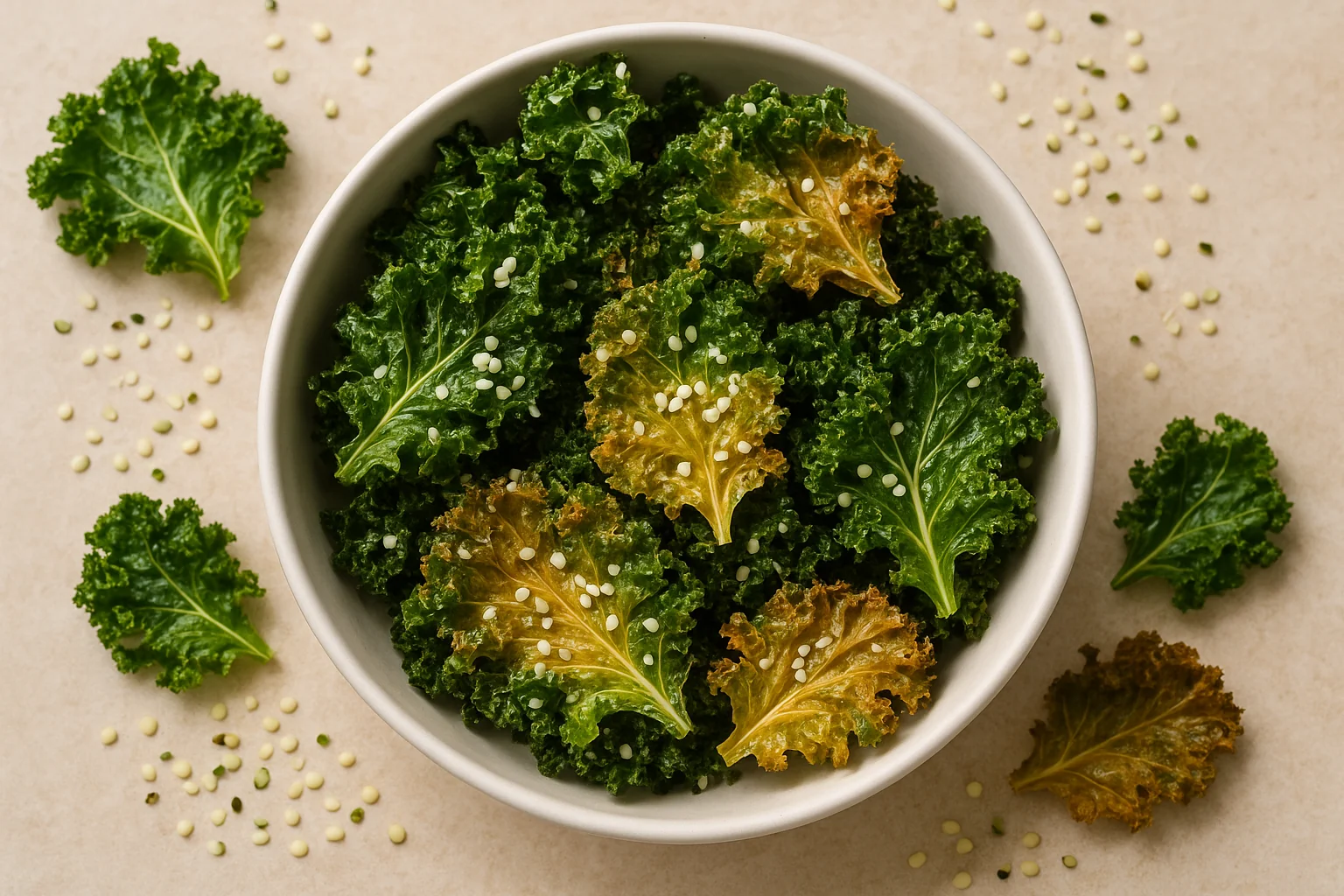

Kale Chips with Hemp Seeds: A Fit Alternative
Crispy kale chips with hemp seeds baked at 120 degrees. Proportions, nutritional values from the USDA database, and two mistakes that cause them to soften.
Kale chips are baked at low temperatures instead of fried. The leaves release water, become crispy like paper, and retain much of what kale offers raw. Two tablespoons of hulled hemp seeds massaged into the leaves with oil add protein and fat, which are almost absent in kale itself. The entire batch takes 25 minutes and one baking sheet. Below you will find the proportions, nutritional values calculated from USDA database records, and two common mistakes that cause them to become soft: moist leaves and too hot an oven. Both can be avoided without additional equipment other than a salad spinner. These chips have one drawback, and it’s better to know about it in advance: they are best on the day they are baked.
KEY INFORMATION
• Raw kale has 390 µg of vitamin K, 93 mg of vitamin C, and 254 mg of calcium per 100 g (USDA).
• Hulled hemp seeds contain 31.6 g of protein and 700 mg of magnesium per 100 g (USDA).
• Lysine is the first limiting amino acid in all studied hemp products (House et al., 2010).
• Chips come out crispy only from dry leaves spread on the baking sheet in a single layer.
Why are kale and hemp seeds a good combination?
Because they complement each other exactly where each is poor. Kale provides micronutrients with trace amounts of protein and fat. Hulled hemp seeds, on the other hand: 31.6 g of protein and 48.8 g of fat per 100 g, while the USDA record does not provide any vitamin K or lutein for them. Together they create a snack that is more complete than either one alone.
The numbers on the vegetable side come from the USDA record for raw leaves: 390 µg of vitamin K, 93.4 mg of vitamin C, and 254 mg of calcium per 100 g, with 2.92 g of protein and 1.49 g of fat (USDA, raw kale). The same record lists 6260 µg of lutein with zeaxanthin. On the seed side, there are 31.6 g of protein and 48.8 g of fat per 100 g, with 700 mg of magnesium (USDA, hulled hemp seeds).
Hemp protein is sometimes described as complete, and this abbreviation requires elaboration. Callaway, Euphytica, 2004 states that edestin and albumin, the two main proteins in the seeds, contain nutritionally significant amounts of all essential amino acids. House et al., Journal of Agricultural and Food Chemistry, 2010 measured how much of this the body actually utilizes and came to a more cautious conclusion than the popular abbreviation: lysine turned out to be the first limiting amino acid in all studied hemp products. The PDCAAS score was 63-66% for hulled seeds and 49-53% for whole seeds. An amino acid present is not the same as an amino acid present in sufficient quantity.
The actual protein content varies between sources: House reports an average of 35.9% for hulled seeds, while the USDA record states 31.6 g per 100 g. The difference comes from batch and supplier, so treat both numbers as ranges.
What does a serving of chips provide?
A 20 g serving of finished chips, or about one third of the batch, contains approximately 140 kcal. This value is calculated from the ingredients, not measured from the finished snack. Water evaporates, calories remain, so a gram of chips is much more concentrated than a gram of raw leaf.
The batch broken down into raw materials looks like this. 200 g of raw kale contributes 5.8 g of protein and 780 µg of vitamin K, plus 187 mg of vitamin C. Two tablespoons of hulled hemp seeds, or about 20 g, add 6.3 g of protein, 9.8 g of fat, and 140 mg of magnesium. Two tablespoons of oil add another 27 g of fat spread over the entire sheet. The numbers for kale and seeds come from USDA records for the raw material, while the value for oil comes from its density.
Energetically, the entire sheet is about 425 kcal, with more than half coming from the oil and one quarter from the hemp seeds. Kale itself contributes 70 kcal. If you want to reduce calories, cut back on the oil, not the seeds.
One thing changes in the oven, and we cannot provide it numerically. Vitamin C breaks down under heat, so the finished chips contain less of it than the leaves before baking. We did not measure this loss, so we provide the value for the raw material and note that the finished snack has less. Magnesium from hemp seeds does not decrease, as minerals do not break down at this temperature.
What do you need for kale chips?
The proportions are enough for about 60 g of finished chips, or 3-4 servings. Preparation takes 5 minutes, baking 20-25 minutes. Besides a salad spinner, which can be replaced with a kitchen towel, you do not need anything special.
- 200 g of fresh kale, or about one large bunch
- 2 tablespoons of hulled hemp seeds
- 2 tablespoons of extra virgin olive oil
- 1/4 teaspoon of sea salt
- 1/4 teaspoon of garlic powder, optional
- pinch of sweet or smoked paprika, optional
- 1 tablespoon of nutritional yeast for a cheesy version, optional
Choose kale with firm, dark green leaves. Wilted leaves release water more slowly and bake unevenly, causing part of the sheet to dry out while another part remains chewy. The variety does not matter much here, but the size of the leaf does, and we will return to this when baking.
Use hulled hemp seeds, not whole ones. The hull will not soften in the oven and will crunch in your teeth, and it dilutes what you are reaching for with the seeds: whole seeds have about one third less protein than hulled ones in House’s study, and removing the hull also improved digestibility.
How to bake kale chips step by step?
The procedure has six steps, two of which determine the outcome: thorough drying of the leaves and a temperature of 120 degrees. The other four forgive minor mistakes, and you can do them by eye.
- Preheat the oven to 120 degrees in top-bottom mode, without convection, and line the baking sheet with parchment paper. A higher temperature shortens baking time but burns the edges of the leaves before the center dries out.
- Tear leaves from the tough central stems and wash them. The stems are too fibrous to become crispy, so leave them for soup or throw them away.
- Dry the leaves in a salad spinner or pat each one with a paper towel. This step often determines whether the chips will be soft, as a moist leaf steams instead of drying out.
- Transfer the dry leaves to a large bowl, pour in the oil, and massage them with your hands for 1-2 minutes until the fat coats every piece. Only now add salt, spices, and hemp seeds so they stick to the oiled surface.
- Spread the leaves on the baking sheet in a single layer, without overlapping. Where they touch, they will remain moist. For a small sheet, bake in two batches instead of cramming everything in at once.
- Bake for 20-25 minutes, moving the leaves from the edges to the center after fifteen minutes. Remove the baking sheet and wait 3-5 minutes, as the chips only become crispy while cooling. Serve the same day.
We noticed in our tests that small leaves of young kale dry faster than large ones and only need 18-20 minutes. Large leaves need the full 25 minutes and bake unevenly because the edge of the sheet heats up more than the center. If you have large leaves, tear them into pieces the size of your hand before oiling. This is an observation from my own kitchen, not a research result.
What spices go well with kale chips?
Practically all of them, as the nutty flavor of hemp seeds does not clash with anything. You add spices together with salt, before the seeds, so they stick to the oiled leaves. Four combinations below have been tested in this order, and each works with the same base. Use less salt than your instinct suggests: the leaf loses water, and the flavor concentrates along with it.
| Version | What to add to the bowl | When to add |
|---|---|---|
| Basic | sea salt, garlic powder | before baking |
| Cheesy without cheese | 2 tablespoons of nutritional yeast, salt | before baking |
| Mediterranean | oregano, smoked paprika | before baking |
| Spicy with lime | chili, lime juice | chili before, lime after cooling |
Toasted hemp seeds also work well as a topping added after cooling, in a curry or spicy version: we described them in the recipe for toasted hemp seeds with spices. If you are looking for a warmer dish with the same ingredient, the same portion of seeds goes into cauliflower cream with hemp seeds, and cold into orange and hemp seed salad.
Frequently Asked Questions
Why do kale chips come out soft?
Most often for two reasons: the leaves were moist or they were lying on the baking sheet one on top of the other. In both cases, water turns into steam and instead of dehydrating the leaf, it softens it. Dry the leaves thoroughly, spread them in a single layer, and do not exceed 130 degrees.
How much protein do kale chips with hemp seeds have?
A 20 g serving contains about 4 g of protein, roughly half from the seeds and half from the leaves. Hulled seeds have 31.6 g of protein per 100 g, raw kale has 2.92 g (USDA). Keep in mind that lysine is a limiting amino acid in hemp products, so the seeds alone cannot replace a mix of protein sources.
Can hemp seeds be baked with kale?
Yes, at low temperatures. The fat in hemp seeds is mostly polyunsaturated, and such acids easily oxidize (Tura et al., Antioxidants, 2022). Baking at 120 degrees for 20-25 minutes is a compromise between drying the leaf and protecting the fat. We do not know a measurement that sets a hard temperature threshold for the seeds.
How long can kale chips be stored?
It is best to eat them the same day. In an airtight container at room temperature, they maintain crispness for two to three days, after which they absorb moisture from the air and become limp. The refrigerator makes it worse, as it has high humidity. Hemp seeds do not shorten or extend this time.
What can replace oil in kale chips?
Canola or avocado oil, which can withstand 120 degrees. Do not use hemp oil for baking: it is rich in polyunsaturated fats that oxidize the easiest, so it is suitable for ready-made dishes, not for the oven. The amount remains the same, two tablespoons for 200 g of leaves.
We have gathered hemp teas and small snacks in the food category in the store at Bucha; you will not find hulled hemp seeds there, as we do not carry them (as of August 16, 2026).
This article is for informational and educational purposes and does not replace consultation with a doctor. If you are pregnant, breastfeeding, taking medications, or have chronic conditions, consult the use of supplements or herbs with a specialist.
Author: Michał Waluk · Published: 2026-06-22 · Updated: 2026-08-16