
Supplements for Athletes Without Doping: What Provides an Advantage and Is Compliant with Regulations
Which supplements comply with the WADA 2026 list, and which risk disqualification. Strict liability, contaminated batches, and data from meta-analyses.
The WADA Prohibited List is updated once a year, and the version for 2026 came into effect on January 1. This is the first thing to establish before any discussion about supplements: a document from two seasons ago no longer describes the actual state, as new items are added and permissible doses change every year. The second is more difficult. A product may have a clean label and a prohibited substance inside, and the consequences are borne solely by the athlete, not the manufacturer or the store. Below you will find what meta-analyses say about individual ingredients: at what duration of effort the effect has actually been demonstrated, how many people participated in these studies, which popular supplements lack data support, and how to check a product before it enters the body.
KEY INFORMATION
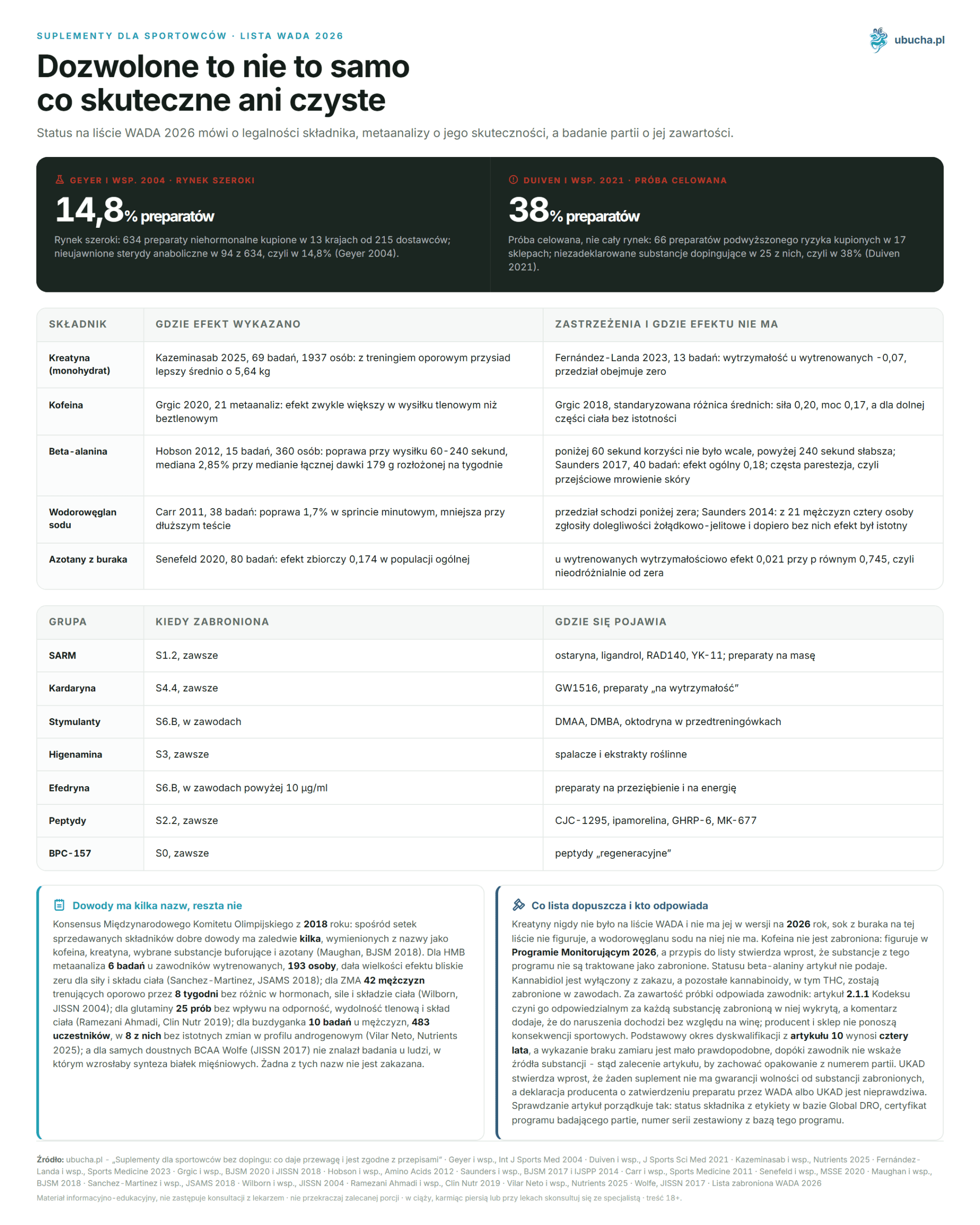
• 94 out of 634 tested supplements, or 14.8%, contained undisclosed anabolic steroids (Geyer et al., 2004).
• Principle of strict liability: the content of the sample matters, not the athlete’s intent.
• Cannabidiol is excluded from the ban, THC remains prohibited in competitions.
• Beta-alanine helped with efforts lasting 60-240 seconds and did not help below 60 seconds.
What is the WADA prohibited substances list and how often does it change?
This is a mandatory international standard of the World Anti-Doping Program, updated annually after consultations conducted by WADA. The version for 2026 is in effect from January 1, 2026 (POLADA, List of Prohibited Substances and Methods 2026). The edition from two seasons ago is no longer a reliable source.
The document is divided into three parts. Throughout the year, in competitions and out of them, categories from S0 to S5 and methods M1-M3 are prohibited: unapproved substances, anabolic agents, peptide hormones along with growth factors, beta-2 agonists, hormone and metabolism modulators, as well as diuretics and masking agents. Only in competitions is the prohibition of stimulants (S6), narcotics (S7), cannabinoids (S8), and glucocorticoids (S9) applicable. Beta-blockers (P1) apply to selected disciplines, including archery, shooting, darts, and billiards.
The start period begins at 23:59 on the day before the competition and runs until the end of the competition and the sampling process, unless WADA has agreed to a different definition for a given sport. In the 2026 edition, it has changed, among other things, that blood or its components are prohibited from being taken even without reintroducing it into the bloodstream, except for analytical procedures and honorary blood donation at an accredited facility. Inhaled salmeterol may be taken up to 200 µg per day, in doses not exceeding 100 µg every 8 hours. The ban on gene and cell doping has been extended to include cell components, including nuclei and organelles such as mitochondria and ribosomes. A new item is also the inhalation of carbon monoxide outside of a diagnostic procedure conducted under supervision (UKAD, summary of changes for 2026). You can check the status of a single substance in the Global DRO database, maintained jointly by national anti-doping agencies.
What is the athlete responsible for if a prohibited substance is found in their sample?
For everything. Article 2.1.1 of the World Anti-Doping Code imposes on the athlete the obligation to ensure that no prohibited substance is introduced into their body, and makes them responsible for any prohibited substance detected in the collected sample. The commentary to this article adds directly that a violation occurs regardless of the athlete’s guilt.
The manufacturer of the supplement bears no sports consequences for this. The store does not either. The athlete bears them, even when the substance was not on the label and they had no reason to suspect it. Guilt is only taken into account when determining the penalty under Article 10, where the basic disqualification period is four years. The Code stipulates in the commentary that proving lack of intent is unlikely until the athlete indicates the source of the prohibited substance. Simply stating “it must have been the supplement” is not enough: a specific product must be indicated, which is why keeping the packaging with the batch number is worthwhile.
This principle applies to anyone competing in a federation associated with the Code, including amateurs in mass races held under the auspices of a sports association. From our experience in handling inquiries, it seems that at the amateur level, the risk appears abstract, although this is where supplements are most often purchased without checking anything.
How often do supplements turn out to be contaminated with prohibited substances?
More often than would be indicated by labels. In an international study, a laboratory in Cologne analyzed 634 non-hormonal products purchased in 13 countries from 215 suppliers. Undisclosed anabolic-androgenic steroids were detected in 94 of them, or 14.8% (Geyer et al., Int J Sports Med 2004).
Newer data is worse for high-risk products. A Dutch team tested 66 products identified as high-risk, purchased from 17 online stores. Undeclared doping substances were found in 25 of them, or 38% (Duiven et al., J Sports Sci Med 2021). This is not the percentage for the entire market, but for products advertised with hormonal or fat-burning effects.
The market’s response is batch testing programs. Informed Sport declares analysis of each batch for prohibited substances before allowing it to be sold; alongside it operate NSF Certified for Sport and the German Kölner Liste. None of these programs provide guarantees and none are an approval by an anti-doping organization. UKAD states directly that there is no guarantee that any supplement is free from prohibited substances, and a manufacturer’s declaration of approval by WADA or UKAD is simply false. The recommendation is to use only batch-tested products and check the batch number before use.
Is cannabidiol allowed in sports, and what about THC?
Cannabidiol is the only exception in category S8. The list for 2026 explicitly mentions it in the exemptions column, while all other natural and synthetic cannabinoids, including tetrahydrocannabinol, remain prohibited in competitions. The exemption for cannabidiol has been in effect since 2019 (USADA, Marijuana FAQ).
The practical difference is sharp. Cannabinoids are not prohibited outside of competitions, and delta-9-THC is the only cannabinoid for which a threshold in urine has been set: 150 ng/ml. This value was raised by WADA by a decision on May 11, 2013, changing the technical document on decision limits for the metabolite carboxy-THC (WADA, announcement from 2013). However, the threshold is not a safety margin that a manufacturer can promise anyone.
Here lies the trap of products with cannabidiol. Full-spectrum extracts by definition contain trace amounts of other cannabis phytochemicals, including THC, and a label declaration does not replace batch testing. We have noticed that in questions about oils, the topic of competition starts rarely comes up, although it determines whether an isolate with a batch certificate is the only reasonable choice. We described how such products behave in tests in the text about CBD and drug tests.
In what effort does creatine actually improve performance?
In short and maximal efforts. A meta-analysis of 69 studies involving 1937 people showed that creatine monohydrate combined with resistance training improved squat performance by an average of 5.64 kg, bench press by 1.43 kg, and peak power in the Wingate test by 47.81 W (Kazeminasab et al., Nutrients 2025).
In aerobic endurance, the same supplement does nothing. A review of 13 studies in trained individuals yielded a collective result of -0.07 with a confidence interval including zero (Fernández-Landa et al., Sports Medicine 2023). The authors state directly that monohydrate proved ineffective in endurance efforts in this population. A marathon runner and a sprinter get two different results from the same powder.
The regulatory status is simple: creatine has never been on the WADA list and is not there in 2026. The ISSN position describes monohydrate as safe and well-tolerated in doses up to 30 g per day used in studies for up to five years (Kreider et al., JISSN 2017). We checked the store catalog at u Bucha: there is no creatine in it, so treat this section as information, not an offer; details are described in the text about creatine.
In what duration of effort does caffeine work and how much was administered in studies?
The strongest and most repeatable evidence concerns aerobic endurance. The ISSN position describes it as a form of effort where the benefit from caffeine is moderate to large and most consistent across studies (Guest et al., JISSN 2021).
In strength and power, the effect exists but is small. A meta-analysis by Grgic and colleagues reported a standardized mean difference of 0.20 for strength and 0.17 for power, with the lower body result not reaching significance (JISSN 2018). A systematic review of 21 meta-analyses summarized this with the statement that the effect size of caffeine is usually greater for aerobic than anaerobic efforts (Grgic et al., BJSM 2020).
The ISSN position also summarizes the study protocols: effective doses are 3-6 mg per kilogram of body weight, most often administered 60 minutes before effort, with the minimum dose possibly reaching 2 mg/kg, and at 9 mg/kg the frequency of adverse effects increases without additional benefit (Guest et al., 2021). Caffeine is not prohibited: it appears in the 2026 Monitoring Program along with nicotine and synephrine, and the note to the list states directly that substances from this program are not treated as prohibited. How much is really needed is broken down in the text about caffeine pre-workout.
In what duration of effort does beta-alanine work?
Between one and four minutes. A meta-analysis of 15 studies involving 360 people showed improvement in efforts lasting 60-240 seconds and weaker in efforts longer than 240 seconds. In efforts shorter than 60 seconds, there were no benefits at all (Hobson et al., Amino Acids 2012).
The median improvement was 2.85% with a median total dose of 179 g of beta-alanine spread over weeks, as the effect comes from the accumulation of carnosine in the muscle, not from a single dose. A larger meta-analysis of 40 studies and 1461 participants confirmed that the duration of effort differentiates the result, and the improvement concerns rather endurance than the actual sports result (Saunders et al., BJSM 2017). The overall effect was 0.18, which is not much.
This translates to a narrow window of applications: 400 and 800 m runs, 100-200 m distances in swimming, 2000 m on a rowing ergometer, repeated entries in combat sports. A 60 m sprinter and a marathon runner are outside this window. A common side effect is paresthesia, which is a temporary tingling of the skin on the face and hands.
What do beetroot nitrates do and who do they not help?
They work moderately in the general population and stop working in trained individuals. A meta-analysis of 80 studies yielded a collective effect of 0.174, but in the subgroup of well-trained endurance athletes, it was 0.021 with a p equal to 0.745, which was indistinguishable from zero (Senefeld et al., MSSE 2020).
This reverses the typical narrative about beetroot juice as a supplement for top cyclists. The authors write that nitrates have limited usefulness in individuals with very good aerobic capacity who have already optimized other training elements. An earlier meta-analysis of 47 studies showed the same pattern differently: the benefit appeared in exhaustion tests and disappeared in time trials (McMahon et al., Sports Medicine 2017).
The dose-response study protocol looks like this: in ten healthy men, 140 ml of juice concentrate, or 8.4 mmol of nitrate, reduced oxygen uptake and extended time to exhaustion by 14%, and doubling the dose to 16.8 mmol did not yield any more. The smallest portion, 70 ml, changed nothing, and the peak concentration of nitrites in plasma occurred 2-3 hours after consumption (Wylie et al., J Appl Physiol 2013). Beetroot juice is not on the WADA list.
When does sodium bicarbonate improve performance and at what cost?
In high-intensity efforts lasting from 30 seconds to 12 minutes. This range is set by the ISSN position, summarizing studies in which 0.3 g per kilogram of body weight was most often used 60-180 minutes before effort (Grgic et al., JISSN 2021).
The scale of benefits is moderate and decreases with the length of effort. A meta-analysis of 38 studies estimated the improvement at 1.7% with a dose of about 0.3 g/kg in a single one-minute sprint, with each tenfold extension of the test subtracting 0.6 percentage points (Carr et al., Sports Medicine 2011). The authors provided a range of 2.0 percentage points in both directions, so the lower end goes below zero. The mechanism is the same as with beta-alanine, except that the buffer works outside the cell, not inside it.
The cost can be significant. In a study where 21 men took 0.3 g/kg, four reported gastrointestinal complaints. In the full group, bicarbonate did not significantly improve performance, and only excluding those four from the analysis yielded a significant effect (Saunders et al., IJSPP 2014). Bloating, nausea, and abdominal pain can outweigh the gains, which is why the protocol is tested in training, never for the first time before a competition. Sodium bicarbonate is not on the WADA list.
Which popular supplements lack data support?
Five names appear in advertisements more often than in positive study results. For each of them, studies exist, but the conclusions turn out differently than the packaging suggests.
| Ingredient | What the study showed | Source |
|---|---|---|
| HMB | Meta-analysis of 6 studies in trained athletes, 193 individuals: effect sizes close to zero for strength and body composition | Sanchez-Martinez et al., JSAMS 2018 |
| BCAAs | No studies where oral BCAAs alone increased muscle protein synthesis in humans | Wolfe, JISSN 2017 |
| Tribulus (Buzdyganek) | Review of 10 studies in men, 483 participants: in 8 of them no significant changes in androgen profile | Vilar Neto et al., Nutrients 2025 |
| ZMA | 42 men training with resistance for 8 weeks: no differences in hormones, strength, and body composition | Wilborn et al., JISSN 2004 |
| Glutamine | Meta-analysis of 25 trials: no effect on immunity, aerobic endurance, and body composition | Ramezani Ahmadi et al., Clin Nutr 2019 |
The consensus of the International Olympic Committee from 2018 summarizes it briefly: among hundreds of ingredients sold, only a few have good evidence of benefits, named as caffeine, creatine, selected buffering substances, and nitrates (Maughan et al., BJSM 2018). The rest is not prohibited, it simply does not do what the advertisement promises. We wrote separately about one of these items in the text about L-glutamine.
Which substances from the supplement market are prohibited and how to check a product?
The most common groups found in products are: androgen receptor modulators, stimulants like DMAA, growth hormone peptides, and substances unapproved for human use. All are listed in 2026 and all can be sold as dietary supplements.
| Substance | Where it appears | 2026 Category | When prohibited |
|---|---|---|---|
| SARM: Ostarine, Ligandrol, RAD140, YK-11 | “research” mass gainers | S1.2 | always |
| Cardarine (GW1516) | “endurance” products | S4.4 | always |
| DMAA, DMBA, Octodrine | pre-workouts | S6.B | in competition |
| Higenamine | fat burners and plant extracts | S3 | always |
| Ephedrine | cold and energy products | S6.B | in competition, above 10 µg/ml |
| CJC-1295, Ipamorelin, GHRP-6, MK-677 | peptide products | S2.2 | always |
| BPC-157 | “regenerative” peptides | S0 | always |
The order of checking before purchase is simple. First, check the status of each ingredient on the label in the Global DRO database, then the certificate of the batch testing program, and finally the batch number from the packaging compared to the database of that program. Caffeine and synephrine are in the 2026 Monitoring Program and are not prohibited substances, which is useful when reading the composition of pre-workouts.
Frequently Asked Questions
Is creatine legal in professional sports?
Yes. Creatine monohydrate has never appeared on the WADA prohibited substances list and is not on the version for 2026. The ISSN position from 2017 describes it as safe in studied doses up to 30 g per day. The risk concerns not the creatine itself, but contamination of a specific batch of powder.
Can cannabidiol oil be used before competitions?
Cannabidiol itself has been excluded from the ban since 2019, but THC remains prohibited in competitions, with a threshold of 150 ng/ml for the metabolite in urine. Full-spectrum extracts contain trace amounts of THC, so an isolate with batch testing is safer. The athlete is still responsible for the test result.
Does a batch certificate guarantee that a supplement is safe?
No, it does not guarantee, it only reduces the risk. UKAD states directly that there is no guarantee that any supplement is free from prohibited substances, and a declaration of approval by WADA or UKAD is false. A batch certificate does not remove responsibility from the athlete.
Do BCAAs make sense if I eat enough protein?
No. Wolfe in a 2017 review found not a single study in humans where oral BCAAs alone increased muscle protein synthesis. Two studies with intravenous administration showed the opposite: a decrease in both synthesis and breakdown of muscle protein.
Is caffeine monitored by WADA?
Yes, but monitoring is not a ban. Caffeine appears in the 2026 Monitoring Program along with nicotine and synephrine, and the note to the list states directly that these substances are not treated as prohibited. The program also includes bupropion, phenylephrine, phenylpropanolamine, and pipradrol.
What to do if a supplement turns out to be the cause of a positive result?
Keep the packaging with the batch number. The commentary to the Code states that without indicating the source of the prohibited substance, proving lack of intent is unlikely, and this determines the penalty under Article 10. Simply stating that the supplement was to blame does not resolve anything.
Vitamin D, magnesium, and omega-3 acids in daily supplementation versions can be found in the supplements section in the store at u Bucha.
This article is for informational and educational purposes and does not constitute medical advice. Before starting supplementation, consult a doctor, especially if you are taking medications regularly, are pregnant or breastfeeding, or have chronic illnesses.
Author: Michał Waluk · Published: 2026-06-22 · Updated: 2026-08-11