
CBD and Drug Tests: Work, Driving, Sports 2026
CBD and drug tests: what the panel detects, thresholds for employees, drivers, and athletes, and why full-spectrum oil can be risky.
The question of whether CBD will show up in a drug test has a simple answer and a complicated caveat. Cannabidiol itself is not a target substance in any standard panel, and pharmacokinetic studies show that pure preparations do not exceed thresholds used in workplace tests. The problem lies elsewhere: in what else is in the bottle alongside CBD. Full-spectrum oil with legally permissible THC content is a completely different situation than a product with certified zero THC. This text separates these two situations, shows the thresholds applicable to employees, drivers, and athletes, explains the difference between screening and confirmatory tests, and advises what to do if the result is positive despite using a THC-free product. All numbers come from studies cited below with identifiers for verification without intermediaries.
KEY INFORMATION
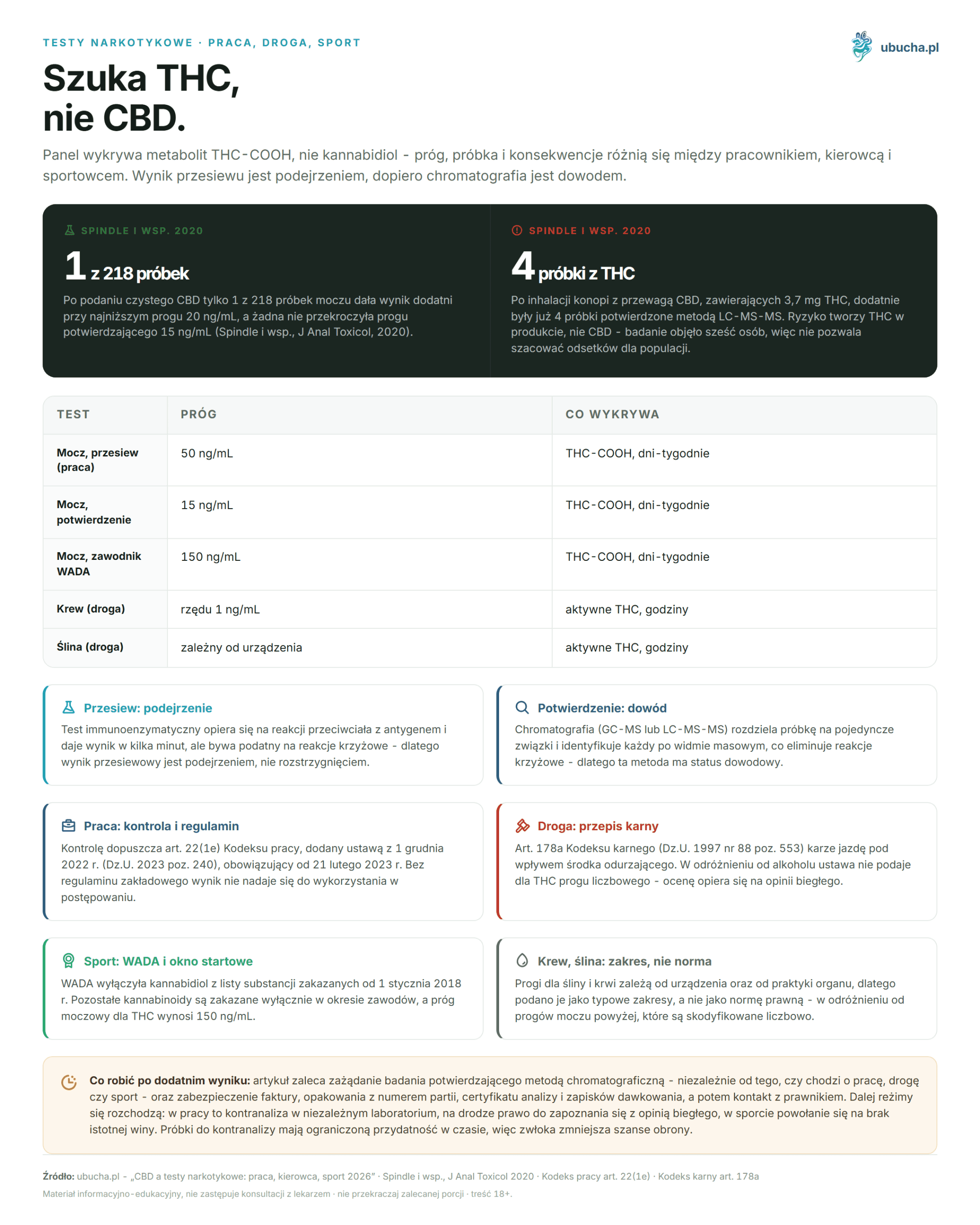
- The cannabis panel detects the THC metabolite, THC-COOH, not cannabidiol. In US federal guidelines, the screening threshold is 50 ng/mL, and the confirmatory threshold is 15 ng/mL (Mandatory Guidelines, SAMHSA).
- After administration of pure CBD, only 1 of 218 urine samples tested positive at the lowest threshold of 20 ng/mL, and none exceeded the confirmatory threshold of 15 ng/mL (Spindle et al., J Anal Toxicol, 2020).
- After inhaling cannabis with predominant CBD containing 3.7 mg THC, four samples were positive confirmed by LC-MS-MS. The risk comes from THC in the product, not CBD.
- Employee testing for substances acting similarly to alcohol is permitted under Article 22(1e) of the Labor Code, added by the December 1, 2022 act (Dz.U. 2023 poz. 240), effective from February 21, 2023.
- WADA excluded cannabidiol from the banned substances list from January 1, 2018. Other cannabinoids are banned only during competition periods, and the urine threshold for THC is 150 ng/mL.
What exactly do standard drug tests look for?
The cannabis panel does not look for cannabidiol. The target substance is the THC metabolite, 11-nor-9-carboxy-delta-9-tetrahydrocannabinol acid, abbreviated THC-COOH. In the US Mandatory Guidelines for Federal Workplace Drug Testing Programs, referenced by most accredited labs, the screening threshold is 50 ng/mL, and the confirmatory test threshold is 15 ng/mL. This asymmetry is intentional: antibodies react with many compounds formed after cannabis use, so the screening threshold must be higher to catch the target analyte above its own threshold by the confirmatory method.
Why the metabolite and not THC itself? Active THC circulates in blood briefly, on the order of hours. Its inactive metabolite is lipophilic, accumulates in fat tissue, and is released gradually, remaining detectable much longer. For the lab, this is a convenient exposure marker, but for the tested person, it means something non-obvious: a positive urine result indicates past contact with THC, not the state at the time of sampling.
A typical panel includes five or ten substances. The five-panel variant includes amphetamines, cocaine, opiates, phencyclidine, and cannabinoids. The ten-panel adds benzodiazepines, barbiturates, methadone, and sometimes substances specified by the test requester. Cannabidiol is not on any of these lists as a target substance and has no reason to be, as it does not cause intoxication.
Can CBD indirectly affect the result? Yes, but only through THC content in the product. A product with certified zero THC has nothing to metabolize into THC-COOH. Full-spectrum oil, where THC is below the legal threshold, does. This distinction recurs several times in this text because it practically determines the entire answer to the title question.
The practical consequence is worth setting immediately before discussing thresholds and procedures. The question “will CBD show up in a test” is poorly posed and thus hard to find a clear answer online. The well-posed question is: how much THC does the product I use contain, and can I document it? The first concerns the substance, the second concerns the specific bottle on your shelf, and only the second can be resolved.
What biological samples are used in cannabinoid tests?
The choice of material determines what we actually measure. Urine is cheapest and offers the longest detection window but shows the inactive metabolite, i.e., the past. Blood and saliva have short windows and detect active THC, i.e., the present. Hair reaches furthest back but is costly and rarely used in Poland, mainly in special proceedings.
The table below organizes thresholds and windows. Urine values come from federal guidelines and anti-doping regulations; saliva and blood thresholds depend on the device and authority practice, so they are given as typical ranges, not legal norms.
| Test Type | Threshold | Detection Window | What It Detects |
|---|---|---|---|
| Urine, screening test (work) | 50 ng/mL | days to weeks | THC-COOH |
| Urine, confirmatory LC-MS-MS or GC-MS | 15 ng/mL | days to weeks | THC-COOH |
| Urine, athlete under WADA rules | 150 ng/mL | days to weeks | THC-COOH |
| Blood (road proceedings) | method-dependent, about 1 ng/mL | hours | active THC |
| Saliva (roadside screening) | device-dependent | hours | active THC |
| Hair | very low, in pg/mg | months | THC-COOH and THC |
The sample type chosen by the employer or authority reveals much about the test’s intent. Urine answers whether someone has had contact with the substance at all. Saliva and blood answer whether the person is currently under its influence. These are two different questions, and only the second directly relates to the ability to work or drive. How long cannabinoids remain detectable is detailed in a separate guide on CBD detection time in urine.
How does CBD differ from THC from the test perspective?
Both molecules have the same molecular formula, C21H30O2, but different spatial structures. This difference determines everything. THC binds strongly to the CB1 receptor in the brain and causes psychoactive effects. Cannabidiol acts differently on this receptor and does not cause intoxication, as confirmed by psychomotor performance studies, which we revisit in the drivers section.
For the test, the important point is different: cannabidiol does not convert in the human body into THC or its metabolite. This point has caused misunderstandings worth clarifying. The work of Merrick et al. (Cannabis Cannabinoid Res, 2016) showed that CBD converts to psychoactive compounds in artificial gastric juice, i.e., in lab conditions. Hence the theory of conversion in the stomach. The response by Grotenhermen, Russo, and Zuardi (2017) compared this with human studies where even high oral doses of CBD did not produce THC-like effects. The practical conclusion: the in vitro model did not translate to the organism.
The problem arises only when the product contains THC. The three basic extract types differ precisely in this. Isolate is almost pure cannabidiol without other cannabinoids. Broad spectrum retains cannabinoid and terpene profiles but undergoes an additional THC removal step. Full spectrum retains everything, including trace THC below the legal threshold.
For a person subject to testing, only one division criterion is useful: whether the product contains THC or not. Other differences, though real for the product’s effect, do not change the test result. What each extract type offers outside research context is explained in the guide to types of CBD oils.
What does the Polish 0.3% THC threshold mean and what does it apply to?
This threshold appears in every conversation about the legality of hemp products and is almost always described imprecisely. The definition is national and specific. Fiber hemp are Cannabis sativa L. plants in which the sum of delta-9-THC and tetrahydrocannabinolic acid (THCA) in flowering or fruiting tops, from which resin has not been removed, does not exceed 0.3% dry weight. The sum is rounded to one decimal place. The basis is Article 4 point 5 of the Act of July 29, 2005 on counteracting drug addiction (consolidated text Dz.U. 2023 pos. 1939), as amended by the March 24, 2022 act (Dz.U. 2022 pos. 763), effective May 7, 2022.
Two details have measurable lab consequences. First: the sum of delta-9-THC and THCA counts, not delta-9-THC alone. THCA is the form in fresh plant material and converts to delta-9-THC under heat. Measuring delta-9-THC alone gives a lower result than the law’s basis. Second: rounding to one decimal place determines borderline results.
It is also important what this threshold does not apply to. The definition refers to plant material, not finished products, so THC content in a specific oil is read from the batch’s certificate of analysis, not the law. For hemp seed food, separate limits expressed in mg/kg apply, which is a different regulation.
It is also worth clarifying the relation to EU law, as it is sometimes presented inversely. The national threshold corresponds to the EU threshold in Regulation (EU) 2021/2115 but does not derive from it. These are two separate regulations with the same numeric value. The earlier EU threshold was 0.2% from Regulation 1307/2013, repealed January 1, 2023. The national 0.20% threshold applied until May 6, 2022. Cannabidiol itself is not listed in any controlled substances lists.
Where does the 50 ng/mL threshold come from and what does it mean in practice?
The value comes from US federal guidelines for workplace drug testing programs and has become a reference point in labs worldwide, including Poland. It balances sensitivity and specificity. A lower threshold would catch passive or very distant exposure. A higher threshold would let occasional users pass. Fifty nanograms per milliliter is the point where these two errors balance at an acceptable cost.
Note what this threshold does not measure. It does not measure impairment. It does not measure dose. It does not measure time since exposure. It only indicates that the metabolite concentration exceeded a set limit, which the lab considers requiring confirmation. All further conclusions, including HR decisions, are interpretations imposed on this single number.
Some employers and sectors use stricter thresholds citing internal safety policies. This practice fits within guidelines if the procedure is described in regulations and the tested person is informed. If you work in a sector with such rules, find the threshold value in workplace documents, not international standards.
Individual variability adds complexity. Metabolite elimination depends on liver enzyme activity, body mass, fat tissue proportion, and hydration. Two people taking the same dose may fall on different sides of the threshold. This is one reason a single screening result should not be the basis for decisions.
This variability also means it is impossible to calculate in advance after how many days from stopping the product the result will definitely be negative. Any table promising such precision sells false certainty. The honest answer: the range is wide, depending on usage pattern and physiology, and the only way to be sure is to test yourself before the official test. Commercial labs offer such tests for a fee, which can be a sensible precaution in controlled sectors.
What is the difference between screening and confirmatory tests?
The screening test, immunoenzymatic, relies on antibody-antigen reaction, gives results in minutes, and aims to quickly separate clean from potentially positive samples. Its weakness is cross-reactivity, where antibodies recognize compounds structurally similar to the target. Thus, a screening result is a suspicion, not a conclusion.
The confirmatory method works differently. Gas or liquid chromatography coupled with mass spectrometry separates the sample into individual compounds and identifies each by mass spectrum, like a fingerprint. This practically eliminates cross-reactions and gives the method evidentiary status. The tandem LC-MS-MS variant lowers detection limits further and is standard for blood and saliva.
The procedure requires every positive screening sample to be confirmed chromatographically before reporting a positive result. This can surprise tested persons: the final result may be negative despite a positive screen if the actual concentration lies between confirmatory and screening thresholds. A positive strip alone should not trigger HR or legal decisions.
This directly affects your rights. If the employer draws conclusions solely from an on-site test, you have grounds to demand confirmation by a reference method. Bedside tests without confirmation are organizational tools, not evidence, and should be treated as such in discussions with supervisors.
Another credibility element is sample chain of custody, documented in procedures. It records who collected the sample, under what conditions, who secured it, to whom and when it was transferred. Any break in this chain undermines the result regardless of method quality, as it becomes uncertain the sample belongs to the tested person. For you, this means documentation is as important as the result, and you should request a copy at the testing stage, not only if a dispute arises.
Broad spectrum or full spectrum: which to choose for testing?
The answer for tested persons is clear and follows pharmacokinetics. Broad spectrum undergoes an additional THC removal step, reducing content below lab detection limits. Full spectrum retains natural cannabinoid proportions with trace THC. Since the test detects THC metabolite, not cannabidiol, the presence or absence of THC in the bottle determines risk.
Full spectrum supporters cite the entourage effect hypothesis, that cannabinoids and terpenes act more effectively together than alone. This hypothesis is under study and cannot be rejected or confirmed today. Even if fully true, for professional drivers or athletes, the calculation remains: possible improved effect does not compensate for the risk of losing a license or disqualification.
A zero THC declaration is valuable only if backed by a certificate of analysis from an independent lab for the specific batch. The document should state analysis date, lab name and accreditation number, method used, and detection and quantification limits. A result described as undetected makes sense only compared to the limit below which the lab sees nothing.
Warning signs are easy to spot. No certificate on the producer’s site. Certificate without lab name. Certificate issued for the product instead of the batch. Analysis older than a year. No accreditation number. Each point alone is a reason for caution; together, they justify seeking another supplier. The difference between isolate and distillate, when going deeper into extract classification, is explained in the distillate vs isolate comparison.
What did the Spindle study really show about positive result risk?
This study is cited more often than read in Polish internet, usually with numbers not in it. It’s worth stating what was actually measured. The team of Spindle et al. published in Journal of Analytical Toxicology in 2020 the pharmacokinetic profile of cannabinoids in urine after CBD administration. Six healthy adults participated in a crossover design, with urine collected before and for five days after dosing.
There were four conditions: 100 mg oral cannabidiol, 100 mg vaporized cannabidiol, vaporized cannabis with predominant CBD containing 100 mg cannabidiol and 3.7 mg THC, and placebo. Samples were screened at 20, 50, and 100 ng/mL thresholds and confirmed by LC-MS-MS at 15 ng/mL.
The result for pure cannabidiol was clear. Of 218 samples, one screened positive at the lowest 20 ng/mL threshold. None exceeded the confirmatory threshold. Authors state plainly: a single dose of pure CBD will not cause a positive urine test at federal workplace thresholds.
The study also answered whether cannabidiol appears in urine at all. It does, at concentrations much higher than THC-COOH thresholds. After oral dosing, mean peak concentration was 776 ng/mL, after vaporization 261 ng/mL, peaking at five hours and within the first hour respectively. These numbers do not affect test results, as no panel detects cannabidiol unless specifically ordered.
The picture changed after inhaling cannabis containing THC. Nine samples tested positive at 20 ng/mL, including two at 50 ng/mL, and four were confirmed above 15 ng/mL. This is the full warning: the risk comes from THC content, not cannabidiol, and the study involved six people, so it cannot estimate population percentages. Authors conclude with a call for accurate THC labeling in hemp products.
What does the Labor Code say about testing for intoxicants?
The basis was introduced by the December 1, 2022 act amending the Labor Code and other laws (Dz.U. 2023 pos. 240), effective February 21, 2023. It added Articles 22(1c) to 22(1h). Sobriety testing is covered by 22(1c), and testing for substances acting like alcohol by 22(1e). Employers may introduce testing if necessary to protect life and health of employees or others, or property.
The provision alone is insufficient. Workplace regulations must specify the employee group tested, test procedure, measurement method, documentation of results, and appeal procedure. Lack or noncompliance of such documents means testing has no basis and results cannot be used in proceedings.
The list of substances covered is set by the Minister of Health’s February 16, 2023 regulation (Dz.U. 2023 pos. 317), including cannabinoids alongside opioids, amphetamines, and cocaine. The regulation also specifies technical requirements and sampling conditions.
Practice shows testing is most common among machine operators, professional drivers, train drivers, energy and security workers. In offices, it is rarer due to difficulty proving necessity for life protection. Remember this sentence that saves many conversations: informing your supervisor about CBD use does not exempt you from sobriety or change test results. Documentation of the product protects you, not declarations.
Can I drive a car while using CBD?
From a psychomotor performance perspective, data are reassuring. The McCartney et al. (2022) study involved 17 healthy adults in a crossover double-blind design receiving placebo or 15, 300, or 1500 mg oral cannabidiol. Performance was measured in a simulator, with the main parameter being standard deviation of lane position. None of the doses impaired cognitive functions or caused intoxication feelings, and analysis confirmed CBD did not worsen driving beyond an accepted margin. A similar conclusion for inhaled form came from Arkell et al. published in JAMA in 2020.
Legally, the situation is stricter. Article 178a of the Penal Code (Dz.U. 1997 no. 88 pos. 553) punishes driving a motor vehicle while intoxicated or under influence of an intoxicant. Unlike alcohol, the law does not specify a numeric THC threshold, so assessment relies on expert opinion and case law. This construction is criticized but in force.
The roadside procedure is usually the same. Police perform a saliva screening test. A positive result leads to blood sampling at a medical facility and confirmatory testing. Blood shows active THC, which remains for hours, not weeks, distinguishing current influence from past exposure.
Practical advice is simple. Use products with certified zero THC. Keep the invoice and packaging with batch number. Do not test a new product immediately before driving; allow a day or two to observe reactions. Do not combine with alcohol. The topic is expanded in the article Can you drive after taking CBD oil?.
Why did WADA exclude cannabidiol from the banned list?
Since January 1, 2018, cannabidiol is not on the World Anti-Doping Agency’s banned substances list. The change was based on assessment that the substance does not meet doping criteria: it does not improve sports performance nor endanger athlete health. For athletes seeking recovery support, this was a real but narrow opening.
The exclusion applies only to cannabidiol. Other cannabinoids, natural and synthetic, remain banned, but only during competition periods. For THC, the urine threshold is 150 ng/mL, three times higher than the standard workplace threshold. Raising this threshold was a conscious decision to avoid penalizing athletes for exposure unrelated to competition.
The 150 ng/mL threshold has its history explaining its level. For years, the value was 15 ng/mL, ten times lower, and under that setting, sanctions affected athletes exposed weeks before competition. Raising the threshold in 2013 separated use potentially affecting competition from residual exposure. The same logic underlies limiting the ban to competition periods and explains why anti-doping rules are milder here than workplace regulations.
The higher threshold does not remove the problem, only shifts it. The mechanism remains the same as for employees: THC content in the product determines risk, and with regular use, the metabolite accumulates. The US anti-doping agency recommends athletes avoid full-spectrum products and choose only those with confirmed zero THC.
For amateur athletes, a certificate of analysis from an accredited lab for the specific batch is sufficient protection. Professional athletes competing under anti-doping rules should use additional certification programs for sports products, testing each batch for banned substances contamination. The higher the competition level, the stricter the selection criteria should be.
How many CBD products have labels matching actual content?
The reference point remains the Bonn-Miller et al. analysis published in JAMA in 2017. The team purchased and tested 84 CBD products from 31 companies selling online in the US. Products were considered label-compliant if content was within a narrow margin around the declaration. Only 30.95% met this criterion, less than one-third. The rest deviated either way: 42.85% contained more cannabidiol than labeled, and 26.19% less.
For tested persons, the second number is more important. THC was detected in 18 of 84 products, i.e., 21.43%, at concentrations up to 6.43 mg/mL. Note the unit, often misread as percent, which changes scale by orders of magnitude. Some of these products declared no THC or only traces.
It is fair to note the study’s scope. It covered the US online market in 2017, before certification requirements were tightened on both sides of the Atlantic. Applying these percentages directly to the Polish market in 2026 would be an abuse, and any circulating numbers about today’s non-compliant product share should be treated cautiously unless backed by specific studies.
The transferable conclusion is different and practically valuable. The producer’s declaration is not evidence. Evidence is the test result of a specific batch by a lab independent of the producer. This principle remains the only sensible protection for persons whose test results may cost them a job or competition start.
How to read a CBD product’s certificate of analysis?
A certificate of analysis is a document issued by a lab confirming the actual composition of a specific product batch. A reliable certificate can be reviewed in two minutes if you know what to look for, and its deficiencies are equally visible. ISO/IEC 17025 accreditation is an international confirmation of the lab’s technical competence and is the starting point for document evaluation.
The content you should find consists of six elements. Product identification with batch number and production and analysis dates. Lab identification with accreditation number. Description of analytical method with detection and quantification limits. Table of cannabinoid results. Terpene profile. Safety tests, i.e., pesticides, heavy metals, microbiology, and mycotoxins.
The order of checking matters. Start with the analysis date, as a document older than a year refers to a batch you no longer buy. Then compare the batch number with the packaging you hold; mismatch means the certificate does not apply to your product. Only then proceed to results.
For THC results, look for notes on non-detection or values below quantification limits, always compared to the stated limit. For cannabidiol, compare the result with the label declaration; deviations within a few percent are normal production variance, larger ones indicate poor standardization. Avoid certificates issued by labs owned by the producer, unsigned documents, or those with handwritten corrections.
Understand the difference between detection and quantification limits, often used interchangeably but meaning different things. Detection limit is the lowest concentration at which the method detects the compound. Quantification limit is higher and defines the level from which the result can be reported numerically with acceptable uncertainty. A note of non-detection refers to the first, so without stating that limit, it says nothing. A certificate stating non-detection without specifying below what is worthless as evidence and should be treated accordingly when choosing a product.
What to do if the test is positive after using CBD?
A positive result does not end the matter, and the first hours matter. Demand a confirmatory chromatographic test, regardless of work, road, or sports context. Secure documentation: purchase invoice, packaging with batch number, certificate of analysis, and your dosing notes. Contact a lawyer specialized in the relevant field. Samples secured for counter-analysis have limited shelf life, so delay reduces defense chances.
In employment, you have the right to counter-analysis in an independent lab, access to test documentation, appeal against refusal to allow work, and the right to speak in disciplinary proceedings. If the employer violated the procedure described in regulations, e.g., skipped confirmation or broke chain of custody, the result loses evidentiary value, which is your strongest defense point.
If the dispute concerns the procedure, not the result, an out-of-court path is to report to the National Labor Inspectorate. The Inspectorate examines compliance of workplace practice with laws, including whether regulations exist and comply. Reporting does not replace court proceedings or decide your individual claim but can be effective where the problem is systemic and affects the whole staff, not one person.
In road proceedings, request two blood samples: one for analysis and one secured for counter-analysis. You have the right to review and challenge the expert opinion. Documenting the THC source may be important for intent assessment but is not an automatic defense line; the decision depends on concentration and circumstances.
In sports, therapeutic use exemption applies to banned substances, so not needed for cannabidiol alone. For a positive THC result, the athlete may claim no significant fault, with product documentation and THC-free certificate as main evidence. Sanctions may be mitigated but require demonstrating care in product choice.
What does the checklist for tested persons look like?
The list below organizes everything from previous sections in the order these actions make sense. It does not replace legal consultation but removes most situations where a positive result comes from ignorance, not actual THC use.
- Choose products with confirmed zero THC instead of full-spectrum.
- Check the certificate of analysis from an accredited lab for the batch you buy.
- Ensure the analysis is not older than a year and the batch number matches the packaging.
- If competing professionally, choose products certified for sports use.
- Keep the purchase invoice with date and packaging with label and batch number.
- Download the certificate of analysis and save it in two places independent of the seller.
- Keep a simple dosing log with date, time, and amount.
- If working in a controlled sector, check workplace regulations and threshold.
- Do not assume informing your supervisor about supplementation replaces product documentation.
- Immediately request confirmatory chromatographic testing if positive.
- Contact a lawyer within two days of receiving the result.
- Do not hand over original documents; provide copies and keep delivery confirmation.
One note on the list’s end. Points five to seven may seem excessive until needed, then they become the only material you have. Doing them takes a few minutes per purchase and is the entire investment.
What to remember about CBD and drug tests?
The conclusion fits in one sentence: tests do not look for cannabidiol but the THC metabolite, so risk depends on THC content in the product, not on CBD use itself. The 2020 study by Spindle et al. showed this directly, comparing pure cannabidiol with cannabis containing 3.7 mg THC in the same experimental setup.
Thresholds differ by context and are worth knowing before they matter. Employees are subject to 50 ng/mL screening and 15 ng/mL confirmation. Athletes under anti-doping rules have 150 ng/mL but only during competition. Drivers are not protected by any statutory threshold, as Polish law uses assessment of state, not numbers, in Article 178a of the Penal Code.
In labor law, the reference is Article 22(1e) of the Labor Code effective February 21, 2023, and the substance list and technical requirements are set by the Minister of Health’s February 16, 2023 regulation. Testing without workplace regulations has no basis, and results cannot be used in proceedings.
Also set aside some unfounded claims circulating. Cannabidiol does not convert to THC in the human body, despite conversion in artificial gastric juice. The Bonn-Miller analysis concerns the 2017 US market and does not describe today’s Poland. Finally, no available study allows stating the percentage of people whose full-spectrum product yields a positive result, as samples were too small.
Frequently Asked Questions
Does a standard drug test detect CBD?
No. The cannabis panel targets the THC metabolite, THC-COOH, with a screening threshold of 50 ng/mL and a confirmatory threshold of 15 ng/mL in urine. Cannabidiol is not on the list of target substances. The risk of a positive result comes solely from THC present in the product.
What is the difference between a screening test and a confirmatory test?
The screening test is antibody-based, provides results in minutes, and can be prone to cross-reactions. The confirmatory method separates the sample and identifies compounds by mass spectrum, thus having evidentiary status. A positive screening result always requires confirmation.
Can I drive a car while using CBD?
The 2022 study by McCartney et al. showed no impairment in driving or cognitive functions after oral doses of 15, 300, and 1500 mg cannabidiol. Legally, however, the risk is created by THC, as Article 178a of the Penal Code punishes driving under the influence of an intoxicant without specifying a numeric threshold.
What does the Labor Code say about testing for intoxicants?
Testing is permitted under Article 22(1e) of the Labor Code, added by the December 1, 2022 act and effective from February 21, 2023, if necessary to protect life, health, or property. The employer must describe the procedure in workplace regulations; otherwise, the result has no evidentiary value.
Is cannabidiol banned for athletes?
No. Cannabidiol has been excluded from the World Anti-Doping Agency’s list of banned substances since January 1, 2018. Other cannabinoids are banned only during competition periods, and the urine threshold for THC is 150 ng/mL, three times higher than the standard workplace threshold.
What is the risk of a positive result from a full-spectrum product?
In the 2020 study by Spindle et al., after inhaling cannabis containing 3.7 mg THC, nine urine samples tested positive at the 20 ng/mL threshold, and four were confirmed above 15 ng/mL. After pure cannabidiol, one of 218 samples was positive, and none passed confirmation.
How many CBD products have labels matching their content?
In the 2017 analysis by Bonn-Miller et al., covering 84 products from the US online market, 30.95% matched their label. THC was detected in 18 products, i.e., 21.43%, at concentrations up to 6.43 mg/mL. Hence the requirement to check the certificate for a specific batch.
What to do if the test is positive after using CBD?
Request a confirmatory chromatographic test, secure the invoice, packaging with batch number, and certificate of analysis, then contact a lawyer. Act quickly, as samples secured for counter-analysis have limited usability over time, and delay reduces defense chances.
If you are looking for products with documented composition, products with certificates of analysis can be found in the oils category.
This article is informational and educational and does not constitute legal advice. The legal status described applies as of publication date: cannabis regulations may change. Consult a lawyer or current legal acts before making decisions.
Author: Michał Waluk · Published: 2026-05-11 · Updated: 2026-08-10