
Caffeine Pre-Workout: What the Position Really Says About the Dose of 2 mg/kg
Caffeine before training: what the ISSN position really says about the dose of 2 mg/kg, what the meta-analyses of strength measured, and what thresholds EFSA provided in its 2015 opinion.
The title of this article repeats a number that circulates in descriptions of pre-workouts and guides: 2 milligrams per kilogram of body weight is said to be the threshold at which caffeine begins to affect performance. The number comes from the position of the International Society of Sports Nutrition, but in the original, it is stated in a different mode than it is usually quoted. Below, we break down this statement into parts: what exactly the authors of the position wrote, what the meta-analyses they refer to measured, what amounts were considered safe by the European Food Safety Authority, and what is not mentioned in these documents at all. We also note that some numbers present in the previous version of this text had no backing in the works they referred to, so each numerical statement stands here today along with the study population and the measured endpoint. None of these numbers is a recommendation for how much caffeine to take.
KEY INFORMATION
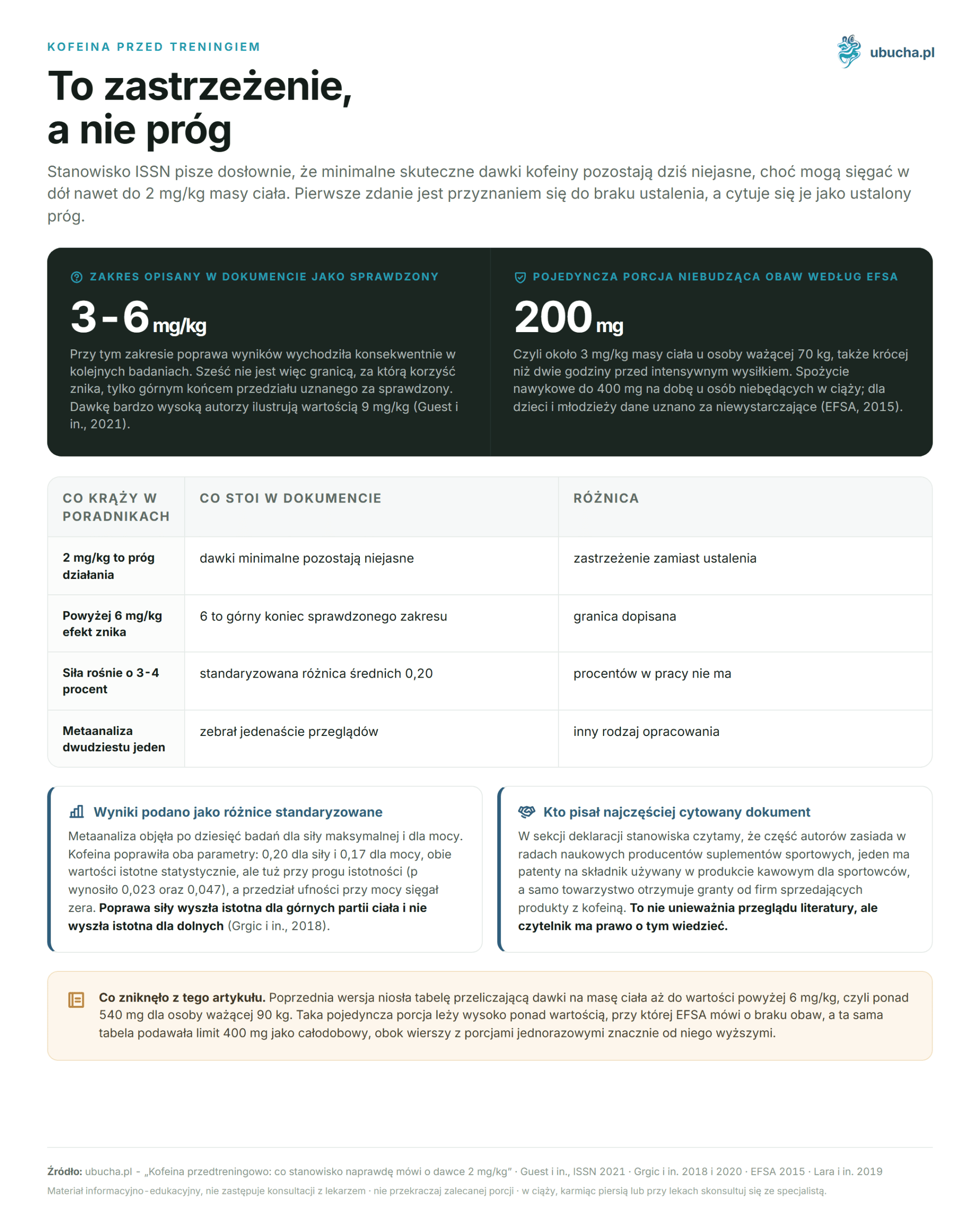
• The ISSN position states that the minimum effective doses of caffeine remain undetermined and may go down to 2 mg/kg of body weight. This is a caveat, not a threshold.
• The range of 3-6 mg/kg is described in the same document as the one at which performance improvement was consistently observed. As an example of a very high dose, the authors cite 9 mg/kg, not 6.
• The meta-analysis by Grgic from 2018 included ten studies for strength and ten for power and reports standardized mean differences, not percentages.
• EFSA in its 2015 opinion considered a single dose of up to 200 mg to be safe for adults, also shortly before intense exercise.
• The authors of the ISSN position declare numerous ties to supplement manufacturers, and the society itself accepts grants from companies selling caffeine products.
Does the ISSN position say that the minimum effective dose is 2 mg/kg?
No in that wording. The International Society of Sports Nutrition’s position on caffeine and sports performance literally states that the minimum effective doses of caffeine remain unclear today, although they may go down to 2 mg/kg of body weight (Guest et al., Journal of the International Society of Sports Nutrition, 2021). The difference between these two statements is fundamental. The first is an establishment, the second is an admission of a lack of establishment. The title of this article, inherited from an earlier version of the text, states the first.
The second half of the title diverges from the document even more clearly. The range of 3-6 mg/kg is described in the position as the one at which performance improvement was consistently observed in subsequent studies. Six is therefore not a boundary beyond which benefit disappears, but the upper end of the range that the authors considered verified. The very high dose, associated with frequent side effects and unnecessary to achieve an effect, is illustrated by the value of 9 mg/kg.
It is worth noting right away where the belief that a solid source stands under the title comes from. The previous version of this entry provided a numerical document reference that does not exist in the Crossref registry. The true number differs by one digit and leads to the document described above. The publisher’s address in both cases corresponded to the same page of the same size, so the mere fact that the link opened confirmed nothing.
How does caffeine affect the body during exercise?
The best-described mechanism is the blocking of adenosine receptors. Adenosine accumulates in the brain during wakefulness and exertion, and by binding to its receptors, it induces drowsiness and a sense of fatigue. Caffeine occupies the same binding sites, not inducing the effect of adenosine, which delays the feeling of exhaustion. A review of this pathway and the factors determining the prevalence of caffeine consumption was published by Fredholm’s team in Pharmacological Reviews (Fredholm et al., 1999).
The ISSN position lists several other possible pathways of action alongside this, but cautiously: individual differences in response to caffeine are linked to genetic variants related to its metabolism and to physical and psychological reactions, not to one simple mechanism. The same document notes that caffeine’s advantage is most consistently and strongly observed in aerobic endurance efforts, and the magnitude of the effect varies between individuals.
The previous version of this text described this mechanism with much more certainty, adding the release of fatty acids and glycogen as a proven pathway for performance improvement. This is a hypothesis present in the literature, but it is not what the ISSN position bases its conclusions on. Therefore, we leave the description to what the documents actually state.
What exactly was measured in the meta-analyses on strength and power?
The meta-analysis by Grgic searched eight databases and qualified ten studies for maximum strength measured by one-repetition maximum test and ten studies for power measured by jump tests. Caffeine improved both parameters, and the results were reported as standardized mean differences: 0.20 for strength and 0.17 for power, both statistically significant but just at the threshold (p was 0.023 and 0.047) and with a confidence interval reaching zero for power (Grgic et al., Journal of the International Society of Sports Nutrition, 2018).
Subgroup analysis provided a more interesting resolution than the average itself. Strength improvement was significant for upper body and not significant for lower body. This is the only sentence about the difference between body parts that this work carries. The previous version of the entry mentioned a meta-analysis of twenty-one randomized studies in another journal, about a strength increase of 3-4 percent and repetitions of 5-8 percent. None of these numbers are in the work, and the number provided led to an article about the incidence of hepatocellular carcinoma in California.
The number twenty-one comes from another work by the same author: a umbrella review that gathered eleven reviews containing a total of twenty-one meta-analyses (Grgic et al., British Journal of Sports Medicine, 2020). The quality of evidence was generally rated as moderate, sometimes low to very low, and the authors noted that most primary studies were conducted on young men.
What amounts of caffeine did EFSA consider safe?
The European Food Safety Authority issued a scientific opinion on caffeine safety in 2015 at the request of the European Commission (EFSA, EFSA Journal, 2015). The panel stated that single doses of caffeine up to 200 mg, or about 3 mg/kg of body weight for a person weighing 70 kg, do not raise safety concerns. The same amount does not raise concerns even when consumed less than two hours before intense physical exertion in normal environmental conditions.
For habitual intake, the panel stated 400 mg per day for adults who are not pregnant, and 200 mg per day for pregnant women, with the latter value concerning fetal safety. For breastfeeding women, single doses and habitual intake up to 200 mg were considered safe for the child. For children and adolescents, available information was deemed insufficient to derive safe caffeine intake at all.
These thresholds describe a ceiling, not a dose to be measured. It is worth comparing them with what has disappeared from this article: the previous version carried a table converting doses to body weight up to values above 6 mg/kg, which is over 540 mg for a person weighing 90 kg. Such a single dose lies well above the value at which EFSA speaks of no concerns, and the same table provided a limit of 400 mg in a side row, as a daily total, alongside rows with single doses significantly higher than that.
Does a break from caffeine before a competition restore its effect?
There is no recommendation for this in the ISSN position, nor is there a number of days. The previous version of this entry attributed a recommendation of seven days of abstinence before competitions to this document and a range of three to seven days in the questions section. The full text of the position does not contain any of these records. However, it does contain a discussion that leads in the opposite direction.
The authors cite a study in which 3 mg/kg of caffeine improved results in twelve trained cyclists regardless of whether individuals who regularly consume caffeine were previously subjected to a four-day break. They also cite another study in which six regular caffeine consumers achieved endurance increases regardless of whether the break lasted zero, two, or four days. The conclusion of those authors was that the improvement at 6 mg/kg is not related to prior habituation to caffeine in recreational athletes.
Separately, it is worth knowing about a study that measured the rate of tolerance buildup to the performance effect itself. Eleven active individuals took 3 mg/kg of caffeine daily for twenty consecutive days or placebo in a crossover design. The advantage of caffeine over placebo in peak power in a progressive test was maintained for the first fifteen days and only then weakened (Lara et al., PLoS One, 2019). More about the phenomenon of tolerance itself and what was not measured about breaks is discussed in a separate text on caffeine tolerance and reset.
Who can caffeine before training harm?
The first group arises directly from the EFSA opinion: pregnant women have a threshold twice as low as other adults, and for children and adolescents, safe intake could not be derived from the available data. It is worth noting the arithmetic: 200 mg is simultaneously the upper single value for adults and the entire daily ceiling in pregnancy, so in pregnancy, these two numbers converge to one.
The second group is individuals training in the evening. The ISSN position links differences in response to caffeine, including undesirable effects on sleep and feelings of anxiety, to genetic variability concerning caffeine metabolism. This means that the same dose at the same time for two individuals will yield a different duration of caffeine presence in the body, and the answer to the question about one’s own variant cannot be read from the supplement label.
The third issue is the conflict of interest in the document that is most often cited on this topic. In the declaration section of the ISSN position, we read that some authors sit on scientific boards of sports supplement manufacturers, one has patents on an ingredient used in a coffee product for athletes, and the society itself receives grants from companies selling caffeine products. This does not invalidate the literature review, but the reader has the right to know this before considering the document unbiased. Separately, we discuss the combination of caffeine with L-theanine in a text about the L-theanine and caffeine stack.
Frequently Asked Questions
Is 2 mg/kg a confirmed threshold for caffeine’s effect?
No. The ISSN position from 2021 states that the minimum effective doses of caffeine remain unclear and may go down to 2 mg/kg of body weight. This is an author’s caveat, not an established threshold. The range described in the same document as verified is 3-6 mg/kg.
Does caffeine stop helping above 6 mg/kg?
The ISSN position does not set a boundary at six. Six is the upper end of the range at which performance improvement was consistently observed. As an example of a very high dose, associated with frequent side effects and unnecessary to achieve an effect, the authors cite 9 mg/kg.
How much caffeine did EFSA consider safe?
The EFSA opinion from 2015 states a single dose of up to 200 mg for adults, also less than two hours before intense exercise, and habitual intake of up to 400 mg per day for non-pregnant individuals. For pregnant and breastfeeding women, the value is 200 mg per day.
By how much does caffeine improve strength according to meta-analyses?
The meta-analysis by Grgic from 2018 included ten studies for strength and ten for power and reports standardized mean differences of 0.20 and 0.17, both statistically significant but just at the threshold. Strength improvement was significant for upper body and not significant for lower body. Percentages are not provided in this work.
Does a break from caffeine before competitions enhance its effect?
The ISSN position does not contain such a recommendation or a number of days. It cites two studies where a break lasting up to four days did not change performance improvement in individuals who regularly consume caffeine. Data on longer breaks is not provided in this document.
Caffeine in the store at Bucha is sold today exclusively in the form of caffeine pouches. We do not offer capsules or caffeine powder, so no number from this article translates to our assortment (as of August 16, 2026). Separately, we described the caffeine pouches and what is known about them.
This article is for informational and educational purposes and does not constitute medical advice. Before starting supplementation, consult a doctor, especially if you are taking medications regularly, are pregnant or breastfeeding, or have chronic illnesses.
Author: Michał Waluk · Published: 2026-07-31 · Updated: 2026-08-16