
L-glutamine: for the intestines and recovery after training (table)
L-glutamine for the intestines and recovery after training: what studies in humans have really shown, where evidence is lacking, and who should be cautious.
Glutamine is the most abundant amino acid in the human body and one of the most poorly understood supplements. In skeletal muscle, it constitutes 50 to 60 percent of the pool of free amino acids, and about 80 percent of the total body reserve lies in the muscles (Cruzat et al., Nutrients 2018). The body can produce it on its own, which is why it is called a conditionally essential amino acid: it becomes essential only when demand exceeds synthesis. Supplement marketing promises everything at once, from a sealed gut to muscle mass gain. This article examines which of these promises are backed by human studies and which are based on transferring conclusions from the test tube to the gym.
KEY INFORMATION
• Glutamine constitutes 50-60% of free amino acids in skeletal muscle and about 20% of the pool of free amino acids in plasma (Cruzat et al., Nutrients 2018).
• The strongest evidence in humans comes from one study: 106 people with irritable bowel syndrome after an infection, eight weeks, normalized intestinal permeability (Zhou et al., Gut 2019).
• There is no convincing evidence in humans for strength and muscle mass gain.
• The authors of a 2018 review state that it is still unknown whether the administration of glutamine should depend on its concentration in the blood.
• In liver disease, kidney disease, and cancer, the decision is made by the doctor, not the supplement label.
Why does the gut use glutamine faster than other tissues?
Because for enterocytes, the cells lining the small intestine, glutamine is a more important fuel than glucose. The authors of the Cruzat review state this directly: for the gut, glutamine is quantitatively more significant as an energy substrate than sugar. The intestinal epithelium divides rapidly and must obtain this energy from somewhere.
The pathway itself is described in detail. Carbon from glutamine is processed in the enterocyte through two routes: via delta-1-pyrroline-5-carboxylate or by conversion to alpha-ketoglutarate, which enters the Krebs cycle. Glutamine is taken up simultaneously from two sides of the cell, from the food content through the apical membrane and from the bloodstream through the basolateral membrane. This is why the form of administration matters, and the oral route is more physiological in this case than intravenous (Cruzat et al., Nutrients 2018).
It is worth drawing a line here, as popular texts do not. Just because glutamine fuels the enterocyte does not mean that an oral supplement seals the gut in a healthy person. The Cruzat review does not address tight junctions or “leaky gut” as a unit at all. It describes metabolism, not clinical outcomes. The claim of sealing requires a different kind of evidence, and there is indeed one such piece of evidence. It is the subject of the next section.
What did the glutamine study show in people with irritable bowel syndrome?
It showed a large and measurable effect, but in a narrowly defined group. In the journal Gut, a randomized, double-blind placebo-controlled trial was published in 2019, which included individuals whose irritable bowel syndrome with diarrhea developed after an intestinal infection and who had increased intestinal permeability.
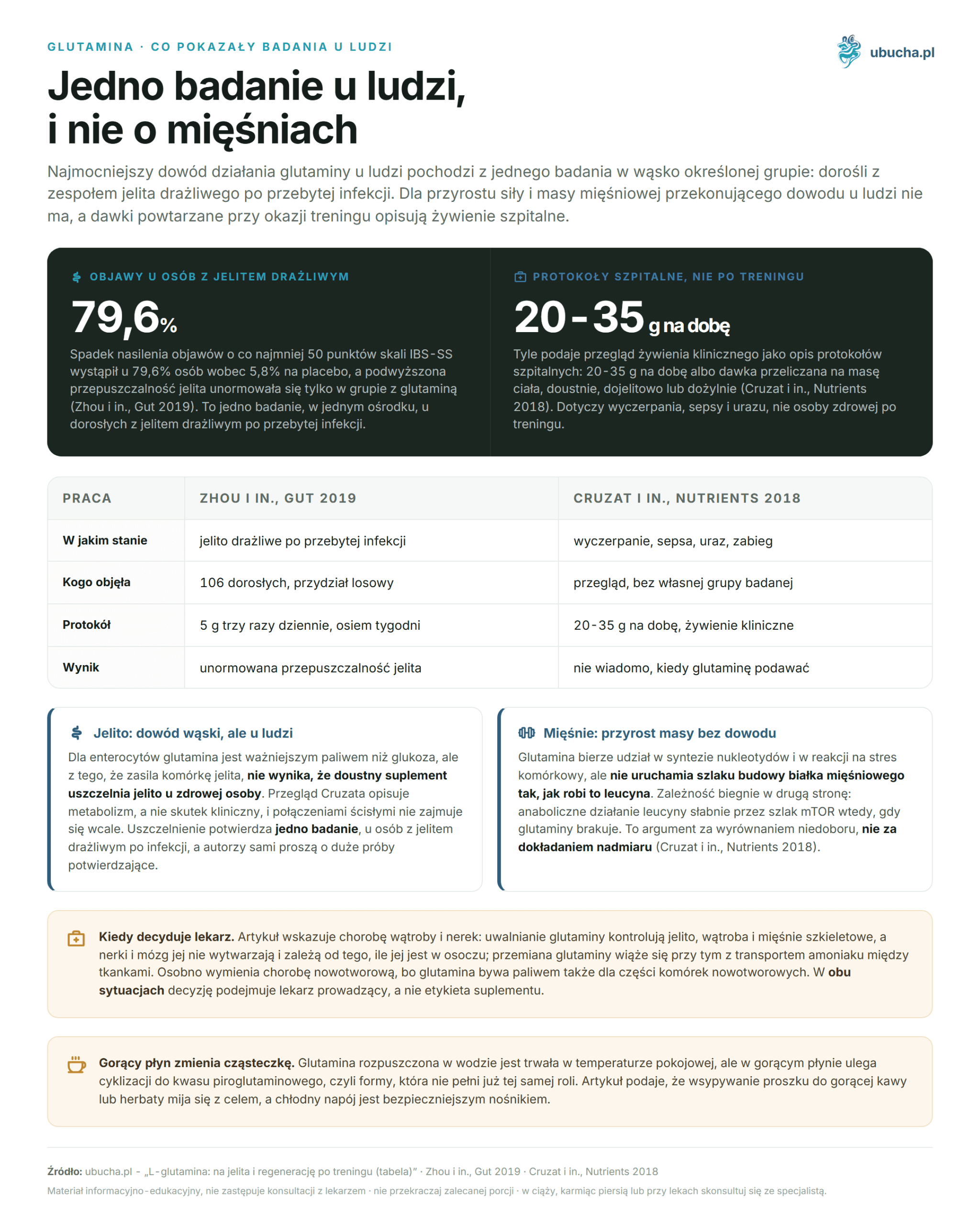
| Study | Participants | Protocol | Outcome |
|---|---|---|---|
| Zhou et al., Gut 2019 | 106 adults who completed the study: 54 on glutamine and 52 on placebo, all with irritable bowel syndrome after infection | glutamine orally 5 g three times a day or placebo, eight weeks, random assignment and double-blind | decrease in symptom severity by at least 50 points on the IBS-SS scale in 79.6% vs 5.8% on placebo; increased intestinal permeability normalized only in the glutamine group |
| Cruzat et al., Nutrients 2018 | review of clinical nutrition data, without its own study group | description of hospital protocols: 20-35 g per day or dose calculated by body weight, orally, enterally, or intravenously | the authors state that in exhaustion, sepsis, and after injuries, it is still impossible to determine whether the administration of glutamine should depend on its concentration in plasma |
Two things from this table are more important than the numbers themselves. First: this is one study, in one center, in a population selected for the mechanism in which glutamine has the right to work. The authors themselves conclude that large trials confirming this are needed. Second: a review from the same period acknowledges that there is not even agreement in clinical medicine on when to administer glutamine. Supplement marketing speaks much more confidently on this matter than the literature.
If you are looking for a broader picture of gut barrier support, the topic is adjacent to short-chain fatty acids and microbiota, described in texts about sodium butyrate and about restoring gut flora after antibiotics.
Does glutamine speed up recovery after training?
So far, this cannot be confirmed at the level that would require a recommendation. It is known that prolonged and intense effort belongs to catabolic-hypercatabolic states, in which endogenous synthesis ceases to meet demand, alongside sepsis, injury, and surgical procedures. This is well documented in physiology.
Further gaps begin. The Cruzat review mentions exhausted athletes as a group in which supplementation is sometimes recommended, and in the same sentence admits that it is unknown whether it should be conducted based on blood glutamine levels. This is not a supportive statement. It is a statement that the decision-making criterion is still lacking.
Separately, two promises that are sold together need to be distinguished. Recovery is one thing, building mass is another. Glutamine participates in nucleotide synthesis and in response to cellular stress, but it is not an amino acid that activates the muscle protein synthesis pathway in the way that leucine does. The relationship here runs rather the other way: the authors of the review note that the anabolic effect of leucine weakens through the mTOR pathway when glutamine is lacking. This is an argument for correcting a deficiency, not for adding excess. Those who buy glutamine hoping for strength gains are buying it under a promise that the literature does not support. A similar distinction between perceived recovery and measurable outcomes is described in the text about CBD for athletes.
What do immune cells need glutamine for?
Immune cells consume glutamine at a rate comparable to glucose, and during infection and high catabolism even faster. Evidence for this was gathered in the mid-1980s by the Oxford laboratory of Eric Newsholme, studying lymphocytes and macrophages. The number of publications on this topic has increased from two or three per year at the turn of the 1960s and 1970s to about fifty per year in the last two decades.
The mechanism is described at several levels. A lymphocyte, in order to multiply, needs both energy and building blocks for nucleic acids and lipids, and glutamine provides nitrogen for the synthesis of purines and pyrimidines. Without it, the differentiation of B lymphocytes into plasma cells does not occur. Glutamine also affects the heat shock protein pathway, which is associated with reduced apoptosis of neutrophils after high-intensity exercise (Cruzat et al., Nutrients 2018).
However, it is worth noting where this description ends. The review documents the metabolic relationship and does so well. However, it does not document that oral glutamine reduces the number of colds in athletes. Statements about upper respiratory infections after competitions, repeated in texts about supplementation, do not appear in this work at all, and without its own study, they have no basis.
Who should be cautious with glutamine?
First of all, people with liver or kidney disease. The release of glutamine into circulation and its availability are primarily controlled by the gut, liver, and skeletal muscles, while the kidneys and brain do not produce it and depend on how much is in plasma. The metabolism of glutamine is associated with the transport of ammonia between tissues, so in the case of failure of these organs, adding a supplement is not neutral and requires a doctor’s decision.
The second group is people undergoing cancer treatment. The authors of the Cruzat review point out that glutamine can also be fuel for some cancer cells, so the decision to administer it in oncology belongs to the treating team, not to the patient reading the label. The same applies to situations where glutamine is part of hospital nutrition: there, the dose and route of administration are determined individually.
The third issue is practical. Glutamine dissolved in water is stable at room temperature, but in hot liquid, it cyclizes to pyroglutamic acid, a form that no longer serves the same role. For this reason, adding powder to hot coffee or tea is pointless. A cool drink is a safer carrier. It is also worth remembering where glutamine comes from without supplementation: in a dietary questionnaire involving over seventy thousand participants, glutamine, along with glutamate and leucine, was among the amino acids consumed in the largest amounts from a protein-rich diet (Cruzat et al., Nutrients 2018).
Frequently Asked Questions
Does glutamine really seal the gut?
In one clinical situation, yes. In the 2019 study by Zhou, 106 people with irritable bowel syndrome after an infection received either glutamine or a placebo for eight weeks. Increased intestinal permeability normalized only in the glutamine group. Outside of this group, there is little evidence in humans.
Does glutamine help build muscle mass?
There is no convincing evidence for this in humans. Glutamine participates in nucleotide synthesis and in response to cellular stress, but it does not activate the muscle protein synthesis pathway like leucine does. These are two different promises, usually sold together in one package.
How much glutamine is in the body and where is it located?
Glutamine makes up 50-60% of free amino acids in skeletal muscle and about 20% of the pool of free amino acids in plasma, with about 80% of the total body reserve located in the muscles. Its concentration in tissues exceeds that of any other amino acid by several times (Cruzat et al., Nutrients 2018).
Can glutamine be added to hot coffee?
Better not. In hot liquid, glutamine cyclizes to pyroglutamic acid, so something different than what was in the package ends up in the drink. In room temperature water, it is stable, so cold water, juice, or a cool smoothie work better.
Does the powder work differently than capsules?
No, it is the same molecule and the same absorption pathway. The difference is practical: powder is easier to measure and dissolve, capsules are more convenient for travel. The choice between them does not change what is known about effectiveness, and less is known than sales descriptions suggest.
Who should not take glutamine without a doctor?
People with liver or kidney disease, as these organs are responsible for its metabolism, and people undergoing cancer treatment, as glutamine can also be fuel for some cancer cells. In both situations, the decision is made by the attending physician.
This article is for informational and educational purposes only and does not constitute medical advice. Before starting supplementation, consult your doctor, especially if you are taking medications regularly, are pregnant or breastfeeding, or have a chronic illness.
Author: Michał Waluk · Published: 2026-07-15 · Updated: 2026-08-16