
Marshmallow Root: for Throat, Cough, and Stomach (FAQ)
Marshmallow root has the status of traditional use. We check the indications, age limits, gap from oral medications, and how thin the research basis is.
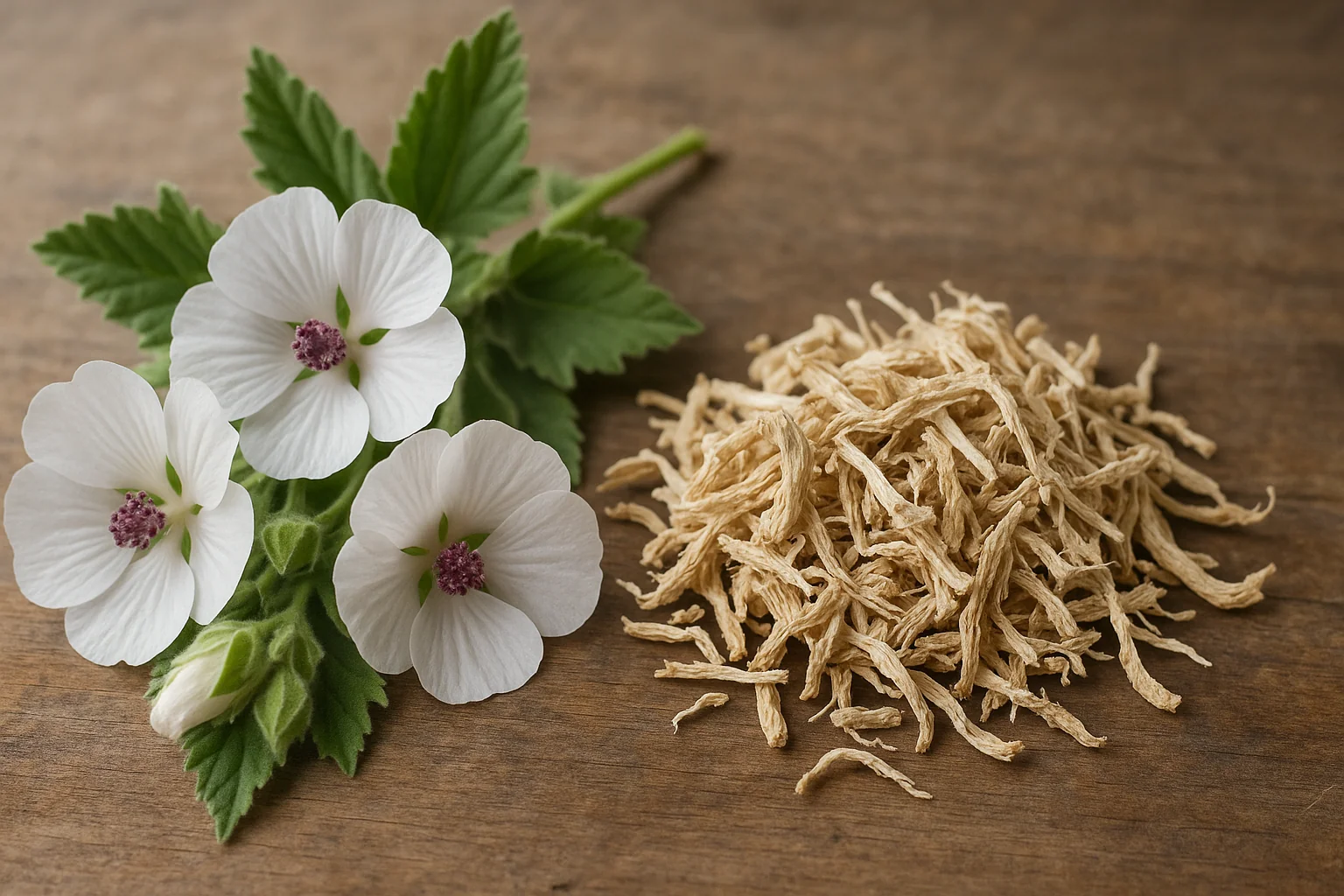
Marshmallow root (Althaea officinalis) is one of the few herbs whose action is explained by physics rather than pharmacology. The root contains mucilaginous polysaccharides that, when in contact with water, form a thick gel coating the mucous membrane. The European Medicines Agency has granted the root the status of traditional use for two indications: irritation of the oral cavity and throat with accompanying dry cough and mild gastrointestinal discomfort. Traditional status means that clinical evidence has been deemed insufficient, and the basis is long-term use, which affects everything that can be honestly written about marshmallow. This article answers the most frequently asked questions regarding this raw material and clarifies three things that are often incorrectly stated in Polish online sources: permissible duration of use, age limits for both indications, and the length of the gap from oral medications.
KEY INFORMATION
• The EMA/HMPC/436679/2015 monograph grants marshmallow root the status of traditional use, which is awarded in the absence of sufficient evidence from clinical studies.
• The indication concerns DRY cough and throat irritation, and separately mild gastrointestinal discomfort.
• The gap from other oral medications is half an hour to an hour before taking or after it, not two hours.
• Duration of use without consultation: one week for throat and cough, two weeks for stomach. Not four weeks.
• Safety during pregnancy and breastfeeding has not been established, so its use is not recommended.
What does the EMA monograph say about marshmallow root?
The monograph covers only the root, describes two separate indications, and assigns the raw material the role of a coating agent in both. The first indication is symptomatic treatment of irritation of the oral cavity or throat and accompanying dry cough. The second is symptomatic relief of mild gastrointestinal discomfort.
Age limits differ between indications, and this is where guides usually go wrong. For throat and dry cough, macerates and syrups are allowed from the third year of life, with a separate threshold for solid forms, which are not recommended below the sixth year. For gastrointestinal discomfort, use below the twelfth year has not been established due to lack of data. The liquid extract in 25 percent ethanol is reserved for adults.
The duration of use is also not the same. If symptoms from the first indication persist for more than a week, the monograph advises consulting a doctor. For the gastrointestinal indication, the limit is two weeks. The statement “EMA allows use for up to four weeks,” which circulates on Polish websites, has no basis in this document and doubles or quadruples the actual limit.
The document adds two more warnings. In case of shortness of breath, fever, or purulent sputum, one should see a doctor without waiting for the end of the treatment. Safety during pregnancy and breastfeeding has not been established, so its use is not recommended at all during this time. This note is usually not mentioned in Polish descriptions of marshmallow.
Why is marshmallow root soaked in cold water?
Because the form provided in the monograph is a macerate, not an infusion. The crushed raw material is soaked in water and left to extract, and the finished macerate should be used immediately after preparation. The document states this explicitly, and it is the only technical hint it contains.
The chemical justification is simpler than usually described. Mucilaginous polysaccharides are long sugar chains, and their ability to form a sticky gel depends on whether the chains remain intact. High temperatures promote their breakdown, which is why herbal tradition advises against boiling water. We have not found any work that would set a temperature threshold or optimal range for this raw material, so we do not provide any degrees here. Versions with specific values, repeated in guides, have no source.
What can be verified is the method of checking the quality of the raw material. The European Pharmacopoeia tests marshmallow root with a swelling index, measuring what volume the powdered raw material will occupy after swelling in water. This is a physical test, not a determination of the percentage content of polysaccharides. The statement about “minimum content of 2 percent mucilaginous polysaccharides” is a mix of two different things and does not correspond to any pharmacopoeial record.
In practice, a macerate is recognized by its consistency: the liquid is noticeably thicker than water and slightly sticky. If it is completely watery after straining, the raw material was either too old or too coarsely ground.
Is there confirmation of marshmallow’s action in studies?
Not in humans. The status of traditional use was granted precisely because clinical evidence is lacking, and the monograph exempts this raw material from the obligation to present pharmacodynamic data. The existing material comes from animal models and cell cultures.
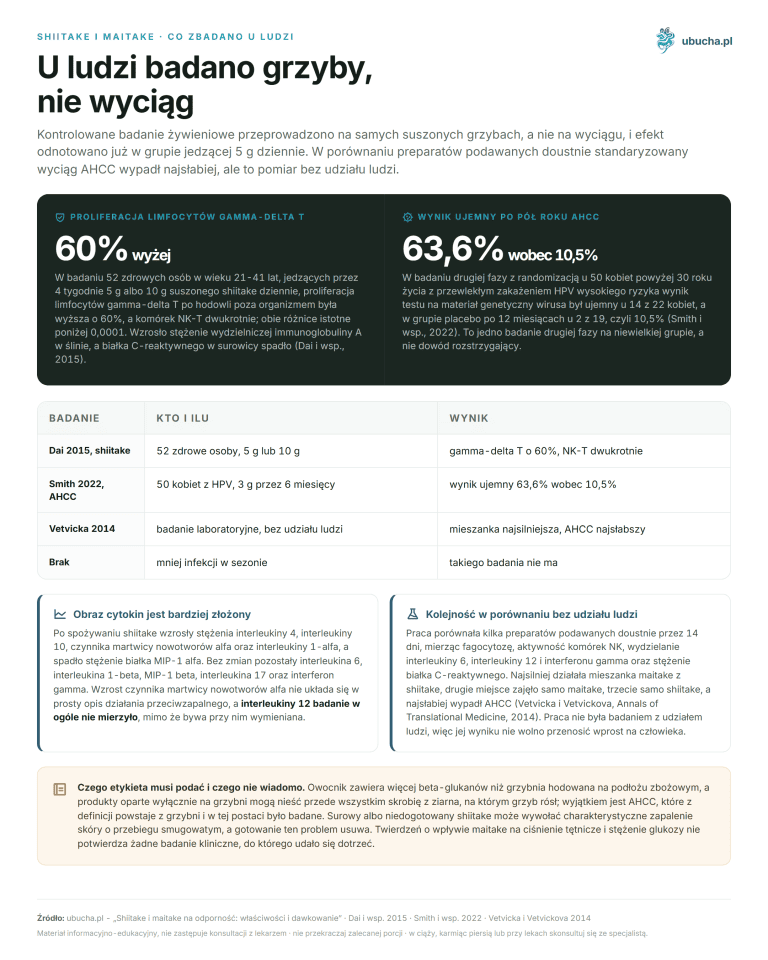
| Study | What was studied | Model | Result |
|---|---|---|---|
| Sutovská 2009, PMID 19447256 | ramnogalacturonan isolated from the root | guinea pigs, cough induced by citric acid aerosol | dose-dependent cough suppression, comparable to codeine; no effect on bronchial smooth muscle; effect weakened by 5-HT2 receptor antagonist |
| Sutovská 2011, PMID 22372330 | the same polysaccharide | allergic and non-allergic guinea pigs (allergic airway inflammation) | cough effect maintained, but clearly shorter in allergic inflammation conditions; airway resistance unchanged |
| Bonaterra 2020, PMC7090173 | ready Phytohustil syrup and root extract | human THP-1 macrophages in culture | inhibition of TNF-alpha and IL-6 release after LPS stimulation; protection against hydrogen peroxide cytotoxicity |
The last row requires a disclaimer that the work itself does not hide, and secondary discussions usually omit. The study was funded by Steigerwald Arzneimittelwerk, which belongs to the group that produces the tested syrup, and three co-authors are its employees. This does not invalidate the result, but the reader has the right to know that the study sponsor and the product manufacturer are the same party.
The result from Sutovská’s work is also more interesting than popular explanations suggest. Since the polysaccharide inhibited cough without changing the reactivity of bronchial smooth muscle, and the 5-HT2 serotonin receptor antagonist clearly weakened its action, the effect is not due to the mucus layer on the membrane. The mechanism appears to be receptor-based, and the “protective coating” is a simplified description.
How much time should pass between marshmallow and oral medications?
From half an hour to an hour, before taking the medication or after it. The monograph formulates this as a precaution: simultaneous absorption of concurrently taken medications may be delayed, so the marshmallow preparation should not be taken within this window. The two-hour rule repeated online is an extension of this number without basis.
It is worth noting where this caution stands in the document. Not in the section on interactions, which briefly states that none have been reported, but in the section on special warnings. The difference is practically significant: it is not about a reaction between substances, but about a mechanical barrier that slows the passage of the drug through the intestinal wall. The result is a delay, not a change in the potency of the drug.
This caution applies to every mixture containing mucilaginous herbs, not just to pure macerate. Mucilage acts the same, whether marshmallow is given alone or together with another raw material. This also applies to mixtures with plantain, which contains its own mucilaginous polysaccharides.
Separately: with drugs that have a narrow therapeutic window, the decision is made by a doctor or pharmacist, not by the rule from the article. Delayed absorption may be insignificant with one drug and significant with another, and the monograph does not mention any specific preparation by name in this context.
Does marshmallow help with reflux and stomach issues?
The monograph provides a gastrointestinal indication, but describes it much more cautiously than guides do. It states: symptomatic relief of mild gastrointestinal discomfort. There is no mention of reflux, peptic ulcer disease, or Helicobacter pylori infection.
Marshmallow does not reduce the secretion of hydrochloric acid and does not eliminate the cause of discomfort. The role attributed to it is protective, and its basis is tradition, not results from patient studies. Comparisons with alginates or hyaluronic acid, found in commercial descriptions, lack comparative studies and are better not repeated.
The limits here are clearer than for the throat. The loose form for this indication is intended for adolescents, adults, and the elderly, and use below the twelfth year has not been established. Consultation is needed after two weeks without improvement, not after a month.
Practically, this means one thing: marshmallow may provide temporary relief for heartburn, but persistent gastrointestinal discomfort is an indication for diagnostics. Recurring burning may sometimes have causes that no protective agent can address, and delaying examination is a real cost.
Frequently Asked Questions
What type of cough is marshmallow used for?
For dry cough. The monograph mentions irritation of the oral cavity or throat accompanied by a dry cough. For wet cough, with expectoration, other raw materials are indicated in the monograph, including thyme herb. Marshmallow is not an expectorant, and descriptions attributing it with thinning mucus go beyond what the document states.
How long can marshmallow be used without consultation?
One week for throat irritation and dry cough, two weeks for stomach ailments. After this period, the monograph advises consulting a doctor. Earlier, regardless of the day count, consultation is required if shortness of breath, fever, or purulent sputum occurs.
From what age can marshmallow be given to children?
For throat and dry cough, macerates and syrups are allowed from the third year of life, while solid forms are not recommended below the sixth year. For gastrointestinal indications, use below the twelfth year has not been established due to lack of data. The liquid extract in ethanol is reserved for adults.
Can marshmallow be used during pregnancy?
The monograph states that safety during pregnancy and breastfeeding has not been established, and due to lack of data, its use is not recommended. This is not information about harm, but about a gap in knowledge, yet the practical conclusion is the same. Lack of data on fertility has been noted separately.
Does marshmallow delay the absorption of medications?
It may delay, which is why the monograph recommends a gap of half an hour to an hour before taking another oral medication or after it. This caution arises from a mechanical barrier, not a reported interaction: the section on interactions with medications states that none have been reported. The two-hour rule found online is an overinterpretation.
Are there studies on marshmallow in humans?
We found no clinical trials involving humans for cough. Available data comes from guinea pig models and cell cultures, and one of these studies was funded by the manufacturer of the tested syrup. This is exactly the situation for which the category of traditional use was designated.
Can marshmallow be combined with other herbs?
Yes, and herbal tradition has been doing this for a long time, combining it with raw materials of different mechanisms of action. It is worth remembering that mechanisms do not automatically sum up, and the gap from oral medications applies to every mixture containing mucilaginous herbs. A similar profile is found in mullein, while a different one is described in the text about thyme.
In the store ubucha.pl, marshmallow is available in the herbs category, but only as a concentrated extract 10 to 1. This is a different form than the crushed root for macerate, which the monograph concerns, so the records about doses and duration of use cannot be transferred to this extract.
This article is for informational and educational purposes and does not constitute medical advice. Before starting supplementation, consult a doctor, especially if you are taking medications regularly, are pregnant or breastfeeding, or have a chronic illness.
Author: Michał Waluk · Published: 2026-08-09 · Updated: 2026-08-16