
Creatine: what it gives, when to take it, and is it only for strength athletes
Creatine has the ISSN position and a meta-analysis of 53 studies. We check what has been shown for strength, the brain, kidneys, and vegetarians, and whether the loading phase changes anything.
A meta-analysis involving 53 studies on creatine concluded that it should change the way we talk about this supplement: effectiveness turned out to be independent of dose, duration of intake, and the population studied. The entire industry discussion about schemes, phases, and optimization concerns variables that could not be linked to the outcome. Creatine has the backing of an international scientific society, safety data spanning five years, and research extending far beyond the gym. It also has numbers attributed to it that do not appear in the sources. Below we separate one from the other and show what exactly was measured, in whom, how long it lasted, and with what result.
KEY INFORMATION
• The position of the International Society of Sports Nutrition (Kreider, 2017) calls creatine monohydrate the most effective ergogenic nutritional supplement available to athletes for increasing high-intensity exercise performance and lean body mass.
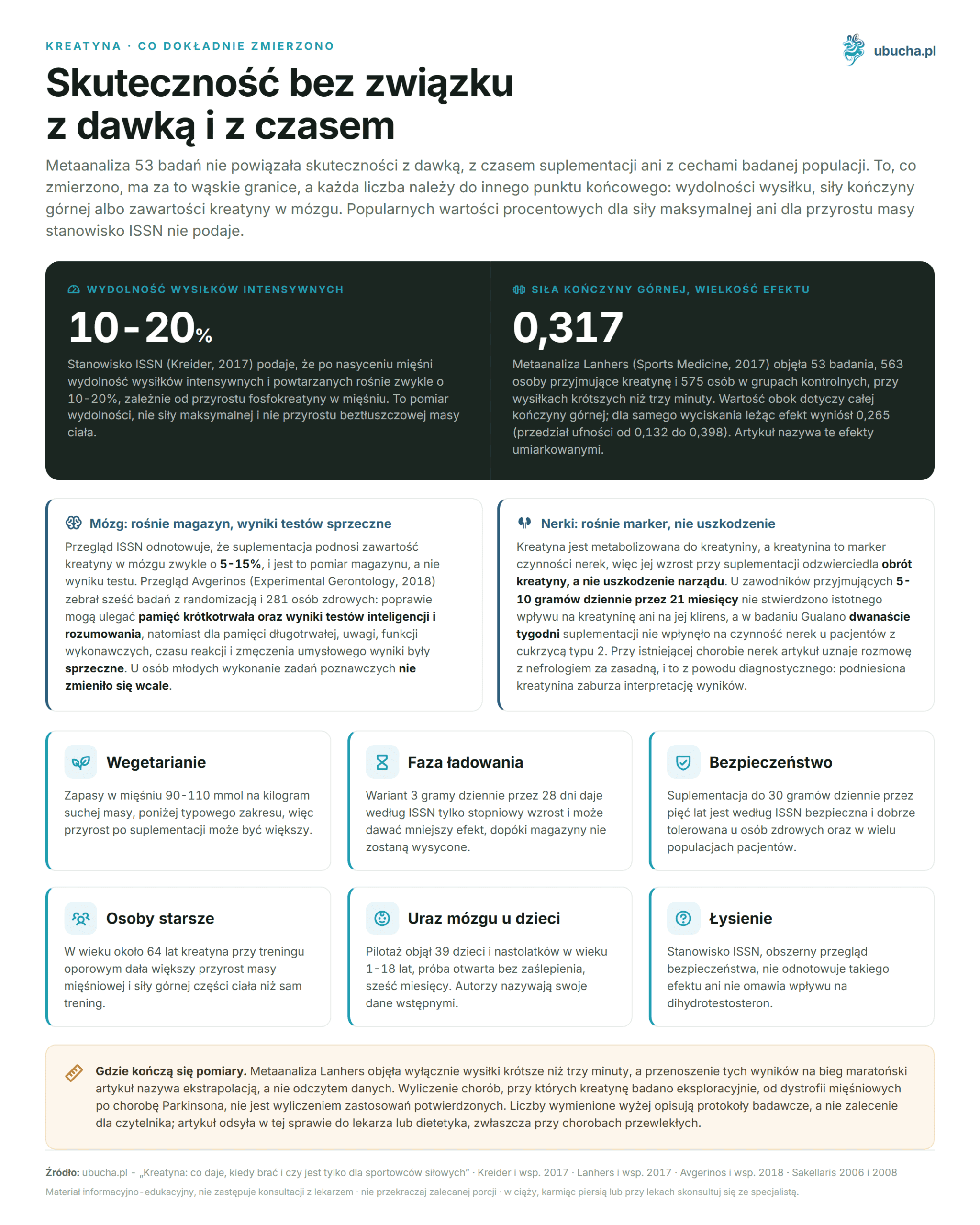
• After saturating the muscles, the performance of intense efforts usually increases by 10-20%, depending on the increase in phosphocreatine.
• A meta-analysis of 53 studies showed effectiveness independent of dose, duration, and characteristics of the studied population.
What is creatine and how does it work in muscle?
Creatine is a compound that the body produces itself, mainly in the liver and kidneys, from arginine and glycine, with the help of two enzymes that first convert them into guanidinoacetic acid and then into the finished molecule. The second half of the daily requirement is covered by diet. The ISSN position states that a pound of raw beef or salmon provides about 1-2 grams.
In muscle, creatine is phosphorylated to phosphocreatine and serves as an energy reservoir for the immediate resynthesis of ATP. This is significant because the reserves of ATP itself last for a few seconds of maximum effort. Phosphocreatine restores them without the involvement of oxygen and without the production of lactate, precisely in the window where other energy pathways have not yet started.
This is where the profile of creatine’s action comes from. It helps where the effort is short, intense, and repeated with incomplete rest, and not where aerobic metabolism counts for hours. The Lanhers meta-analysis, which we discuss below, was limited for this reason to efforts lasting less than three minutes.
It is worth immediately dispelling one concern. The ISSN review notes that long-term suppression of one’s own creatine synthesis with supplementation does not seem to occur. The body does not unlearn how to produce it.
What does creatine give according to the ISSN position?
The position of the International Society of Sports Nutrition (Kreider et al., 2017) states this without cautionary reservations: creatine monohydrate is the most effective ergogenic nutritional supplement currently available to athletes if the goal is to increase high-intensity exercise performance and lean body mass during training. This statement appears twice in this document, once as the official position of the society.
The specific number provided by this review sounds more cautious than most common claims. After saturating the muscles with creatine, the performance of intense and repeated efforts usually increases by 10-20%, with the size of the effect depending on how much the phosphocreatine content in the muscle actually increased. Popular percentage values for maximum strength or mass gain in product descriptions do not come from this document.
Strength was measured separately. The meta-analysis by Lanhers et al. (Sports Medicine, 2017) included 53 studies, 563 individuals taking creatine, and 575 individuals in control groups, and was limited to upper limb strength during efforts shorter than three minutes. The effect size for bench press was 0.265 with a confidence interval from 0.132 to 0.398, and for the entire upper limb, it was 0.317. These are moderate effects, clearly smaller than suggested by advertisements.
The most interesting result is from the meta-regression. The authors found no link between effectiveness and characteristics of the studied population, training protocol, or the dose and duration of supplementation used. Creatine worked independently of these variables.
Does creatine work on the brain?
The brain uses phosphocreatine just like muscle, as an energy buffer, and the ISSN review notes that supplementation usually increases creatine content in the brain by 5-15%. The question is whether this translates into cognitive test results, and the answer is more divided than supplement summaries suggest.
The systematic review by Avgerinos et al. (Experimental Gerontology, 2018) gathered six randomized studies involving a total of 281 healthy individuals. The authors found that short-term memory and intelligence and reasoning test scores may improve. For other areas, including long-term memory, attention, executive functions, reaction time, and mental fatigue, the results were inconsistent. In young individuals, cognitive task performance did not change at all.
It is worth comparing this with individual studies cited in the ISSN review, as they show where stronger claims come from. In Rae’s study, 5 grams daily for six weeks significantly improved working memory and scores on intelligence tests requiring quick processing. In McMorris’s study, sleep-deprived participants taking 20 grams daily for a week significantly lost less in reaction time, balance, and mood tests.
The discrepancy between these sources is real, and it is more honest to show it than to smooth it out. The ISSN review states that creatine may reduce mental fatigue; the Avgerinos review includes mental fatigue among areas with conflicting results. The authors of the latter cautiously summarize that the benefit seems to apply more to older individuals and those under stress than to healthy young adults. Other substances studied in this area are compared in our post supplements for concentration and memory.
Is creatine only for strength athletes?
No, although the reason is different than usually stated. It is not about the discipline, but about how the effort looks: creatine helps where ATP needs to be quickly restored between short bursts. The ISSN review lists in this context sports with intermittent sprints, including American football, soccer, or basketball.
The Lanhers meta-analysis adds a stronger argument than the list of disciplines. Since effectiveness was not related to the characteristics of the studied population or the training protocol, it is hard to defend the thesis that creatine is a supplement of a specific sports subculture. The range of efforts on which it was measured is, however, narrow and hard: shorter than three minutes.
It is worth noting where measurements end. The Lanhers meta-analysis included only efforts shorter than three minutes, while the ISSN review describes creatine primarily in the context of strength sports and those in which the athlete sprints with breaks and recovers during competitions. Transferring these results to marathon running is extrapolation, not data interpretation.
Separately, the ISSN review lists applications that have little to do with competitive sports: supporting post-exercise recovery, preventing injuries, thermoregulation, rehabilitation, and neuroprotection in cases of concussion and spinal cord injuries. What of this is compliant with competition regulations is described in our post supplements for athletes without doping.
Do vegetarians gain more from creatine?
Data indicates that they do, and the mechanism is simple. Creatine in the diet mainly comes from meat and fish, so individuals who do not eat them start from a lower level. The ISSN review provides a specific value: vegetarians have creatine stores in muscle at levels of 90-110 mmol per kilogram of dry mass, which is below the typical range, and for this reason, they may observe greater gains from supplementation.
Confirmation comes from a completely different side, which strengthens the argument. The Avgerinos review, which concerned cognitive functions rather than muscles, noted that vegetarians responded better to creatine than meat-eaters in memory tasks, with no differences in other areas. Thus, two independent measures point in the same direction.
This is one of the few situations in supplementation where a group with predictably greater response can be identified in advance. It does not mean that meat-eaters do not gain; it means they have less room for growth because part of the reserve was covered by their diet.
The ISSN review adds one more note that goes beyond vegetarianism. The habitually low intake of creatine from diet, around three grams daily throughout life, may itself bring significant health benefits. This is an argument about diet, not about supplements.
Does creatine harm the kidneys?
The misunderstanding arises from one molecule. Creatine is metabolized to creatinine, and creatinine is a marker used to assess kidney function. Its increase with supplementation therefore reflects increased creatine turnover, not organ damage, but as a result of testing, it looks the same.
The measurement data on this matter is quite clear. The ISSN review cites observations of American football players taking 5-10 grams daily for 21 months, in whom no significant impact on creatinine or its clearance was observed. It also cites the Gualano study, in which twelve weeks of supplementation did not affect kidney function in patients with type 2 diabetes, i.e., in a group at increased kidney risk.
The overall safety summary in this document sounds strong. Short- and long-term supplementation, up to 30 grams daily for five years, is safe and well-tolerated in healthy individuals and in many patient populations, from infants to the elderly. It is hard to find a broader range in the supplementation literature.
However, in the presence of kidney disease, a conversation with a nephrologist remains advisable, and this is due to diagnostic reasons. Elevated creatinine complicates the interpretation of results, which in this group serve to monitor the disease. This is an argument about the readability of studies, not about harmfulness.
Does the loading phase change anything?
It changes the pace, and as for the final result, the data is less clear than the popular version claims. The ISSN review describes an alternative variant to loading: taking 3 grams daily for 28 days. However, it directly notes that this approach only provides a gradual increase in creatine content in the muscle and may therefore yield a smaller effect on performance and training adaptations until stores are fully saturated.
The popular statement that loading brings nothing because the final effect is identical is therefore an oversimplification. It brings earlier saturation, and the difference concerns the transitional period, not the final state.
On the other hand, the Lanhers meta-analysis, which included the loading phase among the analyzed variables, found no link between effectiveness and dose or duration of supplementation. These two sources are not contradictory, as they measure different things: one describes the kinetics of muscle saturation, the other the total strength effect at the end of the studies. The practical conclusion is that the choice of scheme weighs less than consistency in intake.
We do not provide a portion to measure here. The numbers mentioned above describe research protocols, not recommendations for the reader; how much makes sense in your case should be determined with a doctor or dietitian, especially in the presence of chronic diseases. The topic of timing and saturation is further developed in our post creatine: timing and loading.
What has been studied outside of sports: seniors and head injuries?
Two areas have specific data worth knowing, as they differ in quality. The ISSN review cites a study of older individuals, around 64 years old, in whom creatine supplementation during resistance training resulted in greater increases in muscle mass and upper body strength than training alone. The authors conclude that creatine may help prevent sarcopenia and loss of bone mass in older individuals.
| Study | Who was included | Result |
|---|---|---|
| Sakellaris 2006, The Journal of Trauma | 39 children and adolescents aged 1-18 years after brain injury, open trial | Shorter post-traumatic amnesia and shorter intubation and intensive care stay; significant improvement in cognitive functions |
| Sakellaris 2008, Acta Paediatrica | The same group of 39 patients | Significant improvement in headaches, dizziness, and fatigue |
Both of Sakellaris’s works describe the same pilot study and require an honest disclaimer. It was an open study, without blinding, conducted on thirty-nine individuals, with creatine administered in an oral suspension for six months. The authors themselves call their data preliminary and propose repetition in a double-blind setup. This is a premise for further research, not an established method of treatment after a head injury.
The ISSN review also lists diseases for which creatine has been explored: muscular dystrophies, Parkinson’s and Huntington’s diseases, diabetes, osteoarthritis, fibromyalgia, and cerebral and cardiac ischemia. Listing the studied applications is not, however, a listing of confirmed applications. A set of interventions with strong evidence for sarcopenia is discussed in our post supplements for sarcopenia in seniors.
Frequently Asked Questions
What does creatine give?
According to the ISSN position from 2017, after saturating the muscles, the performance of intense and repeated efforts usually increases by 10-20%, depending on the increase in phosphocreatine in the muscle. A meta-analysis of 53 studies showed a moderate effect for upper limb strength, with a size of 0.317 and a confidence interval from 0.185 to 0.449.
Is creatine safe long-term?
The ISSN review states that supplementation of up to 30 grams per day for five years is safe and well-tolerated in healthy individuals and in many patient populations, from infants to the elderly. In athletes taking 5-10 grams daily for 21 months, no effect on creatinine or its clearance was observed.
Does creatine harm the kidneys?
An increase in creatinine with supplementation reflects the turnover of creatine, not kidney damage. In the Gualano study, twelve weeks of supplementation did not affect kidney function in patients with type 2 diabetes. In the presence of kidney disease, it is advisable to discuss this with a nephrologist, as elevated creatinine complicates the interpretation of tests.
Does creatine work on the brain?
The 2018 Avgerinos review, which included six studies and 281 people, showed improvements in short-term memory and intelligence and reasoning tests. For attention, reaction time, and mental fatigue, the results were inconsistent, and in young individuals, task performance did not change at all.
Is the loading phase necessary?
The ISSN review describes a variant without loading, i.e., 3 grams daily for 28 days, but notes that it only provides a gradual increase and may yield a smaller effect until stores are fully saturated. The Lanhers meta-analysis found no relationship between effectiveness and dose or duration of supplementation.
Do vegetarians gain more from creatine?
The ISSN review states that vegetarians have creatine stores in muscle at levels of 90-110 mmol per kilogram of dry mass, which is lower than typical, and may observe greater gains from supplementation. The Avgerinos review also noted better responses in memory tasks among them.
Does creatine cause hair loss?
The ISSN position from 2017, a comprehensive review of creatine safety, does not report such an effect nor discuss its impact on dihydrotestosterone. This thesis circulates on the internet, but we found no support for it in this document. In case of dermatological doubts, consultation resolves the issue, not a supplement comparison.
This article is for informational and educational purposes and does not constitute medical advice. Before starting supplementation, consult with a doctor, especially if you are taking medications regularly, are pregnant or breastfeeding, or have chronic illnesses.
Author: Michał Waluk · Published: 2026-06-22 · Updated: 2026-08-16