
Probiotic for the Gut: How to Choose a Strain, When to Take It, and Why Form Matters
Evidence for probiotics concerns a specific strain and specific indication, not the number of CFU. We check what studies have shown and how to read the label.
On the packaging of probiotics, the largest font usually indicates the number of billions. This is actually the least useful information on the entire label. Clinical studies did not test “Lactobacillus bacteria” or “ten billion CFU”, but designated strains in designated situations: Lactobacillus rhamnosus GG for diarrhea in children, Saccharomyces boulardii CNCM I-745 for acute diarrhea, Lactiplantibacillus plantarum 299v for irritable bowel syndrome. The same strain can perform well in one indication and fail in another, as shown by a large study published in the “New England Journal of Medicine”. Below, we break down what can be supported by data: why the number next to the strain name matters, how much CFU really means, why taking probiotics after antibiotics is more complex than popular advice suggests, and who such a preparation may harm.
KEY INFORMATION
• Effectiveness depends on the strain and indication, not on the species of bacteria (Sniffen et al., PLoS One, 2018).
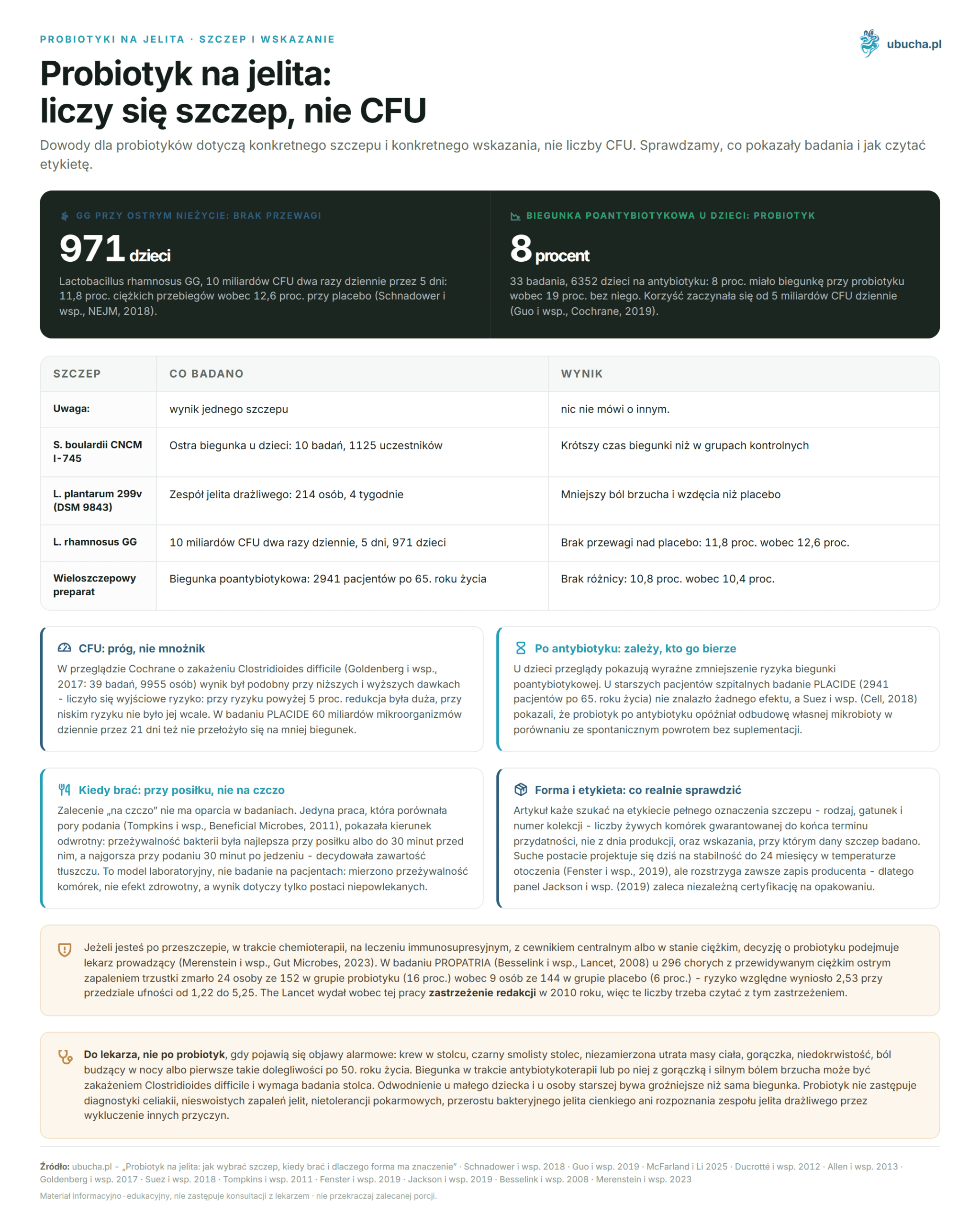
• Lactobacillus rhamnosus GG at a dose of 10 billion CFU twice daily did not shorten the duration of intestinal inflammation in 971 children (Schnadower et al., NEJM, 2018).
• After antibiotic therapy, probiotics delayed the recovery of their own microbiota (Suez et al., Cell, 2018).
• The recommendation to take them “on an empty stomach” is not supported by any study.
Why does the number next to the strain name determine its action?
Because clinical evidence was collected for designated strains, not for genera of bacteria. The review by Sniffen et al. (PLoS One, 2018) summarized it in one sentence: the effectiveness of a probiotic preparation depends on the strain and the disease. The statement “Lactobacillus helps the gut” therefore carries no information.
The full designation consists of three parts: genus, species, and collection number in which the strain is deposited. Lactobacillus rhamnosus GG is also listed in the literature as ATCC 53103, and Lactiplantibacillus plantarum 299v as DSM 9843. Saccharomyces boulardii CNCM I-745 is a yeast, not a bacterium. The definition of a probiotic from Hill et al. (2014) states that they are live microorganisms administered in appropriate amounts, but does not specify what that amount is: it is determined by the study of the given strain.
The following table shows what was tested and with what result. The last two rows concern types of bacteria that performed well in other indications.
| Strain | What was tested | Result |
|---|---|---|
| S. boulardii CNCM I-745 | acute diarrhea in children, 10 randomized studies, 1125 participants | shorter duration of diarrhea than in control groups (McFarland and Li, 2025) |
| L. plantarum 299v (DSM 9843) | irritable bowel syndrome according to Rome III criteria, 214 people, 4 weeks | less severity and frequency of abdominal pain and bloating than in placebo (Ducrotté et al., 2012) |
| L. rhamnosus GG | acute gastroenteritis in children, 10 billion CFU twice daily for 5 days, 971 children | no advantage over placebo: 11.8 percent vs 12.6 percent severe cases (Schnadower et al., 2018) |
| multistrain preparation, lactic acid bacilli and bifidobacteria | prevention of antibiotic-associated diarrhea in 2941 patients over 65 years old | no difference: 10.8 percent vs 10.4 percent (Allen et al., 2013) |
Does more CFU mean better?
No. CFU is the number of live cells capable of forming a colony on a plate, meaning it is a measure of content, not potency. Systematic reviews show that the dose can be important, but the threshold is low, and above it, the relationship breaks off. The advertised “one hundred billion” has no evidence of superiority behind it.
In the Cochrane review (Guo et al., 2019), 33 randomized studies and 6352 children taking antibiotics were collected. Diarrhea occurred in 8 percent of children in the probiotic groups compared to 19 percent in the control groups. Subgroup analysis showed an advantage for doses of 5 billion CFU per day over lower ones. The threshold thus fell significantly below the numbers printed today on packaging.
In the Cochrane review on Clostridioides difficile infection (Goldenberg et al., 2017), which included 39 studies and 9955 people, the result was similar in subgroups with lower and higher doses. What made a difference was something else: the baseline risk of illness. With a risk above 5 percent, the reduction was significant, while with a low risk, there was none at all.
The strongest counterexample to the arithmetic of billions comes from the PLACIDE study. Patients there received 60 billion microorganisms daily for 21 days, a higher dose than in most pharmacy products, and it did not translate into fewer diarrhea cases. The dose is a feature of the strain plus indication, not a parameter that can be cranked up.
Do probiotics always help after antibiotics?
No, and this is the most ambiguous thread in the entire topic. In children, reviews show a clear reduction in the risk of antibiotic-associated diarrhea. In older hospitalized patients, the largest study found no effect, and a separate study suggests that probiotics slow the return of their own microbiota.
The PLACIDE study (Allen et al., Lancet, 2013) included 2941 hospitalized individuals over 65 years old who were given a multistrain preparation for 21 days. Antibiotic-associated diarrhea occurred in 10.8 percent of those treated and 10.4 percent of those taking placebo. The authors found no evidence of effectiveness, even though it was a trial designed to yield a conclusive result.
Even more challenging data came from the work of Suez et al. (Cell, 2018). Researchers took samples of intestinal mucosa, not just stool samples. After antibiotic therapy, strains from the preparation colonized the mucosa better than in individuals not treated with antibiotics, but the recovery of their own microbiota and the return of the host transcriptome to baseline were clearly delayed and incomplete compared to spontaneous recovery without supplementation. An autologous stool transplant provided recovery within a few days.
The conclusion is uncomfortable but honest: the popular justification of “we need to rebuild the flora” has concrete data against it. The benefit of probiotics after antibiotics concerns preventing diarrhea in selected groups, not accelerating the return of microbiota. More about this period is discussed in our post Supplements After Antibiotics.
When to take probiotics: on an empty stomach or with food?
The recommendation to take them “on an empty stomach” is not supported by research. The only study that directly compared timing indicated the opposite direction: survival was best with a meal or up to 30 minutes before it, and worst when taken 30 minutes after eating.
This concerns the experiment by Tompkins et al. (Beneficial Microbes, 2011) on a model of the upper gastrointestinal tract. A four-component preparation was tested. Milk with 1 percent fat and oatmeal in milk protected the bacteria significantly better than apple juice or water, and according to the authors, fat content, not protein, was decisive. Saccharomyces boulardii did not react to either the timing of the meal or its acid-buffering capacity, which distinguishes yeasts from bacteria.
Three limitations to keep in mind. This is a laboratory model, not a study involving patients. Cell survival was measured, not health effect. The result pertains to uncoated forms, as enteric-coated capsules are designed to open only after the stomach. In clinical studies, the timing of administration is dictated by the protocol and is almost never compared, so no scheme provides certainty. The most sensible approach is to replicate the method of administration from the study of the given strain if the manufacturer cites it.
Do probiotics need to be kept in the fridge?
It depends on the product, not a general rule. There is no clinical study that has compared the effectiveness of the same strain stored in cold and at room temperature. The manufacturer’s instructions are decisive, as stability results from the technology of production and the properties of the strain.
The review by Fenster et al. (Microorganisms, 2019) describes how this industry has changed. Probiotic bacteria traditionally went into fermented dairy products with a short shelf life and refrigeration. Dry forms, such as capsules and sachets, are now designed for stability of up to 24 months at room temperature and humidity. The authors emphasize that the declared dose should be achievable at the end of the shelf life, not on the day of production.
The problem is that buyers have no way to verify this. An expert panel in the work of Jackson et al. (Frontiers in Microbiology, 2019) recommends independent certification of identity, purity, and strain counts, and placing information about it on the packaging. Until this becomes standard, the only thing you can do is read the storage conditions and treat their absence as a warning signal. Moisture is harmful in any variant, so a bathroom cabinet is out of the question.
What are the differences between prebiotics, synbiotics, and postbiotics?
These are four distinct categories that labels notoriously mix up. The international society ISAPP has issued separate consensus statements for each, and the differences have practical consequences when purchasing.
- Probiotic is live microorganisms that, when administered in appropriate amounts, confer a health benefit to the host (Hill et al., 2014).
- Prebiotic is a substrate selectively utilized by host microorganisms, providing a health benefit (Gibson et al., 2017). The definition is not limited to carbohydrates or the gut alone.
- Synbiotic is a mixture of live microorganisms and a substrate selectively utilized by them (Swanson et al., 2020). The panel rejected the simple definition of “probiotic plus prebiotic” to avoid blocking preparations designed for the components to work together.
- Postbiotic is a preparation of non-viable microorganisms or their components that confer a health benefit (Salminen et al., 2021). It must contain inactivated cells or their elements.
The practical conclusion is simple. A postbiotic does not contain live cells, so the number of CFU does not describe it, and the question of refrigeration is irrelevant. A prebiotic does not provide bacteria itself, only nourishment for those you already have. If the packaging uses these terms interchangeably, the manufacturer either does not know the definitions or hopes you do not know them.
Who can probiotics harm?
In healthy adults, adverse effects are usually mild and transient. The risk increases in severely ill individuals, post-surgery, and those with reduced immunity, where blood infections caused by strains from the preparation have been reported. This is not a theoretical disclaimer from the leaflet.
In the PROPATRIA study (Besselink et al., Lancet, 2008), 296 patients with predicted severe acute pancreatitis received a multistrain preparation or placebo for 28 days. Infectious complications occurred similarly in both groups, 30 percent vs 28 percent. Deaths were distributed differently: 24 out of 152 in the probiotic group, or 16 percent, compared to 9 out of 144 in the placebo group, or 6 percent. The relative risk was 2.53 with a confidence interval from 1.22 to 5.25. However, this work has a special status: in 2010, The Lancet published a concern regarding it (expression of concern, Lancet, 2010). The work has not been retracted and can be written about, but without this information, it cannot be cited.
The ISAPP panel in the work of Merenstein et al. (Gut Microbes, 2023) gathered current recommendations regarding safety. It pointed to risks in vulnerable populations, the sequencing of the entire genome of the strain to detect virulence genes, toxins, and antibiotic resistance, and the reporting of adverse effects. If you are post-transplant, undergoing chemotherapy, on immunosuppressive treatment, have a central catheter, or are in a severe condition, the decision about probiotics is made by the attending physician.
How to read a label and how does a probiotic differ from yogurt?
On the label, look for the full designation of the strain and the number of live cells guaranteed until the end of the shelf life. Yogurt can be a source of live bacteria, but the mere fact of fermentation does not make it a probiotic unless it contains a tested strain in a tested amount.
The distinction is clarified by ISAPP’s position on fermented foods (Marco et al., 2021). The starter cultures of yogurt, namely Streptococcus thermophilus and Lactobacillus delbrueckii subsp. bulgaricus, process milk and improve its digestibility in lactose intolerance. This is a real benefit, but entirely different from the clinical indication assigned to a designated strain. A fermented product and a probiotic product are two different categories, and the label “with live cultures” is not a probiotic claim.
| What to check on the packaging | Why it matters |
|---|---|
| Type, species, and collection number of the strain | clinical studies concern the strain, not the species |
| Number of live cells at the end of the shelf life | the number from the production date says nothing about what you are buying |
| Indication for which the strain was tested | the same strain may be ineffective for another issue |
| Storage conditions | stability depends on technology, not a general rule |
| Independent laboratory certification | the buyer cannot verify the composition independently |
When does a gut problem require a doctor, not a supplement?
When alarming symptoms appear. Blood in the stool, black tarry stool, unintended weight loss, fever, anemia, pain that wakes you at night, and the first such ailments after the age of 50 are diagnostic situations. A probiotic will not solve them and may delay diagnosis.
Treat separately diarrhea that occurs during or after antibiotic therapy and is accompanied by fever and severe abdominal pain. This may be a Clostridioides difficile infection, requiring stool testing and targeted treatment. Dehydration in a small child and an elderly person also requires attention, as it is the dehydration, not the diarrhea itself, that can be a real threat.
A probiotic does not replace the diagnosis of celiac disease, inflammatory bowel diseases, food intolerances, or small intestinal bacterial overgrowth. The diagnosis of irritable bowel syndrome is also made by excluding other causes, not by a reaction to a supplement. If symptoms last longer than a few weeks or recur, schedule an appointment. We discuss how to choose dietary supplements without animal sources of ingredients in our post Supplements for Vegetarians and Vegans.
Frequently Asked Questions
How to tell if a probiotic has a tested strain?
By the full designation on the label: genus, species, and collection number, for example, Saccharomyces boulardii CNCM I-745. The species alone is not enough, as the review by Sniffen et al. (PLoS One, 2018) showed that effectiveness depends on the strain and indication.
How many CFU should a probiotic have?
There is no single number. In the Cochrane review in children, doses of 5 billion CFU per day performed better than lower doses, but in the review on Clostridioides difficile infection, the division into doses did not change the outcome. The dose is a feature of the strain, not a measure of the quality of the product.
Should probiotics be taken during or after antibiotics?
The data is ambiguous. In children, the Cochrane review from 2019 showed fewer antibiotic-associated diarrhea cases, but in the PLACIDE study of 2941 patients over 65 years old, there was no difference. The work by Suez et al. (Cell, 2018) showed delayed recovery of their own microbiota.
Do probiotics need to be kept in the fridge?
It depends on the product, not a general rule. Dry forms, such as capsules and sachets, are now designed for stability at room temperature, even for up to 24 months (Fenster et al., Microorganisms, 2019). The manufacturer’s instructions on the packaging are decisive.
What is the difference between a synbiotic and a postbiotic?
A synbiotic is a mixture of live microorganisms and a substrate selectively utilized by them (Swanson et al., 2020). A postbiotic is a preparation of non-viable microorganisms or their components (Salminen et al., 2021). A postbiotic does not contain live cells, so the number of CFU does not describe it.
Can probiotics be harmful?
In severely ill individuals and those with reduced immunity, yes. In the PROPATRIA study, 16 percent of patients with severe acute pancreatitis died in the probiotic group compared to 6 percent in the placebo group (Besselink et al., Lancet, 2008), and The Lancet issued a concern regarding this work in 2010.
Probiotic preparations and other products supporting daily diet can be found in the supplements section of the u Bucha store.
This article is for informational and educational purposes only and does not constitute medical advice. Before starting supplementation, consult your doctor, especially if you are taking medications regularly, are pregnant or breastfeeding, or have a chronic illness.
Author: Michał Waluk · Published: 2026-06-22 · Updated: 2026-08-08