
Vitamin D3 and K2: is it worth combining them and how to dose (2026)
Vitamin D3 and K2: how much to take according to Polish guidelines 2023, where the evidence for combining ends, and why K2 requires a doctor's consent when taking warfarin.
Almost nine out of ten adult Poles have vitamin D levels below the optimal threshold in late winter and spring. The measurements included 5,775 people from 22 cities, so supplementation of cholecalciferol from autumn to spring has strong justification in our case. However, a second thesis has emerged around it, repeated in product descriptions: that without vitamin K2, D3 alone directs calcium to the arteries instead of the bones. The biochemistry behind this reasoning is real, but studies on combined preparations are less impressive than advertising suggests. Below you will find what is actually known about both vitamins, what doses are recommended by Polish guidelines from 2023, and why K2 requires a conversation with a doctor when taking anticoagulants.
KEY INFORMATION
• 89.9% of adult Poles had 25(OH)D below 30 ng/ml (Płudowski et al., Pol Arch Med Wewn, 2016).
• Polish guidelines 2023: adults 1000-2000 IU D3 per day, after 75 years 2000-4000 IU.
• The upper limit set by EFSA for adults is 4000 IU per day.
• A two-year study of MK-7 with D3 did not slow down aortic valve calcification.
• K2 weakens warfarin and acenocoumarol.
How does vitamin D3 work and why is it not enough for bones?
Vitamin D3 increases calcium absorption from the intestines, but does not determine where that calcium will go. The distribution is managed by two vitamin K-dependent proteins: osteocalcin in bone and MGP in the vessel wall. Without vitamin K, both remain inactive and do not bind calcium.
Cholecalciferol is produced in the skin under the influence of UVB radiation or enters the body from food: fatty fish, eggs, and fortified products. In the liver, it is converted to 25(OH)D, the form measured in blood tests, and in the kidneys to calcitriol. Holick (New England Journal of Medicine, 2007) described it as a steroid hormone whose receptor acts in most human tissues.
The intestinal effect is the best documented: with normalized 25(OH)D, the body absorbs more calcium from the same meal than with deficiency. Hence the rest of the reasoning. Since D3 raises the pool of available calcium, someone must ensure that it is deposited in the bone, not in the artery wall.
This is where vitamin K comes in. Osteocalcin binds calcium in the bone matrix, MGP inhibits its deposition in vessels, and both proteins must first undergo carboxylation, for which vitamin K serves as a cofactor. Maresz (Integrative Medicine, 2015) summarized this mechanism in a coherent argument, and this is what underlies the popularity of combined preparations. With one caveat, which is not mentioned in advertisements: this is a description of biochemistry, not a result of research on a finished preparation.
What does vitamin K2 do and which form really works?
Vitamin K2 is a family of menaquinones designated by the symbol MK-n. In supplementation, only MK-7 really matters, as MK-4 at doses found in food does not raise vitamin K levels in the blood at all. The difference between the two forms is quantitative but enormous.
Sato, Schurgers, and Uenishi (Nutrition Journal, 2012) administered a single dose of 420 µg MK-4 or MK-7 to healthy women, and then 60 µg for a week. MK-7 was detectable in serum for up to 48 hours after administration, and after a week, it raised levels in all participants. MK-4 did not appear in serum at any measurement point, so its form from food does not affect vitamin K status.
Schurgers et al. (Blood, 2007) compared MK-7 with synthetic vitamin K1. Both were well absorbed, but MK-7 has a significantly longer half-life, making its serum concentration more stable, and with longer administration, it increases seven to eightfold. MK-7 also fully carboxylated osteocalcin.
MK-4 only works at pharmacological doses. In Japanese osteoporosis studies, 45 mg was administered daily for two years (Shiraki et al., Journal of Bone and Mineral Research, 2000), which is about 250 times more than 180 µg MK-7 from trials in postmenopausal women. When choosing a preparation, this is the only difference that really makes a difference. We dedicated a separate text to the menaquinone MK-7 and the claims surrounding it.
| Feature | MK-4 | MK-7 |
|---|---|---|
| Main source | animal products | natto and other fermentations |
| Detectability in serum after a dose of 420 µg | none at any measurement point | up to 48 hours |
| With regular intake | concentration does not increase | concentration increases and stabilizes |
| Dose used in clinical studies | 45 mg per day | 180 µg per day |
Is combining D3 with K2 better than D3 alone?
There is no good evidence for this. The largest randomized trial of a combined preparation administered 720 µg MK-7 with 25 µg of vitamin D to 365 men for two years and did not slow aortic valve calcification compared to placebo (Diederichsen et al., Circulation, 2022).
The same trial included coronary arteries. Among 304 participants without coronary artery disease, the calcification index increased by 203 Agatston units in the treated group and by 254 in the placebo group, and the difference was not statistically significant (Hasific et al., JACC: Advances, 2023). A benefit appeared only in the subgroup with a score of at least 400 units, which the authors describe directly as a hypothesis to be tested in future studies.
Vitamin K2 alone, without D3, performs somewhat better. A meta-analysis of 14 studies involving 1,533 patients showed a slowdown in the progression of coronary calcifications (Li, Wang, and Tu, Frontiers in Nutrition, 2023), and a two-year trial with 360 µg MK-7 in patients with coronary disease favored the supplement (Vossen et al., JAMA Cardiology, 2026). However, a review of nine controlled studies summarized that vitamin K does not consistently inhibit the progression of calcifications, and a more pronounced effect is only seen in individuals with pre-existing calcifications (Vlasschaert et al., Nutrients, 2020).
We noticed while organizing this data that it is worth reversing the question. If D3 without K2 calcified the arteries, it would be evident in studies on vitamin D alone. Meanwhile, in the Women’s Health Initiative, women taking calcium with 400 IU D3 for seven years had the same coronary calcification index as the placebo group (Manson et al., Menopause, 2010). Encouraging numbers for K2 come from observational studies, such as the Rotterdam Study (Geleijnse et al., Journal of Nutrition, 2004), but these causes do not prove anything.
How much vitamin D3 and K2 should you take daily according to Polish recommendations?
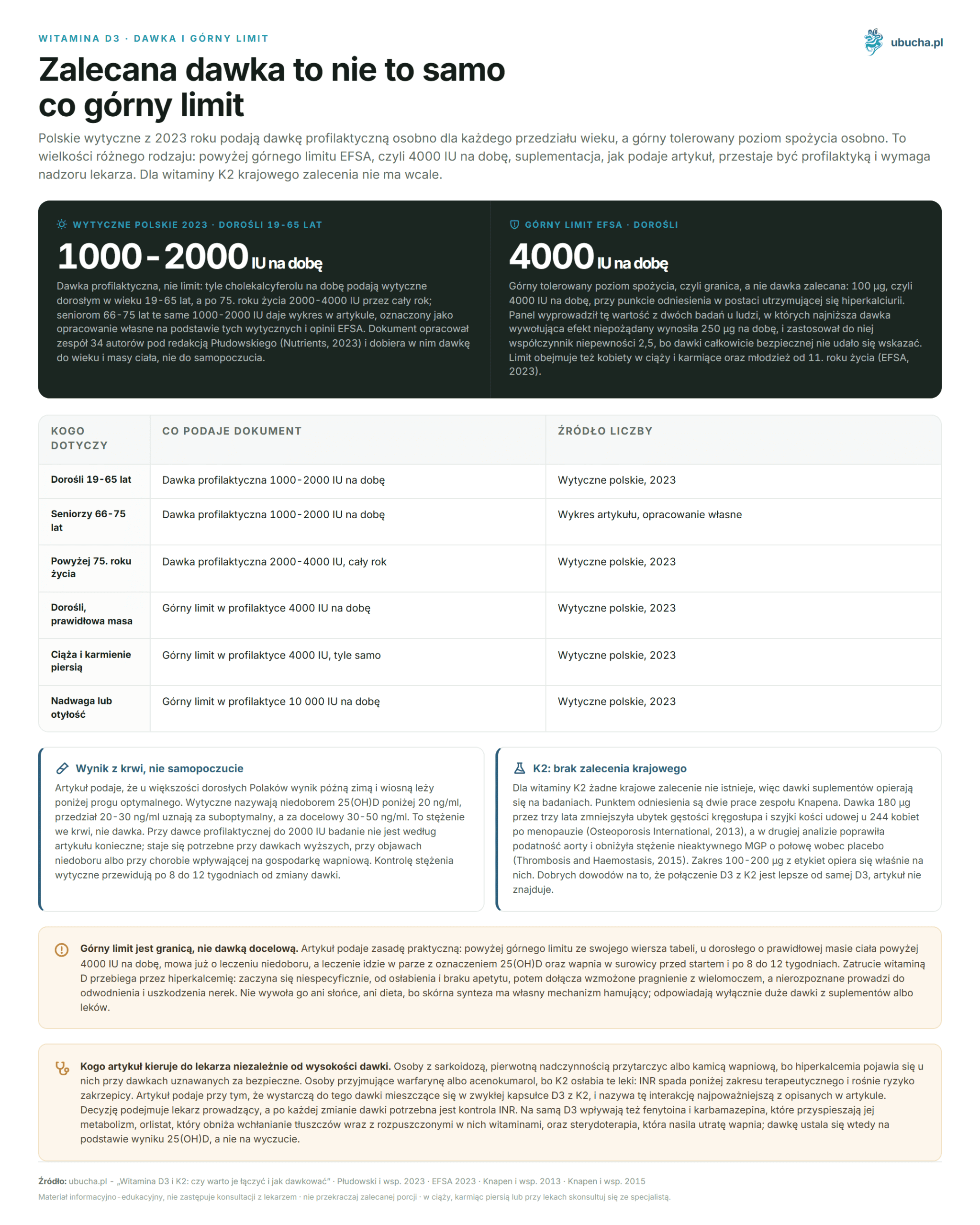
Polish guidelines from 2023 recommend adults aged 19-65 to take 1000 to 2000 IU of cholecalciferol daily, and those over 75 years old to take 2000 to 4000 IU year-round. For vitamin K2, there are no national recommendations, so supplement doses are based on studies.
The document was prepared by a team of 34 authors under the editorship of Płudowski (Nutrients, 2023). According to him, deficiency is defined as 25(OH)D below 20 ng/ml, the range of 20-30 ng/ml is suboptimal, and the target is 30-50 ng/ml. The dose is adjusted based on age and body weight, not on how one feels. The same document separately provides the upper tolerable intake level for prevention: 4000 IU for adults of normal body weight, the same for pregnant and breastfeeding women, and 10,000 IU for adults with overweight or obesity.
For K2, the reference point is two works by the same team. A dose of 180 µg over three years reduced bone density loss in the spine and femoral neck in 244 postmenopausal women (Knapen et al., Osteoporosis International, 2013), and in another analysis improved aortic compliance and halved the level of inactive MGP compared to placebo (Knapen et al., Thrombosis and Haemostasis, 2015). The range of 100-200 µg from labels is based precisely on these, not on institutional recommendations.
When does vitamin D become dangerous?
When you chronically exceed the upper limit. EFSA has set the tolerable upper intake level for adults at 100 µg, or 4000 IU per day, based on persistent hypercalciuria. Above this threshold, supplementation ceases to be preventive and requires medical supervision.
The EFSA panel derived the limit from two human studies in which the lowest dose causing an adverse effect was 250 µg per day. An uncertainty factor of 2.5 was applied to this value, as a completely safe dose could not be identified. The limit applies to adults, including pregnant and breastfeeding women, and adolescents from the age of 11 (EFSA, 2023).
Vitamin D toxicity manifests through hypercalcemia. It starts nonspecifically, with weakness and loss of appetite, then increased thirst with polyuria joins in, and if unrecognized, it leads to dehydration and kidney damage. Neither sunlight nor diet will cause it: skin synthesis has its own inhibitory mechanism. Only large doses from supplements or medications are responsible.
The practical rule is as follows: above 4000 IU per day, we are already talking about treating deficiency, and treatment goes hand in hand with measuring 25(OH)D and calcium in serum before starting and after 8 to 12 weeks, as Polish guidelines predict. Individuals with sarcoidosis, primary hyperparathyroidism, or calcium stones should establish their dose with a doctor regardless of its height, as hypercalcemia can occur at doses considered safe. A summary of upper limits for other ingredients can be found in our guide to UL limits.
Who should not take K2 without a doctor’s consent?
Anyone taking a vitamin K antagonist, such as warfarin or acenocoumarol. These medications work by blocking vitamin K, so its supplementation weakens their effect. Schurgers et al. warned that preparations providing 50 µg MK-7 daily or more may significantly disrupt anticoagulant treatment.
This is the most serious interaction described in this article and the only one where a supplement taken without the doctor’s knowledge can be genuinely dangerous. Warfarin and acenocoumarol inhibit the vitamin K epoxide reductase, causing vitamin K-dependent clotting factors to remain inactive. Providing MK-7 from outside partially bypasses this blockade: INR drops below the therapeutic range, and the risk of thrombosis increases. The threshold from the work of Schurgers et al. (Blood, 2007) lies below half of what an average D3 with K2 capsule contains, so we are talking about completely ordinary doses.
However, this does not mean an absolute ban. A constant supply of vitamin K can be a stabilizing element for patients on anticoagulants, as fluctuations in intake are more harmful than a steady level. The decision is made by the attending physician, and after any dose change, INR monitoring is necessary.
Besides anticoagulants, watch out for medications affecting D3 itself. Phenytoin and carbamazepine accelerate its metabolism, orlistat reduces fat absorption along with the vitamins dissolved in it, and steroid therapy increases calcium loss. The dose is then determined based on the 25(OH)D result, not by intuition.
Who benefits the most from D3 with K2 supplementation?
Individuals with documented vitamin D deficiency, and there are many of them in Poland. In a study of 5,775 adults from 22 cities, 89.9% had 25(OH)D below 30 ng/ml, and 65.8% below 20 ng/ml, which is in the range of overt deficiency (Płudowski et al., Polish Archives of Internal Medicine, 2016).
Measurements were taken in late winter and spring 2014, at the worst moment of the season. The average concentration was 18 ng/ml. Lower values were noted in men, younger individuals, and those with excessive body weight, which contradicts the belief that the problem mainly concerns seniors.
Age remains a factor. MacLaughlin and Holick (Journal of Clinical Investigation, 1985) showed on skin samples that the ability to produce previtamin D3 decreases more than twofold with age. Therefore, Polish guidelines give individuals over 75 a higher dose year-round, not just from September to May.
Another matter is magnesium. Enzymes metabolizing vitamin D seem to require it as a cofactor, so with magnesium deficiency, D3 supplementation works less effectively (Uwitonze and Razzaque, Journal of the American Osteopathic Association, 2018). From our experience in assembling sets, magnesium has stronger justification here than many trendy additional substances. We discuss the differences between its forms in a separate text about choosing magnesium.
Frequently Asked Questions
Do you have to take K2 together with D3?
There is no hard clinical evidence for this. A two-year study with 720 µg MK-7 and 25 µg D3 in 365 men did not slow down aortic valve calcification compared to placebo (Diederichsen et al., Circulation, 2022). The biochemical mechanism makes sense, and K2 in a reasonable dose does not harm, but do not treat it as a condition for the safety of D3.
How much vitamin D3 is safe to take daily without blood tests?
Up to 2000 IU for an adult of normal body weight, according to Polish guidelines from 2023. The upper tolerable intake level according to EFSA is 100 µg, or 4000 IU per day. Higher doses indicate treatment of deficiency and require measurement of 25(OH)D and calcium in serum.
MK-7 or MK-4: which form of vitamin K2 makes sense?
MK-7. In the study Sato, Schurgers, and Uenishi (Nutrition Journal, 2012), MK-4 given at a dose of 420 µg was not detected in the serum of any participant, while MK-7 was detectable for up to 48 hours. MK-4 only works at doses around 45 mg, found in osteoporosis studies, not in supplements.
Is it permissible to combine K2 with warfarin or acenocoumarol?
Not without the consent of the attending physician. Schurgers et al. (Blood, 2007) warned that preparations providing 50 µg MK-7 daily or more may significantly disrupt anticoagulant treatment. The supplement lowers INR and increases the risk of thrombosis, so any dose change requires laboratory monitoring.
How long does it take to see the effects of D3 supplementation?
Polish guidelines from 2023 recommend checking the level of 25(OH)D after 8 to 12 weeks from changing the dose, as only then does the result reflect new intake. Bone effects are measured in years: Knapen et al. (Osteoporosis International, 2013) noted less bone density loss only after three years of administering 180 µg MK-7.
What should vitamin D3 be taken with to improve absorption?
With the largest meal of the day. Mulligan and Licata (Journal of Bone and Mineral Research, 2010) switched to this scheme for 17 patients treated without effect and achieved an average increase in 25(OH)D levels of 56.7% without changing the dose. A regular lunch with fat is sufficient; there is no need to buy an oil-based preparation.
Do you need to test vitamin D levels before supplementation?
With a preventive dose of up to 2000 IU, it is not necessary. Testing 25(OH)D becomes necessary when considering higher doses, having symptoms of deficiency, or having a disease affecting calcium metabolism. Polish guidelines from 2023 assume a target range of 30-50 ng/ml for adults.
If you are assembling a broader set for winter, check our text on dosing omega-3 acids. Preparations with vitamin D3, K2, and magnesium can be found in the supplements category.
This article is for informational and educational purposes and does not constitute medical advice. Before starting supplementation, consult your doctor, especially if you are taking medications regularly, are pregnant or breastfeeding, or have a chronic illness.
Author: Michał Waluk · Published: 2026-06-22 · Updated: 2026-08-11