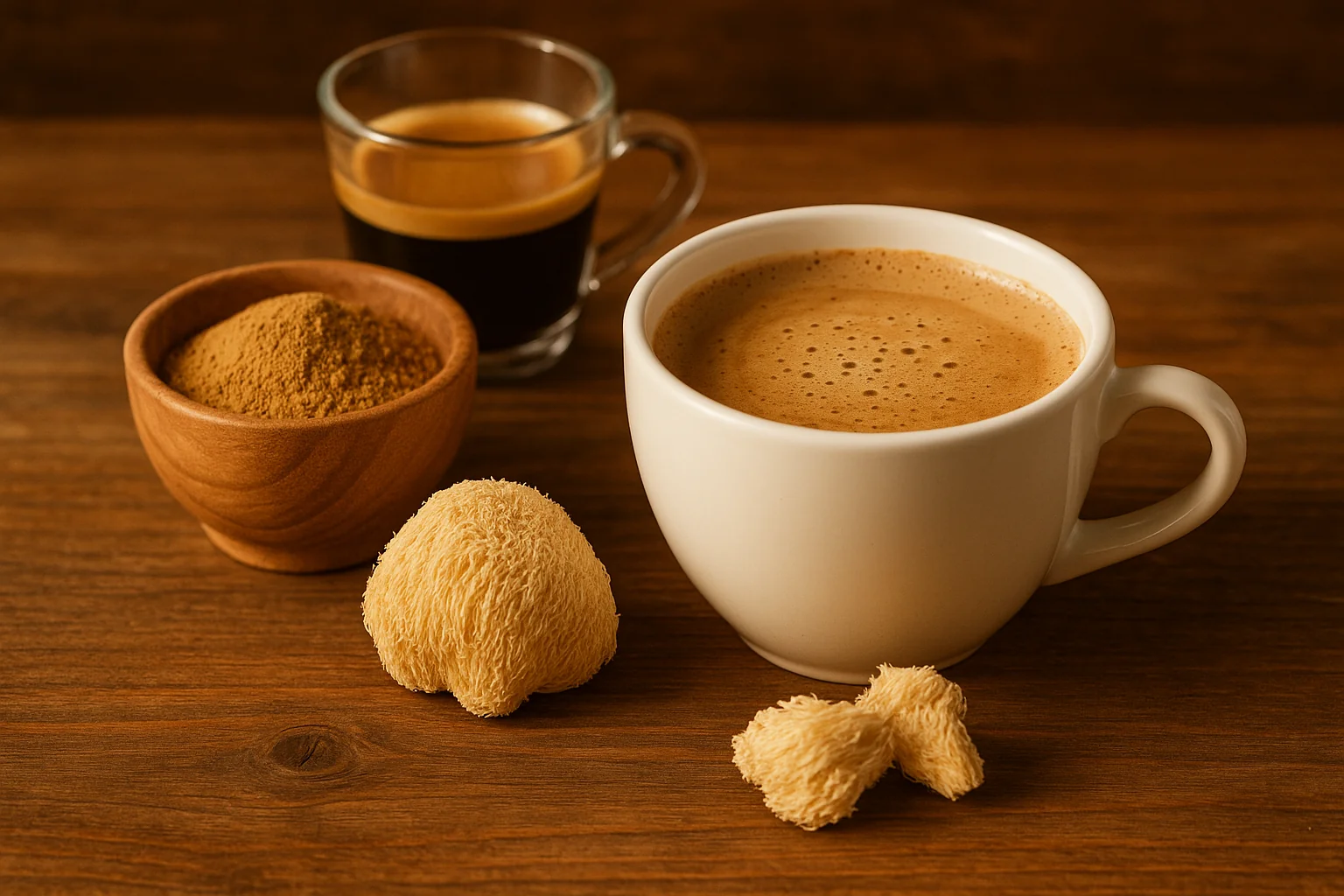

Coffee with lion’s mane: can it replace regular coffee and how does it affect focus
Coffee with lion's mane and focus: what did Mori's study really show, why caffeine is not a pure enhancer of attention, and how to make such coffee at home.
Coffee with functional mushrooms promises something that sounds like a contradiction: more focus and less nervous stimulation at the same time. Lion’s mane, more widely known as lion’s mane, is the most frequently mentioned ingredient in these blends. It is worth checking how much of this promise can be supported by research, as both sides of this pair have been studied very unevenly. Caffeine has been the subject of decades of work, while lion’s mane has only seen a few small trials. Below you will find what was actually measured in these trials, on whom and for how long, as well as a recipe for such coffee at home along with one fact about lion’s mane that changes the way we look at its origin. Along the way, we clarify two details from the same publication that have been repeated in Polish descriptions of such products for years in a distorted form.
KEY INFORMATION
• In Mori’s study (Phytotherapy Research, 2009), thirty individuals aged 50-80 with mild cognitive impairment improved their scores on a scale based on the Hasegawa dementia scale after 16 weeks of lion’s mane intake, and four weeks after discontinuation, scores dropped.
• A review by Nehlig (Journal of Alzheimer’s Disease, 2010) states that caffeine is not a pure enhancer of cognitive functions and can even worsen performance on tasks that heavily tax working memory.
• Studies on lion’s mane were conducted on older individuals with cognitive impairments, not on healthy young adults.
• Lion’s mane is strictly protected in Poland; the raw material comes from cultivation.
How does caffeine’s action differ from that of lion’s mane?
They differ in the time scale and type of evidence. Caffeine blocks adenosine receptors and pushes away the feeling of fatigue within minutes of consumption. Lion’s mane does not contain caffeine and does not stimulate; it is attributed with an effect on nerve growth factor, and studies on it measured the effect after weeks, not minutes.
The image of caffeine is less rosy than descriptions of mushroom blends suggest. A review by Nehlig in 2010 in the Journal of Alzheimer’s Disease summarizes dozens of studies and concludes that caffeine cannot be considered a pure enhancer of cognitive functions. It facilitates learning of material presented passively, but does not yield results with material learned with intent. Tasks engaging working memory improve only to a limited extent, and those that heavily tax it can even hinder performance. The most repeatable effect concerns reaction time.
This same work clarifies the issue of dosage. At low intake, caffeine improves mood and reduces anxiety, while at high intake, it increases tension, nervousness, and irritability. The greatest improvement is seen in tired individuals, which the author interprets as evidence that caffeine is a mild stimulant, not a means of enhancing performance beyond normal levels.
| Feature | Caffeine | Lion’s mane |
|---|---|---|
| Mechanism | blocking adenosine receptors | associated with the release of nerve growth factor, mechanism described at the review level |
| Research time horizon | effect the same day | 16 weeks in Mori’s study, 4 weeks in Nagano |
| Who was studied | broad population sample, many studies | individuals aged 50-80 with cognitive impairments and 30 women |
| Impact on sleep | disrupts with late consumption | measured in Nagano using the PSQI scale, sleep results not summarized |
What did Mori’s 2009 study really show?
This is the most frequently cited work on lion’s mane and the most frequently misquoted. Mori and colleagues (Phytotherapy Research, 2009) conducted a double-blind placebo-controlled study on Japanese individuals aged 50 to 80 diagnosed with mild cognitive impairment.
After a two-week preliminary period, thirty participants were randomly assigned to two groups of fifteen. The experimental group took tablets containing 250 mg of 96% dried lion’s mane powder for 16 weeks, four tablets three times a day. Cognitive functions were assessed using a scale based on a modified Hasegawa dementia scale, abbreviated as HDS-R.
The results of the experimental group were significantly higher than those of the placebo group at weeks 8, 12, and 16, and increased with the duration of intake. Four weeks after the end of administration, they dropped significantly. Laboratory tests did not show any adverse effects.
Two things in this description usually circulate online in distorted form. The scale was not an MMSE test, but HDS-R, which is a different tool with a different construction. And the number “750 mg per day,” repeated in Polish product descriptions, does not correspond to what was given to participants: twelve tablets of 250 mg per day equals 3 g, which is four times more. The portion size from this study is not a recommendation for the reader, but a description of an experiment on clinically diagnosed individuals.
Does lion’s mane improve mood, sleep, and concentration?
The answer is: partially, in one small study and not where it is most often attributed. Nagano and colleagues (Biomedical Research, 2010) randomly assigned thirty women to a group eating cookies with lion’s mane or placebo cookies for four weeks.
Four areas were assessed: menopausal symptoms, depressive mood, sleep quality using the PSQI scale, and so-called unspecified complaints. The results for depression and unspecified complaints after the intake period were significantly lower than before. Compared to placebo, the difference was significant in two items of the unspecified complaints questionnaire, including the item regarding palpitations. Items on concentration, irritability, and anxiety showed only a tendency, without statistical significance.
Two caveats must be placed alongside these numbers. The summary does not provide a result for sleep quality, even though the PSQI scale was used, so the statement about improved sleep after lion’s mane has no basis here. And the authors themselves state that their result suggests a mechanism different from stimulating nerve growth factor. This is the opposite of what is usually quoted from this work.
The conclusion for someone drinking coffee with lion’s mane is moderate. Improvement in concentration as such did not come out significantly in this study, and the only study with a solid cognitive result remains Mori’s work, conducted on a different population. If you are looking for a comparison of ingredients with a stronger evidence base for healthy adults, we have compiled them in the text about L-theanine and caffeine used together.
Where does the neurotrophic effect of lion’s mane come from?
From two groups of compounds described in the fruiting body and in the mycelium. Hericenones come from the fruiting body, erinacines from mycelium grown in liquid. A review by Szućko-Kociuba and colleagues from 2023 in the International Journal of Molecular Sciences gathers evidence that lion’s mane stimulates the release of nerve growth factor, regulates inflammatory processes, reduces oxidative stress, and protects nerve cells from apoptosis.
However, the authors of this review formulate a caveat that never appears in product descriptions: the category requires standardization. They state directly that further research and standardization processes for lion’s mane supplements are necessary to ensure their effectiveness and safety, and progress in the isolation and characterization of compounds, as well as access to pure analytical standards, will only enable the production of products of consistent quality.
The practical conclusion is that mechanism and product are two different matters. Mechanistic evidence concerns isolated compounds in laboratory conditions. The powder in your coffee is an agricultural raw material with variable composition, and between the two lies exactly the gap that the authors of the review call a lack of standardization.
How to prepare coffee with lion’s mane at home?
Homemade preparation is simpler than buying ready-made blends and gives control over what goes into the cup. You need freshly brewed coffee and powder or extract of lion’s mane. Read the portion size from the packaging, as products differ so much that there is no universal measure.
Brew a double espresso or a cup of drip coffee. Add the portion of lion’s mane indicated by the manufacturer, pour hot beverage over it, and stir vigorously for half a minute; a milk frother handles this better than a spoon, as mushroom powders tend to clump. Add cow’s milk or plant-based milk if you drink it. A pinch of cinnamon or cocoa softens the earthy note, which becomes noticeable in larger portions.
There is also a variant for those who do not want to combine lion’s mane with bitter brew: brew a portion of powder in a small amount of hot water for a few minutes, strain, and add the resulting infusion to coffee or drink separately. This same method works in the evening when caffeine is undesirable.
We did not find measurements on the effect of brewing temperature on the content of active compounds in such a drink, so we do not promise anything in either direction. Traditional preparation of medicinal mushrooms is based on hot water extraction, and ready-made soluble blends work the same way. We described the comparison of different carriers of such additives in the text about functional mushrooms in cocoa and coffee.
What to look for when choosing powder or extract?
For three pieces of information, the absence of which is an answer in itself. The manufacturer should state which part of the mushroom the raw material comes from, what the extraction ratio is, and what beta-glucan content is declared. Additionally, there should be batch testing conducted by an external laboratory.
The distinction between fruiting body and mycelium has practical significance here, as both parts carry different compounds: hericenones are described in the fruiting body, erinacines in mycelium grown in liquid. A product based on mycelium grown on a grain substrate contains that substrate along with the mycelium, as both are not separated before drying. The extraction ratio indicates how much raw material was used per gram of powder, so comparing teaspoons between products with different extraction ratios makes no sense.
There is one more thing that no label mentions. Lion’s mane is strictly protected in Poland under Annex 1 to the regulation on the protection of mushroom species from 2014. Collecting it in the forest for personal use is not an option, and every raw material available for sale comes from cultivation. If a seller suggests origin from natural sites in Poland, it is a warning sign, not an advantage.
Can coffee with lion’s mane be consumed in the evening?
Coffee with lion’s mane contains exactly the same amount of caffeine as the same coffee without the addition, so it burdens sleep the same way. Adding the mushroom does not change the pharmacology of the brew, and no manufacturer has shown otherwise.
The rate at which the body eliminates caffeine, however, varies significantly among individuals. A review by Nehlig in 2018 in Pharmacological Reviews describes that the pharmacokinetics of caffeine is highly variable among individuals, mainly due to polymorphism of the CYP1A2 isoform of cytochrome P450, which is responsible for the breakdown of 95% of ingested caffeine. Additionally, there is polymorphism of the A2A adenosine receptor, which is the main target of caffeine in the brain. Therefore, a single cutoff time after which “one should not drink coffee” is an oversimplification; the boundary is individual, and it is best to find it by observing your own sleep.
If you want to take lion’s mane daily, and evening coffee bothers you, separate the two: coffee with the addition in the morning, the infusion of lion’s mane in the evening. If, however, you notice that coffee is working less and less for you, the cause lies with caffeine, not the mushroom; we described this mechanism in the text about caffeine tolerance.
Who is coffee with lion’s mane for, and who is it not for?
The most honest answer is: for someone who already drinks coffee, wants to try lion’s mane, and acknowledges that the evidence pertains to a different group than themselves. The studies on which this entire category stands were conducted on individuals over fifty with cognitive impairments and on thirty women. Healthy young adults, the typical consumer of such blends, have not been studied in these trials.
Caution is warranted in several situations. Allergy to mushrooms is an obvious contraindication. In cases of autoimmune diseases and when taking medications regularly, leave the decision to a doctor. There is no safety data for pregnancy and breastfeeding, so there is no basis for recommendation.
Our assessment after reviewing the available studies is as follows: lion’s mane has the best-documented profile among functional mushrooms added to coffee, yet the evidence is limited, comes from small trials, and pertains to clinical populations. If you treat this as an experiment for a few weeks and do not expect an effect after the first cup, expectations are set correctly. If you are counting on a substitute for sleep or focus that is lacking for other reasons, no mushroom will solve that.
Frequently Asked Questions
Does coffee with lion’s mane replace regular coffee?
It does not replace it, as lion’s mane does not contain caffeine and does not provide stimulation. It is an addition to coffee, not a substitute. Caffeine acts within minutes and wears off the same day, while studies on lion’s mane involved several weeks of daily intake.
What did Mori’s 2009 study really show?
Thirty Japanese individuals aged 50-80 with mild cognitive impairment took tablets containing dried lion’s mane for 16 weeks. Results on a scale based on the Hasegawa dementia scale significantly improved compared to placebo at weeks 8, 12, and 16, and dropped four weeks after discontinuation. The MMSE scale was not used.
How much lion’s mane should be added to coffee?
As much as the manufacturer indicates on the packaging. Products differ in extraction ratios, so a teaspoon of one powder is not the same as a teaspoon of another, and dried fruiting body and extract are not interchangeable. There is simply no single portion that is good for all products.
How to recognize a good lion’s mane product?
By the fact that the manufacturer states which part of the mushroom the raw material comes from, what the extraction ratio is, and what beta-glucan content is declared, as well as providing batch testing. A review in the International Journal of Molecular Sciences from 2023 indicates the lack of standardization of lion’s mane supplements as a major problem in this category.
Can coffee with lion’s mane be consumed in the evening?
Coffee with lion’s mane contains the same amount of caffeine as coffee without it, so it burdens sleep the same way. However, the rate of caffeine breakdown varies significantly among individuals, so a single cutoff time cannot be provided. Lion’s mane itself does not stimulate sleep without caffeine.
Can lion’s mane be collected in Polish forests?
No. Lion’s mane is strictly protected in Poland under Annex 1 to the regulation on the protection of mushroom species from 2014. The raw material for supplements comes from cultivation, not from natural sites, and only such can be purchased.
In the store at Bucha, products with lion’s mane are located in two places. In the adaptogens category, there is soluble and ground coffee with the addition of adaptogens and gummies with lion’s mane, and in the herbs category, there is extract from lion’s mane.
This article is for informational and educational purposes and does not replace consultation with a doctor. If you are pregnant, breastfeeding, taking medications, or have chronic conditions, consult the use of supplements or herbs with a specialist.
Author: Michał Waluk · Published: 2026-05-20 · Updated: 2026-08-16