
Probiotics for Traveler’s Diarrhea: Which Strains Work
Which strains performed better than placebo, which did not, how significant this advantage is, and why yeast from an ampoule is not neutral for every traveler.
Traveler’s diarrhea is the most common ailment for people traveling to countries with lower sanitary standards, so the idea of taking a probiotic for it comes up every time a suitcase is packed. There is evidence, but it is narrower and less clear than most guides suggest: the overall effect is a relative risk reduction of several percent, some popular strains did not outperform placebo at all, and travel medicine guidelines still do not routinely recommend this prophylaxis. In this text, we separate strains based on what is known about each from randomized studies, provide effect sizes with confidence intervals, and show who might be harmed by probiotic yeast. For each number, we indicate how many participants were involved and what the product was compared to, because without this, the percentage of risk reduction makes no sense.
KEY INFORMATION
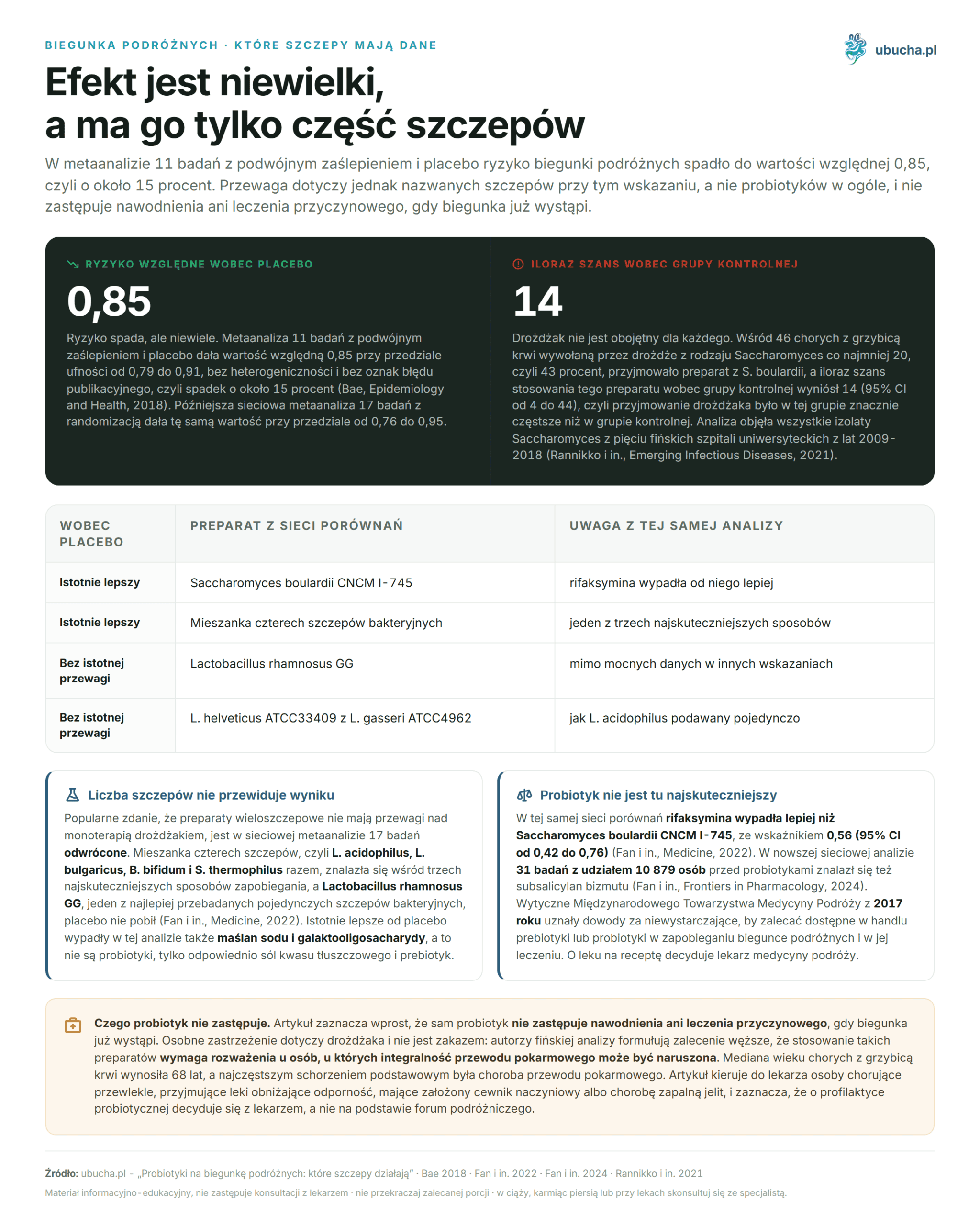
• In a meta-analysis of 11 double-blind studies with placebo, probiotics reduced the risk of traveler’s diarrhea to a relative value of 0.85 (95% CI from 0.79 to 0.91), which is about a 15 percent reduction (Bae, Epidemiology and Health, 2018).
• Lactobacillus rhamnosus GG did not perform better than placebo in network comparisons, while the four-strain product did (Fan et al., Medicine, 2022).
• In the same analysis, rifaximin performed better than Saccharomyces boulardii CNCM I-745.
• Among 46 patients with bloodstream infections caused by Saccharomyces, at least 20 were taking a product with S. boulardii (Rannikko et al., Emerging Infectious Diseases, 2021).
What Causes Traveler’s Diarrhea?
Most often bacteria, but not in the proportions reported by popular sources. A systematic review of 51 studies found enterotoxigenic Escherichia coli in 1,678 out of 5,518 cases, or 30.4 percent (Shah et al., American Journal of Tropical Medicine and Hygiene, 2009). The claim of 30-80 percent of cases circulating in Polish guides has no basis in this work.
The regional distribution is much more interesting than the average. In Latin America and the Caribbean, this pathogen was detected in 33.6 percent of cases, in Africa in 31.2 percent, in South Asia in 30.6 percent, but in Southeast Asia only in 7.2 percent. The difference is statistically significant, and its practical significance boils down to the fact that the direction of travel changes not only the risk but also what you are dealing with.
Besides E. coli, the authors described clear regional differences for several other factors, from Campylobacter and Shigella to noroviruses and protozoa. This was measured separately in long-term travelers: in a review of 82 studies in this group, bacteria accounted for 62 percent of the examined cases, and the incidence rate was 36.3 cases per 100 person-months (Olson et al., Tropical Diseases Travel Medicine and Vaccines, 2019).
Do Probiotics Reduce the Risk of Traveler’s Diarrhea?
They do, but by several percent and with considerable variability among products. A meta-analysis of double-blind studies with placebo included 11 works and yielded a relative risk of 0.85 with a confidence interval from 0.79 to 0.91, with no heterogeneity and no signs of publication bias (Bae, Epidemiology and Health, 2018). A later network meta-analysis of 17 randomized studies yielded almost the same value for probiotics, 0.85 with a range from 0.76 to 0.95.
This same analysis, however, shows where probiotics stand against alternatives. Rifaximin yielded a relative risk of 0.47 (95% CI from 0.35 to 0.63) and performed better than probiotics as a group, with an index of 0.56 (95% CI from 0.4 to 0.78). A newer network analysis of 31 studies involving 10,879 people placed bismuth subsalicylate before probiotics (Fan et al., Frontiers in Pharmacology, 2024).
It is also worth knowing the context against which these numbers were generated. The guidelines of the International Society of Travel Medicine from 2017 deemed the evidence insufficient to recommend commercially available prebiotics or probiotics for the prevention and treatment of traveler’s diarrhea; the author of the 2018 meta-analysis cites this statement directly as the starting point of her work. The effect exists, is repeatable, and is small.
Which Strains Have Data, and Which Do Not?
Evidence is attributed to the strain, not the genus or species, and in traveler’s diarrhea, this distinction changes practical conclusions. The following summary comes from a network meta-analysis of 17 studies, in which each product was compared to placebo separately (Fan et al., Medicine, 2022).
| Product | Significantly better than placebo | Note |
|---|---|---|
| Saccharomyces boulardii CNCM I-745 | yes | rifaximin performed better: 0.56 (95% CI from 0.42 to 0.76) |
| L. acidophilus, L. bulgaricus, B. bifidum and S. thermophilus together | yes | one of the three most effective methods in this analysis |
| Lactobacillus rhamnosus GG | no | no significant advantage despite strong data in other indications |
| L. helveticus ATCC33409 with L. gasseri ATCC4962 | no | similar to L. acidophilus given alone |
| sodium butyrate, galacto-oligosaccharides | yes | these are not probiotics, but rather a fatty acid salt and a prebiotic, respectively |
The popular notion that multi-strain products do not have an advantage over monotherapy with yeast is reversed in this analysis: a mixture of four strains was among the most effective methods, while the best-documented single bacterial strain did not show an advantage. It is also worth remembering that a review of 27 studies with 5,029 participants recommends yeast in two situations: in the prevention of antibiotic-associated diarrhea and traveler’s diarrhea (McFarland, World Journal of Gastroenterology, 2010). How to read the full designation of a strain from the package is explained in our post about choosing a probiotic strain.
The number of colony-forming units on the package is not the same quantity as the number reported in the study. The manufacturer usually declares it at the end of the shelf life or at the time of production, while the study protocol describes what was actually given to participants in that trial. Transferring one number to another is therefore comparing two different things. More about what the number of billions on the label does not tell you can be found in our post about probiotics for gut health and immunity.
Who Can Be Harmed by Saccharomyces boulardii?
Individuals whose intestinal barrier integrity is compromised, and in the case of traveler’s diarrhea, this is not a theoretical situation. An analysis of all Saccharomyces isolates from five Finnish university hospitals from 2009 to 2018 found 46 patients with bloodstream infections caused by these yeasts. At least 20 of them, or 43 percent, were taking a product with S. boulardii, and the odds ratio of using this product compared to the control group was 14 (95% CI from 4 to 44) (Rannikko et al., Emerging Infectious Diseases, 2021).
The authors formulate a recommendation narrower than a ban: the use of such products requires consideration in individuals whose gastrointestinal integrity may be compromised. The median age of the patients was 68 years, and the most common underlying condition was gastrointestinal disease. The popular argument that yeast is convenient for travel because antibiotics do not destroy it pertains to its biology, not its safety.
Practically, this means one conversation before the trip. If you have a chronic illness, are taking immunosuppressive medications, have a vascular catheter, or have inflammatory bowel disease, decide on probiotic prophylaxis with your doctor, not based on a travel forum. It is also worth knowing that the probiotic itself does not replace hydration or causal treatment when diarrhea occurs. What to do after antibiotic therapy and where the number 18.7 comes from compared to 8.5 percent in that indication is described in our post about supplements after antibiotics.
Frequently Asked Questions
How much does a probiotic reduce the risk of traveler’s diarrhea?
In a meta-analysis of 11 double-blind studies, the relative risk was 0.85 with a confidence interval from 0.79 to 0.91 (Bae, 2018). A network meta-analysis of 17 studies yielded the same value with a range from 0.76 to 0.95. This corresponds to a risk reduction of about 15 percent.
Which strain has the best evidence for this indication?
Saccharomyces boulardii CNCM I-745 and a mixture of four bacterial strains performed significantly better than placebo in a network comparison. Lactobacillus rhamnosus GG did not show an advantage (Fan et al., 2022). The evidence always pertains to the strain with full designation, not the species or genus.
Is a multi-strain product worse than a single strain?
This is not supported by the data. In a network meta-analysis, a product with four strains was among the three most effective methods of prevention, while one of the best-studied single bacterial strains did not outperform placebo. The number of strains alone does not predict the outcome.
Is a probiotic sufficient instead of other methods?
It is not the most effective. In a network meta-analysis, rifaximin yielded a relative risk of 0.47, and in an analysis of 31 studies involving 10,879 people, bismuth subsalicylate was also found before probiotics (Fan et al., 2024). A prescription medication is determined by a travel medicine physician.
Is the probiotic yeast safe for everyone?
No. Among 46 patients with bloodstream infections caused by Saccharomyces, at least 20 were taking a product with S. boulardii, with an odds ratio of 14 (95% CI from 4 to 44) compared to the control group (Rannikko et al., 2021). The authors recommend cautious use of such products in individuals with potentially compromised gastrointestinal integrity.
Does the number of billions on the package correspond to the dose in the study?
Not necessarily. The manufacturer declares it at the time of production or at the end of the shelf life, while the study describes what was given to participants in its protocol. These are two different quantities, and there is no single number that would be correct for all products and indications.
This article is for informational and educational purposes only and does not constitute medical advice. Before starting supplementation, consult with a physician, especially if you are taking medications regularly, are pregnant or breastfeeding, or have a chronic illness.
Author: Michał Waluk · Published: 2026-08-09 · Updated: 2026-08-16