
Supplements after antibiotics: what to take to rebuild gut flora and when to start
Probiotic after antibiotics has data only for selected strains, and rebuilding flora is another matter. What studies have shown and when diarrhea is already a doctor.
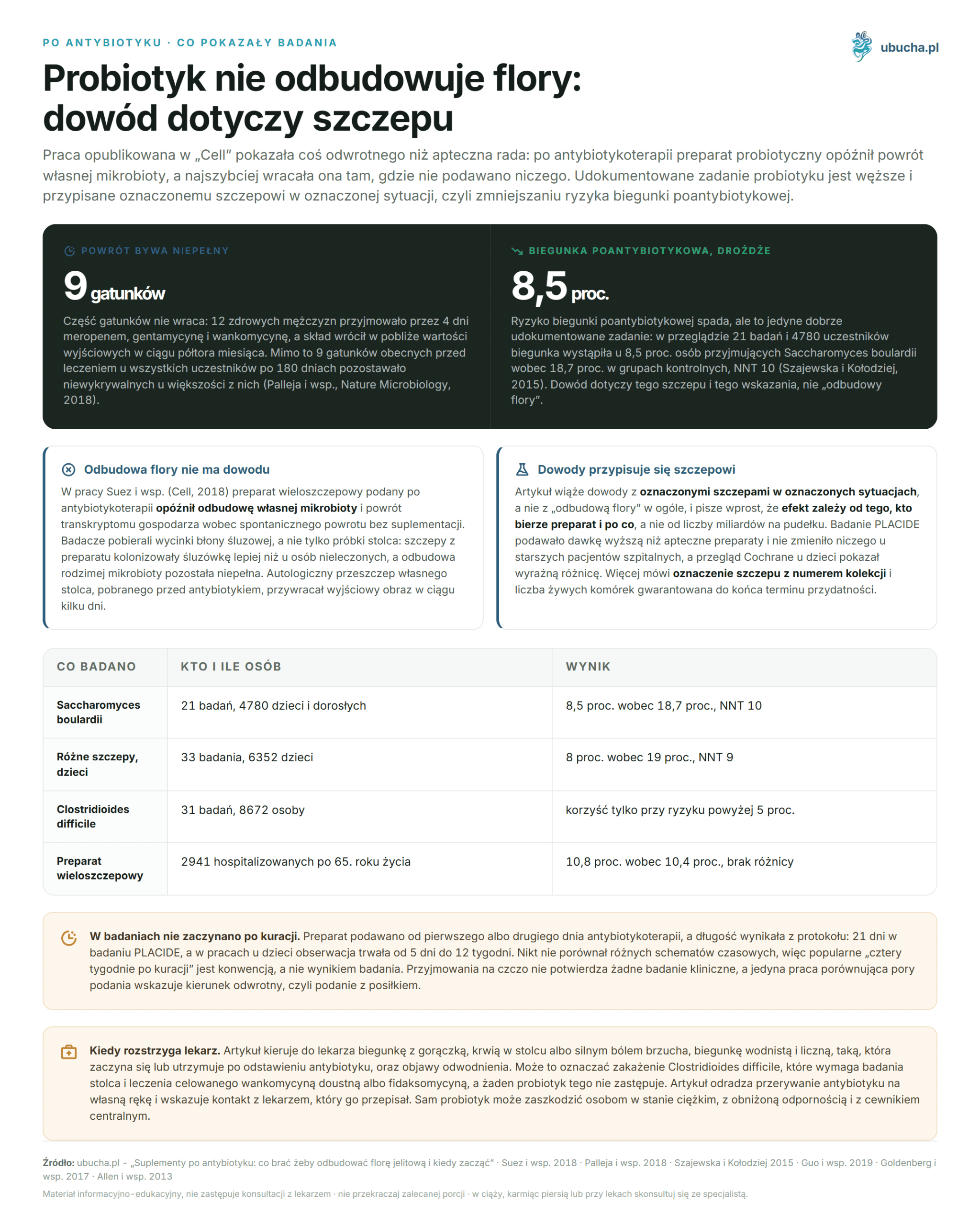
The advice “after antibiotics take a probiotic to rebuild flora” sounds reasonable and is heard by almost every patient in the pharmacy. The problem is that a study published in “Cell” in 2018 showed the opposite: after antibiotic therapy, a probiotic preparation delayed the return of the native microbiota, and it returned fastest where nothing was given. This does not mean that probiotics are useless. It means that they have one well-documented task, which is to reduce the risk of antibiotic-associated diarrhea, and the evidence pertains to specific strains in specific situations, not “rebuilding flora” in general. Below we break down what can be supported by data: how long it takes for the microbiota to return, which preparations make a difference, and when diarrhea is no longer a matter for supplements.
KEY INFORMATION
• After antibiotic therapy, probiotics delayed the recovery of the native microbiota and the return of the host transcriptome (Suez et al., Cell, 2018).
• Saccharomyces boulardii reduced the risk of antibiotic-associated diarrhea from 18.7 to 8.5 percent in 21 randomized studies (Szajewska and Kołodziej, 2015).
• In the PLACIDE study, 60 billion microorganisms daily for 21 days had no effect.
• Diarrhea with fever or blood is a matter for a doctor.
What does antibiotics do to gut microbiota and how long does it last?
It reduces the number and diversity of gut bacteria within 3-4 days of the first dose. In healthy adults, the composition returns to near baseline after about a month and a half, but some species do not return at all even after six months (Palleja et al., Nature Microbiology, 2018).
In this study, 12 healthy men took meropenem, gentamicin, and vancomycin for 4 days. Initially, there was an overgrowth of enterobacteria and a loss of bifidobacteria and butyrate-producing bacteria. The composition returned to near baseline values within a month and a half, but 9 species present before treatment in all participants remained undetectable in most of them after 180 days.
An earlier study Dethlefsen and Relman (PNAS, 2011) tracked three individuals for 10 months, including two courses of ciprofloxacin. Diversity decreased within 3-4 days of starting the drug. A week after the end of the course, the composition began to return, but the return was often incomplete, and the response varied between individuals. In the end, the microbiota was stable, just different from the start. The promise of “rebuilding in a week” is not supported by data.
Does a probiotic after antibiotics rebuild gut flora?
There is no evidence for this, and the best available data suggests otherwise. In the study Suez et al. (Cell, 2018), a multi-strain preparation given after antibiotic therapy delayed the recovery of the native microbiota and the return of the host transcriptome compared to spontaneous recovery without supplementation.
The researchers did something that previous studies did not do: they took mucosal biopsies, not just stool samples. After antibiotic therapy, strains from the preparation colonized the mucosa better than in untreated individuals. However, the cost of this was high. The recovery of the native microbiota and the return of host gene expression to pre-treatment levels were clearly delayed and remained incomplete. An autologous stool transplant taken before antibiotics restored the original picture within a few days. In the laboratory, substances secreted by lactic acid bacteria inhibited the growth of native bacteria, which explains the mechanism.
The conclusion is uncomfortable but honest. “Rebuilding flora” as a goal in itself is not a proven benefit of probiotics and is sometimes a sales argument. The documented goal is narrower and pertains to preventing diarrhea. More about choosing a preparation is discussed in the post Probiotic for the gut: how to choose a strain.
Which probiotics have data for antibiotic-associated diarrhea?
Those that have been studied as specific strains in specific situations. The most data has been collected for Saccharomyces boulardii: in a review of 21 studies with 4780 participants, diarrhea occurred in 8.5 percent of those taking the yeast compared to 18.7 percent in control groups (Szajewska and Kołodziej, 2015).
| What was studied | Who and how many people | Result |
|---|---|---|
| S. boulardii, antibiotic-associated diarrhea | 21 studies, 4780 children and adults | 8.5 percent vs 18.7 percent, NNT 10 (Szajewska and Kołodziej, 2015) |
| various strains, antibiotic-associated diarrhea in children | 33 studies, 6352 children | 8 percent vs 19 percent, NNT 9 (Guo et al., Cochrane, 2019) |
| various strains, Clostridioides difficile infection | 31 studies, 8672 people | 1.5 percent vs 4.0 percent, benefit only with a risk above 5 percent (Goldenberg et al., Cochrane, 2017) |
| multi-strain preparation, 60 billion daily, 21 days | 2941 hospitalized over 65 years old | 10.8 percent vs 10.4 percent, no difference (Allen et al., PLACIDE, 2013) |
The effect therefore depends on who takes the preparation and for what purpose, not on the number of billions on the box. The PLACIDE study administered a higher dose than pharmacy preparations and changed nothing in older hospitalized patients, while the Cochrane review in children showed a clear difference.
When to start a probiotic and how long to take it?
In studies, the preparation was given from the first or second day of antibiotic therapy, not after its completion. The length was determined by the protocol: 21 days in the PLACIDE study, while in studies involving children, observation lasted from 5 days to 12 weeks. No one compared different timing schemes.
The popular “four weeks after treatment” is therefore a convention, not a result. Recommendations for taking on an empty stomach are not confirmed by any clinical study, and the only work comparing timing suggests the opposite direction, that is, taking with a meal. The rule “keep in the fridge” is also not universal: dry capsules are designed for stability at room temperature, so the manufacturer’s instructions prevail.
A two-hour gap from the antibiotic dose makes microbiological sense, as the bactericidal drug also acts on the bacteria in the capsule. However, this has not been tested in a study with a health endpoint, so it is reasonable caution, not a condition for effectiveness. Saccharomyces boulardii is yeast and antibacterial antibiotics do not inactivate it.
From our observations in the store, customer questions mainly concern the timing of administration and refrigeration, which are things that no study has resolved. More is said by the strain designation with the collection number and the number of live cells guaranteed until the end of the shelf life.
What do the data say about diet and fiber after antibiotic therapy?
They say more than data on the capsules themselves, although there are few studies in humans directly after antibiotics. In a controlled experiment on mice, a low-fiber diet exacerbated the microbiota collapse and delayed its return after treatment (Ng et al., Cell Host and Microbe, 2019).
The researchers separated variables that cannot be separated in humans: diet, treatment history, and animal husbandry conditions. Human microbiota transplanted to mice proved resistant and began to return even during antibiotic administration. Two things spoiled the return: lack of fiber in the diet and keeping the animal alone, without contact with a reservoir of bacteria in the environment.
In humans, the closest data comes from a 17-week randomized study, with 18 people in each group (Wastyk et al., Cell, 2021). A diet rich in fermented products, such as kefir, natural yogurt, and pickles, gradually increased microbiota diversity and lowered inflammatory markers. A high-fiber diet did not change diversity but increased the number of bacterial enzymes breaking down complex sugars. Participants were healthy and not taking antibiotics, so caution is advised.
Do glutamine and sodium butyrate regenerate the intestines after antibiotics?
There is no randomized study that has tested either one in individuals after standard antibiotic therapy. Data for sodium butyrate comes from other indications, primarily from inflammatory bowel diseases and irritable bowel syndrome, and for glutamine from clinical nutrition after chemotherapy and extensive surgeries.
The mechanistic argument comes directly from the data described above: antibiotics deplete butyrate-producing bacteria, and butyrate nourishes the epithelial cells of the colon and supports the integrity of the barrier. Clinical reviews regarding microencapsulated sodium butyrate describe indications for inflammatory and functional conditions, not the period after antibiotics (Caban et al., Digestive Diseases and Sciences, 2026). The situation is similar for glutamine, and a large part of the literature consists of studies on animal models.
This is not an argument that these preparations are harmful. It is information about what you are paying for: you are buying a justified mechanism, not a study result with an endpoint such as fewer diarrhea episodes or a faster return of the microbiota. With a limited budget, spending it on fermented products and vegetables gives more.
When does diarrhea after antibiotics require a doctor?
When it is accompanied by fever, blood in the stool, or severe abdominal pain, when stools are watery and numerous, when symptoms begin or persist after stopping antibiotics, and when signs of dehydration appear. This may indicate a Clostridioides difficile infection, which requires stool testing and targeted treatment.
- fever accompanying diarrhea
- blood or mucus in the stool
- severe, increasing abdominal pain
- diarrhea lasting longer than a few days after stopping antibiotics
- weakness, dizziness, low urine output, indicating dehydration
- age over 65, hospitalization, or reduced immunity
Clostridioides difficile accounts for a small portion of antibiotic-associated diarrhea. In the PLACIDE study, this concerned about 1 percent of participants. The course can be severe, especially in hospitalized and older individuals, and treatment is based on oral vancomycin or fidaxomicin. No probiotic replaces this, and in the Cochrane review, preventive administration of the preparation reduced the incidence of infection only in individuals with a baseline risk above 5 percent. Do not stop antibiotics on your own; contact the doctor who prescribed them.
Who can be harmed by probiotics?
Individuals in serious condition, with reduced immunity, and with a central catheter. In the PROPATRIA study, 16 percent of patients with predicted severe acute pancreatitis died in the probiotic group compared to 6 percent in the placebo group (Besselink et al., Lancet, 2008).
In this trial, 296 patients received a multi-strain preparation or placebo enterally for 28 days. Infectious complications occurred similarly often, in 30 versus 28 percent of participants. Deaths were distributed differently: 24 out of 152 in the probiotic group versus 9 out of 144 in the placebo group, with a relative risk of 2.53. However, this work has a special status: in 2010, The Lancet published an editorial note regarding it (expression of concern, Lancet, 2010). The work has not been retracted and can be written about, but without this information, it cannot be cited.
A separate issue concerns yeast. Blood infections caused by the strain from the preparation S. boulardii have been reported in patients with vascular catheters, including a patient treated for colitis of Clostridioides difficile etiology (Lee, Microorganisms, 2025). In healthy adults, adverse effects are usually mild and transient: bloating, gas, temporary discomfort. If you are post-transplant, on immunosuppressive drugs, or have a central catheter, the decision is made by the attending physician.
What best protects the microbiota after antibiotic therapy?
Not taking an antibiotic you do not need. This is the only element on this list with solid quantitative backing: in an analysis of 184,032 outpatient visits in the United States, out of 506 antibiotic prescriptions per 1000 residents per year, only 353 were deemed justified (Fleming-Dutra et al., JAMA, 2016).
The difference is about 30 percent of prescriptions written without indication, mostly for viral respiratory infections. Antibiotics will not shorten the illness then, and they will leave a mark on the microbiota for months. Subsequent courses accumulate: after two courses of ciprofloxacin, the composition of the microbiota stabilized at a different point than before treatment.
Practically, this means three habits. Ask your doctor what infection this drug is for and whether the antibiotic is needed for it. Do not save leftover packaging “for later” and do not take medication that was left by someone else. Complete the entire prescribed course, as interrupting it halfway does not spare the microbiota and promotes the selection of resistant strains. We discuss supplementation in the infection season, which often precedes antibiotics, in the post Supplements for autumn and immunity.
Frequently asked questions
Does a probiotic after antibiotics rebuild gut flora?
There is no evidence for this. In the study by Suez et al. (Cell, 2018), a multi-strain preparation given after antibiotic therapy delayed the recovery of the native microbiota compared to spontaneous recovery without supplementation. The documented task of probiotics is narrower: reducing the risk of antibiotic-associated diarrhea.
Which probiotic has the most data for antibiotic-associated diarrhea?
Saccharomyces boulardii. In a review of 21 studies with 4780 participants, diarrhea occurred in 8.5 percent of those taking this strain compared to 18.7 percent in control groups (Szajewska and Kołodziej, 2015). Evidence is attributed to the strain and indication.
How long should I take a probiotic after antibiotics?
As long as the administration lasted in the study of the given strain. In the PLACIDE study, the preparation was given for 21 days, while in studies involving children, observation lasted from 5 days to 12 weeks. The popular ‘four weeks after treatment’ is a convention, not a study result.
What to eat after antibiotics to support the microbiota?
Fermented products and fiber-rich vegetables. In a 17-week study, a diet rich in fermented products increased microbiota diversity and lowered inflammatory markers (Wastyk et al., Cell, 2021). In mice, a low-fiber diet delayed the return of the microbiota.
How to recognize that diarrhea is a Clostridioides difficile infection?
By alarm symptoms: watery and frequent diarrhea with fever, blood in the stool, or severe abdominal pain, as well as when symptoms persist after stopping antibiotics. Diagnosis is made by stool testing, and treatment is based on oral vancomycin or fidaxomicin.
Can a probiotic after antibiotics be harmful?
In severely ill individuals and those with reduced immunity, yes. In the PROPATRIA study, 16 percent of individuals in the probiotic group died compared to 6 percent in the placebo group (Besselink et al., Lancet, 2008), and The Lancet issued an editorial note regarding this work in 2010. Blood infections caused by the preparation were also reported in patients with catheters.
Probiotic preparations and other products supporting the daily diet can be found in the supplements section in the Bucha store.
This article is for informational and educational purposes and does not constitute medical advice. Before starting supplementation, consult your doctor, especially if you are taking medications regularly, are pregnant or breastfeeding, or have a chronic illness.
Author: Michał Waluk · Published: 2026-06-22 · Updated: 2026-08-08