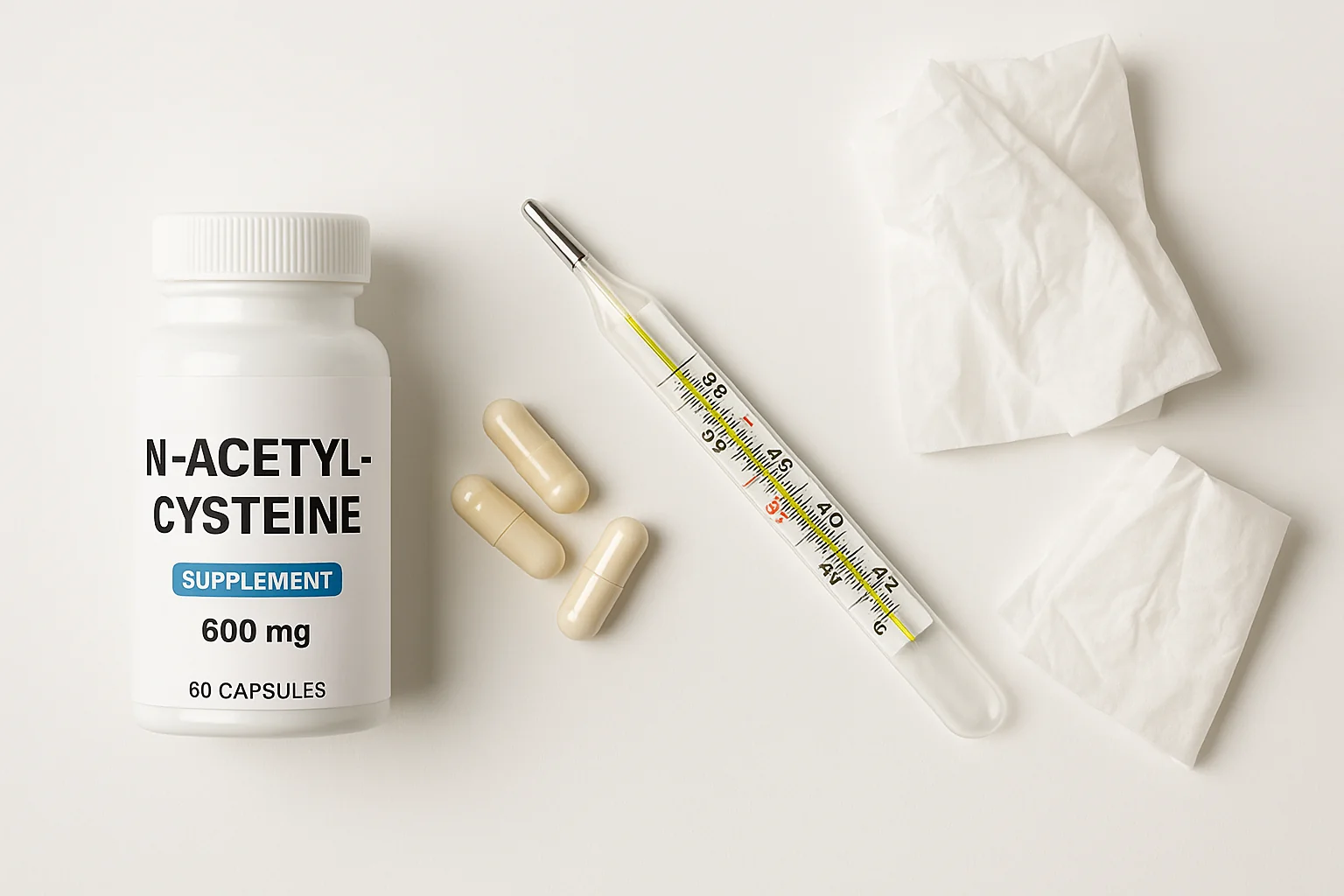

NAC for flu and respiratory infections: what studies show
De Flora's 1997 study: 262 individuals, 6 months, symptomatic flu in 25 percent of infected compared to 79 percent on placebo. We check what this means today.
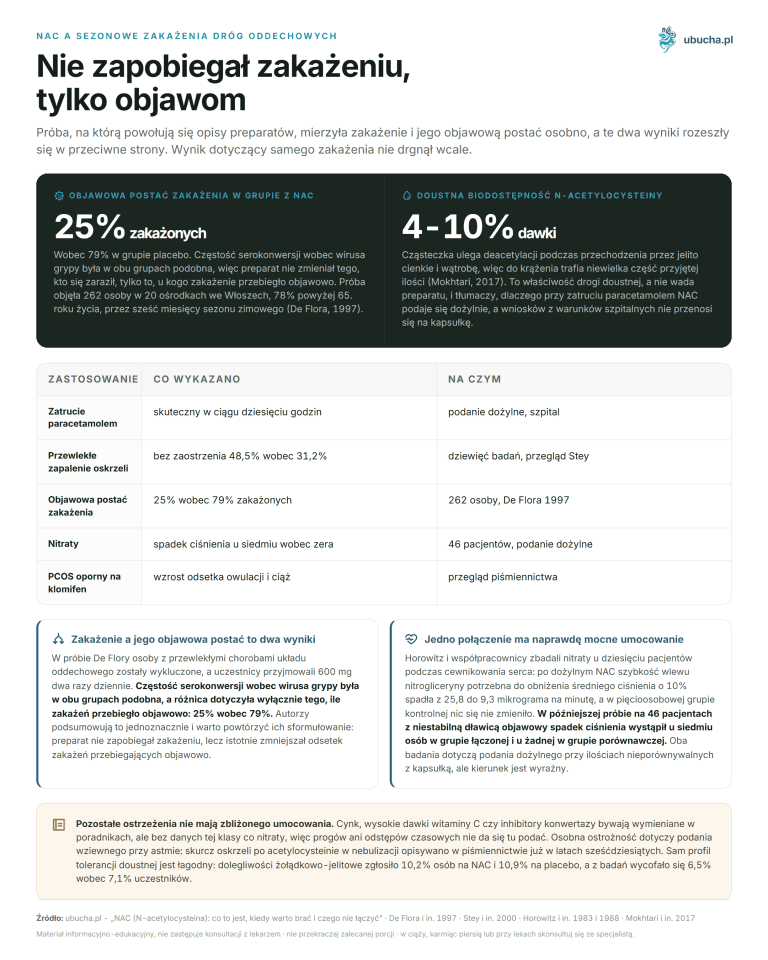
N-acetylcysteine is primarily known as a mucolytic drug, but there is a separate line of research regarding its impact on the course of viral respiratory infections. Its reference point remains the Italian randomized study from 1997: a six-month treatment did not reduce the frequency of influenza virus infection, while among infected individuals, 25 percent developed symptomatic disease in the N-acetylcysteine group compared to 79 percent in the placebo group (De Flora et al., Eur Respir J, 1997). Below, we explain who exactly was included in this study, why the difference between infection and illness is significant here, and how narrow the evidence base is beyond this single result. We also show what the authors of this trial did not measure, as these gaps determine how far its result can be extrapolated.
KEY INFORMATION
• De Flora’s study included 262 individuals, 78 percent of whom were aged 65 and older, over 6 months of the winter season.
• The percentage of seroconversion to the influenza virus was similar in both groups; N-acetylcysteine did not prevent infection.
• Among infected individuals, 25 percent developed symptomatic disease in the treatment group compared to 79 percent in the placebo group.
• Individuals with chronic respiratory diseases were excluded from the study, so the result should not be extrapolated to this group.
• This is a single study from nearly three decades ago. It does not replace vaccination and is not a basis for self-treatment.
What exactly did De Flora’s 1997 study show?
It was a randomized study conducted using a double-blind method in twenty Italian centers. Participants received 600 mg of N-acetylcysteine tablets twice daily or placebo for six months. The endpoints were the frequency and course of influenza-like episodes and the serological response to the influenza virus A/H1N1 (De Flora et al., Eur Respir J, 1997).
The result has two layers, and confusing them is the most common mistake in discussions. Layer one: the percentage of individuals who experienced seroconversion, meaning actual infection with the virus, was similar in both groups. Therefore, the substance did not protect against the infection itself. Layer two: among infected individuals, 25 percent of those treated developed symptomatic disease compared to 79 percent receiving placebo. The authors also noted a significant reduction in the frequency of influenza-like episodes, their severity, and the time spent in bed, with local and general symptoms being clearly milder in the treatment group.
The third result is often overlooked, although it is methodologically interesting. The assessment of cellular immunity showed a progressive shift from anergy towards normal reactivity in treated individuals. This observation is consistent with the proposed mechanism but comes from the same single study, so it does not constitute independent confirmation.
Who was included in this study and for whom is the result binding?
The characteristics of the group determine how far this result can be extrapolated. There were 262 participants of both sexes. Individuals aged 65 and older constituted 78 percent, and 62 percent had chronic degenerative diseases outside the respiratory system. This is an older and burdened population, not a cross-section of healthy adults.
Separately, it is important to note the exclusion criterion, which discussions usually omit, but which the authors state explicitly. Individuals with chronic respiratory diseases were not qualified for the study, deliberately to avoid the influence of the substance on respiratory symptoms interfering with measurement. Therefore, the result says nothing about individuals with asthma or chronic obstructive pulmonary disease. This second group is described separately in the text about N-acetylcysteine in COPD and chronic bronchitis.
The practical consequence is that the further the reader is from the profile of participants, the weaker the basis this result provides for them. A healthy thirty-year-old is not part of the population on which this was measured. The authors themselves narrow the conclusion, stating that there is a significant alleviation of the course of influenza and influenza-like episodes, especially in older individuals from the high-risk group.
How might N-acetylcysteine influence the course of infection?
The proposed mechanism is indirect. The substance provides cysteine, which is a substrate limiting glutathione synthesis, and glutathione plays a role in the lungs that goes beyond merely neutralizing oxidants. In a review dedicated to its role in immunity and inflammation in the lungs, it is described as a signaling molecule involved in regulating innate immunity at many levels (Ghezzi, Int J Gen Med, 2011).
The author of this review makes a caveat worth repeating, as it goes against popular discussions. He warns against an oversimplified picture in which free radicals are inherently harmful, and antioxidants are inherently protective, and points out that in immunology, the relationships are more complex. Oxidants play necessary roles in the immune response, so their suppression is not beneficial in itself.
For this reason, a more cautious reading is: there is a coherent biological hypothesis linking glutathione resources with the efficiency of the response to infection, and one clinical study whose result is consistent with this hypothesis. This is less than a proven mechanism of action, and more than a guess. Similarly, it is worth reading cautiously the data on other preparations studied in respiratory infections, for example, in the text about colostrum and respiratory infections in athletes.
What is known about N-acetylcysteine in COVID-19?
The topic emerged after 2020 and is sometimes presented more strongly than the data allow. The most frequently cited work is a retrospective cohort study from two centers, involving 82 hospitalized patients with pneumonia in the course of COVID-19: 42 individuals received 600 mg of N-acetylcysteine orally twice daily for 14 days alongside standard treatment, while 40 individuals received only standard treatment. In the treated group, there was less severe respiratory failure, and mortality on days 14 and 28 was lower (Assimakopoulos et al., Infectious Diseases, 2021).
However, the limitations of this work are embedded in its design, and the authors themselves name them. The study was retrospective, not randomized, so the groups may have differed in unmeasured factors. The number of participants is small. The authors conclude with the statement that the result requires confirmation in properly designed prospective clinical studies.
For the reader, this means one thing. There is no basis to treat N-acetylcysteine as a treatment or prevention for COVID-19, and citing this work as evidence of effectiveness overlooks what the researchers themselves wrote in it.
What do studies on N-acetylcysteine not resolve?
The first thing is the comparison with vaccination. None of the discussed studies compared N-acetylcysteine with the flu vaccine, and the mechanisms are different: vaccination builds a specific response against particular strains, while De Flora’s observation concerned the course of the disease in already infected individuals. Treating one as a substitute for the other has no support in these data.
The second thing is the number of independent confirmations. The result regarding symptomatic flu comes from a single study from nearly three decades ago, conducted in one country and on one population. Until it is repeated under newer epidemiological conditions, it remains a signal worth noting, not a determination.
The third thing is the application scheme. This article deliberately does not provide any dosage recommendation or timing for starting supplementation, as such a recommendation does not follow from the described studies. The numbers mentioned above describe protocols of specific clinical trials and make sense only together with the population, duration, and outcome. If you are considering using this substance, the decision should be made by a doctor, especially when taking other medications regularly. More about the substance itself and its applications is described in the text about N-acetylcysteine and what not to combine it with.
Frequently asked questions
Does N-acetylcysteine prevent flu illness?
It does not prevent the infection itself. In De Flora’s study, the percentage of seroconversion to the influenza virus was similar in both groups. The difference was in the course: among infected individuals, 25 percent of those treated developed symptomatic disease compared to 79 percent receiving placebo (De Flora et al., Eur Respir J, 1997).
Who participated in De Flora’s study?
It included 262 individuals of both sexes, of which 78 percent were aged 65 or older, and 62 percent had chronic diseases outside the respiratory system. Individuals with chronic lung diseases were deliberately excluded to avoid interfering with the measurement of respiratory symptoms (De Flora et al., Eur Respir J, 1997).
Does N-acetylcysteine replace the flu vaccine?
No, and none of the discussed studies suggest this. Vaccination builds specific immunity against particular strains of the virus, while De Flora’s study measured the course of the disease in already infected individuals, not protection against infection (De Flora et al., Eur Respir J, 1997).
What is the proposed mechanism of action?
The substance provides cysteine needed for glutathione synthesis, which participates in regulating innate immunity in the lungs not only as an antioxidant but also as a signaling molecule. However, the author of the review on this topic warns against oversimplifying that antioxidants always act protectively (Ghezzi, Int J Gen Med, 2011).
Does N-acetylcysteine help in COVID-19?
The available work is a retrospective cohort study on 82 patients, in which those treated required mechanical ventilation less frequently and died less often. The authors note that the result needs confirmation in prospective randomized studies, so it does not constitute a basis for use (Assimakopoulos et al., Infectious Diseases, 2021).
Did De Flora’s study assess treatment tolerance?
The authors state that six months of treatment was well tolerated, and they do not report serious adverse events in the summary. However, this is an observation from a single trial on 262 individuals and does not answer questions about safety in other groups or when taking medications simultaneously (De Flora et al., Eur Respir J, 1997).
This article is for informational and educational purposes and does not constitute medical advice. Before starting supplementation, consult a doctor, especially if you are taking medications regularly, are pregnant or breastfeeding, or have chronic illnesses.
Author: Michał Waluk · Published: 2026-08-09 · Updated: 2026-08-16