
D-mannose for recurrent bladder infections: what the studies say
D-mannose was supposed to prevent bladder infection recurrences. The largest placebo study did not confirm its effectiveness. What is known today and what works.
Recurrent bladder infections are one of the more common reasons women reach for antibiotics multiple times a year. About half of women experience at least one episode of urinary tract infection in their lifetime, and roughly one in five experiences a recurrence within a year (Murali Krishna et al., Journal of Infection Prevention, 2025). D-mannose, a simple sugar available over the counter, has been considered a promising alternative to antibiotic prophylaxis for a decade. It even made it into some scientific society recommendations. However, in 2024, the largest placebo-controlled study did not confirm this hope, and a newer meta-analysis followed the same trend. This article shows where the belief in the effectiveness of d-mannose originated, what undermined it, and what current research indicates instead.
KEY INFORMATION
• The mechanism makes sense: d-mannose is supposed to capture the FimH protein that E. coli uses to attach to the bladder wall.
• The first study (Kranjčec 2014, 308 women) yielded good results but lacked a placebo group and blinding.
• The largest placebo study (Hayward 2024, 598 women, 99 clinics) showed no difference compared to placebo; the authors advise against using d-mannose for prevention.
• A meta-analysis from 2025 involving 890 participants found no significant difference compared to placebo.
• Increasing water intake by 1.5 liters per day reduced the number of episodes in a year-long randomized study.
How does d-mannose block bacteria in the bladder?
D-mannose is supposed to capture bacteria before they attach to the bladder wall. Escherichia coli, responsible for most uncomplicated urinary tract infections, attaches using the FimH protein located at the ends of type 1 fimbriae. FimH recognizes mannose residues on the surface of the epithelium, so free mannose in urine is supposed to act as bait for it.
The mechanism of attachment was described by Martinez and colleagues in the journal The EMBO Journal. However, their work showed something more than is usually cited: FimH not only sticks the bacterium to the bladder epithelium but also triggers its entry into the interior of the cells, involving actin remodeling and phosphatidylinositol 3-kinase. The PapG adhesin, present on another type of fimbriae, did not induce such entry. The authors concluded that uropathogenic strains of E. coli are not exclusively extracellular bacteria (Martinez et al., The EMBO Journal, 2000).
This is significant for assessing the idea itself. Sugar dissolved in urine may act on bacteria floating in the urine, but it will not reach those that have already entered the urothelium cells. Intracellular clusters of bacteria are sometimes cited as one explanation for why infections recur despite a properly treated acute episode. Thus, a sensible mechanism is merely a premise, not proof that the substance will work for the patient.
What did the first large study of d-mannose show?
The study on which the entire later popularity of d-mannose was based was conducted by Kranjčec, Papeš, and Altarac. It involved 308 women with recurrent urinary tract infections, after treatment of an acute episode, randomly assigned to three groups for 6 months: 2 g of d-mannose powder daily, 50 mg of nitrofurantoin daily, or no prophylaxis.
Recurrence occurred in 14.6% of women in the mannose group, 20.4% in the nitrofurantoin group, and 60.8% in the no prophylaxis group. Both active groups had significantly lower recurrence risk than the no prophylaxis group, and the difference between mannose and nitrofurantoin was not statistically significant (Kranjčec et al., World Journal of Urology, 2014).
Two things in this study limit the conclusions and are often overlooked. First, the third group did not receive a placebo; they received nothing, and the study was not blinded. With an endpoint based on reported symptoms, this is a significant difference because a woman knowing she is not receiving any protection behaves and reports differently. Second, d-mannose was not without adverse effects: 17.9% of participants in both active groups reported them, and in the mannose group, diarrhea was noted in 8 out of 103 individuals (Lenger et al., American Journal of Obstetrics and Gynecology, 2020). The claim of a zero rate of complications, repeated in texts about d-mannose, is not supported by the data.
Why did the largest study not confirm effectiveness?
In 2024, a study was published designed to eliminate the weaknesses of the previous one. Hayward and colleagues conducted a double-blind trial with a placebo group in 99 primary care clinics in the UK. It involved 598 women with documented recurrences who took 2 g of d-mannose daily or the same volume of an inert powder for 6 months.
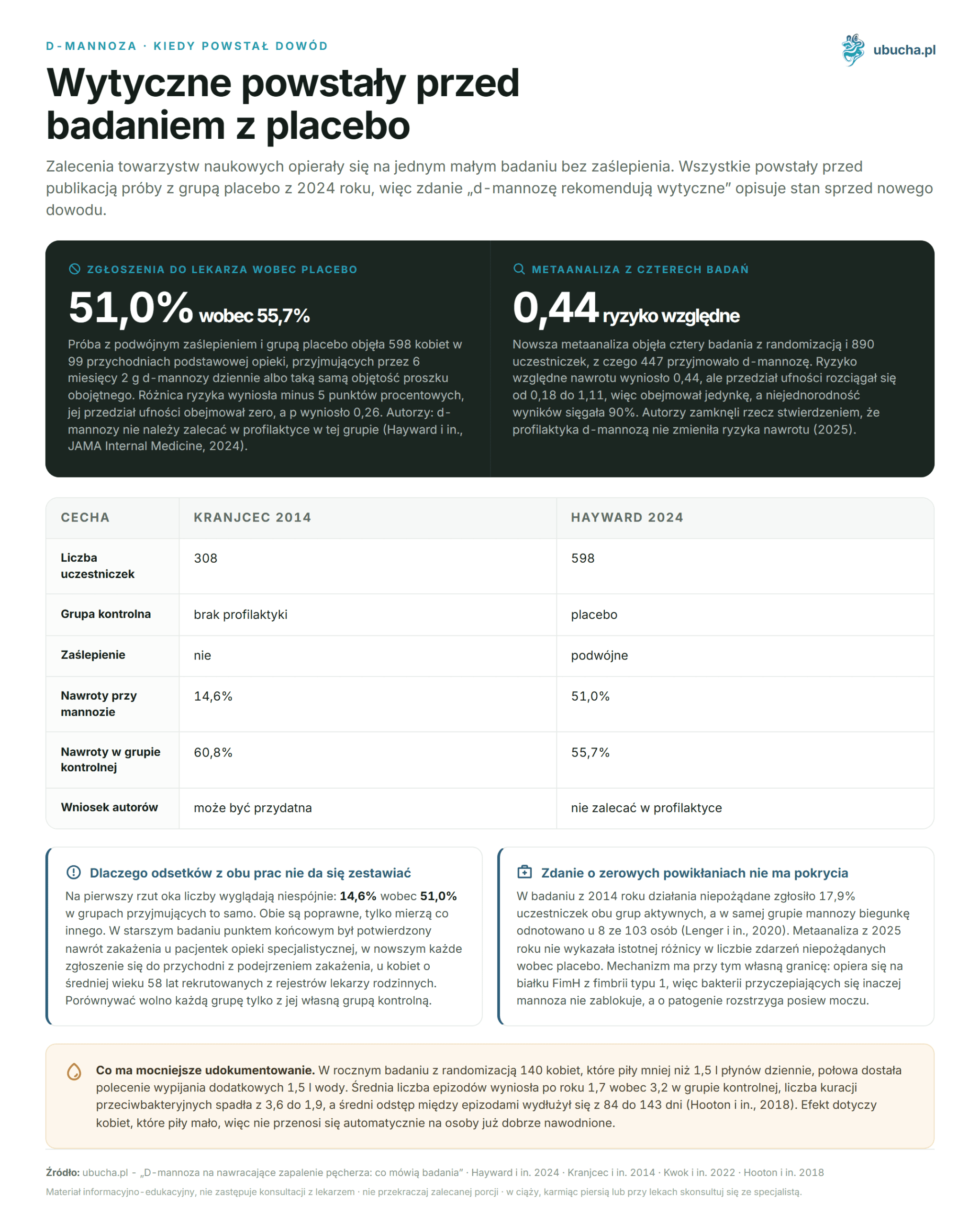
The result was negative. 51.0% of women in the d-mannose group and 55.7% in the placebo group reported to the doctor with suspected infection. The risk difference was minus 5 percentage points, and its confidence interval included zero (from minus 13 to plus 3 points), with p equal to 0.26. None of the secondary endpoints, including symptom duration, antibiotic use, and time to the next infection, differed significantly. The authors concluded directly: d-mannose should not be recommended for prevention in this group of patients (Hayward et al., JAMA Internal Medicine, 2024).
The difference in results is not coincidental. The 2014 study was conducted in specialist care and without blinding, while the newer one was conducted in a regular clinic, with placebo and nearly twice the number of participants. When comparing both trials, a typical pattern for many supplements emerges: a promising signal from a small study without placebo disappears when the study is blinded.
What were the differences between the two d-mannose studies?
The following comparison shows why two studies of the same substance, at the same dose and for the same duration, yielded opposite conclusions. The difference does not lie in the product or the dosing scheme, as these were identical. It lies in what d-mannose was compared to and whether participants knew what they were receiving.
It is also worth noting the raw recurrence rates, as at first glance they appear inconsistent: 14.6% versus 51.0% in groups taking the same substance. Both numbers are correct; they just measure different things. In the older study, the endpoint was confirmed recurrence of infection in patients under specialist care, while in the newer study, it was any visit to the clinic with suspected infection, in women with an average age of 58 recruited from family doctor registers. Therefore, each group can only be compared to its own control group, not the numbers between studies.
| Feature | Kranjčec 2014 | Hayward 2024 |
|---|---|---|
| Number of participants | 308 | 598 |
| Control group | No prophylaxis | Placebo |
| Blinding | No | Double |
| Conducting location | Specialist care | 99 family clinics |
| Dose and duration | 2 g daily, 6 months | 2 g daily, 6 months |
| Recurrences in the mannose group | 14.6% | 51.0% |
| Recurrences in the control group | 60.8% (no prophylaxis) | 55.7% (placebo) |
| Authors’ conclusion | May be useful, further research needed | Not recommended for prevention |
What do current guidelines and meta-analyses say?
Guidelines on this matter are inconsistent, and their divergence has a simple reason: they were created at different times and based on different materials. A review of nine international guidelines regarding recurrent urinary tract infections showed that the Spanish infectious diseases society strongly recommended d-mannose, while European and German urological societies recommended it weakly or moderately, and the British NICE allowed it as a self-care element for some non-pregnant women. The authors of the review noted that the NICE recommendation was based on one small randomized study, namely the 2014 work (Kwok et al., BJU International, 2022).
By comparing the dates of these documents, we noticed something that is not visible in any of them individually. All these guidelines were created before the publication of the 2024 placebo study. The recommendation based on one small study has not been quietly overturned; it simply has not yet been updated. A reader who today encounters the statement “d-mannose is recommended by guidelines” reads the truth about the state of affairs before the new evidence.
Aggregate summaries have followed the same trend. A meta-analysis from 2020, which included only three studies, still showed a clear effect compared to placebo. A newer one from 2025 included four randomized studies and 890 participants, of which 447 took d-mannose. The relative risk of recurrence was 0.44, but the confidence interval ranged from 0.18 to 1.11, thus including one, and the heterogeneity of results reached 90%. The authors concluded that d-mannose prophylaxis did not change the risk of recurrence.
What really reduces the risk of recurrences?
The best-documented and simplest intervention turned out to be water. In a year-long randomized study, 140 premenopausal women who had at least three episodes of bladder infection in the previous year and drank less than 1.5 liters of fluids daily participated. Half were instructed to drink an additional 1.5 liters of water daily.
After a year, the average number of episodes was 1.7 in the group drinking more water compared to 3.2 in the control group. The number of antibacterial treatments also decreased, from 3.6 to 1.9, and the average interval between episodes extended from 84 to 143 days (Hooton et al., JAMA Internal Medicine, 2018). The effect applies to women who drank little, so it does not automatically transfer to those already well-hydrated.
Additionally, all analyzed guidelines consistently support antibiotic prophylaxis, either continuous or post-coital, and newer randomized evidence favors methenamine. With longer antibiotic therapy, a separate topic becomes restoring gut flora. For postmenopausal women, a separate and strongly established option is vaginal estrogens. Regarding probiotics and preparations with lactic acid rods, all guidelines were in agreement otherwise: there is insufficient evidence to recommend anything. Cranberry appears ambiguous in this context, and its action is based on a different mechanism of blocking bacterial attachment than mannose (Ioannou and Baliou, Antibiotics, 2024). More about it is discussed in a separate text on cranberry for urinary tract, and a broader overview of plant options can be found in the post about natural support for kidneys and urinary tract.
Frequently asked questions
Does d-mannose work for recurrent bladder infections?
The strongest evidence says no. In a double-blind placebo-controlled study involving 598 women, the percentage of doctor visits with suspected infection was 51.0% with d-mannose and 55.7% with placebo, and the difference was not statistically significant. The authors advised against using d-mannose for prevention in this group.
Where did the belief that d-mannose helps come from?
From a 2014 study involving 308 women, where recurrence occurred in 14.6% of those taking d-mannose compared to 60.8% without prevention. However, the study lacked a placebo group and blinding, and its result became the basis for some guidelines before a larger placebo study was conducted.
Is d-mannose safe?
No serious complications were reported in studies, but the claim of a zero rate of adverse effects is false. In the 2014 study, diarrhea was reported by 8 out of 103 women taking d-mannose. A meta-analysis from 2025 did not show a significant difference in the number of adverse events compared to placebo.
Can d-mannose replace antibiotics for acute infections?
No. D-mannose is not an approved treatment for acute bladder infections, and studies evaluated it only as a preventive measure. With fever, chills, or pain in the kidney area, symptoms may indicate an upper urinary tract infection that requires urgent medical evaluation and antibacterial treatment.
Why doesn’t d-mannose work on all bacteria?
The mechanism is based on capturing the FimH protein from type 1 fimbriae, present in some strains of E. coli. Bacteria that attach in other ways, such as Klebsiella, Proteus, or Enterococcus, will not be blocked by mannose. Therefore, in cases of recurrence, a urine culture is recommended to identify the actual pathogen.
What has better documentation than d-mannose?
Increasing water intake by 1.5 liters per day reduced the number of episodes in a year-long study from 3.2 to 1.7 in women who previously drank little. Guidelines also support antibiotic prophylaxis, either continuous or post-coital, and for postmenopausal women, vaginal estrogens. The choice of treatment is determined by the doctor.
This article is for informational and educational purposes only and does not constitute medical advice. Before starting supplementation, consult your doctor, especially if you are taking medications regularly, are pregnant or breastfeeding, or have a chronic illness.
Author: Michał Waluk · Published: 2026-08-09 · Updated: 2026-08-16