
Myo-inositol in Pregnancy and Gestational Diabetes: What Does Cochrane Say
The current Cochrane review from 2023: 7 studies, 1319 women, RR 0.53 for gestational diabetes, but the certainty of evidence is low. We check what this means.
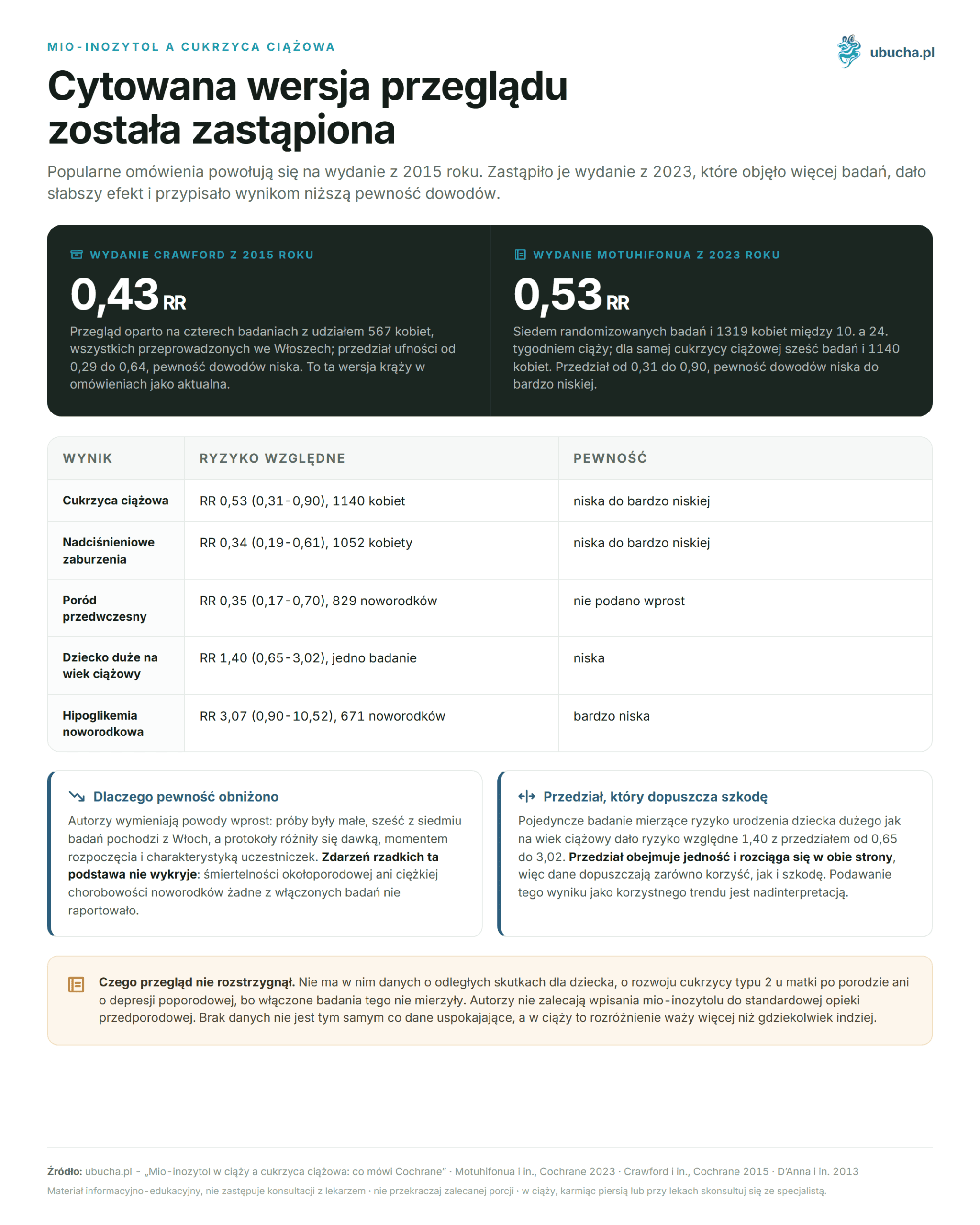
Myo-inositol has been studied for several years as a supplement that could reduce the risk of gestational diabetes. Popular reviews refer to the Cochrane review from 2015, but that version has since been replaced. The current edition is from 2023, has a different first author, and more cautious conclusions: seven studies involving 1319 women, relative risk of gestational diabetes 0.53 with a confidence interval from 0.31 to 0.90, and the certainty of evidence rated as low to very low (Motuhifonua et al., Cochrane, 2023). Below, we describe what exactly was measured, how narrow the basis of this result is, and why the authors of the review do not recommend myo-inositol as part of standard prenatal care.
KEY INFORMATION
• The current version of the Cochrane review is from 2023 (Motuhifonua et al.). The 2015 version, authored by Crawford, has been replaced.
• Gestational diabetes: relative risk 0.53, confidence interval from 0.31 to 0.90, six studies, 1140 women.
• Certainty of evidence: low to very low. The authors lowered it partly because the trials were small, and six of the seven studies were conducted in Italy.
• The review did not show protection against having a baby large for gestational age: relative risk 1.40, range from 0.65 to 3.02, one study.
• This text does not provide dosages. Discuss any supplementation during pregnancy with your healthcare provider.
What does the current Cochrane review really say?
The Cochrane review on myo-inositol in the prevention of gestational diabetes exists in two versions, and the difference between them is significant. The 2015 edition was authored by the Crawford team and was based on four studies involving 567 women, all conducted in Italy; the relative risk of gestational diabetes in it was 0.43 with a confidence interval from 0.29 to 0.64, and the certainty of evidence was rated as low. The current edition, from 2023, has a different title and a different first author, who is Motuhifonua; Crawford appears as a co-author. Citing the 2015 version is not a formal error, but it conveys numbers that the authors have revised.
The current edition included seven randomized studies involving 1319 women who were between 10 and 24 weeks pregnant at the time of inclusion. Six studies were conducted in Italy, one in Ireland. For gestational diabetes, a meta-analysis of six studies involving 1140 women yielded a relative risk of 0.53 with a confidence interval from 0.31 to 0.90. The interval does not include unity, so the effect is statistically significant, but its boundaries range from a reduction of nearly 70 percent to a reduction of 10 percent. The authors rate the certainty of evidence for primary maternal outcomes as low to very low (Motuhifonua et al., Cochrane, 2023).
| Outcome | Value and confidence interval | Basis | Certainty |
|---|---|---|---|
| Gestational diabetes | RR 0.53 (0.31-0.90) | 6 studies, 1140 women | low to very low |
| Hypertensive disorders of pregnancy | RR 0.34 (0.19-0.61) | 5 studies, 1052 women | low to very low |
| Preterm birth | RR 0.35 (0.17-0.70) | 4 studies, 829 newborns | not stated directly |
| Large for gestational age | RR 1.40 (0.65-3.02) | 1 study, 234 newborns | low |
| Cesarean section | RR 0.91 (0.77-1.07) | 4 studies, 829 women | low |
| Neonatal hypoglycemia | RR 3.07 (0.90-10.52) | 4 studies, 671 newborns | very low |
How does myo-inositol affect insulin metabolism?
Inositol is a sugar alcohol that occurs naturally in the body and in grains, corn, legumes, and meat. Among its isomers, myo-inositol is the best described. In a review of mechanisms published in Biochimie, the authors indicate that myo-inositol and its related D-chiro-inositol have insulin-mimetic properties, and inositol derivatives function as secondary messengers of insulin signaling (Croze and Soulage, Biochimie, 2013). Inositol metabolism disorders are associated with insulin resistance, which provides a biological rationale for studying it in pregnancy.
The rationale is sensible because insulin resistance physiologically increases during pregnancy, especially in the second half. This is a normal adaptation that facilitates the delivery of glucose to the fetus. In some women, this increase exceeds the pancreas’s capacity and results in a diagnosis of gestational diabetes. A supplement that improves insulin sensitivity could theoretically shift this threshold.
However, it is necessary to separate two things that are often conflated in popular discussions. A credible mechanism is not evidence of efficacy, and the Cochrane review assesses efficacy, not the likelihood of a mechanism. This is why the certainty of evidence may be low even though the biochemistry aligns. We discuss how inositol performs in insulin resistance outside of pregnancy in the supplement ranking for insulin resistance.
Which studies contributed to this result?
A meta-analysis is not a standalone entity; it is a sum of the studies that entered it. In the case of myo-inositol, three of them carry the most weight, and it is worth knowing their populations, as they differ significantly.
The D’Anna team published a study in Diabetes Care involving 220 pregnant women whose parent had type 2 diabetes. One hundred ten women received 2 g of myo-inositol with 200 µg of folic acid twice daily from the end of the first trimester, while one hundred ten received only folic acid. Gestational diabetes was diagnosed in 6 percent versus 15.3 percent, with p equal to 0.04 (D’Anna et al., Diabetes Care, 2013). The study was open-label, meaning participants knew what they were taking.
The second study by the same team, published in Obstetrics and Gynecology, involved 220 women with obesity before pregnancy, randomized in the 12th and 13th weeks. Gestational diabetes was diagnosed in 14 percent versus 33.6 percent, with an odds ratio of 0.34 and a range from 0.17 to 0.68 (D’Anna et al., Obstet Gynecol, 2015). The third, pilot study by Matarrelli involved 75 non-obese women with elevated fasting glucose in early pregnancy and was double-blind (Matarrelli et al., J Matern Fetal Neonatal Med, 2013). The common denominator is that all three recruited women with elevated metabolic risk, not the general population.
Why did the authors lower the certainty of evidence?
Lowering the certainty rating is not a formality. In GRADE methodology, it means that further studies are likely to change the estimated effect, and with a very low rating, the estimate is practically uncertain. The authors of the 2023 review list the reasons directly.
The first is the sample size. Seven studies involving 1319 women provide a basis that is too narrow to detect differences in rare events, which are the most dangerous: perinatal mortality and severe morbidity in newborns. None of the included studies reported them. The second reason is geography. Six of the seven studies come from Italy, which the authors directly call a problem for the transferability of results to other populations. The third is the heterogeneity of the protocols themselves: the studies differed in dosage, timing of initiation, and characteristics of participants.
There is also a fourth thing that can easily be overlooked when reading the conclusion itself. A single study that measured the risk of having a baby large for gestational age yielded a relative risk of 1.40 with a range from 0.65 to 3.02. The range includes unity and extends in both directions, so the data allow for both benefit and harm. Presenting this result as a favorable trend is an overinterpretation.
What does this result mean for a pregnant woman?
The practical answer is shorter than the volume of evidence suggests. Myo-inositol remains a promising but unconfirmed intervention. The authors of the Cochrane review do not recommend including it in standard prenatal care and encourage further research on women of different ethnic backgrounds and varying risk profiles.
This leads to a simple rule in practice. The decision about any supplement during pregnancy should be made with the healthcare provider or midwife, not based on an article, including this one. The reason is not precautionary: prenatal preparations can be multi-ingredient, and the risk of duplicating an ingredient is real. We describe the same caution with other substances in the text about supplementation during pregnancy and breastfeeding.
It is also important to know what the review did not resolve. There is no data on long-term effects for the child, on the development of type 2 diabetes in the mother after childbirth, or on postpartum depression, as the included studies did not measure this. A lack of data is not the same as reassuring data, and this distinction is more important in pregnancy than anywhere else.
Frequently Asked Questions
Which version of the Cochrane review on myo-inositol is current?
The current version is from 2023, authored by Motuhifonua and co-authors, including Crawford and Crowther. The 2015 version, cited in many reviews as Crawford et al., has been replaced by it. The newer edition included more studies and assigned lower certainty to the results (Motuhifonua et al., Cochrane, 2023).
By how much did myo-inositol reduce the risk of gestational diabetes?
A meta-analysis of six studies involving 1140 women yielded a relative risk of 0.53 with a confidence interval from 0.31 to 0.90. The result is statistically significant, but the range of the interval is large, and the authors rated the certainty of the evidence as low to very low. This means that further studies may shift this result (Motuhifonua et al., Cochrane, 2023).
Did the review show benefits beyond gestational diabetes?
Yes, two. Hypertensive disorders of pregnancy had a relative risk of 0.34 with a range from 0.19 to 0.61, and preterm birth 0.35 with a range from 0.17 to 0.70. However, the authors lowered the certainty of evidence for many outcomes to low or very low, so these are signals for further research, not conclusions (Motuhifonua et al., Cochrane, 2023).
Is myo-inositol safe during pregnancy?
The Cochrane review does not allow for a definitive conclusion. The included studies did not report perinatal mortality or severe morbidity in newborns, and neonatal hypoglycemia had a relative risk of 3.07 with a range from 0.90 to 10.52 at very low certainty. This is a lack of data, not confirmed safety (Motuhifonua et al., Cochrane, 2023).
Does myo-inositol replace folic acid?
No. In D’Anna’s studies, both the experimental and control groups received folic acid, and myo-inositol was an addition to it, not a substitute (D’Anna et al., Diabetes Care, 2013). A separate study by Cavalli examined inositol in mothers at risk for neural tube defects, but it involved a small cohort and does not change recommendations regarding folates (Cavalli et al., Birth Defects Res A, 2011).
Does myo-inositol help women with polycystic ovary syndrome?
A meta-analysis of nine studies involving 247 individuals in the experimental groups and 249 in the control groups showed a reduction in fasting insulin and HOMA index. The decrease in testosterone was only a trend and did not reach statistical significance, while the concentration of androstenedione remained unchanged (Unfer et al., Endocrine Connections, 2017). We describe this in more detail in the text about inositol in polycystic ovary syndrome.
This article is for informational and educational purposes and does not constitute medical advice. Before starting any supplementation, consult your doctor, especially if you are taking medications regularly, are pregnant or breastfeeding, or have a chronic illness.
Author: Michał Waluk · Published: 2026-08-09 · Updated: 2026-08-16